
Death at a Funeral

Death at a Funeral

Posted on April 15, 2010 at 6:01 pm

B-
Lowest Recommended Age: Mature High Schooler
MPAA Rating: Rated R for language, drug content, and some sexual humor
Profanity: Very strong language
Alcohol/ Drugs: Characters inadvertantly take hallucinogenics
Violence/ Scariness: Comic peril, character apparently killed
Diversity Issues: Diverse characters
Date Released to Theaters: April 16, 2010

It feels like the world should come to a stop when someone dies, but unfortunately, it does not. And it feels like the confrontation with the eternal and the shock of grief should somehow make everyone behave, but unfortunately, it does not.death_at_a_funeral_poster_01.jpg
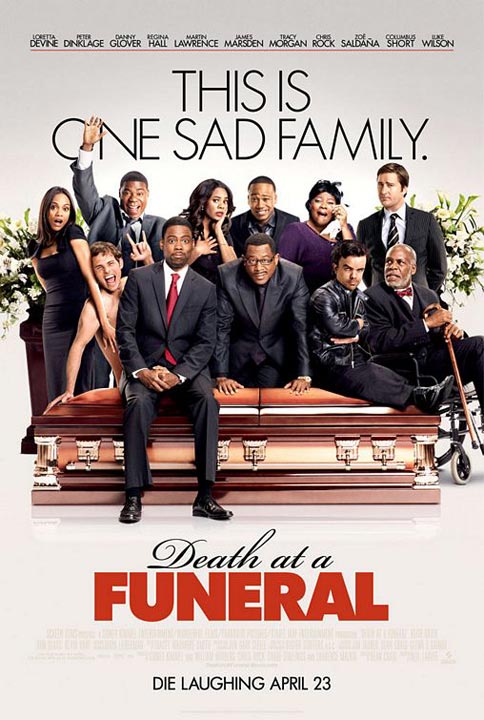
Fortunately, that can be funny, especially when it is happening to someone else. “Death at a Funeral” is a wild, door-slamming, poop-on-the-face, naked-guy-on-the-roof farce set at the funeral of a man whose family did not know him quite as well as they thought. Trying to stay on top of things is the oldest son of the dearly departed, Aaron (Chris Rock), a tax accountant and would-be novelist jealous of his best-selling author brother Ryan (Martin Lawrence). The funeral is at the home that Aaron shares with his wife (Regina Hall) and mother (Loretta Devine). Arriving for the funeral are Aaron’s cousin Elaine (Zoe Saldana of “Avatar”) and her nervous fiance Oscar (James Marsden) and brother Jeff (Columbus Short), family friends Derek (Luke Wilson) and Norman (Tracey Morgan), and cantankerous uncle Russell (Danny Glover). Meanwhile, the wrong body has been delivered by mistake and there is a man at the funeral no one knows, who keeps asking to talk to Aaron about something important.
It all moves along briskly and the juxtaposition of outrageous farce with the most serious of occasions sharpens what would otherwise be pedestrian slapstick. By far the most interesting aspect of the movie is that it is an almost shot-for-shot remake of a British film by the same name, made just three years ago. The two films even share one of the lead actors, Peter Dinklage as the interloper whose relationship with the deceased — and request for payment to keep that relationship quiet — creates a lot of upheaval. Taking a farce that appeared to rely on the understated, restrained British culture in the face of outlandish situations and transplanting it to a black family in Los Angeles demonstrates how much we bring our own expectations to a film.
Director Neil LaBute, best known for searing, disturbing, often-misogynistic plays and movies (“The Shape of Things,” “Your Friends and Neighbors”) lets his able cast run with the material. Marsden is particularly good as the nervous fiance who takes what he thinks is Valium to relax and ends up alternately — and simultaneously — ecstatic, terrified, and utterly dejected. Rock, often uncomfortable on screen, finds some dignity as well as humor in a mostly straight role. Saldana, trim as a greyhound in her LBD, has some great moments as she reassures her frantic fiance and tells off her father, brother, and would-be boyfriend. Hall is delicious as always as a devoted wife who really, really wants a baby — someone needs to give her a starring role. And Dinklage is simply a hoot, one of the most able actors in films today.

(more…)

Related Tags:


Comedy Movies -- format Remake

Toy Story 2

Posted on March 31, 2010 at 3:16 pm

Wow.

WOW!

“Toy Story 2” is stunning, witty, exciting, enchanting, and very moving. Amazingly, it is even better than the sensationally entertaining original.

The animation is better — the facial expressions of the main characters should qualify the animators for a “Best Actor” Oscar and the backgrounds are more authentically lived in. But most important, the script is better. It is very, very funny, with sly references to Star Wars, Close Encounters of the Third Kind, Jurassic Park and even Rear Window. But it is also insightful and touching, with a sort of “Velveteen Rabbit” theme about the importance a well-loved toy plays in the life of a child.

Woody (again voiced by Tom Hanks) is stolen by Al (voice of Wayne Knight) an evil toy store owner, who recognizes Woody as a valuable collectable. With Woody to complete the full set of toys from a 1950’s television show (deliciously re-created), Al can sell them all to a toy museum in Tokyo. Woody is delighted to find out his origin and value, and to meet up with “Woody’s Roundup” co-stars Jessie (voice of Joan Cusack), Stinky Pete (voice of Kelsey Grammer), and his faithful steed Bullseye. They tell him that he will be better off in the museum than waiting for Andy to outgrow him, and he starts to think they may be right.

Meanwhile, Woody’s friends from Andy’s house have organized a rescue mission led by Buzz Lightyear (again voiced by Tim Allen). After a series of hilarious and breathtaking adventures, they arrive to rescue a Woody who is not sure he wants to be rescued.

In these days when 8 year olds can talk knowledgeably about the extra value a mint tag adds to a Beanie Baby auction on Ebay or the market value of 20 different kinds of Pokemon cards, it is enormously valuable to think about the issue Woody must face. Should he have a brief but satisfying life as the beloved friend of a child who will eventually grow up and leave him bereft? As Jessie says with some bitterness, “Do you expect Andy to take you on his honeymoon?” Or should he remain perfectly preserved and perpetually honored as a museum exhibit? Ultimately, Woody concludes that “I can’t stop Andy from growing up, but I would not miss it for the world.” And Buzz agrees: “Life is only worth living if you’re being loved by a kid.” This is an enormously satisfying and meaningful point for a child — or a parent, especially as we face the holiday season avalanche of ads and gifts. Just as it is important for the toy, it is important for the child to love and respect the few toys that are really precious and think about what it is that makes them so special. As The Little Prince says, “It is the time you have wasted on the rose that makes it so important.”

P.S. As I type this, my Raggedy Ann and Andy, given to me on my 10th birthday, are smiling at me from across the room.

Related Tags:


Action/Adventure Animation Comedy For all ages For the Whole Family Series/Sequel Superhero

The Men Who Stare At Goats

Posted on March 23, 2010 at 8:00 am

“More of this is true than you would believe,” “The Men Who Stare at Goats” cheekily informs us as it opens. And while its tone is high satire, even farce, the story it tells is not hard to believe at all. Military officials are portrayed as credulous, ineffectual, and petty. But they are also portrayed as candid, open-minded, and forthright. Much of what goes on in the military’s 20-plus-year exploration of what we used to call the “human potential movement” seems outlandish, but those were outlandish times. And one aspect rings especially true. According to this film, based on the non-fiction book by debunking Welsh journalist Jon Ronson, the real reason the US and the USSR entered into these “new age” programs was that each was convinced the other was doing it. So much for the efficacy of “remote viewing.”

That would be the power to see something mentally that could not be seen visually, either because it was too far away or on the other side of a wall. This division, led by Bill Django (Jeff Bridges), whose long, gray braid hangs down over his fatigues, experiments with all categories of extra-sensory perception including telekinesis (the ability to affect objects without touching them), clairvoyance (the ability to read minds), and precognition (the ability to predict the future).

Jeff Bridges, as a Viet Nam vet who explores the new age fads of the 1970’s, one hot tub at a time, conveys slightly seedy optimism in the early days of the program and shows us the consequences of too much mind-bending at the end. Kevin Spacey is the ambitious psychiatrist who guides the program as it mutates from exploring what our troops can do to exploring how what we have learned can take away from the humanity of the enemy troops we capture. George Clooney centers the film as the most gifted of the program’s subjects, a man who seeks some way to integrate his abilities and experiences to find some meaning in the effort. But Ewan McGregor never convinces us that he is a dumped husband, a reporter, or an American. The reference to Jedi warriors just reminds us of his role as Obi-Wan Kenobi in the “Star Wars” movies and makes his appearance seem like an in-joke.

The light-heartedness of the movie’s tone goes from pratfall humor to a wrenching depiction of the consequences of foolishness. It is smart enough not to be entirely dismissive of the idea that some or all people may have some uncharted capabilities we should try to understand and focus. But it is clear that none of that will do much good against a gun and that the efforts to pursue it may lead to extensive personal and organizational trauma. The main character is unhappy that his scoop is almost entirely ignored when it is published. The media picks up only on the side detail that Barney music was used to break the spirits of prisoners. The pernicious influence of that song appears to have been the only usable information produced by the program; something that any parent of a toddler could have conveyed with great enthusiasm. If this movie directs more attention to Ronson’s findings, that will be gratifying to him, but to us it should also be an important lesson about how one factor in allowing large organizations get out of control is that no one is paying attention.

Related Tags:


Action/Adventure Based on a book Based on a true story Comedy Drama War

Did You Hear About the Morgans?

Posted on March 16, 2010 at 8:22 pm

I have seldom seen the stars of a movie look as thoroughly uncomfortable as Sarah Jessica Parker and Hugh Grant in this drearily low-concept would-be comedy, “Did You Hear About the Morgans?” Parker plays Meryl Morgan, a Manhattan real estate broker so high-powered she is featured on the cover of New York Magazine, who has recently left her husband, Paul (Grant) because he cheated on her. Paul, a high-powered lawyer, has been trying to win her back with gifts and entreaties, but she is resisting.

And then they end up stuck together, unplugged from all of their various electronic devices and their supremely efficient assistants (wasting the talented Elisabeth Moss of “Mad Men”), and about as far away from Manhattan as you can get. They are sent to the small town of Ray, Wyoming by law enforcement authorities after they witness a murder to protect them from being the professional killer’s next victims. And so we’re in the land of city slickers vs the hicks as a form of extreme marital therapy. It’s all sit-, no com.

The jokes were old when “Green Acres” was new. New Yorkers can’t sleep out west because there are no sirens and car horns and they can’t breathe because the air is too clean! Isn’t it cute that people play bingo and shoot guns! (“Oh, my God, it’s Sarah Palin!” Meryl says when she sees Mary Steenburgen as a rifle-toting U.S. Marshall.) One lame stereotype after another (Meryl learns to shoot a gun and milk a cow! Paul squirts his own eyes with bear repellent! Hicks are all Republican and carnivores! Let’s bring everyone together for a dance and a rodeo!) only underscores how self-absorbed, annoying, and entirely unattractive the characters are and how much contempt the film has for its audience. Our primary motivation for wanting them to stay together is that it’s the best way to punish them for creating this awful film. Let them torture each other the way they tortured us.

Related Tags:


Comedy Romance

The Princess and the Frog

Posted on March 15, 2010 at 8:00 am

A-
Lowest Recommended Age: 4th - 6th Grades
MPAA Rating: G
Profanity: None
Alcohol/ Drugs: Social drinking
Violence/ Scariness: Some scary images including skeletons, voodoo, alligators, characters in peril, sad deaths
Diversity Issues: Diverse characters, strong female characters
Date Released to Theaters: December 11, 2009
Date Released to DVD: March 16, 2010
Amazon.com ASIN: B0034JKZ86

Disney has cooked up a yummy batch of gumbo with this blend of the past and present. “The Princess and the Frog” is a satisfying and thoroughly entertaining return to the hand-drawn animation that built the studio. Although it is set in 1920’s New Orleans, it has a modern twist with the studio’s first African-American “princess” — and this is not a heroine who warbles about waiting for the prince to come and rescue her. This is a working woman and the prize she has her eyes on is not some happily-ever-after fairy tale wedding. She wants to run her own business — a restaurant. Like Gepetto, she wishes on a star, but as her father advises her, “that old star can take you only part of the way. You have to help it out with hard work of your own.”

We first see Tiana as a little girl, playing with a good-hearted but spoiled little girl named Charlotte. They enjoy listening to Tiana’s mother, Eudora (Oprah Winfrey) read them the story about the princess who kissed a frog and turned him back into a prince. But Charlotte is wealthy and Eudora is employed by her father (John Goodman) as a seamstress. Tiana’s family may have modest means, but her parents love her dearly and she shares her father’s passion for cooking that signature New Orleans dish, gumbo.

When she grows up, Tiana (Aniki Noni Rose of “Dreamgirls” and “The No. 1 Ladies Detective Agency”) is working hard, determined to make her father’s dream of a restaurant come true. (It is implied that he was killed in World War I.) So she works two jobs while her friends tease her about not having any fun.

Meanwhile, Prince Naveen (Bruno Campos of “Nip/Tuck”) arrives in town, hoping to marry a rich woman but much more interested in playing music and having fun. When he is turned into a frog by Voodoo villain Dr. Facilier (“Coraline’s Keith David), he must find a princess to break the spell. That does not include Tiana, even though she is dressed like a princess at Charlotte’s masquerade ball. He persuades her to kiss him by promising to give her the money she needs to get the building for the restaurant. Since she is not a princess, it goes wrong and she turns into a frog instead.

And that puts them on a journey through a swamp to find a way to become human again. At first the free-wheeling prince and the serious-minded would-be restaurateur have little in common. But soon, as they make new friends (a horn-blowing alligator named Lou and a brave firefly named Ray) and try to keep away from frog-hunters and other dangers, they discover that they get along. They inspire each other to be their best but they like each other for who they are. And that, it turns out, is the real magic.

There is some real Disney animation magic in the details of the settings, especially the jaunty New Orleans of the Roaring 20’s and a musical number in the swamp with fireflies that is heart-stoppingly lyrical. The lively score by Randy Newman pays tribute to the vitality of New Orleans influences, with some zydeco spiciness, but there is sweetness as well, especially when she sings about her dream for the restaurant and imagines what it will be like.

Because this is Disney’s first African-American princess, there has been some extra scrutiny and some extra sensitivity. Some have already been critical of the film because Tiana is not a “real” princess, because she spends a good bit of the story neither black nor white but green when she is a frog, and because her romantic interest is not African-American but from the fictional European country of Moldavia (Campos is from Brazil). There will also be criticism because of the voodoo (with some scary skeletal images) and SPOILER ALERT this is the first Disney film in my memory where one of the key sidekick characters is actually killed by the villain.

I like the fact that Tiana is not a “real” princess like Jasmine, Snow White, Sleeping Beauty, and Ariel. Like Belle, she is non-royal, but romantically involved with a prince. More important, she is an independent, self-supporting, hard-working woman with ambition that goes beyond some sort of romantic rescue. The movie lightly touches on but does not ignore the racism of the era. I like the inter-racial romance (and note that the only other loving couple is Tiana’s parents, both African-American, voiced by Winfrey and Terrance Howard). Setting the story in New Orleans, an exceptionally diverse city, and in the 1920’s, an era of great creative vibrancy, was an especially clever idea. As for spending most of the movie as a frog; well Mulan spent most of her movie as a man. Transformation is at the heart of fairy tales. And in her human form, Tiana is as lovely as any Disney character in history, without being squeezed into a wasp-waist and harem pants like Jasmine. I have some smallish quibbles with the voodoo villain and some overly complicated plot twists, and a more medium-sized quibble with the death of a character. Though it is handled with some grace, it is still unnecessary and likely to upset some younger audience members.

But the movie is genuinely enchanting and the old-fashioned, hand-drawn, 2D animation has a timeless quality that makes us feel welcome. It turns out you don’t need CGI and 3D to feel that you can almost smell that spicy gumbo.

Related Tags:


Animation Based on a book Comedy Drama DVD/Blu-Ray Pick of the Week Musical
THE MOVIE MOM® is a registered trademark of Nell Minow. Use of the mark without express consent from Nell Minow constitutes trademark infringement and unfair competition in violation of federal and state laws. All material © Nell Minow 1995-2026, all rights reserved, and no use or republication is permitted without explicit permission. This site hosts Nell Minow’s Movie Mom® archive, with material that originally appeared on Yahoo! Movies, Beliefnet, and other sources. Much of her new material can be found at Rogerebert.com, Huffington Post, and WheretoWatch. Her books include The Movie Mom’s Guide to Family Movies and 101 Must-See Movie Moments, and she can be heard each week on radio stations across the country.

Website Designed by Max LaZebnik