The Edge of Seventeen

The Edge of Seventeen

Posted on November 17, 2016 at 5:42 pm
Copyright 2016 STX
Copyright 2016 STX
A psychiatrist once told me that just as an infant can have fevers that would be lethal in an adult, a teenager can have symptoms that would be evidence of psychosis at any other stage of life. Mood swings, the feeling that everyone is looking at you, disordered thinking, bizarre appearance: you might be having some sort of breakdown, or you just might be an adolescent. Stories about that intensely traumatic age connect to those of us who have been through it and those who are in the midst of it with a visceral sense of recognition, and, if we’re lucky, a bittersweet humor.

“Edge of Seventeen,” written and directed by Kelly Fremon Craig, captures the intensity and chaos and drama drama drama of this age. Hailee Steinfeld plays Nadine, who, like many 17-year-olds, is certain that she is the only person on earth who truly understands what it is to suffer. She actually has experienced a terrible loss, the death of her father, which has left her remaining family fragile. Her older brother Darian (Blake Jenner of “Everybody Wants Some!!”) compensates by being perfect in every disgusting way possible, from Nadine’s perspective. He is handsome, talented, athletic, and popular. That leaves nothing left for her but to be awkward and miserable.

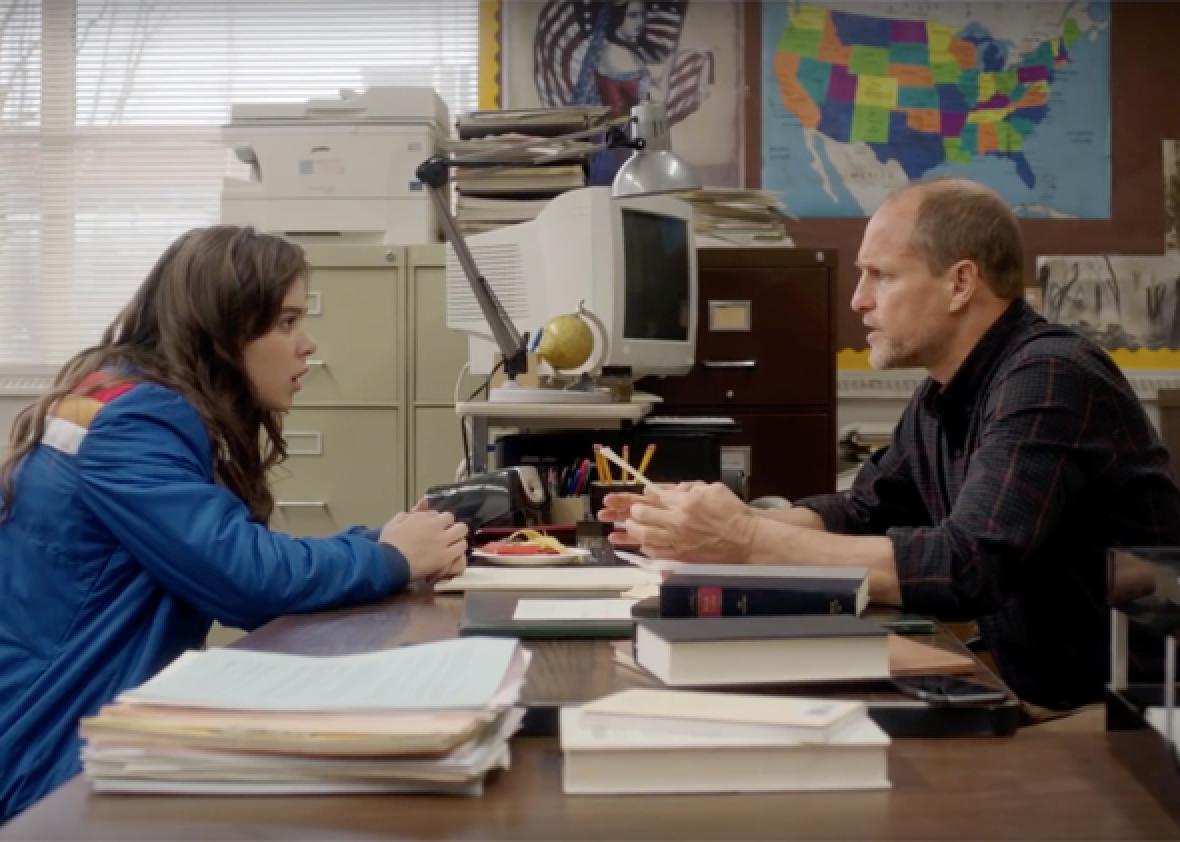
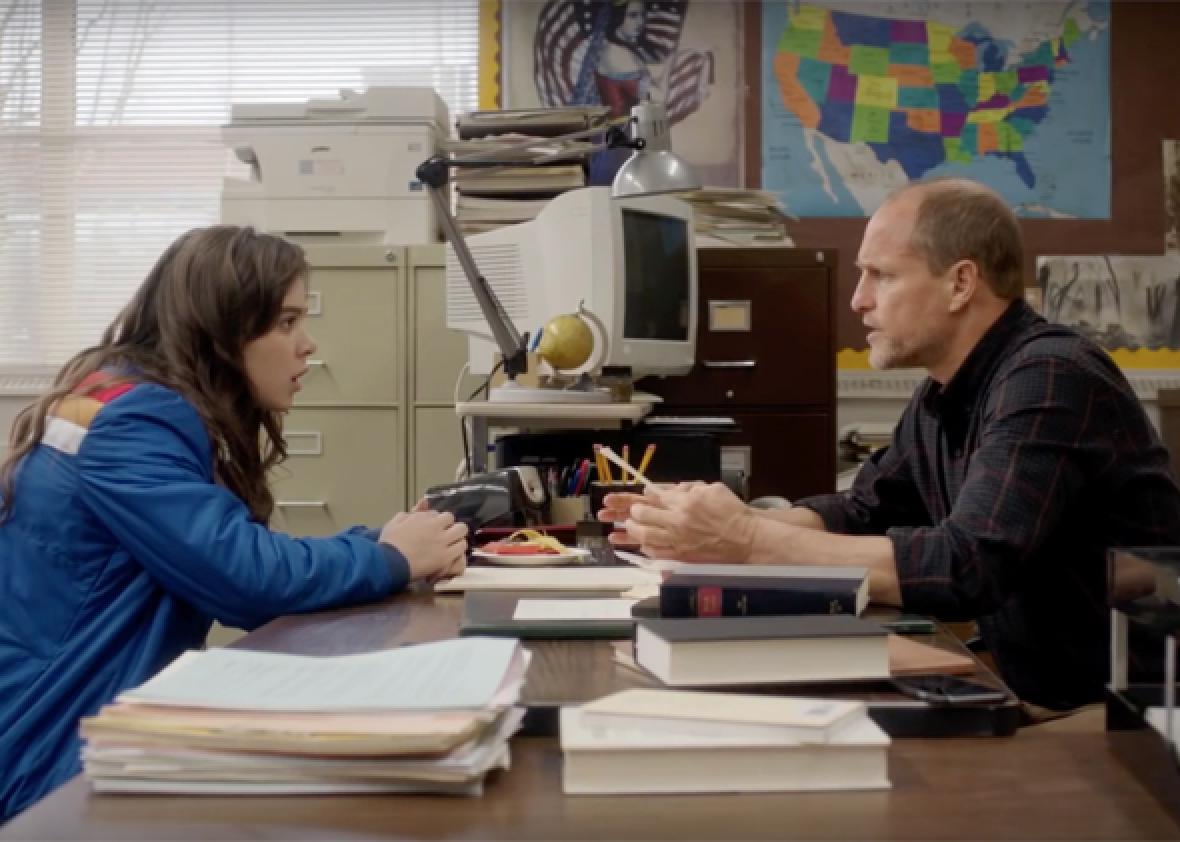
The only thing good in her life, she thinks, is her endlessly supportive and understanding BFF Krista (Haley Lu Richardson), who sympathizes with Nadine about the misery of having no father, a perfect brother, and a crush on an unattainable boy who works at Petland in the mall (Alexander Calvert as Nick). She also has a teacher named Mr. Bruner, played with perfectly dry, understated wit by Woody Harrelson, who knows teenagers well enough to understand that the best way to reassure Nadine is not to try to comfort her. When she trounces into the classroom where he is eating lunch alone to tell him she has to kill herself, he responds by noting mildly that in fact she has just interrupted his own creation of a suicide note. “As some of you know, I have 32 fleeting minutes of happiness per school day during lunch which has been eaten up again and again by the same especially badly dressed student and I finally thought, you know what, I would rather have the dark, empty nothingness.” She thinks she wants everyone to be as fraught as she is. He knows how to strike just the right balance of detachment and sympathy.

So when she tries to cancel a sexually explicit invitation to Nick but accidentally sends it instead, Mr. Bruner is there to take a look and point out that she should be more careful about run-on sentences. The reason she is talking to him about it instead of Krista is that Krista, the single good thing in her life, has committed the ultimate betrayal. She and Darien are in a relationship. Nadine is in such a severe state of collapse that she does not notice that there is a smart, handsome, very nice boy interested in her (Hayden Szeto in a star-making performance as Erwin).

The film itself has that same perceptive sympathy for the agonies of adulthood, allowing us to laugh at Nadine only because we know she’ll be fine — she’s going to grow up and make this movie.

Parents should know that this movie has very explicit and crude language, sexual references, and non-explicit sexual situations, a car accident with a sad (offscreen) death of a parent), and teen drinking.

Family discussion: How did Nadine, Darien, and their mother express their grief differently? Is it easier being the perfect one? What do you do to feel better?

If you like this, try: “Rocket Science,” “Thumbsucker,” and “The Duff”
Related Tags:


Comedy Coming of age Drama Romance School Stories about Teens
Middle School: The Worst Years of My Life

Middle School: The Worst Years of My Life

Posted on October 6, 2016 at 5:53 pm

B+
Lowest Recommended Age: Middle School
MPAA Rating: Rated PG for rude humor throughout, language and thematic elements
Profanity: Some schoolyard language
Alcohol/ Drugs: Social drinking (adult)
Violence/ Scariness: Some peril, sad off-screen death of a child, parental abandonment and marital break-up, cartoonishly exaggerated adult villains, some misbehavior including vandalism and mayhem
Diversity Issues: Diverse characters
Date Released to Theaters: October 7, 2016
Date Released to DVD: January 2, 2017
Amazon.com ASIN: B01LTHWXX4
Copyright Lionsgate 2016

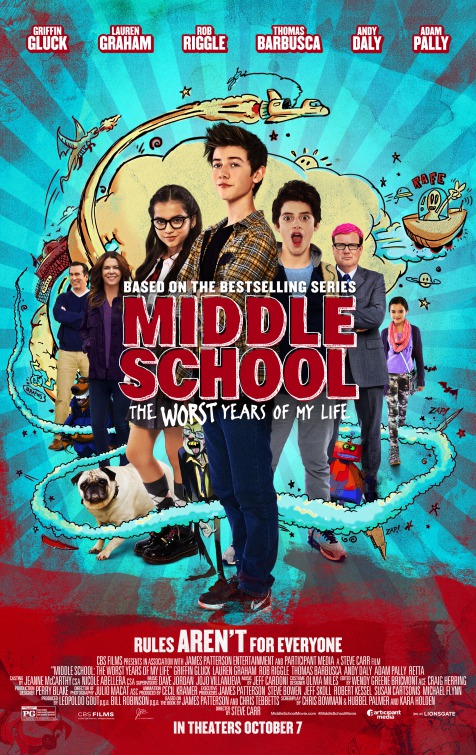
This just might be the most accurate movie title of all time. Middle school is pretty much the worst years of everyone’s life. Terrible stress and tragedy happens at all ages, but it is the years from 12 to 14 where the internal turmoil and agonizing uncertainty are so acute that we still wince remembering them decades later. This film, based on the series of books by mega-bestselling author James Patterson (with Chris Tebbetts and illustrations by Laura Park) has some delightfully satisfying moments of fantasy revenge against a tyrannical, rules-obssessed principal and a borderline-abusive potential stepfather. But it sneaks in some quietly touching and surprisingly wise insights about loss and working with a “new normal.” Bright direction and an exceptionally engaging cast of kids make this film a genuine fall family treat.

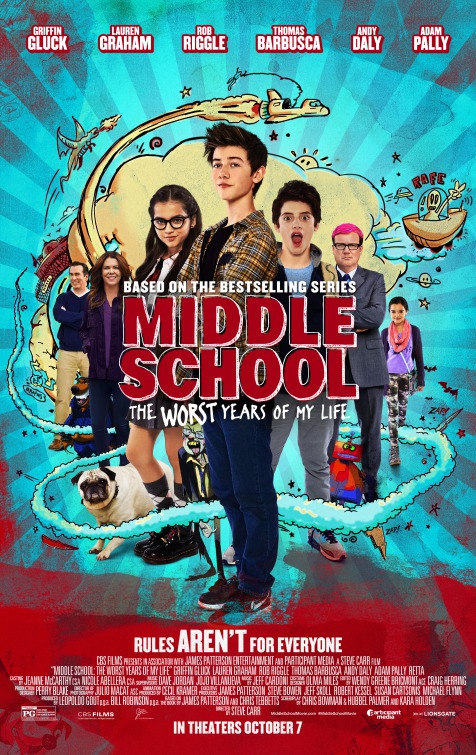
Rafe Khatchadorian (Griffin Gluck) has been expelled from two schools (we never find out why) and has just one more chance. He would rather stay home all day and draw pictures in his notebook, where he has created a whole world of monsters and aliens, charmingly animated. “There’s a big world out there,” Rafe’s mother (Lauren Graham) tells him. “There’s a big world in there, too,” he says. And it is clear that is the world he prefers.

He does not even make it inside the building, though, when he meets the new school’s Principal Dwight (Andy Daly), who cares about just two things: his rules, and the school’s test score ranking. Dwight’s rules basically outlaw anything that is fun, friendly, expressive of individuality, or likely to keep the school from the #1 test score ranking Dwight cherishes so deeply that he has cultivated a number 1 bush by topiary in front of the school. Dwight’s consigliere/enforcer is Ida Stricker (“Parks and Recreation’s” Retta). So, bright, patterned shirts, talking in the hallways, even drawing in a notebook — all banned. There’s also a school bully who threatens to give Rafe “a wedgie so bad you’ll be able to taste your underwear.”

But there are three bright spots. Rafe’s best friend, Leo (Thomas Barbusca), is always there to make him laugh and spur him on. There’s a friendly girl named Jeannie (Isabela Moner), and a kind, sympathetic teacher (“Happy Endings'” Adam Pally) who uses the Drake and the Wu-Tang Clan to teach the class about macroeconomic trends. Rafe decides to take on Dwight by breaking every rule, with Leo’s help. Meanwhile, Rafe’s mom is getting serious with the boyfriend Rafe and his sister call “Bear” (Rob Riggle in his usual role of a walking Axe body spray).

The revenge fantasy is funny and satisfying, mostly about making the pompous Principal Dwight look silly. And it gives Rafe a way to begin to make new friends, to resolve issues with the school bully, and to think through the other problems in his life.

The film is bright and fun, like its sparkling soundtrack of pop songs. The young actors are refreshingly natural and Barbusca has great comic timing. Rafe’s sister Georgia (Alexa Nisenson) and love interest Jeanne (Isabela Moner) are real characters, smart and capable. When the more serious issues arise, it is organic and sensitively handled. The pranks are signed RAFE, which stands for “rules aren’t for everyone.” But this movie is.

Parents should know that this film includes schoolyard epithets, potty humor, references to death of a child, parental abandonment, and marital breakup, comically exaggerated adult villains, cartoon-style peril, and tween misbehavior including driving and mild vandalism.

Family discussion: What is the best way to challenge unfair rules? What school rules would you like to change?

If you like this, try: “Harriet the Spy,” “How to Eat Fried Worms,” and the book series that inspired the film

Related Tags:


Based on a book Comedy Coming of age DVD/Blu-Ray Pick of the Week Family Issues School Stories About Kids Tweens
Mr. Church

Mr. Church

Posted on September 15, 2016 at 5:01 pm

B
Lowest Recommended Age: High School
MPAA Rating: Rated PG-13 for thematic elements
Profanity: Some strong language
Alcohol/ Drugs: Alcohol and alcohol abuse, smoking, prescription drugs
Violence/ Scariness: Illness and very sad deaths
Diversity Issues: A theme of the film
Date Released to Theaters: September 16, 2016
Date Released to DVD: October 24, 2016
Amazon.com ASIN: B01JTQ3QTC

Copyright 2016 Envision Media Arts
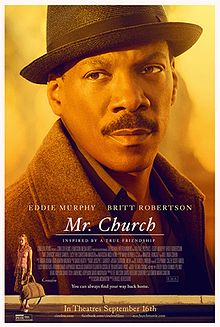
Eddie Murphy gives a thoughtful, nuanced, sensitive performance in a film that suffers from a too-predictable script and suffers even more from very bad timing.

Director Bruce Beresford picked the right time for the similarly themed “Driving Miss Daisy,” released in 1989, the story of a friendship between an illiterate black chauffeur and a cranky Jewish widow in the Civil Rights era South. It was a prestige and popular success, with Best Picture and Best Actress Oscars. But 27 years later, audiences are more sophisticated or less tolerant or both, and the idea of a devoted domestic who sacrifices a great deal from a combination of limited options and loyalty is not a reassuring fable of racial harmony but a grating reminder of white privilege and the prevalence of the narrative of the Magical Negro. No matter how based (as “Miss Daisy” was, as well as films like “The Help”) on real-life experiences and no matter how well-intentioned and affectionate the portrait, no matter how hard Beresford and Murphy try, it is hard to see the portrait at anything but condescending.

But I did my best to try, and watched it as writer Susan McMartin wanted it to be watched, as her sincere tribute to what she calls “a real friendship in my life.” With that context, I was able to appreciate the film’s evocative sense of time and place and Murphy’s understated performance.

Marie (Natascha McElhone) is a single mother of 10-year-old Charlotte (Natalie Coughlin). Marie is very ill, much worse than Charlotte knows. One day, Mr. Church (Murphy) shows up to cook for them. His salary is being paid by Marie’s former lover, a married man who still cares for her. Charlotte is resistant, even hostile, perhaps projecting some of her anger at her mother’s illness onto the man who seems like an intruder. She’d rather just have cereal. But she is quickly won over by his endlessly marvelous food, masterfully prepared, always while listening jazz on the radio. The economy and precision of his hands as he prepares the food is his own kind of jazz. Soon, he introduces her to something even more nourishing: his well-worn library of books, which he allows her to borrow only after filling out a check-out card.

Mr. Church’s care and her own fierce determination keep Marie going long past the predictions of her doctor, and she is able to see Charlotte (now Britt Robinson of “Tomorrowland”) go to the senior prom. But then Marie is gone, and Mr. Church saves the day by making it possible for Charlotte to go to college, until she becomes pregnant and has to drop out. With nowhere else to go, she finds herself back with Mr. Church, who takes her in and cares for her as he always has.

Even after all that, he is still “Mr. Church.” His private life is still private. And when Charlotte tries to find out more, he is furious. But they are family, and that means they find a way to go on together, until it is her turn to take care of him. (We’ve segued from “Driving Miss Daisy” to “Arthur”)

We spend too much time with Charlotte and not enough with Mr. Church. He is a far more interesting and significant character.

Parents should know that this film includes illness and very sad deaths, and smoking and alcohol abuse, and references to adultery and out of wedlock pregnancy. Her story is one we’ve seen many times before. His is one we want to know more about, and this film should have understood that he was its focus.

Family discussion: How did Mr. Church win Charlotte’s trust? Why didn’t he want her to know more about his life?

If you like this, try: “Clara’s Heart”

Related Tags:


Coming of age Drama DVD/Blu-Ray Pick of the Week Family Issues Inspired by a true story
Inside Out

Inside Out

Posted on June 18, 2015 at 5:53 pm

A-
Lowest Recommended Age: Kindergarten - 3rd Grade
MPAA Rating: Rated PG for mild thematic elements and some action
Profanity: Some schoolyard language
Alcohol/ Drugs: None
Violence/ Scariness: Some peril and anxiety, sad death
Diversity Issues: None
Date Released to Theaters: June 19, 2015
Date Released to DVD: November 3, 2015
Amazon.com ASIN: B00YCY46VO
Copyright 2015  Pixar
Copyright 2015 Pixar

Roger Ebert liked to refer to movies as an “empathy machine.” He said that the great gift of movies, more than any other art form, is the way they can put us inside the world, experiences, culture, and perspective of someone completely outside our own experience. But the best movies do that in a way that helps us understand ourselves as well. “Inside Out” is a rare film that takes us inside the mind of one very particular 11-year-old girl in a way that illuminates the vast breadth of human experience, with deep insights about our own particular quirks, struggles, and emotions. It is exciting, hilarious (two of the funniest jokes you will see on screen this year), and deeply profound, making the most complex concepts accessible in so that children and adults will learn more about who they are and how they got that way.

Riley (Kaitlyn Dias) is in the midst of internal and external turmoil. She was very happy in Minnesota, playing on a hockey team, with lots of friends, and feeling, well, at home. But her parents have just moved to San Francisco, so that her father can take a new job with a start-up. Everything is new and different and scary. Everything she liked about her life, everything she took for granted, is up for grabs. And all of this is happening just as that developmental leap that comes around age 11 is causing her to change from the bright-spirited, optimistic, happy little girl who was confident in herself and in her family.  She is getting old enough to see and feel more of what is going on inside and out. Her parents try to be reassuring, but she knows that her father’s new job is risky. She does not know anyone at school and they do not know her. The old friends from the place she still thinks of as home do not have as much time for someone who is far away.

Of course we have seen this before. There are a lot of movies about people of all ages who are forced to adjust to changed circumstances, or to find a way to make a strange new place feel like home. What is different about “Inside Out” is that Riley is not the character we follow through this story. She has her own adventure, but the story takes place in her mind and it is her emotions who take center stage. They operate the helm of the — yes — Headquarters.

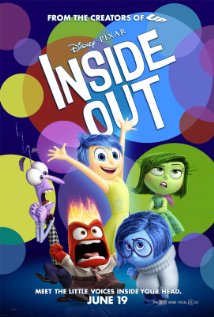
The characters are Joy (Amy Poehler), a pixie-ish blue-haired sprite who is resolutely energetic and upbeat, Anger (Lewis Black), a stocky red fellow who is fiery-tempered and easily outraged, Disgust (Mindy Kaling), green, with a round head, long eyelashes, and a sensitive spirit quick to resist anything new or icky, Fear (Bill Hader), a lean blue creature who usually assumes the worst, and Sadness (Phyllis Smith), who feels everything very, very, very, very deeply. Each of these characters is introduced with what they help Riley do. Anger helps her see unfairness. Disgust helps her to avoid poisonous foods. Fear helps keep her safe. Joy helps her see the world as a place filled with imagination, adventure, and opportunity. And Sadness — we will learn more about what Sadness does later, but for now we will say that it helps her feel empathy. Joy is the leader of the group. She is the most focused and direct and the best able to negotiate with the others. But her goal is to keep all of Riley’s memories happy, and that might not be possible.

As Riley tries to use her mind, her memories, and her emotions to navigate her new community, Joy and Sadness are accidentally transported to where Riley’s memories are stored, and they must make it through an Oz or Wonderland-style land where we learn about everything from abstract thinking to why you CAN’T GET THAT DARN JINGLE FROM THAT STUPID COMMERCIAL OUT OF YOUR HEAD.  A surprising — in every sense of the term — new character shows up to provide support and insight, and to embody the sweet sorrow of growing up.  Co-writer/director Pete Docter told Terry Gross that it was when Mindy Kaling came to talk to him about the film that he understood what it was really about: you have to grow up, and it’s okay to be sad about it.  That applies whether you are the one growing up or just watching it as a parent or friend.  This movie speaks to all of us, whether we have children, are children, were children, or still keep the child we were near our hearts.  A lot of good movies are smart.  But this one is wise.

Parents should know that this movie includes some mild peril, family tension, running away, and a sad death.

Family discussion: Can you think of a time that Joy was steering your mind? How about the other emotions?  When can you feel them working together?  Did you have a Bing Bong? Why did he make that choice?

If you like this, try: “Everybody Rides the Carousel,” “Up,” and “Monsters Inc.”

Related Tags:


3D Animation Comedy Coming of age Drama DVD/Blu-Ray Pick of the Week For the Whole Family

Boyhood

Posted on July 17, 2014 at 6:00 pm

A-
Lowest Recommended Age: Mature High Schooler
MPAA Rating: Rated R for language including sexual references, and for teen drug and alcohol use
Profanity: Very strong language
Alcohol/ Drugs: Teen and adult drinking, teen drug use
Violence/ Scariness: Domestic abuse, guns
Diversity Issues: None
Date Released to Theaters: July 18, 2014
Date Released to DVD: January 5, 2015
Amazon.com ASIN: B00MEQUNZ0

Boyhood_film

“A boy’s will is the wind’s will/And the thoughts of youth are long, long thoughts.” (Longfellow)

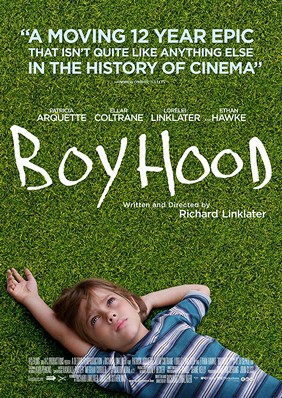
We first see Mason (Ellar Coltrane) lying on the ground, looking up at the sky, and it is clear that his thoughts are very long indeed.  We will stay with Mason and — in an unprecedented longitudinal form of filmmaking from writer/director Richard Linklater — portrayed by Coltrane for twelve years, until he leaves for college at age 18.  This film deservedly appears on most of the year’s top ten lists and has been selected by several critics groups as the best film of the year.

Linklater has followed characters over the years before.  We have seen the romantic relationship of Celine and Jesse in three 24-hour episodes (all involving walking through European cities) in the “Before” films, plus an intriguing segment of the animated “Waking Life.”  That series is an extraordinary, and I hope, continuing undertaking, with stars Julie Delpy and Ethan Hawke working with Linklater to create the storyline and script.

Hawke is in this film, too, as Mason’s father, Mason senior. Patricia Arquette plays his mother and Linklater’s daughter Lorelei plays his older sister, Samantha. All are superb.  Linklater says that he knew what the last shot would be from the beginning. For the rest, he trusted his stars and the developments of the dozen years ahead of them. As the children got older, they joined Linklater, Hawke, and Arquette in helping to fill in the details.

And it is the details that are the story here, giving it a unhurried yet mesmerizingly enthralling feel and an unexpected power. At first, it seems like time-lapse footage of a flower blooming. Then it feels like watching someone’s home movies. By the end, we are so invested in Mason’s life we feel we are watching our own.

Linklater and his cast met for just a few weeks each year to film a little more.  Unlike a conventional narrative, where, as Chekov put it, economy of storytelling means that a gun over the fireplace in act one has to go off by act three, this story is not linear.  But non-linear does not mean random.  The incidents chosen are not necessarily the high points of Mason’s years, but they are indicators that create a mosaic of the fuller picture. Mason sees his mother, who has gone back to graduate school, talking to one of her professors.  But it is unlikely that he understands the meaning of the look they exchange.  We are not surprised to find them married in a subsequent scene.  And we do not need a slow build-up or full character arc to understand the import of the succeeding conflicts between the stepfather and stepson.

Meanwhile, Coltrane and Lorelei Linklater do something no one has ever done quite this way before on screen.  They grow up.  And Richard Linklater trusts the audience enough to let that in and of itself be the dramatic arc of the story.   There were laughs and hoots in the audience over the antiquated look of the computers at Mason’s school.  There are references to the first Obama Presidential campaign and the release of a new Harry Potter book.  But these are all organic, as much as his first heart-break, his second stepfather, and new stepmother, and tough words from his teacher.  There is no micro-managed re-creation of the past; this is the past, our past as well as Mason’s.  It feels real, it feels lived in, and, as he leaves for college, it feels bittersweet but filled with promise.

Parents should know that this film includes domestic abuse, tense family confrontations, guns, very strong language, sexual references (some crude), and teen drug and alcohol use.

Family discussion:  Do you agree with Mason’s photography teacher about what he should do?  Mason had many different role models for masculinity — which do you think he will follow?

If you like this, try: Richard Linklater’s other films, including “Before Sunrise,” “Before Sunset,” and “Before Midnight” and “Waking Life”

Related Tags:


Coming of age DVD/Blu-Ray Pick of the Week Family Issues Stories About Kids Stories about Teens
THE MOVIE MOM® is a registered trademark of Nell Minow. Use of the mark without express consent from Nell Minow constitutes trademark infringement and unfair competition in violation of federal and state laws. All material © Nell Minow 1995-2026, all rights reserved, and no use or republication is permitted without explicit permission. This site hosts Nell Minow’s Movie Mom® archive, with material that originally appeared on Yahoo! Movies, Beliefnet, and other sources. Much of her new material can be found at Rogerebert.com, Huffington Post, and WheretoWatch. Her books include The Movie Mom’s Guide to Family Movies and 101 Must-See Movie Moments, and she can be heard each week on radio stations across the country.

Website Designed by Max LaZebnik