
Yankee Doodle Dandy
Posted on July 4, 2012 at 3:38 pm
James Cagney as George M. Cohan in Yankee Doodle Dandy:
http://www.youtube.com/watch?v=2R1jiVcIGcg
Posted on July 4, 2012 at 3:38 pm
James Cagney as George M. Cohan in Yankee Doodle Dandy:
http://www.youtube.com/watch?v=2R1jiVcIGcg
Posted on June 28, 2012 at 6:00 pm
You might expect a movie about strippers to be either a glossy Hollywood fantasy or a gritty, sour, documentary. The surprise of “Magic Mike” is that it avoids both extremes with an appealing naturalness and intimacy that softens but does not glamorize its setting. 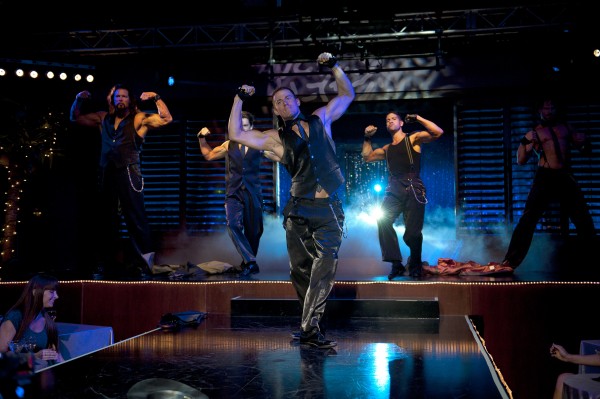
It is inspired by the experiences of co-producer and star Channing Tatum as an exotic dancer before he broke through as an unexpectedly versatile actor (“Step Up,” “G.I. Joe,” “Dear John,” “21 Jump Street”). Equally versatile director Stephen Soderburgh (“Traffic,” “Erin Brockovich,” “Sex, Lies, and Videotape,” “Oceans 11”) gently bumps the story a couple of degrees away from the sordid to keep things fun and even romantic. The big musical numbers are grander and more elaborate than anything you might actually see in a small Tampa club catering to sorority girls and bachelorette parties. But even when it gets debauched and dangerous, it is still kind of sweet. It has a bit of the sense of discovery of Robert Altman’s “The Company.” Plus, those guys have some moves. The dance numbers are a blast, witty, sexy, and very wooo-worthy.
Tatum plays Mike, a would-be entrepreneur who does a little of this and that (and wears very little of this and even less of that) as he tries to straighten out his financial situation so that he can pursue his dream of designing furniture. He meets a young college drop-out named Adam (Alex Pettyfer), and introduces him to the world of exotic dancing, from trolling bars to entice girls to come to the show to turning himself into the fantasy lover they love to be scandalized by. The owner is Dallas (Matthew McConaughey), who has promised Mike he will open up a big club in Miami and make Mike his partner. (Drinking game: take a shot every time McConaughey says “all right.”)
Adam lives with his sister Brooke, played by the very appealing Cody Horn, who has a wonderful easy chemistry with Tatum. So there is a classic structure, with Mike in the center between the hardened and cynical Dallas and the naive kid in a candy store Adam, drawn to the dream of a different life with Brooke. What takes this out of the category of fluff is the way the story is unaffectedly located in the reality of the economic struggles of the area and our time. Mike tries to persuade a bank loan officer to give him some money, shoving stacks of bills across her desk and not quite understanding that even though he is still selling, this transaction differs from the easy and sleazy environments he frequents. But she sees who he is. So does Brooke, and that helps him to see himself beyond the breakaway pants.
Posted on June 21, 2012 at 6:00 pm
B+| Lowest Recommended Age: | Mature High Schooler |
| MPAA Rating: | Rated R for language including sexual references, some drug use and brief violence |
| Profanity: | Very strong and explicit language |
| Alcohol/ Drugs: | Drinking, drunkenness, drug use |
| Violence/ Scariness: | Disturbing themes of the end of the world, some violence |
| Diversity Issues: | Diverse characters |
| Date Released to Theaters: | June 22, 2012 |
| Date Released to DVD: | October 22, 2012 |
| Amazon.com ASIN: | B007L6VRBM |
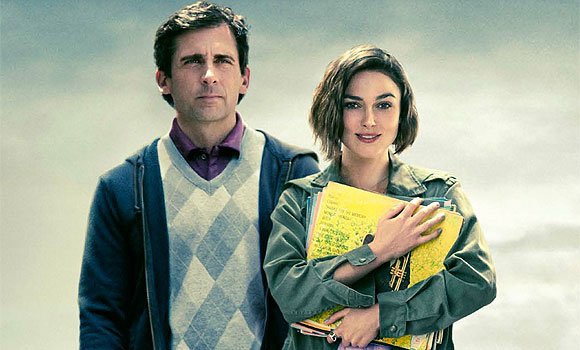 Dr. Johnson memorably said that the prospect of hanging concentrates the mind wonderfully. Part of what stories do for us is concentrate the mind by providing us with narratives that eliminate distracting quotidian effluvia and allow us to focus on one element of the story. In “Seeking a Friend for the End of the World,” writer/director Lorene Scafaria (“Nick and Nora’s Infinite Playlist”) makes that concentration explicit. The world is literally ending in three weeks, and we get to see how that concentrates the minds of Dodge (Steve Carell), Penny (Kiera Knightley), and the people they meet as everyone has to decide what from their “someday” list gets moved up to “now.”
Lorene Scafaria, who wrote the lovely “Nick and Nora’s Infinite Playlist,” here directs her own screenplay with a top-notch cast and a sure sense of tone and pacing. The classic elements of the journey film with a mis-matched pair on the road in search of something is kept fresh through the setting, the adventures and encounters along the way, and sensitive performances from Carell and Knightley.
As Elizabeth Kubler-Ross might have predicted, a lot of people get stuck in stage one: denial. The movie opens as Dodge and his wife hear the radio announcer promise to keep the audience up to date on the progress of the asteroid known as Matilda and its collision path with Earth, along with a countdown to the end of days and “all your classic rock favorites.” At first, most people run on automatic pilot. Dodge goes to his office and tries to explain to a client that his insurance policy does not really cover what is about to happen. “The Armageddon policy is extra.” His boss tries to fill some abandoned positions by offering promotions. People who always wanted to kill someone offer their services as assassins for hire by those who do not want to be alive when the meteor hits. Musicians put on an end of the world awareness concert. It’s like Wile E. Coyote running off the cliff and staying suspended in air until the realization hits — and then he does.
People start to get desperate. Dodge’s wife leaves him. A friend (Patten Oswalt) explains that the end of the world has made it very easy to sleep with women. Dodge’s friends have a party and try to fix him up with a woman (Melanie Lynskey) who arrives wearing all of the jewelry she was saving for the right occasion. But that is not what he wants. The world is increasingly divided between people who choose various ways to numb themselves and those who take this last chance to stop being numb.
Dodge meets his neighbor, Penny, an English girl who has missed the last opportunity to get back to her family. She has a mis-delivered letter from a girl he loved and lost. And she has a car. When rioters take over their building, he offers to get her to a plane if she will help him find the woman who sent the letter. Helping each other gives them purpose. Getting to know Penny gives Dodge more of a sense of being alive than he has ever had before. Dodge had always been too cautious. Penny had always been too irresponsible. Now he must take chances and she must grow up. It’s never too late.
On their journey, they see people and places from their past, including Penny’s survivalist ex-boyfriend (Derek Luke), who thinks that stockpiling weapons and canned goods will help him rebuild society. They stop at a relentlessly chipper restaurant called Friendsy’s (yes, lots and lots of flair) where the staff’s increasingly shrill Ecstasy-fueled cheeriness becomes borderline deranged. And then, even with just days and then hours left, they begin to shift from the past to the future. And, as Rabindrath Tagore wrote, “The butterfly counts not months but moments, and has time enough.”
Posted on May 31, 2012 at 6:30 pm
 Wes Anderson films are not so much directed as curated. Often accused of being more interested in his props than his characters, Anderson’s fussy, even obsessive focus on the objects and sets gives his films a missing the forest for the trees feeling that seems claustrophobic and frustratingly precious to some audiences and astutely ironic to others. Some, I think, see both.
On a fictional island called Penzance off the coast of mid-1960’s New England, two middle school pre-teens run away partly to be together but mostly to be someplace different from where they were. Sam (Jared Gilman) is an owlish-looking orphan who escapes from “Khaki Scout” camp overseen by the very meticulous Scout Master Ward (Edward Norton). He wears glasses and a coonskin cap. He lives with foster parents who have rejected him and, as we find, after camp is over he will be sent to live in an orphanage by a woman so odiously officious the only name she goes by is Social Services (Tilda Swinton).
Suzy (Kara Hayward) is a serious and determined girl who lives with a family that does not appreciate or understand her. She wears knee socks, packs a record-player, and is very attached to her binoculars, which give her a chance to look at places far from home. Her mother (Frances McDormand) addresses her children in their home via megaphone. Sam first sees Suzy when she is in costume as a bird, about to appear in a performance of Benjamin Britten’s opera about Noah and the flood. They engage in a secret correspondence and make plans for their getaway.
Sam and Suzy create a world for themselves that is part fantasy, part very real. They are practical, if limited, in their understanding of their situation. Sam uses his camping skills to provide food and shelter, and they rename their site Moonrise Kingdom, establishing themselves as rulers of a place that exists in the opposite of the harsh daylight of their previous reality. They try some kissing but sleep next to each other in complete innocence. Suzy brought a record-player as one of her essentials, and they listen to music.
Meanwhile, Scout Master Ward, Suzy’s parents, and the local sheriff (Bruce Willis), who is having a joyless affair with Suzy’s mother, are searching the island for the missing children. Sam, who was ostracized for being weird by the other scouts, becomes a hero for his daring and romantic adventure and they help him try to escape with the assistance of another Scout leader (Jason Schwartzman) who is less upstanding than Ward. Even Ward ends up complimenting Sam on his “commendable” campsite.
Sam and Suzy may not have a plan for taking care of themselves past a few days and one of the things Anderson does best is conveying that exact moment between the end of childhood and the beginning of adolescence (Suzy’s home is called “Summer’s End”) when things are animated by imagination that can feel completely real. Like Peter Pan and Wendy, Sam pretends to smoke a pipe and Suzy presides over a group of Lost Boys to create a family that allows them to be both adult and forever young. Like the young heroes of Dickens’ story about Mr. and Mrs. Harry Walmers, Jr., the young runaways seem to have an almost incantatory faith in the power of marriage to create a bond that will protect them from the power of the grown-ups.
In many ways Sam and Suzy are more adult than the grown-ups around them, who are petty, foolish, or lonely. And, as usual in Wes Anderson films, they are not as fully realized as the props and settings around them. It is telling that the children assume a paper mache decoy will fool the adults; it almost does. Suzy’s library books in particular are a marvel of period detail, so vivid and evocative audiences of a certain age will swear they had those books on the shelf next to Madeleine L’Engle and Norton Juster. It’s details like the coonskin cap that delight his fans and infuriate everyone else. No one in the mid-60’s and no 12 year old of any era wore a coonskin cap. The omniscient “Our Town”-style narrator (Bob Balaban) can tell us a storm is coming but he cannot make the emotions of the story feel real or meaningful.
Parents should know that this film includes some sexual references and experimentation by middle-schoolers, teen and adult smoking and drinking, some strong language, some violence, and human and animal characters peril and injury.
Family discussion: Why did the scoutmaster change his mind about which was his “real job?” Why did the children run away? How does it change the story to have it set in the 1960’s instead of today?
If you like this, try: “A Little Romance” and “Fantastic Mr. Fox”
Posted on May 3, 2012 at 6:00 pm
A dream team ensemble cast of British acting superstars gives a predictable story of displaced retirees spark and depth in this cozy tale based on the novel These Foolish Things, by Deborah Moggach
A group of British retirees come to India for one last adventure. Or, they come because they have nowhere else to go. Some have not let themselves think about which it is, or whether it is both. Easy-going Douglas (Bill Nighy) and the perpetually disappointed Jean (“Downton Abbey’s” Penelope Wilton) come because their limited resources cannot cover the life Jean sees for herself. “Would it help if I apologize again?” he asks. “No, but do it anyway,” she replies.
Muriel (Maggie Smith) is appalled by having to leave “proper” Britain to live among foreigners but it is the only way she can get the operation she needs without long delays from the National Health Service. Evelyn (Judi Dench), a recent widow in reduced circumstances, must learn to take care of herself — and finds that she likes it. Madge (Celia Imrie, the “we’re going to need bigger buns” “Calendar Girl”) hopes to find romance. Norman (Ronald Pickup) wants something a bit more carnal. Graham (a courtly Tom Wilkinson) wants to reconnect with his past. They each find The Best Exotic Marigold Hotel “for the elderly and beautiful” in Jaipur via a website. When they arrive, they learn the description of “a luxury development for residents in their golden years” was more aspirational than accurate. “You Photoshopped it!” one new resident accuses. “I offered a vision of the future,” Sonny explains. He tells them that everything will be all right in the end and “if it is not all right, it is not the end.” 
The young proprietor is Sonny (“Slumdog Millionaire’s Dev Patel), whose grand plans and grander hopes for the hotel are so vivid he seems a bit surprised when it is pointed out that the the place is falling down and lacking some of the most basic of amenities, like doors with locks and reliable water. There are the expected culture clashes. The Brits are not used to chaotic riot of noise and color on the streets and the spicy food. But it is worth it to see Maggie Smith’s disdainful expression as she nibbles defiantly on the chocolate biscuits she brought from home, pronouncing, “I won’t eat anything I can’t pronounce!”
Seeing the impeccable performances of this magnificent cast is reason enough to see the film as these actors transform the most conventional of situations by making us care about the characters and their hopes. Wilton’s portrayal of Jean, the bitter wife, shows us how she cannot seem to find her way out of a labyrinth of disappointment. Dench as Evelyn, sitting on the phone listening to an endless recording telling her that her call is very important, knows that she has never really been very important. But there is something more than the kind of bittersweet but cozy story of plucky septuagenarians. Perhaps the reason they stay in the rundown hotel is that they understand how superficial appearances are. Perhaps the idea of restoring its grandeur to what it once was means something to them in a world where old age is “outsourced.” It is encouraging for some of them to learn that “like Darwin’s finches, we are slowly adapting to our environment.”
Parents should know that this film includes some strong language (f-word), sexual references (gay and straight) and partial nudity, sad death, and drinking.
Family discussion: Who gets the biggest surprise? Who changes the most?
If you like this, try: “Enchanted April,” “Monsoon Wedding,” “Mrs. Palfrey at the Claremont,” and “A Room With a View”