Judas and the Black Messiah

Judas and the Black Messiah

Posted on February 11, 2021 at 5:22 pm

B +
Lowest Recommended Age: Mature High Schooler
MPAA Rating: Rated R for violence and pervasive language.
Profanity: Very strong language including n-word
Alcohol/ Drugs: Drinking, drugs
Violence/ Scariness: Peril and violence, characters injured and killed
Diversity Issues: A theme of the movie
Date Released to Theaters: February 12, 2021

Copyright Participant Media 2021
“Know their names,” Black Lives Matter tells us. The ones we know now we know because of technology. We saw George Floyd telling the cop who had his knee on Floyd’s neck that he could not breathe. iPhones and social media have brought these tragedies into our homes and made it impossible for us to look away.

None of that was around in 1969, when young Black activists named Fred Hampton and Mark Clark were killed by the Chicago police. Hampton was Chairman of the Illinois Black Panthers and Deputy Chairman of the national organization. At age 19 he was identified by the FBI as a radical threat. At age 21, he was killed in his apartment when the police raided it before dawn. Police fired over 100 shots. The Black Panthers fired one.

There were no iPhones to record what happened that night. This movie begins to give Fred Hampton and Mark Clark the visibility they could not get in 1969.

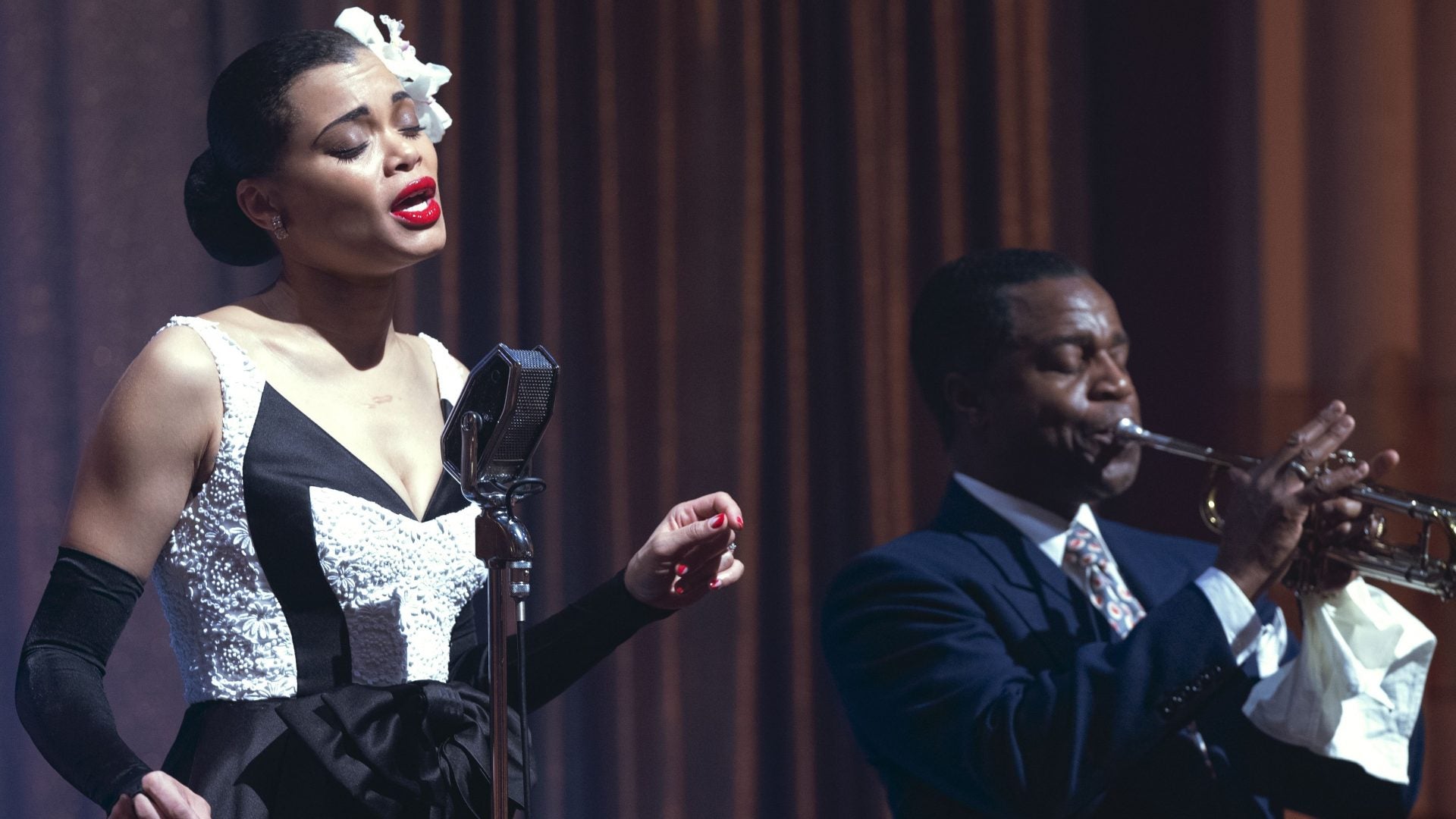
“Judas and the Black Messiah” is the second film in less than a year to show us Fred Hampton. In “The Trial of the Chicago 7” he is played by Kelvin Harrison, Jr., sitting behind Bobby Seale. This film, as the title suggests, is less about Hampton’s vision or activities than the story of William O’Neal, who was hired by the FBI to infiltrate the Black Panthers, and the conflicts he faced in betraying the trust of people he grew to respect.

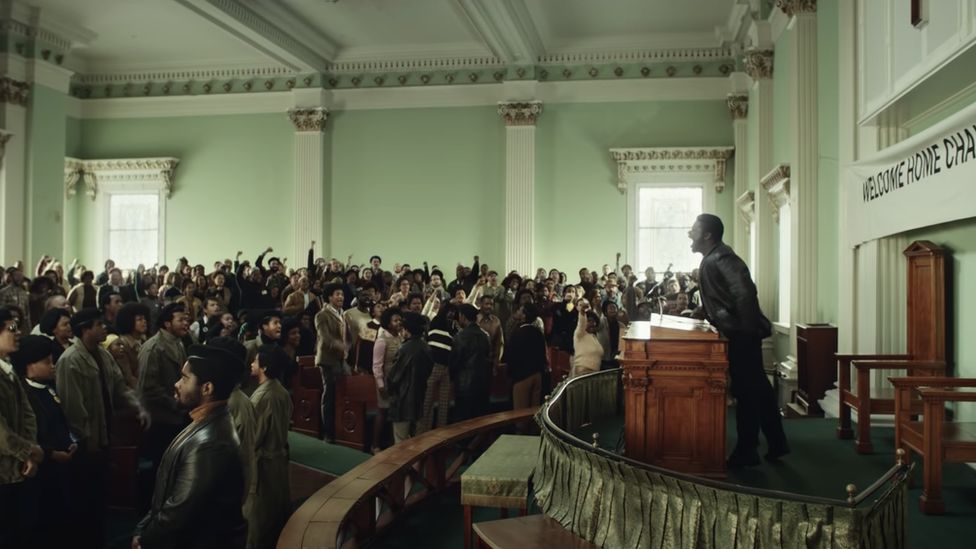
The men are played by two of the most electrifying performers of our time, Daniel Kaluuya as Hampton and LaKieth Stanfield as O’Neal, though both are substantially older than the real-life characters. Kaluuya (“Get Out,” “The Black Panther”) is a British actor who has the daunting challenge of playing a 1960s Chicagoan known for being a mesmerizing speaker. As a Chicagoan, I can certify his accent as remarkably authentic. And as an audience member I can testify to the magnetism he brings to the role, whether he is addressing a crowd of admiring students, a group of hostile competitors, or Panther members who need guidance. His Hampton understands the power of listening, and of speaking quietly. He knows how to tie what he wants them to do to recognizing the pain of the people he is talking to, and recognizing, too, how much they need to be shown a bigger, brighter version of what is possible and of the power they have to get there. And when it’s time to fire them up, he knows how to preach.

He is even better one on one. In one of the movie’s most powerful scenes, he sits at the kitchen table of a woman (a beautiful performance by Alysia Joy Powell) whose son has been killed. He gently, compassionately listens to her talk about how in her mind he is always seven years old, how he is more than what got him in trouble. In another highlight, he meets with the hostile members of a group called The Crowns that sees the Black Panthers as competition. The FBI has circulated a forged flier supposedly created by the Black Panthers that insults the Crowns. Hampton does not argue. He does not get defensive. He just reflects back to the Crowns the power they have and asks them to think of what they can accomplish together. His scenes with the activist and poet who became the mother of his child, played with tenderness, grace, and dignity by Dominique Fishback, are also beautifully done. He quotes Che Guevara to her, “Words are beautiful but action is supreme.” She responds, “You were using words, so maybe choose them more carefully. And just so you know, you are a poet.”

“I don’t need no mic,” he tells the students. He wants to speak to them intimately, conversation, not oratory. But he uses strong words when he needs to. “That’s the difference between revolution and the candy-coated facade of reform,” he tells them. “Reform is just the masters teaching the slaves to be better slaves.” He says his job is to “heighten the contradictions” because oppressed people cannot always see the shackles.

Hampton often speaks quietly, but some of his rhetoric is incendiary. He speaks of getting AK-47s and bandoliers. He quotes Che Guevara and Mao Tse-Tung. But his programs start with free breakfasts for hungry children and his plans are for a clinic and a school.

Stanfield (“The Photograph,” “Short Term 12”) as O’Neal shows us the anguish of a man caught between the FBI agent who alternately cajoles and threatens him. O’Neal was a teenager when he was arrested for impersonating an officer and stealing cars. Agent Roy Mitchell (Jesse Plemons) invites him to his apartment, buys him a car, and takes him to high-end restaurants. O’Neal says he saw Mitchell as a role model. But he sees himself as an activist, even years later when he was interviewed for the PBS series “Eyes on the Prize.” We see Stanfield re-enacting that interview at the beginning of the film and the footage of the real O’Neal at the end.

The conflict of compromise undercover operatives struggle with has been portrayed in other stories and films, from Kurt Vonnegut’s Mother Night to Johnny Depp and Al Pacino in Donnie Brasco. Writer/director Shaka King (writing with Will Berson from the original screenplay by Keith and Kenny Lucas) finds sympathy for just about everyone except for J. Edgar Hoover (played by Martin Sheen and a lot of make-up) and the Chicago cops. Even Mitchell, who manipulates O’Neal, shows some disgust at Hoover’s trying to goad him by asking how he would feel if his 8-month-old daughter some day brought home a Black boyfriend.

But O’Neal’s story is less interesting than the story of Hampton himself, what he read, who he was inspired by, and how he inspired others. The script is muddled and confusing in places. But the stirring story and the exceptional performances, and the score from Craig Harris and Mark Isham make this a powerful, important film, well worth seeing and learning from.

Parents should know that this film deals frankly with issues of racism, resistance, betrayal, and police brutality. Characters use strong language. There are sexual references and there is a non-explicit sexual situation. Violence includes guns and characters are injured and killed.

Family discussion: What should we learn about leaders like Fred Hampton when we study American history? Why did the FBI consider him such a significant threat? How should the government treat activists like Hampton?

If you like this, try: the documentaries “The Murder of Fred Hampton,” “The Black Panthers: Vanguard of the Revolution,” and “Nationtime.”

Related Tags:


Based on a true story Drama movie review Movies -- format Movies -- Reviews Politics Race and Diversity
Bliss

Bliss

Posted on February 4, 2021 at 5:50 pm

B-
Lowest Recommended Age: High School
MPAA Rating: Rated R for drug content, language, some sexual material and violence
Profanity: Strong language
Alcohol/ Drugs: Alcohol, drugs
Violence/ Scariness: Peril and some violence including an accidental homicide
Diversity Issues: None
Date Released to Theaters: February 5, 2021

Copyright Amazon Prime 2021
If you could, if it was possible, would you smooth all of life’s rough spots? Would you remove all worry, all fear, all sadness, all pain? Would you want to live in a world of perpetual bliss?

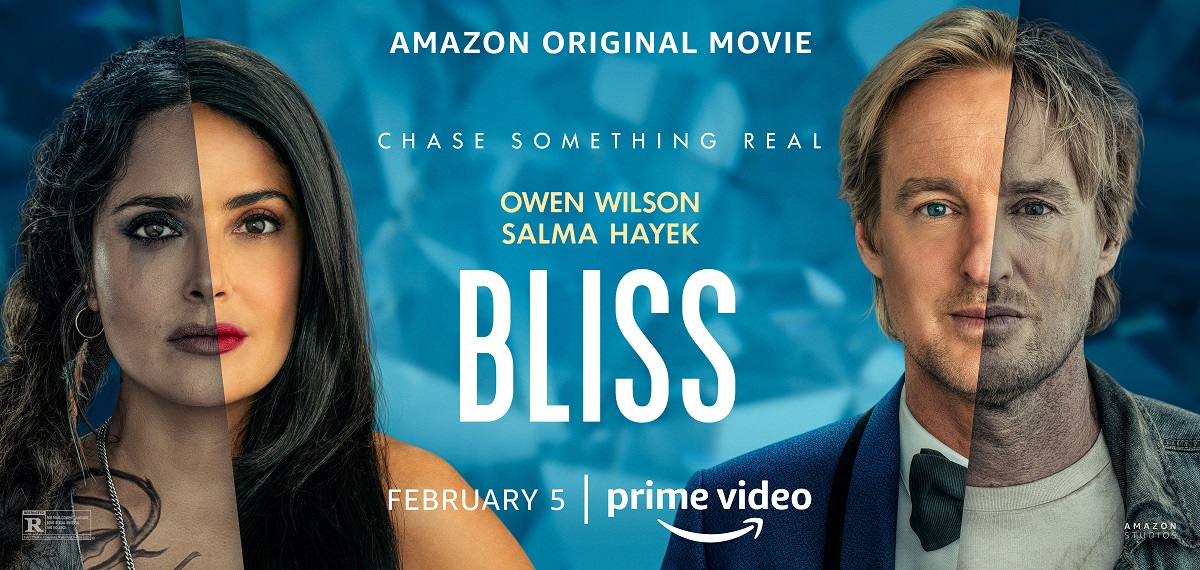
That is the question raised provocatively but very imperfectly in “Bliss,” with Owen Wilson as greg, a gray-spirited low-level worker failing in a soul-killing dead-end job apologizing to customers who call tech support. Our own anxiety levels rise as we see him seemingly not aware of the pressure he is under. The boss wants to see him immediately. But instead of leaving his office, he talks on the phone — to a daughter reminding him of the details of her graduation and to a pharmacy that refuses refill his pain-killer prescription. We learn from this that his marriage is over due to failures on his part, that his promises are not reliable, that he has a drug problem, and that he is in trouble at work. And we see him obsessively drawing pictures of place and a woman he has never seen, like Richard Dreyfuss sculpting mashed potatoes in “Close Encounters of the Third Kind.”

But then it turns out our assumptions and his may be wrong. We find ourselves in a blue-or-red-pill situation, “The Matrix” without the bullet time, or the bullets. After things go even more terribly wrong, Greg finds himself in a bar, where a mysterious woman named Isabel (Salma Hayek) tells him he is “real” in a way the others in the room are not. There may be another reality or, perhaps, just one real reality, which is not the one with the office and the phone calls.

SPOILER ALERT: I am going to have to spoil a few things in order to be able to talk about the movie, so if you do not want any spoilers, stop reading now, watch “Bliss,” and then if you want to know more about what I think about it, you can come back. Isabel does not give Greg the whole story. She just takes him to stay with her at a makeshift shelter in an area where homeless people camp out. It turns out she and Greg are not just part of but responsible for an experiment in re-calibration for people who have found the idyllic life of the future so blissful the only thing they have to complain about is the temperature of the pool water. It just might be that even in a world supposedly free from stress there still remain concerns (about the legitimacy and success of one’s research in absolute terms and in the way it is perceived by others). It may also be that worry and fear are inextricably linked to creativity, imagination, and an innate human inclination to problem solving and some notion of progress.

These are wonderful questions to explore and there are moments of real emotion in the film along with superb design work by Kasra Farahani (“Captain Marvel”). But the script gets tangled up in its own perameters of the world or worlds it creates. The internal logic of the storyline is inconsistent enough to undermine our connection to the characters and to the issues it raises. In case you’re looking around wondering which reality you’re in, my advice is to bet on the one with Bill Nye the Science Guy in it.

Parents should know that this movie includes strong language, peril, and an apparent accidental homicide.

Family discussion: Which reality would you chose and why? What would happen if all trouble, stress, and worry was removed from our lives?

If you like this, try: “The Matrix,” “The Black Box,” “Black Mirror,” and “Passion of Mind”

Related Tags:


Drama movie review Movies -- format Movies -- Reviews Science-Fiction
Supernova

Supernova

Posted on January 28, 2021 at 5:49 pm

B +
Lowest Recommended Age: Mature High Schooler
MPAA Rating: Rated R for language
Profanity: Very strong language
Alcohol/ Drugs: Social drinkiing
Violence/ Scariness: Illness, dementia, discussion of suicide
Diversity Issues: None
Date Released to Theaters: January 29, 2021

Copyright Netflix 2021
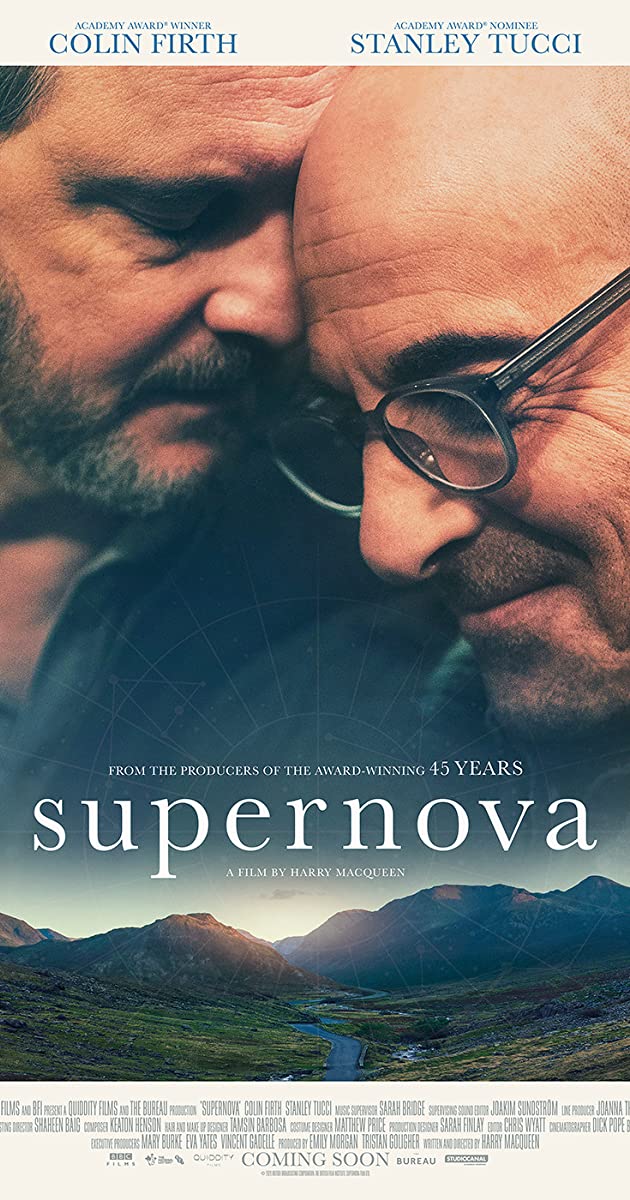
A lot of thought goes into weddings, but very little of it focuses on one of the promises couples make, the one about “in sickness and in health.” And yet those of us who are lucky enough to share our lives with the ones we love for decades will face a time when one has to care for the other. In “Supernova,” Colin Firth and Stanley Tucci play a longtime devoted couple who are facing one of the most painful losses of all. One of them has been diagnosed with dementia.

Firth plays Sam, classical pianist, and Tucci is Tusker, a successful novelist. Asleep, they tenderly embrace. Awake, they amiably bicker and banter as they embark on a road trip in a well-traveled camper.

Sam is clearly the more serious of the two, with Tusker more sardonic and a bit of a tease. Writer/director Harry Macqueen understands the rhythms, stresses, and enduring pleasures of a long-term relationship. And Firth beautifully portrays the way Sam worries, worries about revealing that he is worrying, all the time relishing his time with Tusker all the more because he knows there will be less of Tusker every day.

The trip itself is about memory as they visit places and people that have meant the most to them. And as we understand better the strain they are under, their connections and conversations take on deeper meanings. Looking out at a magnificent view that many couples have found romantic Tusker asks what wish Sam would make. Sam says something many couple have said in that same spot. He wishes this vacation could go on forever. But what he means is that he wants to freeze this moment. Tusker, even impaired, knows Sam well enough to respond to the subtext: “So can you tell that it’s gotten worse?”

The trip takes them backwards and forward. They relive some of their past, through recollection, stops at meaningful locations, and encounters with people who have been important to them for a long time. And then obliquely and then more explicitly they look ahead as they consider their options and priorities. Tusker will become more dependent but, most terrifying for both of them, he will become less himself.

How much deference do you give to someone you love deeply when his judgement may be severely diminished? How much deference do you give to someone you love when he wants to care for you — and you don’t want to be cared for, you want both of you to be spared what will inevitably be (literally) horrible?

Macqueen has a light touch with the bigger picture hinted at in the movie’s title. His palpable sympathy for both men and for the complexity of the decisions they are making and the subtle, sympathetic performances from Firth and Tucci make this film a quiet gem, true to the characters and their love story.

Parents should know that the themes of this movie including memory loss and suicide and characters use very strong language.

Family discussion: Do you agree with Tuskar’s decision? How should Sam respond?

If you like this, try: “Still Mine,” “Away From Her,” “The Leisure Seeker,” “Blackbird,” and “I Remember Better When I Paint”

Related Tags:


Drama Illness, Medicine, and Health Care movie review Movies -- format Movies -- Reviews
The Little Things

The Little Things

Posted on January 27, 2021 at 7:00 am

C
Lowest Recommended Age: Mature High Schooler
MPAA Rating: Rated R for violent/disturbing images, language and full nudity.
Profanity: Very strong language
Alcohol/ Drugs: Alcohol
Violence/ Scariness: Serial killer crime drama
Diversity Issues: None
Date Released to Theaters: January 29, 2021
Date Released to DVD: May 4, 2021

Copyright Warner Brothers 2021
Three Oscar winners cannot save “The Little Things,” a crime thriller that starts out promisingly and about halfway through completely loses its way. It’s almost like the screenplay was created by two different people, or undermined by the director. But John Lee Hancock (“The Blind Side,” “Saving Mr. Banks,” “The Highwaymen”), both wrote and directed, so he is responsible when the story veers into Gothika Rule territory.

It takes place in 1990, and we begin with a pretty young woman driving on the highway and singing along to the Go-Gos as a sinister motorist behind her makes her uncomfortable and then terrified. The first half sets up two mysteries. The first is the realization that the young woman who has been murdered is the victim of a serial killer, expanding and making more urgent the search to find the one responsible. The detective in charge is Jim Baxter (Rami Malek), who takes the job very seriously, even personally. “We work for her,” he says about the dead woman.

A lower-level officer named Deke Deacon (Denzel Washington) has been sent to Baxter’s police station to pick up some evidence. The second mystery is why the people there are (mostly) so hostile to him and why a clearly experienced, capable, and dedicated has not risen in rank. “And they say Black guys never return to the scene of the crime,” another detective says with acid in his voice. But the forensic pathologist seems more sympathetic, agreeing to spend some time with him when a delay in making the evidence available keeps him there overnight.

There’s “something like it up north,” Deke says, and soon he and Baxter are beginning to work together to find the killer. “Things probably changed a lot since you left,” says Baxter. “Still gotta catch ’em? Then nothing has really changed that much,” Deke says.

So far, so good. As long as Deke and Baxter are behaving like intelligent, dedicated professionals, the movie holds our interest as a police procedural with intriguing characters. But then Jared Leto enters the picture as suspect Albert Sparma and it all begins to fall apart. Baxter seems to have an inexplicable change of personality with a decision so monumentally stupid and contrary to day one of any kind of law enforcement training not to mention basic common sense that it takes us out of the story.

Meanwhile, what we learn about Deke’s past is not as meaningful as the movie clearly thinks it is, making the story’s primary mystery secondary to the point of almost inconsequential. Washington’s is the only performance that continues to hold our attention as Leto hits one creepy note and stays there and Malek is unable to overcome his character’s inconsistency. More important, the swerve in tone undermines the film’s aspirations for moral complexity. The title of the film refers to the little things that are important to get right, whether you are a killer trying to evade justice or law enforcement trying to achieve it. In the case of this movie, the little things are all right but the big thing, the screenplay, is a mess.

Parents should know that this movie is about a serial killer and it has some grisly and graphic images and strong language.

Family discussion: Why did Deke send the package to Baxter? How was that decision tied to his own experience? Why did Flo keep the memento on her keychain?

If you like this, try: “Inside Man” and “Silence of the Lambs”

Related Tags:


Crime Drama DVD/Blu-Ray movie review Movies -- Reviews Thriller
Our Friend

Our Friend

Posted on January 21, 2021 at 5:35 pm

B +
Lowest Recommended Age: High School
MPAA Rating: Rated R for language
Profanity: Very strong language
Alcohol/ Drugs: Social drinking, medication
Violence/ Scariness: Illness and very sad death
Diversity Issues: None
Date Released to Theaters: January 22, 2021
Date Released to DVD: March 29, 2021

Copyright 2021 Roadside Attractions
“Friend” is a category that is near-endless in scope. We use it to describe a work colleague we have lunch with sometimes, someone we’ve seen at parties whose middle name we don’t know, someone we met playing tennis who never heard the story of how our two-year-old locked herself in the bathroom with the cat. We use that word for the people we deliver casseroles to when things get tough, and those who deliver them to us, never crossing the doorway into the house. And yet we use the same word to encompass a person who gave up his job, his home, and his relationship to help people he cares about through as excruciatingly painful and physically, mentally, and emotionally exhausting experience as there is, the terminal illness of a young mother. That is the real-life story of Our Friend.

Dakota Johnson plays Nicole Teague, wife of journalist Matthew Teague (Casey Affleck), devoted and endlessly patient mother to Molly and Evangeline, and best friend of Dane (Jason Segel), a shy and sometimes awkward guy who has struggled with depression and with direction. But when Nicole’s diagnosis is dire, he leaves New Orleans to move in with the family, saying simply, “I just feel like I’m supposed to be here right now.”

He tells his girlfriend it will probably be just for a few weeks. But he stays as his vacation days get used up and he loses his job and as her patience gets used up and he loses her. He just stays, never asking how he can help, just quietly providing a sense of stability in the home.

“Our Friend” is based on Matthew Teague’s award-winning story in Esquire. In an interview, I asked Teague about Dane, who, as characters in the movie point out, is not successful in conventional terms but whose quiet and extraordinarily sensitive support defines the term “no greater love.” He said simply, “He is my hero. And it’s pretty great to have a best friend who is also your hero.”

Teague also spoke candidly about the two kinds of health care professionals families encounter in critical illness. The first are only about doing anything medically possible to prolong life. The second come in for hospice care, and will do anything they can to keep the patient comfortable and support the family.

We see both in this film, the second portrayed by the great Cherry Jones as the well-named Faith. Pointedly, as really happened, Dane arrives just as both Nicole and the family dog are diagnosed with cancer, and it is Dane who has to take the dog to the vet and be there for what we euphemistically call being put to sleep. Matthew exhaustedly says he wants to make sure the girls do not associate the two cancers.

We see the impact of the illness on Nicole. As the doctor warns at the beginning, the family will see her unlike anything in their past understanding of who she is. There will be confusion, anger, lashing out, and not just from Nicole. But the focus of the film, as the title indicates, is on the friend, who just shows up and says, “Would it help if I stayed with you for a while?”

The script by Brad Ingelsby (“The Way Back,” “Run All Night”) jumps back and forth in time, as though it is all from Matthew’s memory as he writes the story. It opens with Dane sitting on the porch with the girls as Matthew and Nicole rehearse what they will say to let their daughters know that their mother is dying. Though typed titles tell us where we are in time vis a vis the diagnosis, it is sometimes distracting. But director Gabriela Cowperthwaite, who showed great compassion for damaged characters in “Meagan Leavy,” imbues the film with enormous compassion for its characters and the lead actors, especially Segel, bring endless warmth and humanity to their roles, which always feel fully inhabited. We feel their loss. And we feel the sustaining connections that help them through.

Parents should know that this movie is the story of the illness and death of a young mother, and it is very sad. Characters use strong language and there are references to adultery.

Family discussion: What made Dane different from the other friends? Who has been a Dane in your life? Who would you be a Dane for?

If you like this, try: “50/50,” with Seth Rogen playing a character based on himself in the true story of a someone who helps a young friend with cancer, and “My Life” with Michael Keaton and Nicole Kidman

Related Tags:


Based on a true story Drama DVD/Blu-Ray Illness, Medicine, and Health Care movie review Movies -- format
THE MOVIE MOM® is a registered trademark of Nell Minow. Use of the mark without express consent from Nell Minow constitutes trademark infringement and unfair competition in violation of federal and state laws. All material © Nell Minow 1995-2026, all rights reserved, and no use or republication is permitted without explicit permission. This site hosts Nell Minow’s Movie Mom® archive, with material that originally appeared on Yahoo! Movies, Beliefnet, and other sources. Much of her new material can be found at Rogerebert.com, Huffington Post, and WheretoWatch. Her books include The Movie Mom’s Guide to Family Movies and 101 Must-See Movie Moments, and she can be heard each week on radio stations across the country.

Website Designed by Max LaZebnik