Little Women

Little Women

Posted on December 24, 2019 at 5:00 pm

A-
Lowest Recommended Age: 4th - 6th Grade
MPAA Rating: Rated PG for thematic elements and brief smoking
Profanity: None
Alcohol/ Drugs: Social drinking, brief smoking
Violence/ Scariness: Very sad death, references to other deaths including death of a baby
Diversity Issues: A theme of the movie
Date Released to Theaters: December 25, 2019
Date Released to DVD: April 6, 2020
Copyright 2019 Sony Pictures

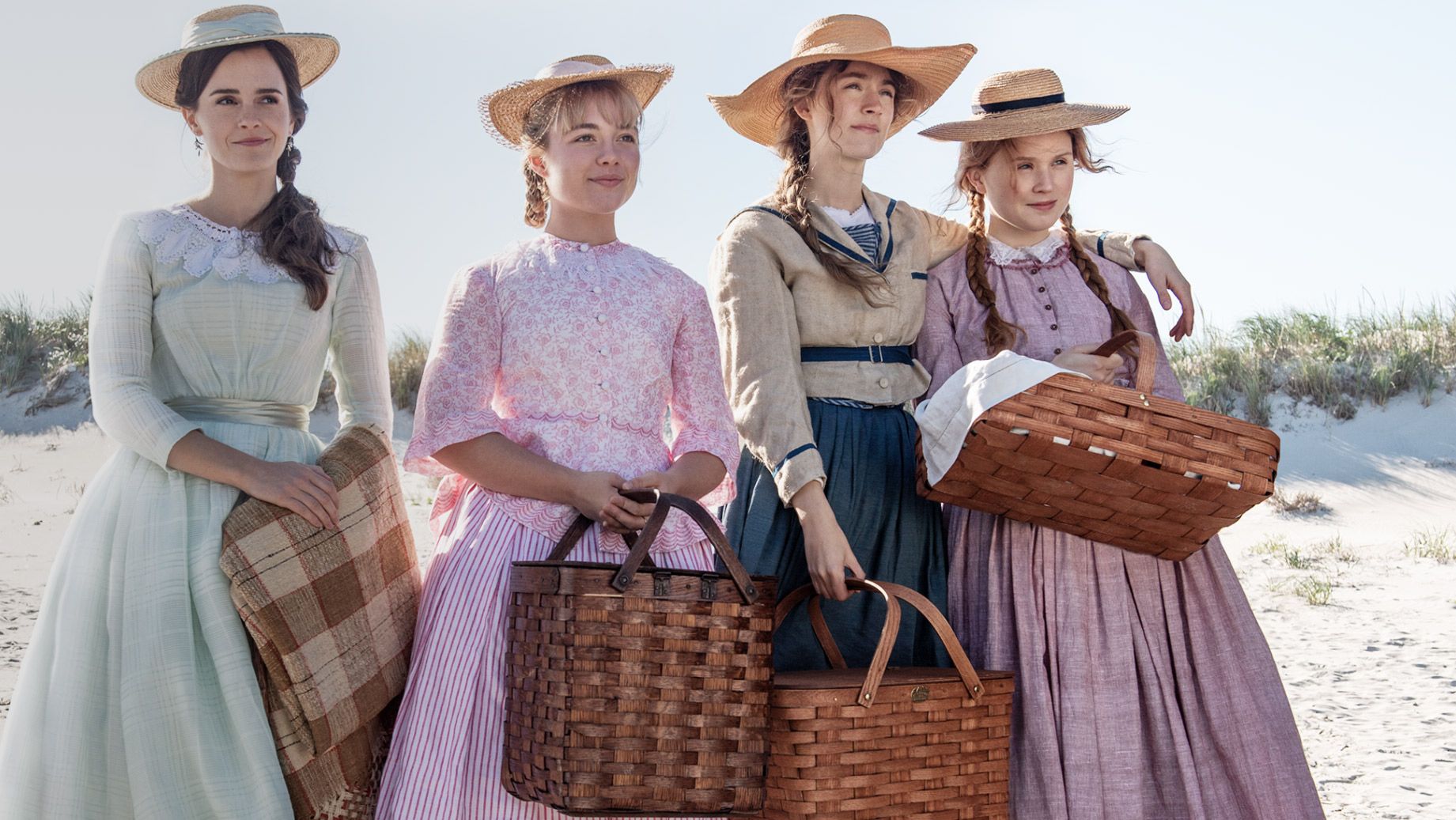
You need to know where I’m coming from on this one. There is no book more central to my life than Louisa May Alcott’s Little Women. My mother, Josephine Baskin Minow, has been Jo since she first read Little Women when she was a child, And now our children call her Marmee. I loved it so much that I read all the other Alcott books on the library shelf (I especially recommend Eight Cousins and An Old Fashioned Girl). Little Women has been central to the lives of young women for more than 150 years, inspired by its heroine, who was inspired by Alcott herself. Jo March is fiercely loyal, impetuous, impatient, and a writer, both eager and reluctant to find her own voice. Authors who name the book as a major influence range from Cynthia Ozick, Simone de Beauvoir, Doris Lessing, Margaret Atwood, Jane Smiley, Anne Tyler, Jhumpa Lahiri, Ursula Le Guin and Nora Ephron to “Twilight”‘s Stephenie Meyer.

Alcott’s semi-autobiographical story of four sisters has been adapted many times, including a Broadway musical, a 48-chapter Japanese anime series, an opera, and films starring Katharine Hepburn, Elizabeth Taylor, and Winona Ryder. The most recent BBC version (of four) was shown in the United States on PBS. One of two major adaptations last year was a modern-day retelling with a quartet of appealing young actresses, adapted with skill and understanding by writer/director Clare Niederpruem.

So, my standards and expectations could not have been higher and it is my very great pleasure to tell you that this new film from writer/director Greta Gerwig exceeded them all. Writer/director Greta Gerwig not only loves and understands the book, she also appreciates that in 2019 we are only beginning to catch up to Alcott’s vision of what is possible for young women and for all of us. Those who do not know Alcott’s work or have only seen the early versions may think that Gerwig has “modernized” the story. But every part of it comes from Alcott (some from other writings) and every part of it is entirely consistent with her fierce, independent, and devoted spirit and rebellious energy. And Saoirse Ronan is the best Jo March yet, her long-limbed coltishness not so much “boyish” as vitally engaged in a world that cannot always keep up with her.

The book was originally written in two parts, but the second volume (called Good Wives) has been a part of what we know as Little Women for more than a century. Gerwig begins the story in the middle of the second book as the now-adult Jo (a teenager in the first volume) meets with a newspaper publisher (a charmingly crusty and wry performance from playwright Tracy Letts, last seen as Henry Ford II in “Ford v. Ferrari”). In case we are not as quick as he is to see through her claim to be bringing stories written by a “friend,” Gerwig lets us see the ink that still stains her fingers. When her story is accepted (with the moralizing parts cut out), she exuberantly races home.

Then, as we will throughout the film, we go back and forth between the two parts of the story, indicated by different color pallattes, the warmer hues for the earlier years, when the girls were all at home and their father (Bob Odenkirk) was a Union volunteer in the Civil War. There were struggles and growing pains, but there was also a sense of purpose and possibility that is not as clear in the cooler-hued older years, when Jo is in New York living in a boarding house, and Amy (Florence Pugh) is touring Europe and studying art. Pugh may be too old for Amy in the early scenes, but she and Gerwig give Amy far more depth than any previous portrayal (perhaps including Alcott’s). Emma Watson is lovely as oldest sister Meg (obligatory complaint about what was left out of this version — the scenes of Meg coming to John’s defense when Aunt March attacks him and the scene of her showing off her “new dress” to him). Gerwig’s script softens the professor’s critique of Jo’s more lurid stories-for-hire and his involvement in getting the book-within-a-book published, but the scene of his telling her that the melodramatic stories she is writing for money are not good is still an important turning point.

Laura Dern plays Marmee, a woman of character, courage, and intention. The private moment she takes in the foyer of the house to make sure she can greet her daughters with good cheer on Christmas morning after caring for the impoverished Hummels is a small master class of acting. When Marmee tells Jo that she still struggles with anger every day, we see where Jo got her inner fire and how inner fire can become the foundation for determination and principle.

And then there is Timothée Chalamet as Laurie, the sensitive boy whose temperament is protected from becoming headstrong and careless by the example of the March family, their attitude toward work and also their attitude toward fun. Like Laurie to Jo, Chalamet is a perfect match for his “Lady Bird” co-star Ronan, and we could happily watch a whole movie of them putting on plays, attending riotous meetings of the Pickwick Society, and skating on the pond.

It is still one of the all-time great coming-of-age stories of a family and an artist finding her voice. By putting making the early year portion of the film flashbacks that comment on, provide context for, and deepen the “present-day” storylines, Gerwig makes us ready for a perfect ending that brings Alcott, her fictional avatar, and the story of all of us who have tried to tell our stories together.

Parents should know that this film includes a sad death and reference to other deaths including the death of a baby, family stress and conflict, and brief smoking and drinking.

Family discussion: Which sister is most like you? Was the publisher right about the ending to the story? Why do so many women, especially writers, say that this story was their most important inspiration?

If you like this, try: the book by Louisa May Alcott and the other movie and miniseries versions of this story

Related Tags:


Based on a book Classic Coming of age Drama DVD/Blu-Ray Epic/Historical Family Issues For the Whole Family movie review Movies -- format Remake
Richard Jewell

Richard Jewell

Posted on December 12, 2019 at 5:42 pm

B-
Lowest Recommended Age: High School
MPAA Rating: Rated R for language including some sexual references, and brief bloody images
Profanity: Very strong language
Alcohol/ Drugs: Alcohol
Violence/ Scariness: Bombing, explosions, characters injured and killed, brief disturbing images
Diversity Issues: Portrayal of female professional using sex to manipulate men
Date Released to Theaters: December 14, 2019
Date Released to DVD: March 16, 2020
Copyright Warner Brothers 2019

Erik Erikson said that at each stage of life we have a choice between growth, learning, and compassion and fear, immaturity, and self-absorption. The final choice he posed was for old age, when people have to choose between ego integrity (satisfaction and completeness at the end of life, a sense of having made a difference) or despair (being lost, lacking a sense of purpose). (I highly recommend “Everybody Rides the Carousel,” an animated film from John and Faith Hubley, illustrating Erikson’s theories.) Two big end-of-the-year releases by two men, one in his 70’s, the other almost 90, seem to come down on different sides.

Martin Scorsese’s “The Irishman” is a movie by old men about what it is to be old, to be looking back on the choices you’ve made and the consequences they have had. The characters in the film, based on real people and their sometimes questionable stories, committed brutal crimes. The movie never excuses their behavior, but it portrays them in a complex, humane, elegiac manner.

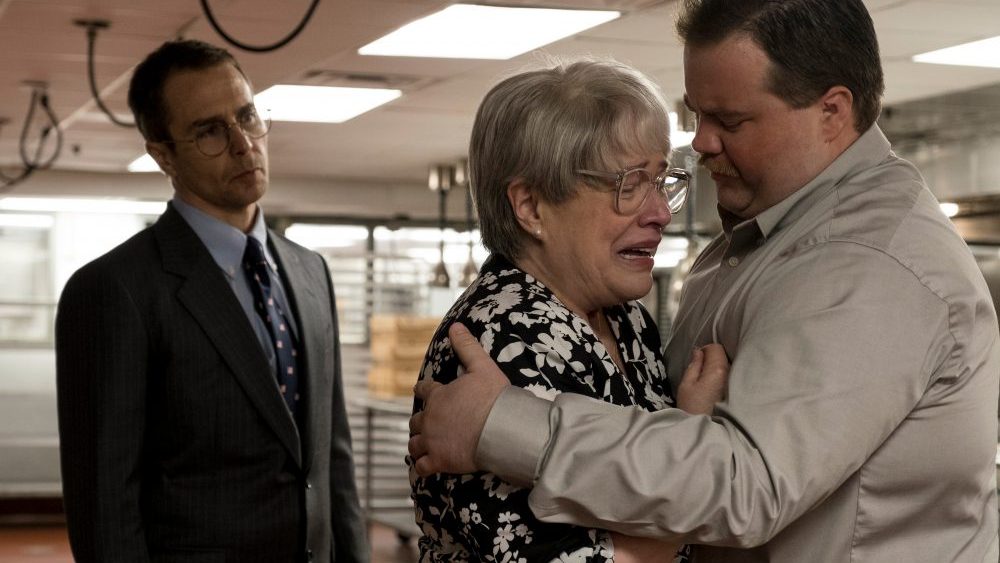
89-year-old Clint Eastwood has made “Richard Jewell,” also based on a true story, this one about a man who was accused of a crime he did not commit. Richard Jewell (Paul Walter Hauser) was pudgy and his social skills were uneven. He was fascinated with order and authority and wanted very much to be a police officer. He lived with his mother and he had a lot of guns (“This is Georgia,” he shrugs.) He fit the profile and was an easy target in a city desperate to keep the international athletes, IOC officials, and media confident that everything was under control.

One of three films this month about real-life heroic lawyers who fought near-insurmountable odds to bring justice (the other two are “Dark Waters” and “Just Mercy”), this could have been a heartwarming story, but Eastwood’s cranky “get off my lawn” perspective cannot resist overdoing it as though he was talking to an empty chair. Instead of a movie about a guy who was the victim of the FBI under pressure to find a culprit and the media frantic to find a story. Eastwood is so sure we will not be able to figure out who the bad guys are that he all but has them wear signs.

It isn’t just this FBI agent who is wrong; it’s the government. And it isn’t this reporter or this newspaper that is wrong; it’s the media. It is not enough that the reporter’s first reaction on hearing that there has been a bombing is to hope that the bomber is story-worthy. Eastwood has to make her trade sex for information. (She is dead now, but her newspaper has demanded that the movie make clear it is not an accurate representation.) Our hero, meaning the lawyer, played by the always-great Sam Rockwell, has a bumper sticker in his office that says, “I fear government more than I fear terrorism.” JUST IN CASE WE DON’T GET THE POINT.

It’s a shame because the story has an even more important lesson in this era of social media, citizen “journalists” and milkshake ducks. But the shrill tone of the film gets in the way, especially in its portrayal of the reporter as not just irresponsible about the facts but willing to trade sex for a story. Pro tip: if you are going to make a movie about how terrible it is that the media exaggerates and lies, try not to do that in the movie itself.

Parents should know that this movie includes very strong language and a bombing with some brief disturbing images. Characters drink alcohol and a woman use sex to get information.

Family discussion: Why was Richard Jewell a suspect? Why did Watson believe him?

If you like this, try: “Sully” and “American Sniper” from the same director

Related Tags:


Based on a true story Drama DVD/Blu-Ray movie review Movies -- format
Bombshell

Bombshell

Posted on December 12, 2019 at 5:38 pm

B +
Lowest Recommended Age: Mature High Schooler
MPAA Rating: Rated R for sexual material and language throughout
Profanity: Very strong and crude language
Alcohol/ Drugs: None
Violence/ Scariness: Sexual pressure and harassment
Diversity Issues: A theme of the movie
Date Released to Theaters: December 13, 2019
Date Released to DVD: March 9, 2020

Copyright 2019 Lionsgate
The word “bombshell” works both ways as the title of this film based on the true story of the #metoo moment that rocked the powerful leadership of Fox News and brought down its visionary founder Roger Ailes. “Bombshell” means a very attractive woman (check out the Jean Harlow movie of the same name, about a gorgeous movie star, and the documentary of the same name, about Hedy Lamar). And “bombshell” also means a shocking piece of news. Both are equally apt.

Those who watched “The Loudest Voice in the Room” on Showtime know that Ailes transformed the news media by creating a network that had two important innovations: gorgeous women in revealing clothes delivering news stories slanted toward white people who think their victimhood has been overlooked. As an executive puts it in this film, “You have to adopt the mentality of an Irish street cop. The world is a bad place. People are lazy morons. Minorities are criminals. Sex is sick, but interesting. Ask yourself, ‘What would scare my grandmother, or p— off my grandfather?’ And that’s a Fox story.”

The story is almost operatic in scope and drama and director Jay Roach and screenwriter Charles Randolph (“The Big Short”) hit the tone just right, the heightened urgency of the newsroom, the millions of small and devastatingly large compromises at the top of the media food chain.

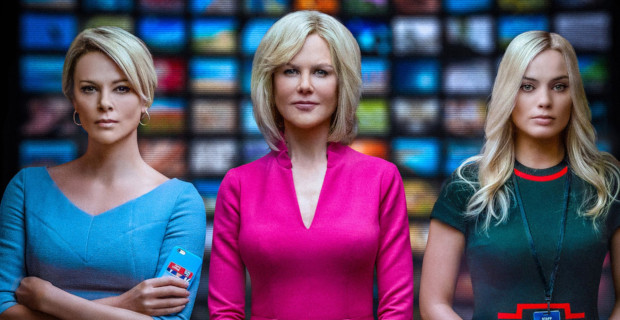
The performances are sizzling. Gretchen Carlson (Nicole Kidman) is a fading star at FOX, relegated to off-peak programs. (I could not help thinking of this performance as a bookend with Kidman’s “To Die For,” with Kidman as a woman who was willing to do anything, including sexual favors and murder, to get a job on TV news.) Megyn Kelly (Charlize Theron) is a rising star, and as this movie begins, she is horrified to find herself in the middle of a story as then-candidate Donald Trump makes ugly and crude accusations because she surprised him by asking him to comment on some of his insults to women (“You’ve called women you don’t like fat pigs, dogs, slobs and disgusting animals”) in an on-air interview. Margot Robbie plays Kayla, a fictional character based on the ambitious lower-level staff and what those who asked Ailes for on-camera opportunities were expected to do to show their “loyalty.”

Some early critics of the film object to the women being portrayed as feminist heroines. But they are not portrayed as feminist heroines; on the contrary. They’re not fighting courageously for justice like Norma Rae or Erin Brockovich. They are carefully calibrating how much abuse, how many humiliations, how much indignity they are willing to trade for the professional opportunities they want, even when it means ignoring abuse of other women. Answer: a lot. Ultimately, there is a limit, though, and watching each character locate that line is what makes this movie smart and engrossing. For Carlson, it is being fired. For Kayla, it is a painful realization after the fact, and after someone else has taken the almost unthinkably daunting step of going first. And the stakes are clear. “Once you go public, no one will hire you,” Carlson is told. Her post-lawsuit career has focused on sexual harassment issues either because she now recognizes the importance of the issue or because she cannot get any other job. The week of the film’s release she wrote an op-ed in The New York Times calling on Fox to withdraw the non-disclosure agreement she had to sign in order to settle her case. It’s unlikely, but if they do, maybe we’ll get another movie out of it.

The focus here is on Kelly. It is one thing to burn your bridges after you have been fired and have nothing to lose, but it is entirely another for a woman near the top of her profession who says, “I’m not a feminist; I’m a lawyer,” who does not want to be the story, who is in cutthroat competition with the other beautiful blondes and not one to raise a fist and proclaim that sisterhood is powerful. What will it take to get her to speak out and what price will she pay for saying something? Kelly is a complicated character and the way her dilemma is presented here is complicated and nuanced, more directed toward nods of recognition than standing ovations. Her career has been rocky (except for financially) since her decision to acknowledge the abuse, which makes this a cautionary tale that does not make the prospect of feminist heroine-ing look very appealing.

What is even more fascinating here is the setting. Is Fox a news organization as it has traditionally been understood? We get glimpses of other Fox personalities, including Bill O’Reilly, who left Fox following his own #metoo abuses. The way the organization responds to Carlson’s claims — handing out “Team Roger” t-shirts before any investigation even though it is generally known why there’s a lock on his door and a separate entrance to his office — says something about whether “loyalty” is more important than the truth, to them and to us.

Parents should know that this film is based on the real life #metoo upheavals at FOX News, with explicit discussions and some depiction of sexual harassment, abuse, and predation, and very strong language.

Family discussion: Why did the three women respond differently? How has coming forward affected their careers? What is the best way to prevent abuse by people in power?

If you like this, try: “The Loudest Voice” miniseries and “The Hunting Ground”

Related Tags:


Based on a true story Drama DVD/Blu-Ray Gender and Diversity Journalism movie review Movies -- Reviews
The Aeronauts

The Aeronauts

Posted on December 5, 2019 at 5:30 pm

B +
Lowest Recommended Age: Middle School
MPAA Rating: Rated PG-13 for some peril and thematic elements
Profanity: Some mild language
Alcohol/ Drugs: None
Violence/ Scariness: Extended peril, character sacrifices himself to save another
Diversity Issues: A theme of the movie (though the real-life character played by Felicity Jones was male)
Date Released to Theaters: December 6, 2019
Copyright 2019 Amazon Studios

Science fiction giant Arthur C. Clarke said, “Any sufficiently advanced technology is indistinguishable from magic.” “The Aeronauts,” based on the true story of early adventurers in meteorology and flight, exists at exactly that point in the middle. The “Theory of Everything” stars Felicity Jones and Eddie Redmayne play balloon pilot Amelia Wren and scientist James Glaisher, and for most of the movie they are up in the sky, marveling at sights and atmospheric conditions no humans have ever experienced before — or trying to survive them.

When they are in the air, it is gorgeous, exciting, and great fun. The visuals are spectacular, and sound designer Andy Kennedy and his team get a special shout-out for the superb audio effects, the exquisite silence, the creaking of the balloon basket, the clinks of the instrumentation. The never-ending series of life-or-death challenges are staged with such urgent vitality we almost feel that we are in the basket with them.

For most of the scenes on the ground, including a number of flashbacks, well, the screenplay never quite slips the surly bonds of earth. It is much better when they are up in the sky, battling the elements.

Wren and her husband piloted balloons until he was killed on one of their flights. Glaisher was a scientist who insisted that weather could be predicted with the help of meteorological data, despite the scorn of the scientific community and lack of support from his father, who is struggling with dementia. Glaisher is finally able to get the money for the balloon and persuades Wren to be the pilot.

Wren is highly theatrical, and Jones is utterly captivating in an early scene as she plays to the crowd, as savvy about showmanship as she is about flying. It is a lot of fun to see the actress who has often been given more subdued or internal characters do everything  — even cartwheels — to charm the crowd. She may appear to be light-hearted and flamboyant, but it is all precisely orchestrated and calculated. She knows what it takes to get the balloon in the air is not just the equipment and fuel but the other fuel, money.

Redmayne’s character is more like the shy, bookish type we’ve seen him play before. But it is fun to see his growing appreciation for both Wren and the adventure.

Those of us who pull down the shade on our airplane windows so we can watch movies on our laptops should take a moment to look outside and imagine what it was like to be the first human beings who saw — and heard — the inside of a cloud. “The Aeronauts” is best at conveying the thrill of that discovery, or, rather, series of discoveries, and the courage and ingenuity that went into getting up there and getting back down as close to safely as possible. It should inspire the audience not just to look out at the clouds but to dream of their own adventures.

NOTE: Rolling Stone did a fact-check to compare the movie to the real story.

Parents should know that this movie includes extended peril with a lot of suspense and some disturbing images. A character sacrifices his life to save someone else.

Family discussion: Why did Amelia change her mind about taking James up in the balloon? Who is most like James and Amelia today?

If you like this, try: “The Theory of Everything” also starring Felicity Jones and Eddie Redmayne, “Those Magnificent Men in Their Flying Machines” and read the book that inspired the film, Falling Upwards: How We Took to the Air

Related Tags:


Action/Adventure Based on a true story Drama Epic/Historical movie review Movies -- format Movies -- Reviews
The Two Popes

The Two Popes

Posted on November 26, 2019 at 5:01 pm

B +
Lowest Recommended Age: Middle School
MPAA Rating: Rated PG-13 for thematic content and some disturbing violent images
Profanity: None
Alcohol/ Drugs: None
Violence/ Scariness: Images of violence, references to sexual abuse, illness
Diversity Issues: None
Date Released to Theaters: November 27, 2019
Copyright Netflix 2019

Sometimes history is made by groups of people in labs or courtrooms or legislative bodies or battlefields. Sometimes history is made by two people talking to each other quietly. We hear those stories less often. It may be that what makes those changes possible is keeping them secret.

We will never know what really happened when Pope Benedict (Anthony Hopkins) became the first supreme pontiff to resign since 1294, selecting the man who became Pope Francis (Jonathan Pryce) as his successor. Everything about it was surprising. Popes have almost always served until death, and the selection process, gorgeously visualized here, is ancient and mysterious. We see with the rows of scarlet-clad cardinals clicking their bright blue pens to cast their votes and the two smoke options, black to show no decision yet, white to show that the new pope has been chosen. The idea of a pope resigning (creating the new position of emeritus pope) and guiding the selection of his successor was unprecedented (well, we don’t know much about what happened in the 13th century, but it was so long ago that “unprecedented” seems appropriate) and so there was no template to follow.

And yet, as it cannot help but be, it is political. The cardinals are only human. During the 2005 selection process, While many votes went for Cardinal Jorge Mario Bergoglio, he was a long shot. There had never been a Jesuit pope, one from the Americas, one from the Southern Hemisphere. Almost all of the popes have been Italian and all have been from Europe since the Syrian Gregory III, who reigned in the 8th century. And so the one selected was a German cardinal named Joseph Aloisius Ratzinger.

More than geography and religious order separated the two men. Pope Benedict was conservative and traditional. Bergoglio is more liberal, more about Catholicism as a call to compassion and engagement with the community. He lived simply and wanted to return being a parish priest. After a few years, he wanted to retire. He wrote to Pope Benedict to ask for permission but before his letter was received, Pope Benedict wrote to ask him to visit. Bergoglio thinks it is to discuss his retirement. Pope Benedict has another career path in mind.

There are some flashbacks, particularly concerning their deepest regrets and most painful failings. But most of the movie is two of the greatest actors of our time playing two of the most formidable and consequential figures of our time, talking to each other about the most foundational issues of faith and philosophy. Sometimes they are indirect. Sometimes they clash in style and substance. But they always exemplify their commitment to their beliefs with grace and kindness. Pope Benedict plays the piano. Bergoglio orders pizza and Fanta. They develop an understanding and a kind of friendship. It is a pleasure and a privilege to be able to eavesdrop on this conversation, and inspiring, too.

Parents should know that this movie includes references to and brief depictions of historical atrocities and references to sexual abuse by priests.

Family discussion: What were the biggest differences in viewpoint between the two popes? What was more important to Pope Benedict than their differences in interpretation and commitment to tradition?

If you like this, try: the documentaries “Pope Francis: A Man of His Word” and “Hesburgh”

Related Tags:


Based on a true story Drama movie review Movies -- format Movies -- Reviews
THE MOVIE MOM® is a registered trademark of Nell Minow. Use of the mark without express consent from Nell Minow constitutes trademark infringement and unfair competition in violation of federal and state laws. All material © Nell Minow 1995-2026, all rights reserved, and no use or republication is permitted without explicit permission. This site hosts Nell Minow’s Movie Mom® archive, with material that originally appeared on Yahoo! Movies, Beliefnet, and other sources. Much of her new material can be found at Rogerebert.com, Huffington Post, and WheretoWatch. Her books include The Movie Mom’s Guide to Family Movies and 101 Must-See Movie Moments, and she can be heard each week on radio stations across the country.

Website Designed by Max LaZebnik