The Phenom

The Phenom

Posted on June 23, 2016 at 5:38 pm

Copyright 2016 Bron Capital Partners

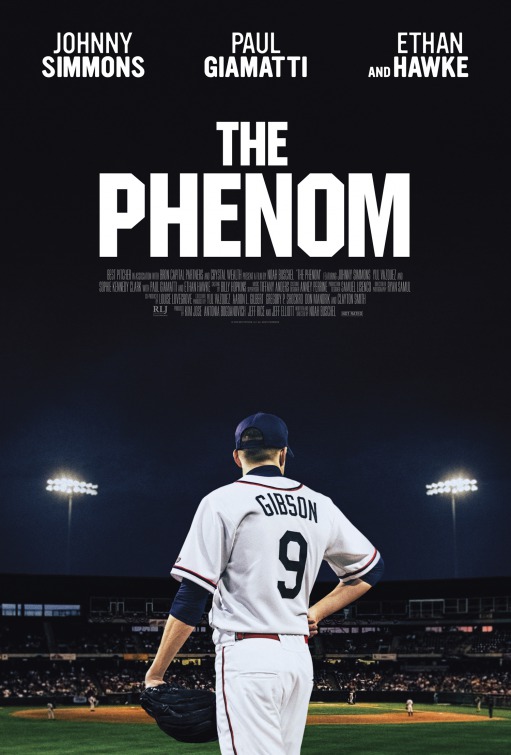
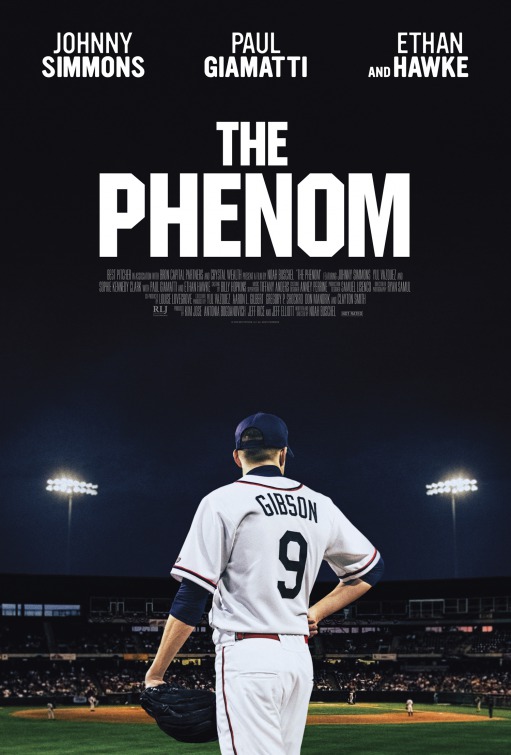
For writer/director Noah Buschel, “The Phenom” is clearly a labor of love. For the audience, it is a small gem filled with unexpected insight and performances of exceptional precision and intelligence. We may think we know what to expect from a film about a gifted athlete who explores the impact of his abusive father with the help of an understanding therapist. But each scene has surprises, with sharp dialogue, vivid characters, and a lot to say about the business of both sports and media. This is a sports movie that quotes F. Scott Fitzgerald. And there’s a brief but powerful scene as the athlete talks to the press that reminds us of how mch this film rewards careful attention.

Johnny Simmons plays Hopper, a “phenom” of a pitcher who has had trouble delivering in the major leagues. He’s sent to the team’s psychologist, a former phenom himself, who was featured on the cover of TIME Magazine at age 22 because of his pioneering work in helping athletes achieve focus and overcome fear. Dr. Mobley is played by Paul Giamatti, who has another connection to baseball — his father, Bart Giamatti served as the Commissioner of Major League Baseball.

Giamatti’s Dr. Mobley is understated, reassuring, and accessible. “A lot of young pitchers struggle with control,” he tells Hopper. It’s “a passing thing.” He does not even want to give it a name because that would “legitimize” it. He tells Hopper that it can be good to look back because damage from the past can be “vaseline on the lens” that interferes with our ability to understand the present and accomplish what we hope for.

Hopper’s whole life has been about getting to the major leagues. His father, Hopper senior (Ethan Hawke) is a volatile bully Hopper’s teacher describes as “an expert at cutting corners and when there weren’t any corners, he’d make circles around her.” He constantly berates his son, bragging that he taught him everything he knows, forcing him to run splits as punishment for smiling. “Never show emotion on the mound. And you’re always on the mound.” He tells Hopper to develop an “intimidation face.”

Hopper has dinner at his girlfriend’s house and is so disconnected from life off the field that he has no idea of how to respond in a home where people discuss ideas and events at the dinner table. Later, when he hurts the girl’s feelings and she speaks up, he tells her the only thing he knows: “You need to toughen up.”

Hopper clearly has to choose between two father figures — his biological father, whose approval he cannot help seeking, and Mobley, whose safe space could be something Hopper could learn to trust. Simmons finds a way to show us the feelings the repressed young pitcher still cannot acknowledge, and his scenes with both Giamatti and Hawke are all the stronger for being understated, never overly dramatic. Owing more to “Ordinary People” than to baseball classics like “Bang the Drum Slowly,” this is a touching drama made up of small moments told with truth and care.

Parents should know that this unrated film has some adult material including drugs and drug dealing, an abusive parent, and strong language.

Family discussion: Why didn’t Hopper know how to talk to Dorothy? Should Dr. Mobley have told him the truth? What was his best advice?

If you like this, try: “Ordinary People” and “Fear Strikes Out”

Related Tags:


Drama Family Issues Sports VOD and Streaming
Genius

Genius

Posted on June 9, 2016 at 5:23 pm

Copyright Lionsgate 2016

They are legends of 20th century American letters, so renowned a single name suffices: Fitzgerald, Hemingway, Rawlings, Lardner, Wolfe. But there is another name — Maxwell Perkins — who was essential to their work and often advisor and support system for their personal lives as well. A. Scott Berg’s brilliant 1978 biography of Perkins has inspired a film that focuses on the most important relationship of Perkins’ professional life — his work on the first two books by Thomas Wolfe.

Intriguingly, all of the major male roles are taken by British and Australian actors playing Americans, and unsurprisingly they are all superb, never missing an final r or an elongated vowel — or worse — showing off. Colin Firth plays Perkins, a mild-mannered man who loved his family but was most alive as a appreciator of literature — he knew it when he received it as a manuscript and he knew how to trim away the underbrush to make it better. His great skill was seeing the story the writer wanted to tell and doing whatever was necessary to get it into the hands of readers.

After Hemingway’s spare, masculine prose and Fitzgerald’s elegant sentences and impeccable structure, Perkins receives a submission from Wolfe that is vital, poetic, and a veritable avalanche of words. “Please tell me it’s double-spaced,” he says, looking at the pile of paper. “That’s a long paragraph,” Perkins daughter remarks, reading over his shoulder. “It started four pages ago,” her father replies.

Like Michelangelo seeing the statue inside the block of marble, Wolfe sees a novel that preserves Wolfe’s torrential style but prunes away the excess. He reassures Wolfe that he will only “shape it a bit, cut off the top branches.” Wolfe knows it needs pruning. “You don’t know how I struggled to cut the gorgon down.”

And Wolfe (Jude Law), who tells Perkins that not just his books but most of all literature is about the search for a father, responds to Perkins’ utter engagement in service to his story. The relationship between a writer and a great editor is one of the most intimate and fulfilling, something between a gifted psychoanalyst, an inspiring teacher, and a fairy godparent — or, just a parent. Perkins, the father of five daughters (charmingly portrayed), found a spiritual son in the troubled genius, and, as Berg’s book argues, was a genius himself in the way he was able to cull out of him timeless classics.

This sympathetic portrayal acknowledges the devastation that can be wrought by geniuses. We see Wolfe’s troubled relationship and careless dismissal of his supporter and mentor, the set designer Aline Bernstein (Nicole Kidman), who is anguished not because she left her husband and children for the much-younger Wolfe, but because once she was successful at getting him launched, he did not need her anymore. We the devastation that can be felt by them as well, as Fitzgerald (Guy Pearce) struggles to write and to care for his wife, Zelda, who is near-catatonic. But the hero of the story is the man waiting patiently backstage, ready to supply a discreet loan or a helpful suggestion: Don’t name the book Trimalchio in West Egg — how about The Great Gatsby? The quiet dignity and integrity of Firth’s performance is a tribute to all whose art is a life of service.

Parents should know that this film includes drinking and drunkenness, smoking, abusive behavior, some sexual references, mental illness, and a sad death.

Family discussion: What did Perkins see in Wolfe that the other publishers did not? Do you agree with Wolfe’s statement that literature is about the search for fathers? How was that reflected in his relationship with Perkins?

If you like this, try: the writing of Wolfe, Fitzgerald, and Hemingway and the biography of Maxwell Perkins by A. Scott Berg. You can also read the unedited manuscript originally submitted to Perkins to see if you think he was right.

Related Tags:


Based on a book Based on a true story Biography Drama
Money Monster

Money Monster

Posted on May 12, 2016 at 5:58 pm

Copyright Smokehouse Pictures 2016

Director Jodie Foster, in her most ambitious project so far, shows an impressive command of the language of film and a discerning eye for the gulf between the way we like to think of ourselves and the way we are in “Money Monster,” which begins promisingly but then pulls its punches with a disappointingly conventional last 40 minutes. It aims for “The Big Short” plus “Dog Day Afternoon,” but comes up just ahead of “Man on the Ledge.”


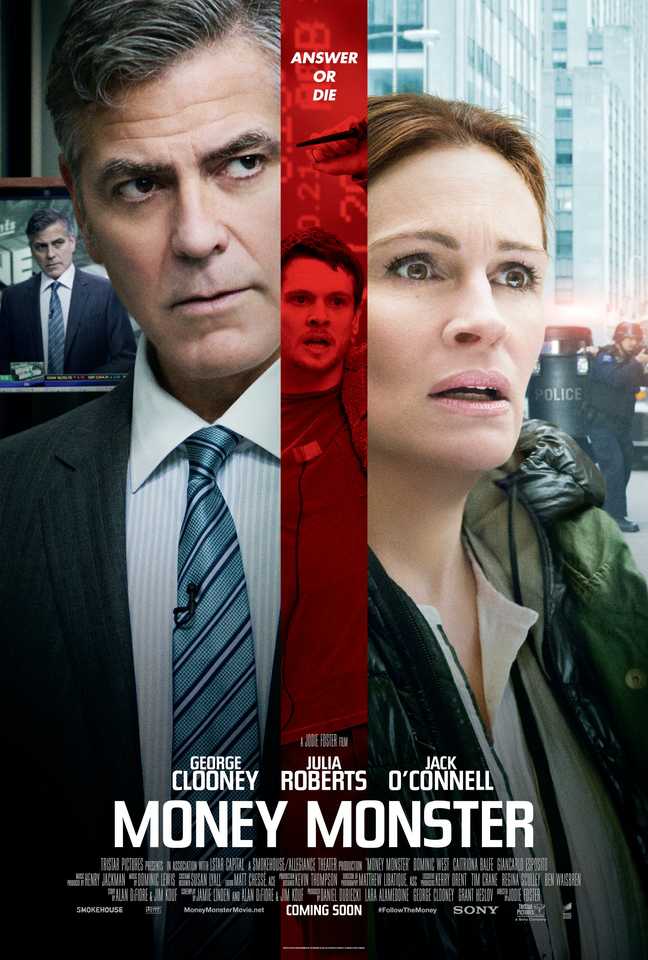
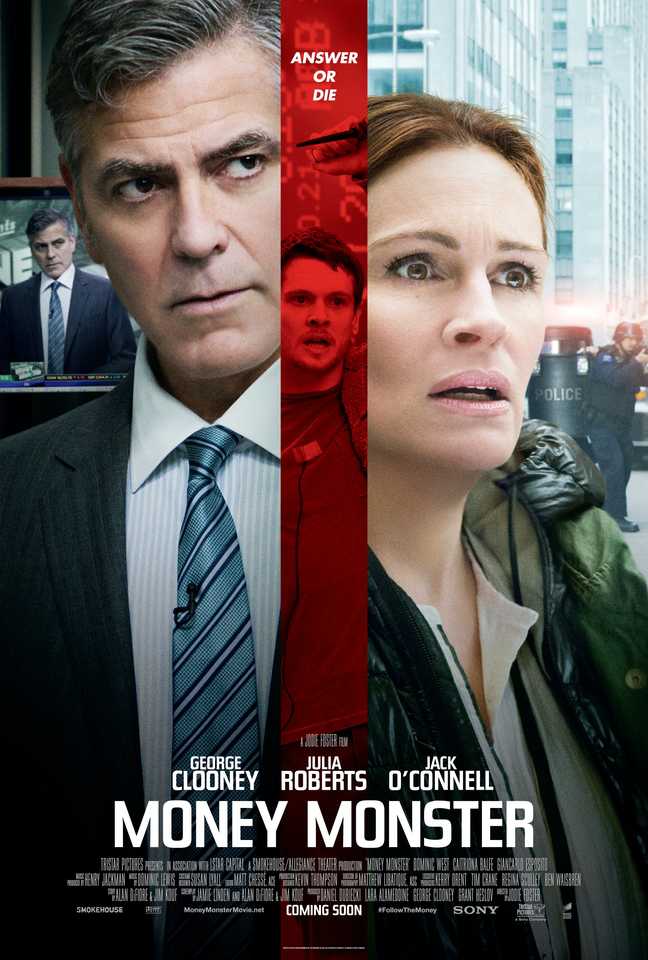
George Clooney plays Lee Gates, the host of a Jim Cramer-style television show about investing that is more dazzle than reporting. He dances with back-up girls, he amplifies his commentary with movie clips and outrageous stunts. Every episode has a stock buy recommendation “of the millennium,” and on this night he has to announce that one of his previous favorites, IBIS, has suffered a precipitous drop in the stock price due to a “glitch in its algorithm.” IBIS is one of those buzzword-y Wall Street darlings that no one really understands, but it has to do with a fully automated system for “high-frequency trading.”

Gates, a long-time enthusiast of the company, has invited the IBIS CEO (Dominic West as Walt Camby) to be a guest on the show, but the company’s director of communications, Diane Lester (Caitriona Balfe) is appearing instead, explaining that Camby is on an airplane and cannot be reached. Before her segment, though, a man named Kyle (Jack O’Connell of “Unbroken”) walks onto the set. He has a gun, and he takes Gates hostage, forcing him to wear a vest packed with explosives. He invested everything he had in IBIS, based on Gates’ glib assurances.

In the booth, speaking to Gates via earpiece, is his producer, Patty Fenn (Julia Roberts). As a producer, she is used to being the only grown-up in the room (and a little tired of having to be one). She quickly evaluates the situation and keeps things going moment to moment while she tries to figure out a way for the situation to end without anyone being hurt.

Foster skillfully takes us from the intensity of the hostage standoff on live television to show us what is going on with the police led by Captain Powell (Giancarlo Esposito), trying to find out more about the man with the gun and evaluating potential strategies for disarming him, and to the efforts to track down Camby both by Patty’s staff and by IBIS insiders. A couple of unexpected twists and some well-timed comic relief help hold our interest. And Clooney gives one of his most nuanced performances as a man who has spent a lot of time and burned a lot of bridges trying not to think too hard about the impact he has had on people. As both he and Patty use the skills that made them successful in the world of infotainment — and a few new skills, too — the natural chemistry between Clooney and Roberts and their combined star power keep the tension level high. But Kyle and Camby are under-written and the last 20 minutes are a disappointment with a resolution that is too easy and too Hollywood. We know who the monster is, here and we wish the movie knew it, too.

Parents should know that this film includes constant strong language, violence including gun, bomb, characters injured and killed, betrayal and illegal behavior, and sexual humor and situations, and drug use.

Family discussion: What makes Lee change his mind about Kyle? Would you take investing advice from Lee? What does it mean to say “we don’t do journalism?”

If you like this, try: “Dog Day Afternoon,” “John Q,” and “The Big Short”

Related Tags:


Drama Television
Last Days in the Desert

Last Days in the Desert

Posted on May 12, 2016 at 5:45 pm

B+
Lowest Recommended Age: Middle School
MPAA Rating: Rated PG-13 for some disturbing images and brief partial nudity
Profanity: None
Alcohol/ Drugs: Alcohol
Violence/ Scariness: Disturbing images, sad death of a parent
Diversity Issues: None
Date Released to Theaters: May 13, 2016

Copyright 2-16 Different Drummer
Copyright 2016 Different Drummer
The Gospels of Matthew, Mark, and Luke tell us that after he was baptized, Jesus entered the desert and spent 40 days fasting and praying. It was only when he left the desert that he was ready to take up his ministry. We do not know much of what went on, but two of the gospels say that during that time he was tempted by the devil.

Writer/director Rodrigo Garcia (“Nine Lives,” “Mother and Child”) wanted to explore that moment when the divine and the human sides of Jesus were both tested. With three-time Oscar-winning cinematographer Emmanuel Lubezki (“Gravity,” “The Revenant”) giving a burnished glow to the bleak and beautiful California desert, he tells the story of the last few days in the desert, as Jesus struggles with his destiny and spends time with a family with its own problems.

Ewan McGregor plays both Jesus (called Jeshua) and the devil. If God has made us in his image, then why wouldn’t the devil try to tempt us by having us see ourselves in him? But the real interaction here is with a family, a father (Irish actor Ciarán Hinds), a mother who is dying (Israeli actress Ayelet Zurer), and a son (Tye Sheridan) who live in an isolated hut. Like fathers throughout the millennia, this one thinks he knows what is best for his son, and it is doing what he has done. He is losing his wife and cannot bear to think of his son moving away. But like sons throughout the millennia, this one disagrees with his father. He wants to try life in the city. They cannot even talk to each other about it.

Don’t worry that this is going to be Jesus arriving like Dr. Phil or even Oprah to straighten everyone out. One of the wisest choices of the film is that Jesus, who will soon be performing miracles and instructing his followers is here in this place to listen and try to understand. There is no question of curing the mother or sitting the father and son down to try to negotiate or even get them to acknowledge the legitimacy and good intentions of each other’s positions. Jesus seems to understand that this is as close as he will ever get to what it is like to be in a family and he is there to listen, to observe, and to learn.

The quiet beauty of the film adds a meditative power, and McGregor’s performance reminds us how essential the human qualities of Jesus’ experience were in making possible the miracles that followed his time in the desert.

Parents should know that this film includes brief nudity and a sexual situation, sad death of a parent, some disturbing images, and spiritual struggles.

Family discussion: What did Jesus learn from the disagreement between the father and son? Why were Jesus and the devil played by the same actor?

If you like this, try: “The Gospel of John” and “Risen”

Related Tags:


Drama Epic/Historical Movies -- format Spiritual films

A Bigger Splash

Posted on May 12, 2016 at 5:23 pm

B+
Lowest Recommended Age: Adult
MPAA Rating: Rated R for graphic nudity, some strong sexual content, language and brief drug use
Profanity: Very strong and crude language
Alcohol/ Drugs: Drinking, smoking, drugs
Violence/ Scariness: Violence including homicide
Diversity Issues: Background of race and class issues
Date Released to Theaters: May 13, 2016

Where there is Eden, there is usually a serpent. In this case, it is literal and metaphoric, as Paul (Matthias Schoenaerts) and Marianne (Tilda Swinton) are blissfully happy in a lovely home with a pool on an exquisite island near Sicily. Occasionally they are confronted by local wildlife, including a couple of snakes. But mostly they lie naked outdoors, make love in the pool, and go swimming, slathering mud all over each other then sleeping as it dries. Both are recovering, which means both are vulnerable. Marianne is a rock star — in a flashback we see her on stage at an enormous arena with the crowd shrieking her name. She has had an operation on her vocal chords and must not speak at the risk of losing her voice entirely. Paul is a photographer and documentarian who has been to rehab for substance abuse and a suicide attempt. They are gentle and loving with each other.

And then the cell phone rings. It is Harry (Ralph Fiennes), Marianne’s former producer and lover, and he says he is landing on the island in five minutes and needs to be picked up. He arrives with a very young woman named Pen (Dakota Johnson) and it is clear that they are there to break things — to break the silence, to break hearts, to break the fragile peace Marianne and Paul have found when they left home to get away from people like Harry. “We’re hiding out,” Paul tells him. “Not from me!” Harry replies.

Harry is loud, carelessly arrogant, and needy. Some people are obnoxious because they do not know better; Harry knows and relishes it. He is the kind of guy to take up with a girl Pen’s age, but it turns out she is his recently discovered American daughter. Partly because he did not know he was her father until she was grown and partly because he lives in the space between outre and obscene. He literally pees on a grave. “Everyone’s obscene,” he says, “that’s the whole point.” He does not believe in limits, with one possible exception he claims to put on himself. After a lot of hinting from Harry, Marianne invites him and Pen to stay in the house they are renting.

“A Bigger Splash,” takes its title from a David Hockney swimming pool painting, is a remake of the 1969 Alain Delon film “La Piscine” (“Swimming Pool”). The characters experience need, fear, love, loss, and deception. They reflect the power and corruption of celebrity while around them we see glimpses of desperate refugees held in pens. Beautifully composed images show dreamlike settings, but there are intrusions within the pristine purity of the house: the shadow of an airplane about to land, a reptile on the table, some gauche visitors invited by Harry. “You’re not speaking, sweetheart,” he says to Marianne. “So I had to make other plans.” Small details are superbly chosen — a dress awkwardly worn in one scene turns up again later where it is more suitable, Harry’s story about producing a Rolling Stones song (with a fabulous dance), both Harry and Paul placing pills on Marianne’s tongue, a glint of gold and silver on her eyelids. It’s a mood piece, brilliantly performed, resonating like a bell that was rung days before.

Parents should know that this film includes very explicit nudity, sexual references and explicit situations, drinking, smoking, drugs, violence including homicide, and very strong language.

Family discussion: Why did Marianne invite Harry to say with her? Why did Pen lie?

If you like this, try: “Swimming Pool” and “Laurel Canyon”

Related Tags:


Drama Movies -- format Remake
THE MOVIE MOM® is a registered trademark of Nell Minow. Use of the mark without express consent from Nell Minow constitutes trademark infringement and unfair competition in violation of federal and state laws. All material © Nell Minow 1995-2026, all rights reserved, and no use or republication is permitted without explicit permission. This site hosts Nell Minow’s Movie Mom® archive, with material that originally appeared on Yahoo! Movies, Beliefnet, and other sources. Much of her new material can be found at Rogerebert.com, Huffington Post, and WheretoWatch. Her books include The Movie Mom’s Guide to Family Movies and 101 Must-See Movie Moments, and she can be heard each week on radio stations across the country.

Website Designed by Max LaZebnik