Unbroken

Posted on December 24, 2014 at 5:49 pm

A-
Lowest Recommended Age: Mature High Schooler
MPAA Rating: Rated PG-13 for war violence including intense sequences of brutality, and for brief language
Profanity: Some strong and offensive/abusive language
Alcohol/ Drugs: None
Violence/ Scariness: Intense wartime peril and violence, characters injured, abused, and killed, some disturbing images, parent strikes a child with a belt
Diversity Issues: A theme of the movie
Date Released to Theaters: December 25, 2014
Date Released to DVD: March 23, 2015
Amazon.com ASIN: B00HLTDC9O
Copyright 2014 Universal Pictures

Oscar-winning actress Angelina Jolie breaks into the top ranks of American directors with “Unbroken,” showing an exceptional understanding not just of actors, but of tone, scale, and letting the camera tell the story. Working with the magnificent cinematography of Roger Deakins (“True Grit,” “Skyfall”), she adopts a classical style well-suited to the WWII setting, but every choice is careful, thoughtful, and powerful.

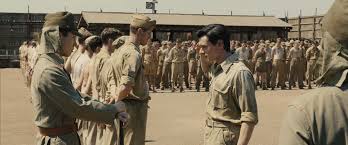
Based on the best-seller by Laura Hillenbrand, this is the story of Louis Zamperini, the son of Italian immigrants. He was a rebellious kid who became an Olympic athlete. His bomber plane crashed over the Pacific, and he survived for 47 days at sea, before being captured with one surviving crewmate, by the Japanese. In the prison camp, he was singled out for horrific abuse and repeatedly beaten.

The screenplay by the famously off-beat Joel and Ethan Coen is straightforward, direct, and sincere, keeping the focus on the war years, with the incidents from Zamperini’s past brought it primarily to show us how he relies on his memories to keep going. “Nobody’s chasing me,” he tells his brother who is urging him to run faster as he trains for a race. “I’m chasing you,” his brother tells him.

That internalized sense of mission helps him hold onto the idea of his own power as the brutal Japanese captors try to take everything away from him.

The opening scene puts us in the sky, and Jolie superbly evokes the thrill and the terror of flying on a bombing mission in aircraft that seem barely past the era of the Wright brothers. The crash scene is vertiginously disorienting. Jack O’Connell plays Zamperini with an effortless masculinity, understanding that it has nothing to do with macho posturing, just an imperishable sense of integrity, courage, and honor. O’Connell, Finn Witrock (“Noah”), and Domhnall Gleeson (“About Time”) perfectly capture the rhythms of an experienced crew, some amiable wisecracks and bravado to recognize the perilousness of their situation, but always focused, on task, and always, always, putting the team first.

We become so attached that it is sharply painful to see the characters experience such deprivation and abusive treatment. Japanese pop star Miyavi (real name Takamasa Ishihara) plays the sadistic Mutsushiro Watanabe, known as Bird. He knows of Zamperini’s celebrity as an athlete and sees that he is a symbol to the other prisoners.

If the Bird can break Zamperini, it will crush the morale of the whole camp. So, he singles Zamperini out for beatings and mind games. But Zamperini knows that “we beat them by making it to the end of the war alive.” He simply will not give up, and defining his own sense of what it means to win allows him to maintain a sense of control that is his most powerful weapon.

It is gorgeously filmed, superbly acted, and directed with great sensitivity and compassion, but the real impact of the film comes at the end, when we learn through a few simple titles, what happened to Zamperini after the war. Even Jolie recognizes that there is nothing she can put on screen to match the real-life footage of Zamperini, back in Japan at four days before his 81st birthday, running with the Olympic torch.

Parents should know that this movie includes very intense and disturbing wartime peril and violence, with a plane crash, an extended period lost at sea, and grueling prison camp abuse, and some strong language including racist epithets. School-age bullies harass and punch a character and a parent beats a child with a belt.

Family Discussion: What was the toughest challenge for Louis? Why didn’t he give up? Why did he forgive his captors?

If you like this, try: the book, Unbroken: A World War II Story of Survival, Resilience, and Redemption, and Zamperini’s own book, Don’t Give Up, Don’t Give In: Lessons from an Extraordinary Life, along with the films Stalag 17 and The Great Escape, also based on real-life WWII stories of American prisoners of war.

Related Tags:


Action/Adventure Based on a book Based on a true story Drama DVD/Blu-Ray Pick of the Week Sports War

Big Eyes

Posted on December 24, 2014 at 5:14 pm

Copyright Weinstein Company 2014

In Woody Allen’s 1973 film “Sleeper,” set in a decadent future, Diane Keaton plays a superficial socialite who tries to think of the highest compliment she can give to an amateurish painting.  “Oh, it’s Keane! It’s pure Keane!” she exclaims.  Audiences of that time would recognize that reference to Walter Keane, responsible for the wildly if inexplicably popular “big eyes” paintings of sad-looking waifs.  When the concept of “kitsch” (cheap, popular, low-brow, and corny “art”) first came to the United States in the 1970’s, the Keane images were often used as an example.

Note that word “responsible.”  Walter Keane (Christoph Waltz) was “responsible” for the success of the paintings but he was not responsible for producing them.  It was revealed in a dramatic trial that while Walter Keane claimed credit as the sole artist behind the paintings (and prints and books), he had never put a brush to canvas.  Every one of the paintings was created by the only artist in the family, his wife, Margaret (Amy Adams).

Director Tim Burton, whose film about notoriously awful movie director Ed Wood is one of his best, has created another very good film about very bad art.  Like that film, “Big Eyes” is highly stylized, with heightened period detail exaggerated to reflect and comment on the art that it depicts.  At one point, in some distress, Margaret pushes a shopping cart through a grocery story, seeing the big eyes in the faces of everyone she looks at.

This film also draws on the 60’s era beginning stages of the women’s movement to anchor the story.  Margaret took her daughter and left her first husband at a time when most middle class women were expected to stay home and defer to their husbands.  She arrived in San Francisco at the dawn of the “consciousness raising” era, at the epicenter of movements advocating more focus on individual needs and personal fulfillment.  But Margaret still thought of herself as powerless in her relationship with Walter, in part because it was her nature and the way she was raised to defer and get along, partly because she was dependant on him.  She married him in a hurry because her ex-husband was threatening to sue her for custody at a time when single mothers who left their husbands and had to find jobs had very few rights.  “I’m a divorcee with a child,” she tells a friend.  “Walter is a blessing.”

It was also partly because she loved him, at first.

Margaret was pretty good at painting the pictures, but Walter was undeniably a world-class genius at selling them.  He was very good at marketing up: he sold to movie stars and appeared as a guest on the Tonight Show with Johnny Carson.  He got a commission for a mural at the World’s Fair.  And he was even better at marketing down. When he noticed that people who could not afford the paintings were taking home posters from the gallery, he realized that there was an opportunity there.  “Would you rather sell one $500 painting or a million crappy reproduced posters?”  Pretty soon there were Keane images for every budget, with the originals in an art gallery and the copies in stores, alongside kitchen utensils and t-shirts.

Margaret signed her work “Keane,” and Walter slipped easily into taking credit for it.  He told Margaret (correctly) that no one took women artists seriously and that (also correct) that he was willing to do the kind of glad-handing and public appearances that she is not.  So, she stays locked in her studio painting all the time, increasingly isolated, finally even from her own sense of who she is.

The eerie look in the big eyes of the children in the paintings begins to seem haunting. Margaret realizes that she has to leave another husband. And she has to tell the truth.

Tim Burton has a story with the grotesquerie built in, not just the outlandish images but the turbulence of the era. Waltz has the showier role and delivers as a man whose ebullience mutates into a grandiosity from which there was no return. Adams, as the woman whose passion for expression grows — finally — into the ability to speak for herself with her voice as well as her brush.

Parents should know that this film includes some disturbing themes including emotional abuse, broken marriages, fraud, some sexual references, and brief strong language.

Family Discussion:  Who was responsible for the success of the big eye paintings?  Why did Walter lie and why did Margaret let him?

If you like this, try:  “Ed Wood” from the same director

Related Tags:


Based on a true story Drama

Pride

Posted on December 22, 2014 at 6:00 am

A-
Lowest Recommended Age: High School
MPAA Rating: Rated R for language and brief sexual content
Profanity: Very strong language, some crude
Alcohol/ Drugs: Drinking, smoking
Violence/ Scariness: Some peril and violence, bullying and harassment
Diversity Issues: A theme of the movie
Date Released to Theaters: October 9, 2014
Date Released to DVD: December 22, 2014
Amazon.com ASIN: B00OY7YNKI

The ingredients for this film were so irresistible that it is a unexpected bonus to find that it is so much better than it needed to be.

It’s based on a true story of extraordinary kindness, generosity, and friendship and it stars a bunch of adorable English actors (Imelda Staunton, Bill Nighy) who could read the tax code out loud and make it cuddly and uplifting.  But it is also very smart, very touching, and very timely, and one of the best films of the year.

Copyright CBS Films 2014

Prime Minister Margaret Thatcher imposed a system of market-based economic changes that created massive upheavals, depicted in films like “Billy Elliot,” “Brassed Off,” and “The Full Monty.”  The miners were on strike from 1984-85 after the Thatcher government announced that it was shutting down many of the coal mines, and it was a bitter, angry time.

It was also the early stages of gay pride.  And one young activist, Mark Ashton (the enormously charismatic Ben Schnetzer) sees a connection between gay pride and the miners.  They have a common enemy.  He sets up something called Lesbians and Gays Support the Miners, and gets a couple of friends to join him in collecting money to help the miners on strike.

But most of the miners groups turn him down.  Only one responds, a group in Wales.  Their leader Dai (Paddy Considine) comes to London to pick up the money LGSM has raised, and his thanks is genuine and very moving.  “When you’re in a battle against an enemy so much bigger and stronger than you, to find out you had a friend you never knew existed, well, that’s the best feeling in the world.”

They invite the LGSM to visit, and the welcome ranges from warm to a bit stiff and uncomfortable, except for one woman who calls them perverts and tries to get them thrown out.  As one might predict, there are scenes of gay men dancing and cute country folk asking questions (“Is it true that all lesbians are vegetarian?  I heard that at the covered market!”).  And one of the local guys sheepishly asks one of the London gay men for a dance lesson to impress a girl.  There’s also a guy who’s not out to his family.  And, as time passes, the spectre of a far worse scourge than Thatcher will shift the focus of the gay pride movement to AIDS.

But for a brief moment, there was a connection that grew from a common threat to a unity of purpose to understanding and real friendship.  The final section is a reminder of how much difference we can make and how much that difference is needed.

Parents should know that this film has some mature themes and strong languages.  Characters drink and smoke and there is some peril and violence.

Family discussion: What did the gays and the miners have in common?  What groups seeking dignity and justice can you help?

If you like this, try: “The Full Monty,” “Brassed Off,” and “Billy Elliot.”

Related Tags:


Based on a true story Comedy Drama DVD/Blu-Ray Pick of the Week GLBTQ and Diversity Politics

The Hobbit: The Battle of the Five Armies

Posted on December 16, 2014 at 5:47 pm

Copyright Warner Brothers Studios 2014

Visually stunning, capably presented, and utterly unnecessary, this final in the six-movie Tolkien cycle is just for the fans.  I think even Tolkien himself would cry “no mas” at this point.  Remember how the third LoTR movie had about five or six endings because Jackson just could not bear to let go?  This whole movie is like that.

It’s not bad.  There’s just too much of it.

The second of the Hobbit movies remains my favorite because it had the most excitingly staged action scenes and the best characters.  And it left us with a heck of a cliffhanger as Smaug the dragon delivered on the promise of the title, leaving his lair to desolate the village of Lake-Town.  But that all gets resolved pretty quickly (and excitingly) and then, as this title makes clear, most of the rest of the time is not about the original quest to reclaim the Lonely Mountain or the sub-quest to obtain the powerful Arkenstone.  It is about a battle of just about everyone, with shifting loyalties and heartbreaking losses.  If you are not a hard-core Tolkienite at the Stephen Colbert level, here’s the one key guideline to keep in mind: the worse the teeth, the more evil the creature sporting them.  The elves, dwarves, and men may have their grievances with each other and may even go into battle against each other, but as any crossword puzzle fan knows, Orcs are the bad guys, ugly cusses with terrible gnashy teeth, and nothing unites rivals and enemies quicker than the arrival of a much worse enemy coming after all of them.

Martin Freeman (television’s “Sherlock” and “Fargo”) returns as Bilbo Baggins, the heart and the moral center of the story.  While my mind wandered at times to consider such questions as who does all that intricate hair-braiding that the characters sport?  It must be like a middle school slumber party around those campfires, with everyone in a circle doing the hair of the person in front of them.  Isn’t that total turnaround by Thorin Oakenshield a little unbelievable? And I can never figure out exactly the scope of the powers and jurisdiction of characters like Gandalf and Galadriel. Plus, the snively traitor guy gets much too much screen time.

But I never stopped admiring the gorgeously imagined visuals or the subtle complexity of Freeman’s performance. As we see on “Sherlock,” there is no one better at showing us a thoughtful and deeply honorable struggle over how to respond to terrifying and complex challenges. There may be epic battles, shifting loyalties, elaborate stunts, and a lot of gnashing of very scary-looking teeth, but it is the part of the title before the colon that is what matters.

Parents should know that this movie has extensive and graphic peril and war violence with many sad deaths and some disturbing images.

Family discussion: What was the most difficult decision made by Thranduil? By Bilbo?

If you like this try: The other Hobbit and Lord of the Rings films by Peter Jackson and the books by J.R.R. Tolkien

Related Tags:


3D Action/Adventure Based on a book Drama Epic/Historical Series/Sequel War

Exodus: Gods and Kings

Posted on December 11, 2014 at 9:51 pm

Copyright 2014 Twentieth Century Fox

The story of Exodus is central to three of the world’s most significant religions and one of the Bible’s most cinematic stories, with a flawed but charismatic hero and a stirring story of slaves seeking freedom.  It has already been filmed at least eight times, from Veggie Tales’ Moe & The Big Exit to Cecil B. DeMille’s epic The Ten Commandments, with Charlton Heston and Yul Brynner and Jeffrey Katzenberg’s animated The Prince of Egypt.  Now Ridley Scott, who showed his mastery of sword and sandal epics with Gladiator has taken on the story with an all-star (but mostly non Middle-Eastern) cast and the latest 3D technology to really deliver on the special effects.  Not so much on the theology part, though, or even the morality or meaning of it.  Scott is clearly more interested in chases and battles and plagues, and so busy with it that he leaves out some of the story’s most important incidents.  For example, instead of having to leave the palace because he killed an Egyptian who was beating a slave, Scott gives us a soapy story about Ramses’ jealousy.  And we know Ramses is decadent because every time we see him, he’s eating.

The action and special effects work well, though.  This is a two and a half hour movie that starts in the middle of the story and Scott keeps it moving.  We first see Moses (Christian Bale) and Ramses (Joel Edgerton) as Seti (John Turturro), the Pharaoh, is giving them each a sword.  At first, Ramses, Seti’s son, thinks he has been given the wrong one.  But Seti has given them each other’s swords on purpose, to remind them that they must care for each other as they are about to go into battle.  A seer has a prophesy: “In the battle, a leader will be saved and his savior will someday lead.”  This inflames Ramses’ insecurity, especially when it comes true.

After Seti’s death, Ramses puts Moses in prison and tries to have him killed.  Moses finds a home with a small community of shepherds and falls in love with Zipporah (María Valverde).  Their life there is very sweet for nine years until he sees a burning bush and receives a message from God.  Scott makes an imaginative choice here about portraying the Deity that I won’t give away, but I am still trying to decide how I feel about it.  God tells him what he already knew in his heart.  The Hebrews are his people and he cannot run away from his responsibility to help them find freedom.  So he goes back to Memphis.

Bale holds the screen well as Moses, but Turturro, Kingsley, and Sigourney Weaver as Ramses’ mother do not have enough to do to.  But there is a lot of time devoted to spectacle.  Well past the two-hour mark, there are still 40 years of wandering in the desert and the Ten Commandments (twice) to get through, and they are sped through very quickly.  The striking of the rock to get water, manna, the golden calf, and Moses not being permitted to enter the promised land are all skipped over.  Two significant ideas that are included are Moses’ disagreements with God (and God’s approval of it) and the journey from the first scene, where Ramses believes in omens and faith and Moses believes in reason, to the end of the film, where they switch places.

Moses tells Ramses he must free the slaves and Ramses says the same thing that people have said throughout history when there is no possible moral justification for their position.  He says that it is not economically feasible and will take a long time.  Moses, trained as a general, gets the Hebrews to attack the Egyptians’ supply chain, but God gets impatient and steps in with the plagues, which are very vivid and rather disturbing.  After the death of the Egyptian first-born children, including his own son, Ramses tells the Hebrews to go.  But then he and his army ride after them, until the miracle at the Red Sea, very impressively staged.  But, again, the focus is shifted from the story of the Exodus to much less interesting battle between two cousins raised as brothers.  

The visual scope here is impressive.  There just isn’t much soul.

Parents should know that this movie includes Biblical themes including slavery, plagues and other kinds of peril and abuse, extensive peril and violence, battles, many characters injured and killed including children, and disturbing scenes with dismemberment and dead bodies.

Family discussion: How did being raised as a prince affect the way Moses saw himself and his role? How was he affected by learning the story of his birth? Why does he object to the plagues?

If you like this, try: “The Ten Commandments” with Charlton Heston

Related Tags:


3D Action/Adventure Based on a book Documentary Drama Epic/Historical Remake Spiritual films
THE MOVIE MOM® is a registered trademark of Nell Minow. Use of the mark without express consent from Nell Minow constitutes trademark infringement and unfair competition in violation of federal and state laws. All material © Nell Minow 1995-2026, all rights reserved, and no use or republication is permitted without explicit permission. This site hosts Nell Minow’s Movie Mom® archive, with material that originally appeared on Yahoo! Movies, Beliefnet, and other sources. Much of her new material can be found at Rogerebert.com, Huffington Post, and WheretoWatch. Her books include The Movie Mom’s Guide to Family Movies and 101 Must-See Movie Moments, and she can be heard each week on radio stations across the country.

Website Designed by Max LaZebnik