Civil War Movies to Commemorate the 150th Anniversary of the Battle of Gettysburg
Posted on June 29, 2013 at 7:58 pm
This week is the 150th anniversary of the Battle of Gettysburg, still the greatest loss of life in American history, the turning point of the war, and the inspiration for one of the greatest speeches in history, Abraham Lincoln’s Gettysburg Address, three simple paragraphs that connected our future to the visions that fueled our past.
The struggles of that era continue to resonate through today’s debates about the essence of the American character. Many movies that focus on the Civil War, and of course Ken Burns’ acclaimed documentary series for PBS is a masterpiece. These are also especially worthwhile:
Gettysburg Michael Shaara’s award-winning book The Killer Angel is the basis for this two-part saga produced by Ted Turner and starring Jeff Daniels, Martin Sheen, and Richard Jordan.
The Blue and the Gray This 1982 miniseries starring Gregory Peck, Stacy Keach, Kathleen Beller, Lloyd Bridges, Geraldine Page and Colleen Dewhurst is based on the work of Pulitzer Prize-winning Bruce Catton.
The Red Badge of Courage Real-life WWII hero Audie Murphy stars in this story of a frightened young soldier, based on the classic book by Stephen Crane published in 1895. (Remade in 1974 with Richard Thomas)
The General Buster Keaton loves Annabelle and he loves his train engine, called The General. When both are captured by the Union,he must come to the rescue in a masterpiece of exciting action and comic genius.
Lincoln Daniel Day-Lewis won a much-deserved Oscar for his performance in this outstanding Steven Spielberg film about the last days of the life of the 16th President.
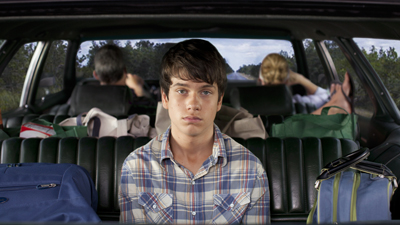
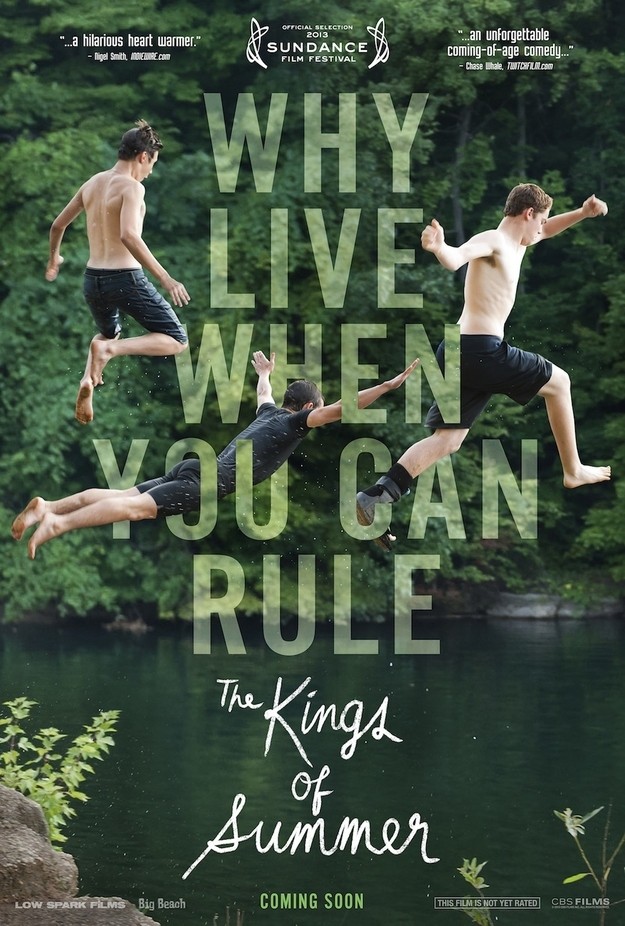
When Mark Twain had Huck Finn leave the kind-hearted widow who hoped to “civilize” him to “light out for the territories,” he tapped into the dream of all teenagers and the teenagers inside all of us to escape from all rules and restrictions and create our lives from scratch. Peter Pan and the Lost Boys had Neverland. Baby boomers sang along with Crosby, Stills, Nash and Young about “trying to get ourselves back to the garden.” Every generation wishes for the simplicity and purity of the natural world. In the wise, touching, and often wildly funny “The Kings of Summer,” three 15-year-olds follow their own call of the wild to run away from home and build a house in the woods. Their parents may see them as boys, but they want a place where they can define what it means to be men.
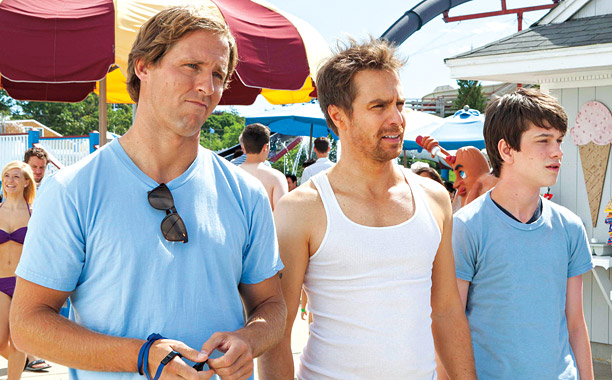
Nick Robinson, who perfected a look of exquisite pain at the humiliating behavior of his father in a brilliant series of Cox cable commercials, plays Joe Toy. He lives with his widowed father, Frank (“Parks and Recreation’s” Nick Offerman in a witty and heartfelt performance). Of course at that age, a parent does not have to do anything to be excruciatingly embarrassing. It is bad enough that Frank actually exists, but he also has the nerve to tell Joe what to do. Worse, he is dating someone, and worst of all he expects Joe to play a board game with her. The horror!
Joe’s best friend Patrick (Gabriel Basso), is smoldering with his own adolescent fury. His parents say things like, “Rope in the attitude, mister” and just because his ankle is in a cast, they want him to be careful. How dare they! “I’m happy to be where my parents are not,” he says.
Another kid named simply Biaggio (the wonderfully oddball Moises Arias) wants to join them. He does not have any special problem with his family. He just “didn’t want to do nothing.”
Joe, Patrick, and Biaggio build their house in the woods. They breathe the air of free men and rejoice in their liberation from all rules and conventions. They vow “to boil our own water, kill our own food, build our own shelter, be our own men.” If foraging for food in the woods means a stop by the Boston Market across the highway from the forest, well, no one can argue with how good it tastes.
Director Jordan Vogt-Roberts and writer Chris Galletta bring a fresh and sympathetic eye to the story, evoking the pleasure of what feel — for a little while — like endless possibilities. The film perfectly captures that liminal moment when teenagers live in the space between childhood and becoming an adult. And they’re old enough to carry it off, at first. They are young enough to be certain their parents are wrong about pretty much everything — and to be confident that they can do everything better. The house is like something the Lost Boys might build for Peter Pan, with a stolen door from a port-a-potty for the entrance and essentials like a mailbox, a slide, a basketball hoop, and an air hockey table.As is often the case with boys of 15, they look like they are from three different planets. Patrick is muscular and physically much more mature than the others and Biaggio could be 12. Joe is somewhere in the middle. Biaggio’s random and inscrutable pronouncements are amusingly accepted by the other two as if they made as much sense as anything else, or as if making sense did not matter. And of course the most unexpected complication is when a girl comes through the port-a-potty door.
Like that other icon of the dream of escaping the oppression of civilization, Henry David Thoreau, the boys learn that there is a time to go to the woods, and a time to come home.
Parents should know that this movie has very strong and crude language and teen drinking and smoking.
Family discussion: What was the most important thing Joe learned? What about Frank? What would you bring to a house in the woods?
Please, please don’t call this third entry in the story of Celine and Jesse the final chapter of a trilogy. The audience is almost as invested in them as we are in the stories of the “Up” movie documentary series that has visited a group of English people every seven years since they were children and now shows us how they are doing in their 50′. Those of us who follow the series know their stories almost as well as our own and look forward to the next installment as though it was a college reunion of our friends.
We almost feel that way about Jesse and Celine. They may be fictional characters, but they are so closely connected with the actors who play them and co-write the screenplays that are so intimate, so true to the nature of love in ways that movies seldom approach that it invites us into their most intimate moments, and our own. Most movies take shortcuts when the characters fall in love, giving us a quick, “You’re a fan of that esoteric musician/writer/sports figure no one heard of? So am I!” or just a montage with a pop song while the couple bicycles on the beach and marvels over the choices in an open market.
But the first in this series, “Before Sunrise,” was that rarest of films that show us that falling in love is when you start a conversation you never want to end. Jesse (Ethan Hawke), a college student on his last night in Europe before returning to America, impetuously invites a French student named Celine (Julie Delpy) to get off the train and spend the night with him, walking around Vienna. They talk about life, love, and everything and agree to meet in six months and part without exchanging contact information. This was 18 years ago, before texting, tweeting, Google, and Facebook. Writer-director Richard Linklater did not plan to tell another Jesse and Celeste story, though he did include a brief scene with the two of them talking in bed in his animated film, “Waking Life.”
That scene, as marvelous as it was, was non-canon (or, as comic books would say, “an imaginary story”). When we meet them again nine years after their original meeting in “Before Sunset,” they have not seen each other since they said goodbye in Vienna. Like “An Affair to Remember,” one of them was there six months later, and one had a good reason we will find out for not being there. Jesse, married and with a young son, is a writer whose recent novel was inspired by his night with Celine. When he goes to a book signing in Paris, she is there. Once again, he has to catch a plane back to America, and once again they walk through a European city and talk and talk and talk. This time, Hawke and Delpy were credited as co-writers. In the swooningly romantic last moment (spoiler alert), he misses the plane to stay with her.
And now, another nine years have gone by, and they walk around another spectacularly beautiful city, this time on their last night of a working vacation in Greece. Once again, there is a plane returning to America, but this time it is taking Jesse’s son back to his mother, Jesse’s now-ex-wife. It is a wrenching goodbye, in part because Jesse’s son, a young teenager, is so mature and understanding. “It’s like sending him back across enemy lines,” he tells Celine. “This is the one thing I promised myself I would never do.” And then Jesse gets some bad news from home, increasing his sense of isolation from his home.
Jesse and Celine are happily unmarried and the parents of twin girls. In the first movie, they had the excited rhythm of very young people discovering the pleasures of connection. In the second, they had the tentative rhythms of people who knew pain and loss and were struggling to trust again, exploring the possibility of re-connecting. Here, in a long drive from the airport, they talk with the rhythm of people who are deeply connected, laughing, sometimes pointedly, about petty irritations, skirting old wounds. They are comfortable with each other, but struggling to keep a sense of themselves as individuals and as people in love in the midst of domestic chaos. Jesse hates being away from his son, but cannot get custody so he can live with them in France or move back to the United States without disrupting Celine and their daughters.
They have a long, luscious lunch with friends who exemplify every stage of love and talk about meaning and memory and love and art and relationships and the notion of self and the differences between the sexes and the way each generation thinks it is inventing the world and watching it collapse. When they were young, they could not wait and wanted everything to speed up. Now, they want everything to slow down.
Then once again Jesse and Celine go for a long walk and talk, sparing, flirting, testing each other. Their friends have given them every parent’s greatest desire, a night away from the children. They find themselves in a surprisingly generic hotel room, begin to make love, and then enter into the kind of massive meltdown of an argument that only people who know each other very, very well can have. Early in the film, talking about her career, Celine says she is “tired of being a do-gooder that rolls the boulder up the hill” like Sisyphus. We get the feeling that the same applies to the stresses of keeping a relationship strong and intimate when you have to spend so much time scheduling and handing off.
They sit to watch a sunset. Celine says, “Still there, still there, still there….gone.” They know that ahead of them lies loss of all kinds. Will they face it together? There are movies where the sequels are so bad that they reduce your affection for the originals. With this series, each film deepens the meaning and sensibility of the story so that now, taken as one whole, the three (so far) have become one of the most romantic stories in the history of film. I’m counting the days until part four.
Parents should know that this film includes very strong and crude language, sexual references and situations, female nudity, and tense emotional confrontations.
Family discussion: How do the other people who join Jesse and Celine for lunch illuminate the stages of relationships? What do you think will happen to them in the next nine years?
If you like this, try: “Before Sunrise” and “Before Sunset,” the Canadian film “The Barbarian Invasions” and one of the best movies ever made about a relationship over many years, “Two for the Road” with Audrey Hepburn and Albert Finney
Rated PG-13 for language, some action, and sexual content
Profanity:
Some strong language
Alcohol/ Drugs:
Drinking
Violence/ Scariness:
Action-style violence, characters in peril, references to sad death
Diversity Issues:
Diverse characters
Date Released to Theaters:
May 31, 2013
Date Released to DVD:
September 2, 2013
Amazon.com ASIN:
B00DWZHTRW
The most purely entertaining movie of the year so far is “Now You See Me,” and like all great magic tricks, it makes us delighted to be fooled. We are warned from the very beginning that the closer we look, the less we will see, but even on the alert for the magician’s tools of misdirection and mirrors, it keeps us happily guessing until the very last second. We might suspect the why, but the who and the how are another story. One of the magicians tells us that stage magic is deception designed to entertain, delight, and inspire, and that’s just what this movie does.
Four magicians with four very different styles, all very independent, rather arrogant, and very competitive but none at the top of their field are brought together in a most mysterious manner, and the next thing we know, they are headlining in a huge arena sponsored by a multi-millionaire named Arthur Tressler (Michael Caine). The master of close-up magic and card tricks is J. Daniel Atlas (Jesse Eisenberg). Merritt McKinney (Woody Harrelson) is the specialist at hypnosis (and post-hypnotic suggestion). Henley Reeves (Isla Fisher) is an escape artist. And Jack Wilder (Dave Franco) is a pickpocket and locksmith. The very fine line between trickery and outright con is crossed now and then as we meet our heroes, or possibly, anti-heroes.
In their big, bravura, very polished show, they announce they are going to rob a bank where someone in the audience has an account. The man they select at random(?) is French. Is that a setback? Au contraire! The next thing we see or think we see is the Frenchman magically transported to Paris, inside the bank’s safe — just as it is about to open for business because Paris is seven hours ahead. And then, the money appears, and the magicians generously distribute it to the audience.
A French agent from Interpol (Mélanie Laurant of “Beginners” as Alma Dray — names are not this movie’s strong point) and a cranky agent from the FBI (is there any other kind?) named Dylan Rhodes (Mark Ruffalo) team up to investigate. A professional debunker of magicians (a la The Amazing Randi) played by Morgan Freeman provides some guidance — or is that just more misdirection?
It would be wrong to say any more. Just go see it to enjoy the tricks and the great performances and directions that are real movie magic.
Parents should know that this movie includes some strong language (a crude insult, f-word), characters in peril, drinking, and sexual references and a sexual situation.
Family discussion: What clues did you miss? Which kind of magic would you like to be able to do?
If you like this, try: “The Illusionist” and “Oceans 11”
She has the face of a flower and she still believes that the world is an enchanted place that cannot hurt her. She does not understand what is going on around her, but we do.
Her name is Maisie (the exquisite Onata Aprile). She is seven and she lives in New York with her parents, a fading rock star named Susanna (Julianne Moore) and a British art dealer named Beale (Steve Coogan). They are self-centered and feckless, and she does not yet realize that their hugs are more about themselves than about her. They split up, and then, incapable of being alone and primarily to reassure themselves and spite each other, immediately take on new, very unwise partners. Beale begins a romance with Maisie’s nanny, Margo (Joanna Vanderham). And Susanna, feeling doubly betrayed, one-ups him by impetuously marrying a bartender named Lincoln (Alexander Skarsgård). This comes out when Lincoln, who Maisie has never really met, appears at her school to pick her up. “I’m sort of like Maisie’s…stepfather,” he sheepishly tells the teacher.
Maisie’s clothes often have fantasy elements, like a tiara, showing the gloss of fantasy she brings to her world — and the casual indulgence of the adults in her life. Moore’s neediness, as a woman who is losing her career, her romantic partner, and her child, is raw and affecting. Coogan gets a rare chance to show what a fine serious actor he can be. In one scene, he impetuously invites Maisie to go to England with him, and then immediately changes his mind. We see every thought on his face, including his chagrin at recognizing that he is betraying the daughter still young enough to believe in him.
This movie feels very much of this moment and has a very specific sense of place in its shabby chic New York settings. But it is based on a book by Henry James written more than a century ago. Directors Scott McGehee and David Siegel have a delicacy and sensitivity that gives their superb cast the chance to create complicated characters. They are not afraid to mix moments of humor with selfishness, heart-wrenching loss, and tragic choices.
Parents should know that this movie deals with themes of parental neglect and family dysfunction. It includes sexual references and non-explicit situations, drinking, strong language, and many poor choices.
Family discussion: What will happen to Maisie? What will she think of her parents when she gets to be a teenager? A grown-up? What has changed since Henry James wrote the book?
If you like this, try: “Careful, He Might Hear You”