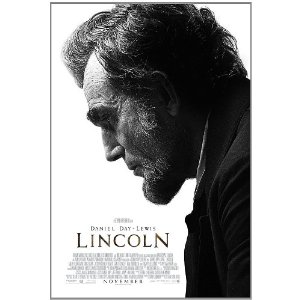
Lincoln

Posted on November 8, 2012 at 6:00 pm

B+
Lowest Recommended Age: High School
MPAA Rating: Rated PG-13 for an intense scene of war violence, some images of carnage, and brief strong language
Profanity: Some strong language, one f-word
Alcohol/ Drugs: Drinking, smoking
Violence/ Scariness: Battle violence with some graphic images, sad deaths, assassination
Diversity Issues: A theme of the movie
Date Released to Theaters: November 9, 2012
Date Released to DVD: March 25, 2013
Amazon.com ASIN: B009AMANH4

The first question about big, prestige films like “Lincoln” is always where it falls on what I call the spinach scale.  Will I tell people to see it because it is entertaining or because it is good for them.  For all its meticulous attention to historical verisimilitude and its extended depiction of people in rooms talking about a Constitutional amendment, “Lincoln” is not an eat-your-spinach-because-it’s-good-for-you movie.  It is a robust, engrossing story that illuminates our own time as well as the era of the 16th and arguably greatest President.

Task number one for director Steven Spielberg, screenwriter Tony Kushner (Angels in America), and star Daniel Day-Lewis is to make the icon into a human being, to show us his greatness but also his humanity.  In our hearts, this almost-literally larger than life man sounds like James Earl Jones — we can almost hear that deep voice reciting the Gettysburg address.  But those who actually heard Lincoln speak described his voice as high, thin, and reedy-sounding.  It may be jarring at first, but in an exceptionally well-designed introductory scene Day-Lewis deploys that timbre with such gentleness and modesty that it quickly becomes an asset not just to his performance but to our understanding of this man.

Lincoln is sitting quietly, talking to a small group of Union soldiers, two black and two white.  We see immediately that the soldiers respect him greatly — they can recite the Gettysburg address from memory — but that they feel completely comfortable being honest with him about their experiences and their recommendations.  What we feel immediately is that he is both respected and trusted, and that he has a rare ability to listen.  He may not be a modest man — at one point he thunders, “I am the President of the United States and clothed in immense power!”  But he is a humble man, who understands that he can best lead by allowing others to move forward with him.  He loves to share stories, more than others love to hear them.  But like a great preacher, he knows that it is the stories that persuade people.  Everyone softens a little for a story, especially one with a punchline.  And a story helps the listener toward the conclusion without feeling pushed.

A century and a half later, audiences may be surprised to see how little has changed.  Indeed, even the vilest insults of the Twitterverse and the shrillest complaints of Super-PAC ads do not touch the comments made by Members of Congress, who do not hesitate to question each other’s integrity or sanity.  “Fatuous nincompoop,” for example.

Audiences may be more surprised to find that “Democrat” and “Republican” seem to have switched places.  What has not changed is the way that politics attracts people of great cowardice and even greater courage, of people who hold on and people who reach forward, of people who want to help themselves and people who want to help others at great cost to themselves, including those who can never thank them.

When Lincoln decides that his most important priority is eradicating slavery through approval of the 13th Amendment to the Constitution, his team brings in a trio of lobbyists (John Hawkes, Tim Blake Nelson, and a wonderfully puckish James Spader) who are as cheerfully cynical as anyone on K Street today.  Through a combination of bribes and threats, they work to get the votes they need.  It is clear the Civil War is about to end, and if the South is readmitted to the Union, it will never pass.  Lincoln understood that the only way to keep the country together was to take its most divisive issue off the table.  He also understood that doing so would have its own terrible costs.  Even those who supported the Amendment had to make compromises, including its most ardent defender (a scene-stealing performance by Tommy Lee Jones as Pennsylvania’s Thaddeus Stevens).

Kushner and Spielberg, like their main character, recognize the power of story-telling, and this illuminating tale would make its subject proud and perhaps to inspire all of us to aspire to that as well.

Parents should know that this film has some battle scenes, graphic images in hospital including amputated limbs, some strong language including one f-word, sad losses, drinking, and smoking.

Family discussion: There are a lot of compromises in this movie and a lot of shading of the truth – which were the most difficult?  Why was the passage of the 13th amendment so important?  What moments in the film reminded you of today’s political debates and strategies?

If you like this, try: some of the other portrayals of Lincoln on film, including “Young Mr. Lincoln” and “Abe Lincoln of Illinois” and the musical about the Declaration of Independence, “1776”

Related Tags:


Based on a true story Biography Drama DVD/Blu-Ray Pick of the Week Epic/Historical Politics War

The Mark

Posted on November 3, 2012 at 3:59 pm

The Mark is the first of a two-part Christian end times film starring Craig Sheffer.  He plays Chad Turner, a non-believer who gets caught up in the fight of his life and of his soul as a courier of a critically important biometric chip with world-changing powers.  On board an airplane with a businessman named Mr. Cooper (Eric Roberts), who will present the chip to the G20 summit, they are taken prisoner by Joseph Pike (Gary Daniels), a brutal man who has been hired by a billionaire to get the chip for him.

But Turner is not carrying the chip.  It has been implanted in his arm.  It is worthless unless he is alive.  Pike and Cooper are utterly ruthless but both have to find a way to fight each other without crashing the plane or killing Turner.  And then, somehow, some of the people on the plane just disappear, without their clothes and jewelry.  Everyone else is left behind.

Turner has lost his faith in just about everything, except perhaps for a lovely flight attendant named Dao (Sonia Couling).  But the brutality and corruption he sees in Cooper and Pike and the goodness he sees in Deo awaken the hero in him.

I have one copy to give away.  Send me an email at moviemom@moviemom.com with “Mark” in the subject line and don’t forget to include your address (US addresses only).  I’ll pick a winner at random on November 7.

Related Tags:


Action/Adventure Contests and Giveaways Drama Spiritual films

Cloud Atlas

Posted on October 25, 2012 at 6:00 pm

Six nested stories set in the past, present, and future entwine grand themes of the conflicts between those who would oppress and those who demand freedom, those who must create and those who want to repeat what is already there, those who love and those who are afraid to love or be loved.  Some in the audience will be enchanted by the grand scope of the story-telling and the intricate details of the mosaic that make up each of the story’s parts.  Others will be impatient with the gimmicks and distracted by the prosthetics, wigs, and make-up.  Many will grapple with the frustration of experiencing both reactions.

When they made the “Matrix” films, they were known as the Wachowski brothers, Andy and Larry.  But since then, Larry has become Lana while resisting terms like “transition” as “complicity in a binary gender narrative.”  That clearly fueled the commitment to age, race, and gender fluidity throughout the film. Even the most sharp-eyed cataloger of prosthetic noses and teeth will be surprised as the credits reveal the multiple roles taken by Tom Hanks, Halle Berry, Hugo Weaving (Mr. Smith in the “Matrix” films), Hugh Grant, Jim Sturgess, James Broadbent, Ben Wishaw, Keith David, Doona Bae, and others.

The oldest story, set in the early 19th century and told in the  traditional style of ahistorical drama, has Sturgess as a man disturbed by the abuse of slaves in the Pacific who is being poisoned by a doctor (Hanks) he thinks is curing him.  His journals become a book on a shelf in the next story, set in the 1930’s, with a musician (Wishaw) writing to the man he loves about assisting a venerated composer and working on his own composition, called “Cloud Atlas.”  In the 1970’s, styled to remind us of that era’s “paranoid cinema” films like “The Parallax View” and “The China Syndrome,”  an investigative reporter (Berry) gets stuck in an elevator with an elderly scientist who gives her some important information about a nuclear facility.  She discovers his 40-years-old correspondence with the musician in his papers.  In the present day, we see something of a shaggy dog story as a British publisher (Broadbent) goes on the run from hooligans and ends up having to escape from a “One Flew Over the Cuckoo’s Nest”-style facility.

Two stories are set in the future.  The first, in what is now Korea, has a “Blade Runner-“ish society made up of consumers and “fabricants.”  One of them sees a movie based on the story of the publisher’s escape (starring Hanks), which helps her understand that she must rebel against the abuses of her society.  Her story becomes part of the origin myths of a post-apocalyptic society hundreds of years even farther into the future, where much of humanity has returned to an almost bronze-age level of technology and everyone speaks in a Jar-Jar Binks form of pidgin English that may have worked better on the printed page but on screen is intrusive and overdone.

As the the “Matrix” films, the more specific and concrete it gets, the less resonance it has.  Its greatest message about human aspiration and inspiration and connection is in the message as medium.  The scope and audacity of this undertaking, the biggest budget independent film in history, with the Wachowskis putting up their own homes to make the final budget numbers, outshines the details that never quite reach the clouds.

Parents should know that this film includes some graphic violence including murders, rape, shoot-outs, knives, arrows, suicide, brutal whipping, poison, car crashes, and a character being thrown off a balcony.  Characters are in peril, injured and killed.  There are dead bodies with disturbing images, some strong words including f-word and n-word, gay and heterosexual sexual references and explicit situations as well as nudity, crude sexual humor, portrayal of slavery and totalitarianism, smoking, and drug use.

Family discussion: Which of the stories was the most compelling and why?  Who was the bravest character?  Who learned the most?

If you like this, try: the book by David Mitchell and the “Matrix” movies


Related Tags:


Action/Adventure Based on a book Drama Epic/Historical Fantasy Romance Science-Fiction

Alex Cross

Posted on October 18, 2012 at 6:00 pm

In “Alex Cross,” Tyler Perry is called upon to: show devastating grief, show incendiary fury, make threats, throw punches, and take over a part played twice on screen by Morgan Freeman.  He is not up to any of those things.  Perry is a powerhouse as a writer/director/impressario and I am a fan of his unique blend of high melodrama, low humor, and true-hearted faith in God and family.  But here, in a prequel to the gritty detective films “Along Came a Spider” and “Kiss the Girls,” based on the best-selling thriller series by James Patterson, Tyler is not a good fit.  It opens with Tyler as Cross in run-with-a-gun mode, chasing after a bad guy, and then we see him bantering with his long-time best friend and partner (Edward Burns) and with his gorgeous wife (Carmen Ejogo).  There isn’t a persuasively authentic moment in any of that.  Indeed, the 6’5″ Perry’s most believable performance is when his character has to reach something from a high shelf.  That feels real.

Cross is supposed to be a Sherlock Holmes-style  hyper-observant detective with a degree in psychology who is also a devoted family man with a cute-cranky mother (Cecily Tyson) who is also gangbusters in chasing, shooting, and beating up bad guys, not to mention some vigilante-style rough justice.  He is always right.  How do we know?  His best friend/partner says, “Just once I would like it if you got something wrong because this is really getting annoying.”

And the bad guy here (an unrecognizably strung-out Matthew Fox) is also something of a super-villain who has mastered every kind of weapon and technology and has an evil genius command center with marked-up maps and mechanicals pinned to the wall (how retro) and a champion mixed martial arts combatant and specialist in torture and charcoal drawings, who leaves meticulously detailed clues that are only revealed by an Al Jaffee-style Mad fold-in.

The story begins with the murder of a gorgeous and very wealthy woman with a kinky side.  She explains a statue of the god of war in her bedroom: “War is a passionate undertaking of strategy and skill just like sex.  So it belongs beside the bed.”  She is butchered and her three bodyguards are shot and burned.  That leads to a botched attempt on one of her colleagues, an arrogant German guy who does something with money that is so important he has the kind of super-security they usually reserve for places where there is actual money and not just computers people use to move it around, except in movies where we have to show how smart the villain is by having him surmount all of the obstacles.  And then it all gets very personal and very, very ugly.  The body count rises, including a lot of collateral damage as well as some that hit close to home.  The exposition-heavy dialog is clunky (“But this building is impenetrable!” someone says as the building is being penetrated).  The banter is clunkier: “I’d rather take advice from a ham sandwich.” “Love you too, it goes without saying.”  And yet, he says it.

I was not a fan of the last Alex Cross film, Along Came a Spider, because of its plot holes and factual clangers.  (No, the Secret Service does not protect the children of Senators and the Russian President does not live in America.)  Once again, the plot becomes increasingly more preposterous when super-detective figures out that super-villain is targeting someone who is about to make a presentation to the city council.  Now, in that situation I might suggest moving the meeting to a different time or place, but no, these braniacs decide to send every cop in the city to the location to lock it down. For a presentation.  That must be some power-point.  It goes without saying that someone claims it’s the equivalent of impenetrable and it goes without saying that our Energizer bunny of a bad guy is way ahead of them.  But they say it anyway.

Parents should know that this is an R-level movie.  It has very intense and graphic violence for a PG-13 with torture including severed fingers as well as brutal fighting, guns, and bombs, very sad deaths of characters including a pregnant woman, explicit sexual situations for a PG-13 including bondage and partial nudity, some language, and references to drug use and drug dealing.

Family discussion: Who was right, Dr. Cross or his mother?  What makes him so aware of the revealing details all around him?

If you like this, try:  Morgan Freeman’s performances as Alex Cross in “Kiss the Girls” and “Along Came a Spider”


Related Tags:


Based on a book Crime Drama Series/Sequel
THE MOVIE MOM® is a registered trademark of Nell Minow. Use of the mark without express consent from Nell Minow constitutes trademark infringement and unfair competition in violation of federal and state laws. All material © Nell Minow 1995-2026, all rights reserved, and no use or republication is permitted without explicit permission. This site hosts Nell Minow’s Movie Mom® archive, with material that originally appeared on Yahoo! Movies, Beliefnet, and other sources. Much of her new material can be found at Rogerebert.com, Huffington Post, and WheretoWatch. Her books include The Movie Mom’s Guide to Family Movies and 101 Must-See Movie Moments, and she can be heard each week on radio stations across the country.

Website Designed by Max LaZebnik