
Trailer: Welcome to Happiness
Posted on September 9, 2016 at 8:00 am
It looks a bit like “Being John Malkovich,” and the cast includes Keegan-Michael Key and Nick Offerman. So I am really looking forward to it.
Posted on September 9, 2016 at 8:00 am
It looks a bit like “Being John Malkovich,” and the cast includes Keegan-Michael Key and Nick Offerman. So I am really looking forward to it.
Posted on September 8, 2016 at 5:23 pm
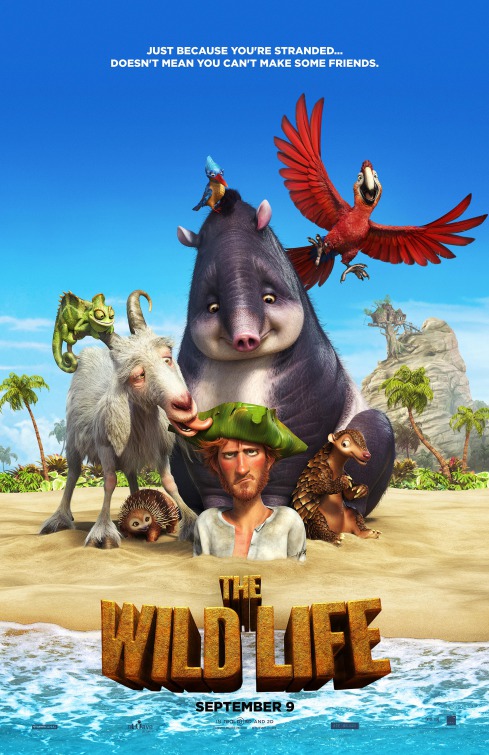
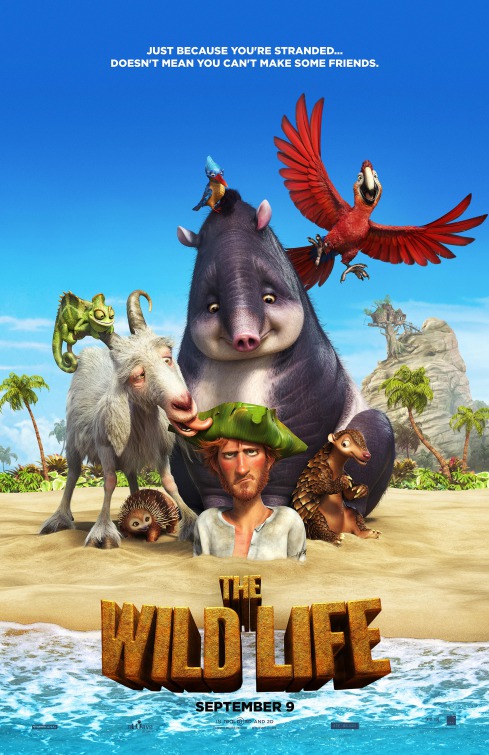
The animation is quite good in “The Wild Life,” with exceptional use of space designed to make the best use of 3D and cleverly constructed mechanics. But the voice talent is poor, the characters are dull, and the story and script start out badly and go downhill from there.
It is inspired by but bears little relation to the classic shipwreck story Robinson Crusoe, by Daniel Defoe, memorably illustrated by the great N.C. Wyeth (father of Andrew). But in this version there is no Man Friday. Instead it is, for no particular reason, told as a flashback from the perspective of the animals on the island, including a pangolin, a hedgehog, a tapir, and a parrot named Mak, later dubbed “Tuesday” by Crusoe.
The movie begins with pirates seeing what they think is a signal flame on a remote island. The captain sends his men to check it out and bring back anything of value. They capture Crusoe, and Tuesday settles in with some friendly mice on the ship to tell them the story from the beginning.
We meet Crusoe and his dog Ainsley onboard La Luna. They are novices at sea travel and looked down upon by the seasoned sailors. Crusoe does a lot of looking down, too, at the ocean, as he barfs into it. Also on board are two scraggly cats with Cockney accents, the scheming May and henchman Mal (Debi Tinsley and Jeff Doucette). A storm destroys the ship and Crusoe and Ainsley are trapped when the sailors depart in the lifeboat. The ship crashes on the shore of a tiny uninhabited island. Well, uninhabited by humans. The animals live in a predator-free paradise, with daily luaus, and they are all very happy except for Mak the parrot, who dreams of finding something exciting and different.
Crusoe, Ainsley, and the splintered remains of the ship are thrilling for Mak but terrifying for the other animals. Eventually Crusoe gains Mak/Tuesday’s trust and the animals begin to make friends with him, helping him to build a treehouse complete with running freshwater. But May and Mal, briefly stuck on an adjacent rock and soon accompanied by a litter, are determined to return to the island and pretty much eat and/or destroy everything and everyone.
Illuminata had the same mix of exceptional animation technique and underwritten story in “Fly Me to the Moon.” I wrote in my review, “Unfortunately, the dull characters and weak story keep getting in the way of the gorgeously produced backgrounds.” My strong recommendation for their next film is that they try to find writers and performers as capable as their visual artists.
Parents should know that this film includes a scary shipwreck, mean cats, pirates, guns, and fire, characters drink alcohol and there is a sad offscreen death of a character.
Family discussion: Why is Mak the only one on the island who is curious about the rest of the world? Why did Mal do what May said? How can you tell the difference between a coincidence and a bad omen?
If you like this, try: “The Pirates! Band of Misfits” and “Shipwrecked”
Posted on August 19, 2016 at 8:00 am
A Monster Calls by Patrick Ness, inspired by the late Siobhan Dowd, is the story of a boy whose mother is critically ill. He feels utterly isolated. His father has a new family. His grandmother is cold and unsympathetic. The sympathy of his teachers just makes him feel worse. And then one day, a monster calls, a monster with stories to tell. The film stars Liam Neeson, Felicity Jones, and Sigourney Weaver.
Posted on August 18, 2016 at 8:00 am
A-| Lowest Recommended Age: | Kindergarten - 3rd Grade |
| MPAA Rating: | Rated PG for thematic elements, scary images, action and peril |
| Profanity: | None |
| Alcohol/ Drugs: | None |
| Violence/ Scariness: | Monsters, peril, sad offscreen deaths |
| Diversity Issues: | None |
| Date Released to Theaters: | August 19, 2016 |
| Date Released to DVD: | November 20, 2016 |
| Amazon.com ASIN: | B01KMKM4TW |

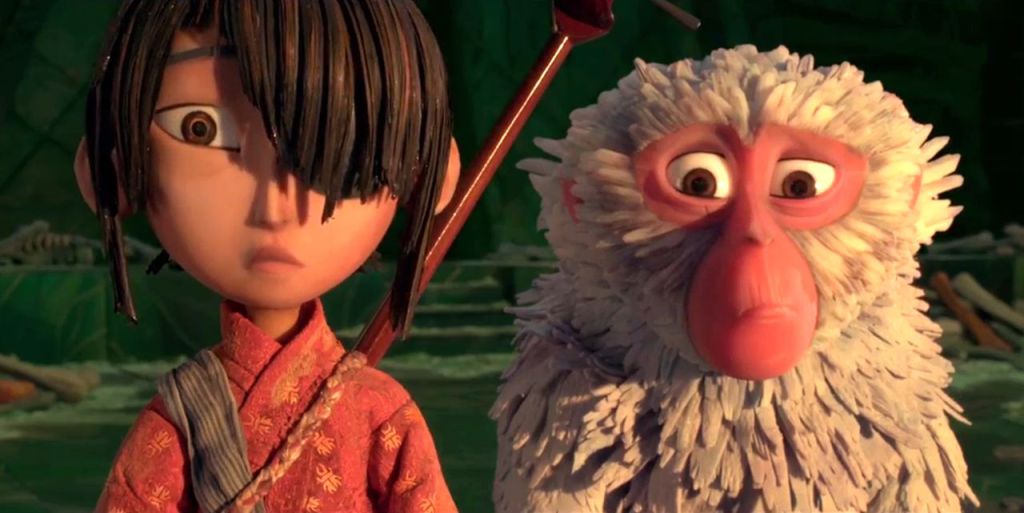
LAIKA Studios’ fourth film, “Kubo and the Two Strings,” is a fable of exquisite beauty and meaning, gorgeously produced in the most painstaking of all forms of filmmaking, stop-motion animation. They are the modern-day equivalent of the monks who labored for years on each page of illuminated manuscripts.
Every detail in every frame and every element of the story, set in a magical version of ancient Japan, reflects the simple profundity of the ancient and contemporary Japanese art that inspired it. LAIKA’s last film, “The Boxtrolls,” was set in a cluttered, sooty, steampunkish imaginary Victorian London, and the studio’s motto was “no square corners, no straight lines.” This time it went in the opposite direction, with the muted palette and spare, carefully balanced settings of Japanese woodblock prints and the sharp lines and perfect corners of origami.
One of the hardest elements to get right in stop-motion is water, because it is impossible to control it frame to frame. In “Boxtrolls,” the studio’s greatest technical triumph was an elaborate set-up for a brief scene in which a character touched standing water and created some ripples. LAIKA loves to challenge itself, and so this film starts with a storm at sea. A woman we will learn is Kubo’s mother is desperately trying to stay upright on a tiny boat. We know she is escaping someone or something, but we are not sure yet what or who it is. And we do not learn until she is washed up on the shore, exhausted and hurt, that she is not alone. In her backpack, there is a baby. It is Kubo.
Like Harry Potter, Kubo had a father who died trying to protect him from a danger so great that Kubo bears a wound. One of his eyes is gone. Kubo’s mother survived, but she used all of her magic to save him and now she is frail, forgetful, and inconsolable.
When we next see them, he is about 11, and has been caring for her all his life. Each day, he makes her food and feeds her. And then he walks from their home in a cave on top of a cliff into the nearest town, where he tells stories in the market. He has the power to bring origami characters to life to act out thrilling tales of the great samurai warrior Hanzo. The townspeople love his stories, which always end with a cliffhanger, and they toss him coins.
The community has an annual Obon festival, where they light lanterns and remember the dead. Kubo wants to go, so he violates his mother’s rule about never being out after dark. And the danger she protected him from years ago comes after him in the form of his mother’s two spooky sisters, both voiced by Rooney Mara and both wearing implacable-expression white masks and terrifying swoopy capes made of black feathers.
Kubo’s mother has just enough magic left to save him one more time. And then she is gone, and Kubo finds himself on a journey, accompanied by the live version of the small monkey charm he always carried in his pocket. He and Monkey (Charlize Theron) set off to find the three pieces of Hanzo’s armor that he will need to fight the sisters and their father, who wants Kubo’s other eye. Along the way they meet a samurai who has been cursed and turned into a giant beetle (Matthew McConaughey). And they meet and fight three different monsters, a giant skeleton, an underwater garden of eyes, and an enormous, floating, reticulated moon serpent, each giving Kubo a chance to discover his courage and power.
This is a gorgeous, epic adventure with grandeur, scope, and spectacular settings, every bit of it wonderfully imaginative. It reflects LAIKA’s own adventurous spirit in taking on narrative and technical challenges as daunting as that faced by any hero. Who else would try to create a stop-motion battle under water? Or take on, in a family movie, a quest that encompasses themes of family, story, courage, loss, destiny, and meaning? LAIKA understands that the most enduring fairy tales are not afraid to deal with darkness because that is the only way to understand its true message, here delivered in a breathtaking conclusion, of tenderness and forgiveness.
Parents should know that this film includes fantasy-style peril and violence with monsters and magic, and sad deaths of parents.
Family discussion: Why did Kubo answer his grandfather’s questions the way he did? Why didn’t Monkey tell Kubo where she came from? Why did the two strings make a difference?
If you like this, try: “Coraline,” “Paranorman,” and “The Boxtrolls”
Posted on August 11, 2016 at 5:24 pm
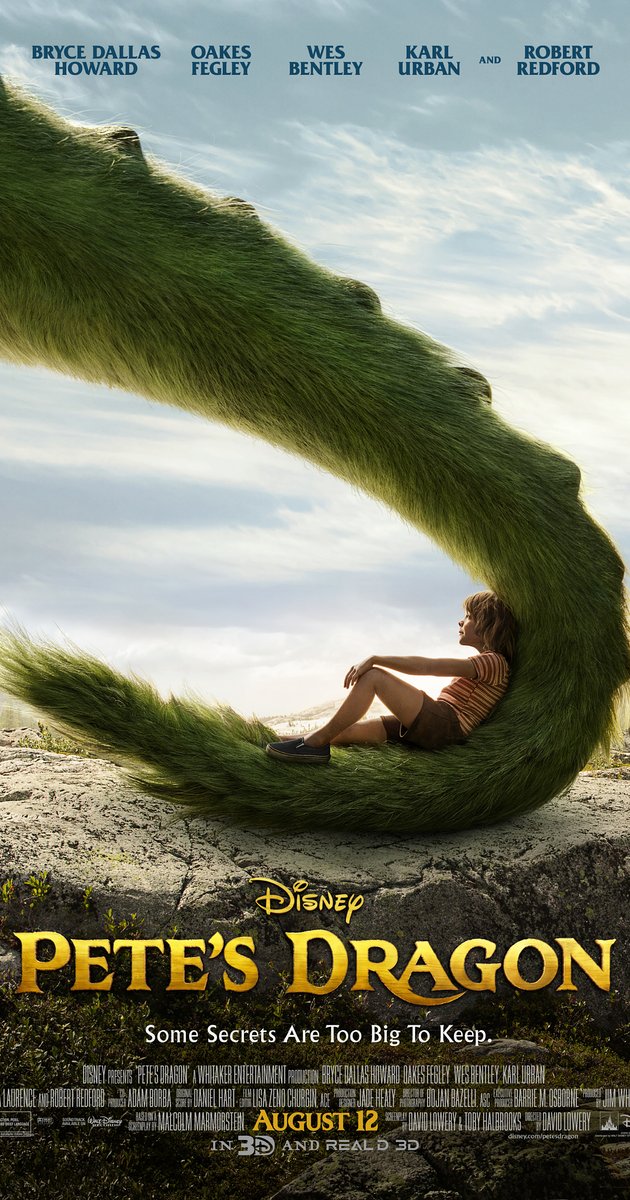
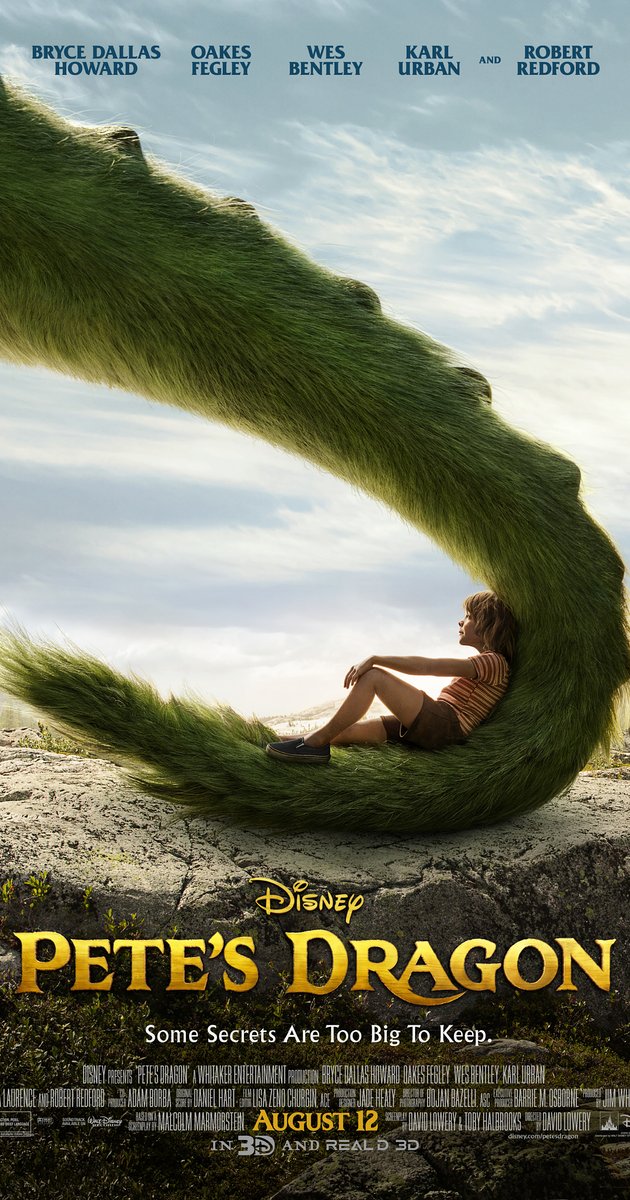
Disney has wisely jettisoned the songs, the plot and the cartoon for the remake of the Helen Reddy musical with live-action boy befriended by a cartoon dragon. It’s still about Pete and his dragon friend Elliott, and the entirely new story that is genuinely enchanting.
This seems to be a year for stories about children who make friends with giant, magical creatures. We’ve already had “The BFG” and have “A Monster Calls” coming up. And this reworking also owes quite a debt to another live-action 3D Disney remake of just a few months ago, “The Jungle Book.” But hey, it is a lovely fantasy — a child left alone finds a devoted protector. Pete (Levi Alexander), age 5, is reading a book called Elliott Gets Lost in the back seat of the car with the encouragement of his parents when there is an accident. The parents are killed (very discreetly handled off-screen), and Pete is left alone, like Mowgli and Tarzan, but instead of being raised by wolves or apes, he is taken in by a furry green dragon he dubs Elliot.
Six years later, Pete (now played Oakes Fegley) is living a life of Rousseauian paradise in the woods. We don’t waste time on how or what they eat or why his teeth are so white and even. It’s just racing through the Edenic forest and, in the film’s most exhilarating scene, leaping off a cliff in the sure knowledge that Elliott will be there to catch him and take him soaring through the sky in gorgeous 3D. They are very happy together.
But a logging operation is moving very close to the cozy cave where Elliot and Pete live. Two brothers, Gavin (“Star Trek’s” Karl Urban) and Jack (Wes Bentley) are cutting trees in the forest under the watchful eye of Jack’s girlfriend, Grace (Bryce Dallas Howard), a forest ranger who considers the woods her home. Her father Meacham (Robert Redford) likes to tell local children the legend of the dragon in the woods and boasts that he once fought the dragon with a knife. But Grace insists that she knows every inch of the forest and does not believe his story.
Gavin is reckless and greedy. When Gavin’s crew goes beyond Grace’s limits, Jack’s daughter Natalie (“Southpaw’s” Oona Laurence) discovers Pete, who has not seen another person in six years. He goes home with Jack and Grace and begins to learn about the human world. But he misses Elliot terribly. Gavin discovers Elliot and thinks he can make a fortune by capturing him.
The movie is disjointed at times, likely due to recutting, leaving unanswered questions about Grace’s relationship to Jack and Natalie and oddly having three main characters motherless. I never quite got used to the idea of a dragon with fur instead of scales. But it is thrilling to see Pete and Elliot soar together and the love between them is genuine and heartwarming enough to make this one of the year’s best family films.
Parents should know that this film includes fantasy/action-style peril and violence, sad death of parents (discreetly shown) and references to other absent parents, and brief mild language.
Family discussion: Why did Gavin and Jack have different ideas about their business? If you had a dragon friend, what name would you pick?
If you like this, try: “The Jungle Book” and “Free Willy”