Les Misérables

Posted on December 24, 2012 at 6:00 pm

Fair warning: I seem to be impervious to the appeal of “Les Misérables.”  I was not a fan of the stage show or the songs, but I understand that it is the most popular musical of all time, and I approached this movie version with an open mind.  My take is that it will make the fans happy, but I am still unpersuaded.

The musical is based on Victor Hugo’s vast novel about Jean Valjean (a magnificent Hugh Jackman), who served 19 years in prison for stealing a loaf of bread to feed his family and spends the rest of his life trying to do good and to avoid the relentless pursuit of Police Inspector Javert (Russell Crowe), who is trying to put him back in prison for violating his parole.

When Valjean is first set free, he is bitter and angry.  He repays the kindness of a priest who tries to help him by stealing valuable silver treasures from the church.  Immediately captured, he is returned to the priest (played by Colm Wilkinson, the foremost Valjean in the stage version).  But the priest insists that the items were gifts, and with the police watching, he encourages Valjean to take more.  Valjean is transformed by this compassion and generosity, and he vows to be as good, loving, and devoted to helping others as the man who cared for him.

Years later, Valjean, under another name, is prosperous and public-spirited.  He owns a factory and he is mayor of his town.  Fantine (a heart-breaking Anne Hathaway) works in his factory to support a daughter she boards with an innkeeper and his wife.  She loses her job because she refuses to sleep with a foreman and is forced into prostitution.  Valjean is horrified and feels responsible.  As she lies dying, he promises to care for her daughter, Cosette.

Valjean rescues Cosette from the corrupt innkeeper (Sasha Baron Cohen) and his wife (Helena Bonham-Carter).  But he has attracted the attention of Javert, and so he and Cosette must hide.  Ten years later, with Paris in the upheaval of a revolution, an idealistic young man named Marius (“My Week with Marilyn’s” Eddie Redmayne) sees Cosette (Amanda Seyfried) and instantly falls in love with her.  In the midst of uprisings and violent reprisals, Valjean tries to keep his promise to Fantine and keep Cosette safe and happy.

Production designer Eve Stewart has done a masterful job, making the setting as vibrant and as essential to the story-telling as any of the characters.  Director Tom Hooper (“The King’s Speech”) made a critical contribution by having the actors sing their parts while they were filming, instead of pre-recording them to be played back when the movie was being shot.  Since the movie is “sung-through” (all dialogue is sung rather than alternating speaking and singing), this gives the music a welcome organic quality and immediacy. Hathaway’s character is on screen for only a brief time, but her big number, the “I Dreamed a Dream” song memorably sung by Susan Boyle, is wrenching.  Hooper keeps the camera on her beautiful face, like the “Nothing Compares 2 U” Sinead O’Connor video, the better to feel her anguish, and it is a stunning moment.  Elsewhere, he over-does the artsy angles and sometimes assumes too much familiarity with the storyline.  Crowe’s voice is not up to the task and Seyfried’s is stretched beyond its capacity.  Newcomer to film Samantha Barks (from the London cast) as Eponine, the daughter of the innkeepers who also loves Marius, sings like an angel and lights up the screen.

It’s a long slog at nearly three hours, for a non-Miz-head.  But I came away with more understanding of those who are.

Parents should know that this is an epic story of struggle against oppression with disturbing and graphic abuse of prisoners and others, many characters injured and killed, sad deaths (including death of a child), and a woman accused of sexual misconduct and forced into prostitution.

Family discussion: How does the priest change Jean Valjean’s notion of what he should do? Why was Javert so conflicted? Why were the rebels willing to risk their lives?

If you like this, try: the PBS concert specials saluting the 10th and 25th anniversaries of the musical and the non-musical film versions

Related Tags:


Based on a book Based on a play Drama Epic/Historical Musical Tragedy

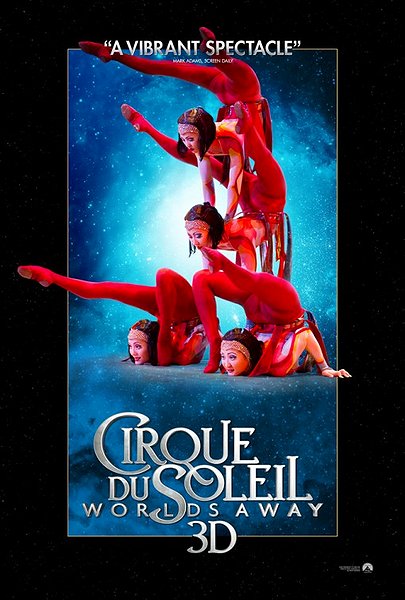
Cirque du Soleil: Worlds Away

Posted on December 20, 2012 at 6:00 pm

Her curiosity overcoming her shyness, a girl with big eyes and a gamine haircut (Erica Linz) walks through the gate for the “Circus Marvelous.”   She sees “The Aerialist” (Igor Zaripov), first smiling a welcome as he helps install the tent, then on a flier given to her by a clown, and then high above, performing with breathtaking ease and grace.  Suddenly he falls, hitting the sandy ground below, which collapses beneath him like quicksand.  The girl goes after him through an enchanted world of fantasy, splendor and feats of artistry, acrobatics, dance, music, and very firm, lithe bodies jumping, swirling, twisting, and bending, all in very tight costumes.  Plus there is an adorable tricycle powered only by a pair of small yellow galoshes, and a man on fire reading a newspaper.  He is not at all flustered when the flames creep up his body and onto his hat.  The fire is almost a dance partner.

Cirque du Soleil is an international phenomenon with shows on every continent but Antarctica.  Its founding principle is the immediacy and drama of live performance, the exact opposite of a movie.  Anything that can be imagined can be put on film; its very appearance of truth makes us marvel at the technology for fooling us so effectively.  We value Cirque for its old-school reality.  When we sit in the tent, we see performances in real time, with real peril, never to be seen exactly the same way again.  Producer James Cameron (“Avatar”) and director Andrew Adamson (“Shrek”) understand that they cannot replicate that experience and instead give us the chance to marvel by taking us up close and inside the action with immersive 3D.  The seamlessness and grace of the acrobatics adds to the dreamy quality.  In real life, we expect a sense of exertion and anxiety to underscore the sense of risk.  In the movie, the balletic movement adds to the fantasy that we are in a frictionless world unlimited by the laws of physics.

The girl and the aerialist wander, fall,  fly, and are chased through dreamlike — and occasionally nightmarish — scenes from seven of Cirque du Soleil’s Las Vegas shows: O, KÀ, Mystère, Viva ELVIS, CHRIS ANGEL Believe, Zumanity, and in one of the film’s highlights, the Beatles tribute show, LOVE.  An almost mythic inclusion of the four classical elements: fire, water, earth, and air, provide the settings for movement that flows seamlessly between dance, athletics, and stunts that do more than defy the laws of gravity; they transcend them.  In one stunning sequence, an enormous board studded with pins is tilted, distorting our perspective so that the performers swing as though they are weightless.

The costumes and make-up are dazzling, witty, and wildly inventive.  In one scene, a pair of girls are connected by a single Dr. Seuess-style hairdo.  In another, humans shaped like crustaceans skitter across the stage.  Many of the trippy visuals are accompanied by the kind of music they play in spas to relax people getting facials, but things pick up with an Elvis song and a medley of Beatles classics, including “Octopus’ Garden,” “Lucy in the Sky with Diamonds,” “For the Benefit of Mr. Kite,” that unmistakeable first chord from “Hard Day’s Night,” and a resounding “All You Need is Love.”

Zaripov has a striking purity when he performs.  It is beyond ease; it is serenity.  There is no sign of stress or exertion, even when he seems to be holding himself parallel to the ground with just one hand on a rope.  He juggles a giant cube as though he is balancing a prima ballerina.  And when Linz finally catches up, their exquisite aerial ballet is one of the most eloquently romantic moments on screen this year.

Parents should know that there are some mildly scary moments including a snake and a kidnapping.

Family discussion: How is Cirque du Soleil different from traditional circuses?  Which of the settings was your favorite and why?

If you like this, try: See Cirque du Soleil in person or watch the dance videos by LXD online

Related Tags:


3D Based on a play Fantasy For the Whole Family Musical

Disney’s Cinderella — New Diamond Edition

Posted on October 3, 2012 at 3:57 pm

This week, Disney’s animated classic Cinderella is being released with a glorious new Three-Disc Diamond Edition: Blu-ray/DVD + Digital Copy, and that glass slipper really sparkles!

The classic fairy tale by Charles Perrault is lovingly and imaginatively brought to life in this animated Disney version, also a classic. Cinderella, a sweet, docile, and beautiful girl forced to act as a servant for her mean stepmother and stepsisters, goes to the ball with the help of her fairy godmother. But her godmother warns that the beautiful coach and gown will only last until midnight. Cinderella meets the Prince at the ball, and they share a romantic dance. But when the clock begins to strike midnight, she runs away, leaving behind one of her glass slippers. The Prince declares he will marry the girl whose foot fits that slipper. He finds her, and they live happily ever after.

Disney expanded the simple story with vivid and endearing characters and memorable songs. The animation is gorgeously detailed and inventive. In one musical number, as the stepsisters squawk their way through their singing lesson in another room, Cinderella sings sweetly as she scrubs the floor, reflected in dozens of soap bubbles.

When Cinderella asks if she can go to the ball, her stepmother tells her she can, if she can make an appropriate dress. She then keeps Cinderella much too busy to have time to make the dress. But Cinderella’s friends, the mice and birds, make one for her in another delightful musical number. As the fairy godmother sings “Bibbidi Bobbidi Boo,” she transforms a pumpkin into a coach, the mice into horses, the horse into a coachman, and finally, Cinderella’s rags into a magnificent ball gown. The scene when the Duke comes looking for the girl whose foot will fit the glass slipper is very suspenseful and highly satisfying.

While the story has enduring appeal, many people are troubled by the passive heroine, who meekly accepts her abusive situation and waits to be rescued, first by her godmother and then by the Prince. It is worth discussing, with both boys and girls, what some of her alternatives could have been (“If you were Cinderella, would you do what that mean lady told you?”), and making sure that they have some exposure to stories with heroines who save themselves. A Ella Enchanted, based on the book by Gail Carson Levine, and Ever After, starring Drew Barrymore, have ingenious explanations for the heroine’s obedience and spirited heroines who can rescue themselves.

In today’s world of blended families, it might also be worth discussing that not all step-parents and siblings are mean. Even children who are living with intact families of origin may need to hear this so that they will not worry about their friends.

Families who see this movie should talk about these questions: Why does Cinderella do what her stepmother says? What could she have done instead? Why is the King so worried about whether the Prince will get married? If you had a fairy godmother, what would you like her to do for you? Or would you like to be a fairy godmother? Whose wish would you grant?

This story has been told many times, and families might enjoy seeing some of the other versions, including Cinderfella, with Jerry Lewis as the title character and Ed Wynn as his fairy godfather. The made-for- television musical version Rodgers & Hammerstein’s Cinderella, starring Leslie Ann Warren and the remake with Brandi and Whitney Houston are well worth watching.

Children might be amused to hear the rumor that Cinderella’s most famous accessory is the result of a mistake. It is often reported that in the original French story, her slipper was made of fur. But a mistranslation in the first English version described it as glass, and it has stayed that way ever since. But in reality, while there have been many versions of the story over the years, the best-known early written version, by Charles Perrault, did describe her slippers as glass. Other versions have her wearing gold slippers or a ring that fits only the true Cinderella.

Related Tags:


Animation Based on a book Classic Date movie Family Issues Fantasy For the Whole Family Musical Remake

Pitch Perfect

Posted on September 27, 2012 at 6:00 pm

The sensationally talented Anna Kendrick finally gets to play the lead in a story about the cutthroat world of a capella competitions.  It’s “Stomp the Yard” with singing, or  “Glee Goes to College.”  The songs are fabulously entertaining, the romance is sweet, Rebel Wilson’s understated zingers are hilarious, Kendrick is pure joy.  John Michael Higgins (“Best in Show”) and co-producer Elizabeth Banks (“The Hunger Games”) are the acid-tongued commentators at the big competitions.

And the projectile vomiting is torrential.

I blame “Bridesmaids.”  I am certain that as this movie was being prepared, some dimwit studio executive saw how well “Bridesmaids” was doing at the box office and ordered up three scenes of disgusting bodily function humor be (awkwardly) inserted.  Minutes after the film begins a musical performance is interrupted by massive barfing.  We are later treated to two additional and increasingly ludicrous throwing-up tsunamis, plus some cringeworthy jokes, many very crude, uncomfortably racial, or based on increasingly lame plays on the words “a capella.” Few are even remotely funny.

Kendrick plays Beca, who arrives at college by herself as everyone else is being dropped off by their parents.  She is a loner and she does not want to be there.  She just wants to get a job creating music.  But her professor father makes her promise to give it a year.  If she can complete the year successfully, and that includes an activity, he will let her drop out and pursue her dream.  So she joins the girls’ a capella (no musical instruments, just voices) group, led by micro-managing control freak Aubrey (Anna Camp), who is determined to come back from the unpleasant nausea incident at the finals of the previous year that has made them the objects of derision, especially from the champion male group.  She insists on keeping everything safe and bland, with uniforms that make them look like 1970’s flight attendants and a set-list of safe but bland middle-of-the-road pop.

And there’s a guy.  Jesse (Skylar Astin) likes Beca, but Aubrey has made consorting with the members of the male singing group a firing offense.  And Beca, very hurt by her parents’ divorce, really does not want to like anyone.  But her natural gifts and passion for music inspire her to remix some fresh and edgy songs.  The relationships play out through and amid various musical encounters, with the best an informal riff-off competition in an empty swimming pool (good acoustics).

Kendrick proves she is a real movie star but the mash-up with low comedy keeps tripping up the movie’s momentum.  The musical harmonies are sublime but Beca’s pointlessly hostile Asian roommate, who only speaks to other Asians and a member of the singing group who is unable to make an audible sound are way off-key.

Parents should know that this movie has some racial and sexual humor with crude references (though the lead couple do nothing more than kiss), some strong language, drug references, and torrential projectile vomiting

Family discussion:  Should Beca’s father have pushed her to go to school and try activities?  What was the most important thing she learned from being part of the group?

If you like this try: “Glee 3D: The Concert Movie” and the television show “The Sing-Off” and the non-fiction book that inspired this film, Pitch Perfect: The Quest for Collegiate A Cappella Glory by Mickey Rapkin

Related Tags:


Based on a book Comedy Musical Romance School

Sparkle

Posted on August 16, 2012 at 10:28 pm

You can’t help wondering what Whitney Houston was thinking when she decided to co-produce and star in the remake of a flawed but beloved 1976 musical melodrama about a singer who becomes involved with an abusive performer and becomes addicted to drugs.  Was this a cautionary tale?  A reflection on her own choices?  In this movie she plays Emma, the very strict mother of three musical daughters, living in 1968 Detroit.  She is determined that her daughters will adhere only to the three priorities she drills into them: respect, education, and having a relationship with the Lord.

Emma once tried to make it as a singer herself and is determined that her girls will not suffer the heartbreak she experienced.  But her youngest daughter, Sparkle (“American Idol’s” youngest-ever champion Jordin Sparks) wants to writes songs, and she wants to be a star.  She does not have the stage presence of her sultry oldest sister, Tammy, known to everyone as Sister (an electrifying Carmen Ejogo) and is too timid to tell the truth about her feelings in her lyrics.  The third sister, Dolores (Tika Sumpter), just wants to go to medical school.  She agrees to sing Sparkle’s songs so she can get money for school and Sister agrees because she likes the money and excitement.

They sneak out at night to perform so their mother does not know.  Their manager is the poor but ambitious Stix (Derek Luke), whose cousin Levi is in love with Sister.  But Sister wants money and excitement.  She agrees to marry Satin (Mike Epps), a comedian who specializes in the kind of racial humor that makes white audiences feel comfortable.  Emma throws them out.  The trio becomes more and more successful, but Sister’s life with Satin is filled with domestic abuse and cocaine and she resists her sisters’ efforts to help her.

Some intriguing themes about the racial conflicts of the era are raised almost in passing and never developed while the soapy parts of the story drag on and the storyline loses any pretense of believability.  Sparks is not an actress, and Houston spends most of the movie giving that “Hell to the no” look we saw too often in her reality show.  Ejogo is a sensation and Luke continues to be one of Hollywood’s overlooked treasures, bringing a dignity and sweetness to the role.  Epps is excellent, showing us Satin’s volatility and magnetism.  The musical numbers raise the roof, especially the cover of the earlier film’s biggest hit, “Giving Him Something He Can Feel” (later covered by En Vogue) and Sparks’ rousing finale.  But the highlight is Houston’s passionate “His Eye is on the Sparrow,” a powerful spirit-lifter and a sad reminder of her once-to-a-century gifts.

Parents should know that this film includes a scuffle, domestic abuse, characters who are injured and one killed, tense emotional confrontations, sexual references including teen pregnancy and non-explicit situations, some strong language including ugly racial epithets, smoking, drinking, and drug use.

Family discussion:  Why did the three girls have such different ideas about what they wanted?  Why was their mother so strict?  Why did Sister tell the other two they had to leave her house?

If you like this, try: the original Sparkle with Lonette McKee and Irene Cara, “Dreamgirls,” and “Grace of My Heart”


Related Tags:


Drama Family Issues Musical Remake Romance
THE MOVIE MOM® is a registered trademark of Nell Minow. Use of the mark without express consent from Nell Minow constitutes trademark infringement and unfair competition in violation of federal and state laws. All material © Nell Minow 1995-2026, all rights reserved, and no use or republication is permitted without explicit permission. This site hosts Nell Minow’s Movie Mom® archive, with material that originally appeared on Yahoo! Movies, Beliefnet, and other sources. Much of her new material can be found at Rogerebert.com, Huffington Post, and WheretoWatch. Her books include The Movie Mom’s Guide to Family Movies and 101 Must-See Movie Moments, and she can be heard each week on radio stations across the country.

Website Designed by Max LaZebnik