Less a movie than a mosaic, this remake of the 1980 classic with the Oscar-winning title anthem about the high school for the performing arts has been re-imagined for the hyper-linked and just plain hyper 21st century. As in the original, we follow the stories of aspiring performers from their first audition through four years of high school. But this time, so many characters are thrown at us that we never connect with any of them. This film is as much an artifact of its era as the dancing-in-the-streets first one, perhaps in ways it did not intend. It is a revealing reflection of its target audience: kids used to keeping up to date via tweets and Facebook status lines, the generation that cannot see the line between access to information and understanding the information’s context and import.
It indicates more than it shows, not because it is subtle, but because it is frantic, trying to follow the lives of ten students over four years in less than two hours. Narrative is pushed to one side. Even the too-brief but excellent musical numbers are chopped up and intercut not so much as an artistic statement as a recognition that society as a whole now meets the clinical definition of ADD.
The talented cast passes by so quickly it is like watching a 107-minute trailer. Naturi Naughton makes a strong impression in vocal numbers that include “Out Here on My Own” from the 1980 film. Kay Panabaker has a sweet honesty that comes across well on screen and more than any of the others she shows us the difference in her character as she grows up and gains confidence. An exceptionally strong cast of adults adds some depth to the faculty roles, including “Will and Grace’s” Megan Mullally and “Frasier’s” Bebe Neuwirth and Kelsey Grammer along with movie and theater veteran Charles S. Dutton. If only they had been able to sit down writer Alison Burnett and director Kevin Tancharoen to give them the kind of stern pep talk about craft and discipline that they give to their students, this would have been a better movie.
Spike Lee’s latest movie is a film version of the Tony Award-winning musical autobiography, something between a concert and a play, about, by, and starring the one-named musician named Stew. He heads up the on-stage band, which functions somewhere between an orchestra and a Greek chorus, in this story based on his experiences leaving home to move to Europe and find himself.
Stew and his collaborator, Heidi Rodewald have put together a show that is very specific and autobiographical but also archetypal. It has a terrific script that perfectly captures the tug of home, the lure of away, the hunger for art, and the vulnerability of relationships. The main character’s only name is Youth to emphasize his Candide-ish qualities. The show is genre-crossing, with music that shows the influence of rock, pop, funk, gospel, and more. It explodes with electrifying performances by Daniel Breaker as Youth and a top-notch cast that instantly creates a range of international characters. Lee’s camera takes us into the heart of the action, even back-stage, seamlessly integrating three different performances.
Rated PG for some suggestive choreography and scary images
Profanity:
None
Alcohol/ Drugs:
None
Violence/ Scariness:
Gruesome images of ghouls, ghosts, and monsters
Diversity Issues:
Diverse characters
Date Released to Theaters:
October 28, 2009
“This is It” is here to rescue us from the tabloids and remind us what true star power looks like. There are moments of aching sadness as we get a behind-the-scenes look at the concert tour that never happened, but it is the very intimacy of the preparation process that makes the film so enthralling. Jackson comes across as the consummate professional, always polite and appreciative but with a stunning mastery of the smallest detail and the biggest special effect in putting together what would have been a ground-breaking performance.
Jackson seems physically frail at times, conserving his voice and his energy in the musical numbers as the back-up dancers give it performance-level power every time. In one lovely moment, he falls so much in love with a song he is rehearsing that he cannot resist giving it full power and, as happens more than once in the course of the film, all of the people working on the show just stop to watch and listen, utterly entranced. In another moment, we glimpse his quick, private smile of satisfaction with a number that has come together. When he sings “I’ll Be There,” we can’t help being reminded that even though he is gone, his performances will be a part of our lives forever.
There’s a glimpse of the auditions, the dancers almost overcome with the chance to try out for what they consider the zenith of entertainment. He tells one musician to “let it simmer” and demonstrates a guitar riff for another. He is unfailingly appreciative and thoughtful, over and over thanking everyone and unfailingly respectful in giving direction, almost apologetic when he says that the earpiece is making it harder for him to hear. The endless series of bizarre outfits with their military stripes and Munchkin-like shoulders, seem irrelevant when we watch the way he interacts with people and the way he thinks about the songs and dances. Appropriately, the most thrilling moment is “Thriller.” Jackson says he wants to take us places we have never been before, and in this combination concert film/documentary, he reminds us of the power of imagination and talent and the reason he was a star.
If this story wasn’t true, they’d have to invent it. Indeed, they already did. “This is Spinal Tap,” one of the most outrageous, influential, and utterly hilarious movies ever made, is a “mockumentary,” a fake documentary about a heavy metal rock group on a disastrous tour in support of a disastrous new album. “Anvil: The Story of Anvil” is an actual documentary about an actual heavy metal rock group on a disastrous tour in hopes of making a new album and it is hilarious and touching and completely captivating.
Like all great documentaries, this is the story of a passionate dream. Guitarist Steve ‘Lips’ Kudlow and drummer Robb Reiner (not to be confused with one-b Rob Reiner, who directed “This is Spinal Tap”) met as teens in a small town near Toronto and have been performing together for four decades. They had a brief brush with success in the 1970’s, when they performed at a festival with acts that have since gone one to sell hundreds of millions of CDs, and their Metal on Metal album is considered seminal to the genre. But for some reason, they never made it despite subsequent alliterative albums like Worth the Weight and Hard n Heavy. The eternally optimistic Lips has a day job delivering school lunches. But when a European fan calls to say she has booked them on a tour, they drop everything and go. Everything goes wrong. But, as Lips says, at least they have a tour for things to go wrong on.
There are some nice little bows to “Spinal Tap” — a producer whose amps go to 11, a drive by Stonehenge. And the inspired title lets you know from the beginning that it is cheekily subversive, even of its own pretensions. It never takes itself or the band too seriously. But the passion of its characters for rocking out hard and for the partnership they share is perfectly suited to rock as the ultimate affirmation of life in the face of The Man in all forms, from club managers who don’t pay to recording executives who don’t get it to time that goes by too fast. The support of their families and their unquenchable commitment to the music is ineffably moving. It is funny and surprising but filled with heart.
Passive female heroine dreams of being rescued by prince
Date Released to Theaters:
1937
Date Released to DVD:
February 2, 2016
Amazon.com ASIN:
B01711CIF0
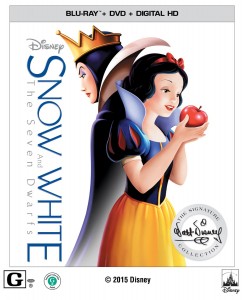
Copyright Disney Studios 2016Disney’s new Signature Collection release of its first animated feature film on Blu-Ray is gorgeously restored and filled with behind-the-scene extras and a wonderful opportunity to catch up with the one that is still “the fairest of them all.”
Snow White (voice of Adriana Caselotti) is a sweet girl whose step-mother, the Queen (voice of Lucille LaVerne), is vain and cruel. Snow White dreams of a prince to love, and meets the Prince of her dreams when she is fetching water for the castle. Meanwhile, each night, the Queen looks into a magic mirror and asks who is the fairest one of all. The mirror tells her that it is she, and she is satisfied. But one night, the mirror tells her that Snow White has become more fair, and the Queen, consumed with jealousy, tells her huntsman to take Snow White to the forest and kill her.
The tender-hearted huntsman cannot kill her and instead tells her to run away. Racing through the forest terrified, she collapses in tears. But she makes friends with the animals, who live in the woods and they lead her to a small cottage. Once inside, she cleans up the mess, singing “Whistle While You Work.” She thought, when she saw the small beds, that children lived in the house, but it turns out that it is the home of seven dwarfs, who work each day digging jewels from a mine.
When they come home, they are surprised to find her stretched out across their beds, sound asleep. But they soon make friends and are delighted to have her stay and take care of them.
Eventually, the Queen discovers that Snow White is still alive. The Queen makes a poisoned apple and turns herself into an old hag so she can deliver it to her. Snow White at first follows the dwarfs’ advice not to speak to strangers, but finally takes a bite of the apple and collapses. The Queen runs away and falls into a steep ravine.
The dwarfs are heartbroken and create a beautiful crystal bier for her to lie on. The prince discovers her there and gives her a kiss, which awakens her, whereupon he carries her off to live happily ever after.
Children used to today’s Disney stories may be surprised by a more passive heroine and by a score more classical than pop. But in addition to its historical value as the first animated feature, it is still a delight, with memorable songs and characters. It is hard to remember that before Disney the dwarfs in the Snow White story had no names and no individual characters. Sneezy, Sleepy, Grumpy, Dopey, Doc, Happy, and Bashful are all vivid characters, and their dance number with Snow White is a highlight.
This movie provides a good opportunity to discuss jealousy, and how to handle it. And, of course, it raises issues about women and beauty, about women’s role in the home, and about finding happiness only through dreams of “Someday My Prince Will Come.” Blended families are often sensitive about the traditional fairy tale villain being the “wicked stepmother,” and some children will need reassurance.
Extras in this edition include Disney’s own comments about the film and a feature about the influence of this groundbreaking animated feature, plus never-before-released storyboards of a deleted scene where the prince meets Snow White.
Talk to kids about how characters like Snow White might be different if they were created today, and make sure that they see a range of alternative role models. Note: The movie is very scary when Snow White is running through the forest (though reassuring when the animals turn out to be friendly) and when she bites the apple; the Queen is especially scary when she turns into the old hag. By today’s standards, Dopey might well be considered an insensitive stereotype of a developmentally disabled person.
Families who see this movie should discuss these questions: Why is the Queen jealous of Snow White? Why is being beautiful so important to her? Why did Snow White stay at the castle? Why did the huntsman disobey the Queen’s orders? Why did the dwarfs love Snow White so much?
Families who enjoy this movie should watch some of the other versions of the Snow White story, including the Faerie Tale Theatre production with Elizabeth McGovern.