Contest: Win a Blu-Ray of “Alice Through the Looking Glass”
Posted on December 9, 2016 at 10:05 am
Copyright 2016 Walt Disney Pictures
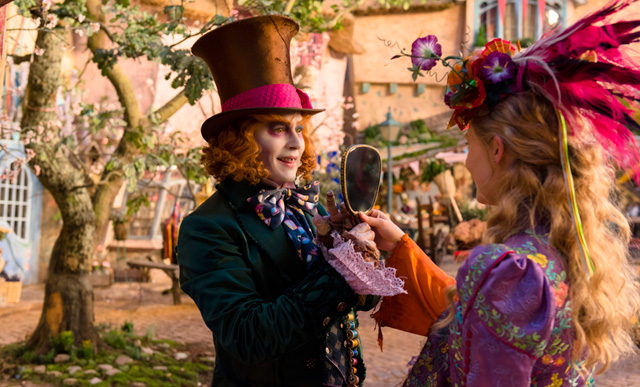
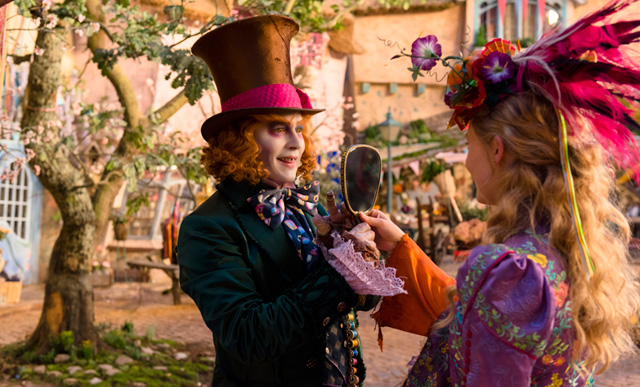
Johnny Depp, Anne Hathaway, and Mia Wasikowska star in “Alice Through the Looking Glass,” Tim Burton’s extravaganza inspired by Lewis Carroll’s classic fantasy. And I have a copy to give away!
Send me an email at moviemom@moviemom.com with Alice in the subject line and tell me your favorite fantasy character. Don’t forget your address! (U.S. addresses only). I’ll pick a winner at random on December 15, 2016. Good luck!
Rated R for crude sexual content and language throughout, drug use and graphic nudity
Profanity:
Very strong, crude, explicit, and graphic language throughout
Alcohol/ Drugs:
Drinking and drugs (played for comedy)
Violence/ Scariness:
Comic peril and violence with some injuries
Diversity Issues:
Diverse characters
Date Released to Theaters:
December 9, 2016
Copyright 2016 Paramount
Not since “Snakes on a Plane” has there been a movie whose title so clearly explains exactly what the premise is and what the audience should expect. Indeed, star T.J. Miller (“Deadpool,” “Silicon Valley”) has said in interviews that he took the role based on the title alone (and his past relationship with the directors), without ever reading the script. And, honestly, it does not matter to its intended audience. They just want to see comic, outrageous, chaos, and that is just what this movie delivers, with an all-star cast of top comic talent. Each gets a chance to show off, and, as slob comedies go, this one has a winningly sweet heart.
Clay (Miller) runs the Chicago office of his late father’s software business. Well, “runs” is perhaps not quite the correct term. He more or less presides over it, in a benign but bro-ish way. The actual grown-up supervision is performed by Josh (Jason Bateman), a very responsible guy, but subdued following his divorce. And the actual productivity falls to Tracey (Olivia Munn), a coding genius.
Clay’s sister Carol (Jennifer Aniston) is the tough, smart, no-nonsense boss of the whole enterprise and she intended to shut down Clay’s all-nonsense, money-losing branch. She cancels the Christmas party and tells Clay everyone will be laid off unless he can land a $14 million new client, Walter Davis (Courtney B. Vance). Other characters in the office include Clay’s assistant Allison (“SNL’s” Vanessa Bayer), a single mom and sort of office mom, too, fussy HR head Mary (“SNL’s” Kate McKinnon), office complainer Jeremy (Rob Corddry), new hire Fred (Randall Park), and a manager named Nate (Karan Soni) whose staff is convinced he is lying about having a hot model girlfriend and has challenged him to bring her to the party.
You can guess where it goes from here, and you know whether that is your idea of fun or whether you’d prefer to stay home and re-watch “A Christmas Story” or whatever cinematic eggnog is on the Hallmark Channel. “Gets out of hand” does not begin to convey the extent of the very bad choices made by all involved, with intentional and unintentional abuse of substances, and — an update to the traditional photocopying of body parts — using a 3D printer for a full-size model. There’s a chase, some bad romance, some better romance, and a trip to the hospital. Jillian Bell, as always, is a highlight, essentially repeating her “22 Jump Street” role. This time, instead of a drug dealer, she’s a pimp.
Perhaps the best that can be said is that it is more fun than any actual office Christmas party.
Parents should know that this film is a very raunchy comedy with explicit sexual references, situations, and male and female nudity and kinkiness, crude language, drinking and drunkenness, drugs, and comic peril and violence with some injuries.
Family discussion: Would you want to work for Josh or Clay? Why was Carol jealous of Clay?
If you like this, try: “Old School” and “The Night Before”
Striding confidently down the halls of the Congressional office buildings, picking up the check in restaurants with crisp white tablecloths and extensive wine cellars, and, inevitably, at fundraisers, lobbyists are impossible to miss in Washington, D.C. They wear discreetly expensive suits. In fact, they are usually pretty discreet about everything, whether it is handing over money or making threats. Especially when they are making threats.
The film’s title may use the quaint honorific “Miss Sloane,” but do not let that mislead you. Elizabeth Stone (Jessica Chastain in a subtle, vibrant performance) is not looking back. She is a top lobbyist and she tells us right away that means that she always must be thinking ahead. “Lobbying is about foresight and anticipating your opponent’s moves and plotting countermeasures.” She is all about tactics, she is ruthless, and she is determined. “Make sure you surprise them and they don’t surprise you.” Everything about her is controlled and knife-edged. Her sheet of red hair is cut so severely it could slice through granite.
There are a fews signs of stress, though. When she thinks no one is looking, she pops some white pills. Some nights she goes to a hotel to spend time with a male escort. And she is rattled when the one she is used to seeing is not there and the new one (Jake Lacy as Forde), but not so rattled that she declines.
The most significant sign of stress is that in a meeting with a very lucrative prospective client, instead of listening politely when he explains his plan to create a group to promote the idea of women opponents to any restrictions on gun ownership, she laughs, harshly and derisively. Her boss (Sam Waterston) is furious. But for Elizabeth it is just one moral outrage too many. In what she herself recognizes is a “Jerry Maguire” move, she quits, taking her staff with her — except for Jane (Alison Pill), her closest aide, who opts to stay with the high salary and opportunity for partnership. Elizabeth is going from one extreme to the other, working to oppose the gun lobby on behalf of a small non-profit run by Rodolfo Schmidt (Mark Strong, usually the bad guy but here fine as an idealist).
The smart script by first-time screenwriter Jonathan Perera and brisk direction from John Madden (“Shakespeare in Love”) make this a solid Washington thriller with some telling (and accurate) details, moral dilemmas, and plot twists that keep you guessing until the last ten minutes.
Parents should know that this film includes strong and crude language, substance abuse, sexual references and a mildly explicit situation, and corruption and betrayal.
Family discussion: Why did Elizabeth allow herself to be so consumed by the job? Why did she decide to make a change? What would she recommend to improve politics and government?
Disney has kept the best of its reliable formula and freshened it up with a spirited story inspired by the ancient myths of the Pacific Islands and a spirited heroine who dreams of adventure, not finding a prince. It is gorgeously animated, heartwarming, exciting, and slyly self-aware. At one point a character notes that if she has a dress and an animal sidekick, she must be a princess. And in a scene way at the end of the credits (stay ALL the way to the end), a character re-appears to compare himself to another well-known animated Disney character. But it is also utterly sincere in its affection for the heroine and her quest.
Moana (Auli’i Cravalho) lives on an Polynesian island paradise. Her father is the king and she will someday be the community’s leader. She has the run of the island, and loves the shore. She has the heart of an explorer, but her parents tell her that their people do not go beyond the reef because it is not safe out on the ocean. They do their best to warn her, but there is nothing that can stop Moana’s curiosity and sense of adventure, even after an initial voyage goes badly. Moana wants to know what happened to the courageous voyagers who once led expeditions from her island led by wayfarers who navigated with the stars. The ocean itself invites her to explore.
When an environmental disaster strikes, Moana realizes that the rules have to change. Her people will be wiped out unless she can return the heart that was stolen from Te Fiti, the goddess who created the world. Her heart, a pounamu stone, was stolen by the mischief-maker Maui (Dwayne Johnson), and the destruction that created has reached Moana’s island. Moana needs to find Maui and return the heart, before all of the island’s plants and fish turn to ashes.
Moana finds Maui, but he does not want to help, he has lost the stone, and Te Fiti broke the magical fishhook that is the source of most of his power. Without a working fishhook, his ability to shapeshift is badly compromised, leading to some hilarious misfires (watch quickly for one of his mistaken personas, a character from “Frozen”). Johnson’s ebullience is perfect for Maui, reminiscent of Robin Williams as the genie in “Aladdin,” with his mercurial personas and helpful but trickster role. He is covered with Maori-style tattoos which delightfully interact with him, a mini-movie of their own.
The two of them go on a journey filled with adventure and with great songs from “Hamilton’s” Lin-Manuel Miranda and Opetaia Foa’i. Highlights include Maui’s riotous “You’re Welcome,” as he explains all that he has given mankind (inspired by Maori creation myths) and “Shiny,” performed by Jemaine Clement as a treasure-loving giant crab. Moana is an appealing heroine, brave, smart, determined and devoted to her community. She is even devoted to her animal sidekick, a scrawny chicken with very little brainpower.
The animation is spectacular, with the ocean a character of its own, pygmy pirates, the giant crab, and a lava monster. And the resolution is especially satisfying, with not just redemption and triumph for our heroes and justice, compassion, and forgiveness rather than demonization of the character who would otherwise be the typical villain. The loveable characters, hummable songs, and heartwarming and joyful conclusion make this a holiday season treat for the whole family.
NOTE: Stay all the way to the end of the credits for an extra scene. And be sure to get there in time for the adorable animated short before the film, “Inner Workings,” a sort of variation of “Inside Out,” as we see a man’s internal organs responding to the world around him and enticing him to transcend his daily drudgery with a visit to the beach. It was directed by veteran Disney animator Leo Matsuda.
Parents should know that this film includes action-style peril and violence with some disturbing images, sad (offscreen) deaths, brief schoolyard language, and brief potty humor.
Family discussion: Why didn’t the ocean return the heart itself? What did Moana learn from Maui’s story about his parents?
If you like this, try: “Whale Rider,” “Brave,” and “Mulan” — and try navigating without GPS
Rated R for language throughout and some sexual content
Profanity:
Very strong language
Alcohol/ Drugs:
Drinking and drunkenness, substance abuse and recovery
Violence/ Scariness:
Fighting, tragic deaths of parent and children
Diversity Issues:
None
Date Released to Theaters:
November 23, 2016
Date Released to DVD:
February 20, 2017
Amazon.com ASIN:
B01LTHZVKG
Copyright 2016 Pearl Street Films
We think the hard question is why bad things happen to good people, but really the hardest question is this: when the hard things happen, how do we go on?
Writer/director Kenneth Lonergan likes to explore this question in films that are complex, layered, and respectful of the audience’s intelligence and attention span. He lets the story bloom in its own time. He lets his characters lead messy lives, even after the story ends. He does not lay out all the backstory with voiceover narration or the kind of exposition-heavy dialog (“It’s been three year since it happened. Don’t you think it’s time to move on?”) that writers often use as shortcuts. As we go back and forth in time, it is not clear whether we are seeing incidents from the past that the characters are recalling now or whether it is just Lonergan himself, letting us deepen our understanding. Either way, it is presented with exquisite care, and exquisitely calibrated performances that reward our careful attention.
Lee (Casey Affleck), his brother Joe (Kyle Chandler), and Joe’s son Patrick (Ben O’Brien as a child, Lucas Hedges as a teenager) enjoy an afternoon on Joe’s fishing boat. And then we see Lee, shoveling snow, doing repairs in an apartment building, dogged and remote. He overhears a tenant telling someone she thinks he is attractive, but he does not respond. He argues with his boss. He overreacts at a bar and gets into a fight. Later, we will hear someone refer to him in hushed tones as “the Lee Chandler.” But it will be a while before we learn the tragic details that led to his notoriety.
Lee gets a call. Joe, who had a bad heart, has died. Lee is calm and capable, driving to the hospital and making arrangements. But he is shocked to find that Joe has made him Patrick’s guardian. We know that Lee is a limited, damaged man. And perhaps we know that the unexpected guardianship of a teenager is his opportunity for redemption. We’ve all seen that movies, probably often enough we can predict how many minutes until the big hug scene. But Lonergan has something different in mind, something more layered and complex. It is sad, but not dreary. There are moments of great humor, especially as Lee and Patrick try to find a way to figure out what they are going to do next. Each, in his own way, is disconnected from his feelings and not interested in trying. Patrick cares about his two girlfriends and his band. He wants to hold onto his father’s boat, even though Lee cannot afford it. He wants to stay in the film’s title town, even though Lee works in Boston. Lee — well, he pretty much just wants to whatever task lies in front of him without having to feel too much.
It all literally pieced together for us gradually as moments from the past are revealed, perhaps as recalled by Lee, perhaps just Lonergan’s sure sense that only putting the pieces of the puzzle together slowly, leaving some spaces for us to fill in ourselves, will give us the deeper sense of recognition. Individual scenes are exquisitely composed and performed, especially a conversation between Lee and his ex-wife, Randi (Michelle Williams), another in a police station, and an awkward meal with Patrick, his mother, a recovering substance abuser (Gretchen Mol), and her tightly-wound new partner (Matthew Broderick), poised between protective and controlling. The cumulative power sneaks up on you, until the perfectly imperfect ending.
Parents should know that this film includes disturbing material with very strong and crude language, a deadly fire, tragic deaths including parent and children, attempted suicide, sexual references including teen sex and brief nudity, drugs, drinking and drunkenness, and some fighting.
Family discussion: Why did Joe pick Lee? Why didn’t Patrick show more emotion? Why does this movie wait to tell us what happened to Lee?
If you like this, try: “You can Count on Me” and “Margaret” from the same writer-director