Conscious 2 — A New Streaming Platform With Movies to Inspire
Posted on November 22, 2016 at 7:43 am
Need a break from the stress of the holidays or the tumult of politics? Check out Conscious 2, a new streaming service about mindfulness, healing, and inspiration. Fascinating, moving, meaningful series and movies include:
Extended fantasy peril and violence, some disturbing images and scary creatures
Diversity Issues:
None
Date Released to Theaters:
November 18, 2016
Date Released to DVD:
March 27, 2017
Amazon.com ASIN:
B01LTHOAGM
Copyright 2016 Warner Brothers
It is so good to be back in the Potterverse again.
This first of an expected five film series is true to the spirit of the world of Harry Potter; indeed, it is the first film with a screenplay from J.K. Rowling herself. But it departs from the Potter films in significant ways: it is the first story to be set in the past and the first to be set outside the UK. It takes place in 1920’s New York City.
It is also the first to center on adult characters, though a teenager and a child have featured roles. It has the best of both the familiar and the new, thanks to the experienced eye of director David Yates, who also directed the last four Potter films) and the score from James Newton Howard, echoing the Potter film’s theme.
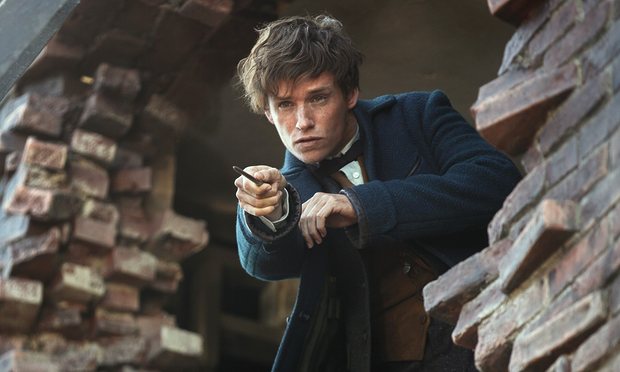
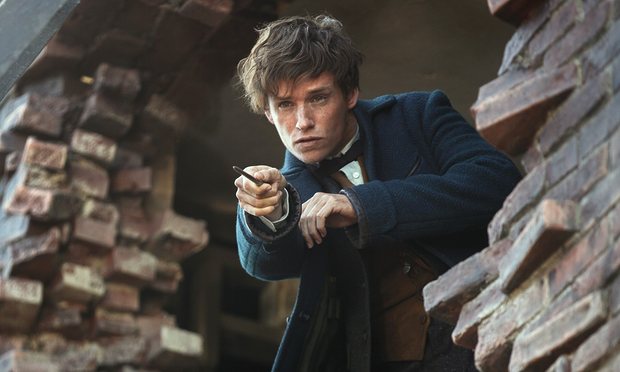
Eddie Redmayne (“The Theory of Everything” and “The Danish Girl”) plays Newt Scamander, a shy wizard who arrives on Ellis Island with a briefcase that has some thrilling magical attributes. There’s a handy switch to make its contents muggle-worthy (though, as he will learn, in the US muggles are referred to as “no-majs,” pronounced no-maszh). It can contain many different kinds of fantastic beasts. And it is a portal to a sort of animal sanctuary Newt maintains for his beloved creatures, all of which will escape at least once to create chaos or save the day, sometimes both at once.
He arrives just as a group called Second Salem vows to eliminate anyone performing magic. The leader is a fervently fanatic woman named Mary Lou (Samantha Morton), who abuses her adopted children, especially her teenage son Credence (Ezra Miller, soon to be DC’s Flash on the big screen).
So MCUSA (pronounced mc-kusa), the Magical Congress of the United States of America, led by Seraphina Pickery (Carmen Ejogo) is especially concerned about doing anything that would bring them to the attention of the no-majs in any way, much less make them think that the wizards and witches are dangerous. And a rogue wizard named Grindelwald has been creating mayhem in both the wizard and muggle worlds.
Newt meets a no-maj, an amiable would-be baker named Jake Kowalski (a warm-hearted performance from Tony winner Dan Fogler) carrying a very similar-looking briefcase just as one of the fantastic beasts escapes from his own. The creature, who looks a bit like a duck-billed platypus, has an inconvenient habit of grabbing anything shiny or sparkly. By the time Newt has retrieved him, Jake has seen too much and is about to have his memory wiped when a variety of other mix-ups and adventures take him deeper into the world of magic. Soon, Jake and Newt team up, aided by a disgraced MCUSA investigator named Tina Goldstein (Katherine Waterston of “Inherent Vice”) and her mind-reading sister, Queenie (charmingly magnetic Alison Sudol, channeling Carole Lombard).
Newt is an utterly engaging character, a bit shy and tentative, but somehow we are not surprised to learn that he was expelled from Hogwarts — or that it was over the objection of a young faculty member named Dumbledore. As with all of the Potterverse films, the production design is enchanting, even the no-mag areas. The old-time New York settings, including a variation on a speakeasy, are gorgeously realized, with a depth of imaginative detail that makes us want to hit a pause button. The creatures range from grotesque to magnificent, and Newt’s constant affection for them all (like Hagrid) is endearing. The big confrontation has some real emotional heft, and Rowling keeps one of her best surprises to the end.
When is the next chapter coming? I’m ready! At least, after I watch this one a few more times.
Parents should know that this film includes extended fantasy peril, action, and violence, characters injured and killed, some disturbing images and scary creatures, and brief bodily function humor.
Family discussion: Which is your favorite creature? Why does Newt think that people find him annoying?
If you like this, try: the Harry Potter books and movies and “Labyrinth”
Sports stories give us heroes whose determination and courage is constantly tested. The athletes who face those challenges — who live for those challenges — can help us understand and face our own. Vinny Pazienza was a great boxer, but what made him heroic was not his skill in the ring or his unprecedented wins in three different weight classes. It was his comeback from injuries he got in a deadly car crash, including a broken neck so severe that it was not clear whether he would ever walk again. He was given the choice between spinal fusion that would guarantee that he could walk but would prevent him from getting back in the ring, or six months in a Torquemada-style halo contraption literally screwed into his skull, where the slightest bump could paralyze him forever but, if everything went perfectly he might regain enough mobility to fight again, he chose the halo. He ended up resuming his training — against the advice of his doctors — and removing the halo after three months, then returning to boxing. Let me put it this way: knocked down worse by life than by any opponent in the ring, he was up by 9.
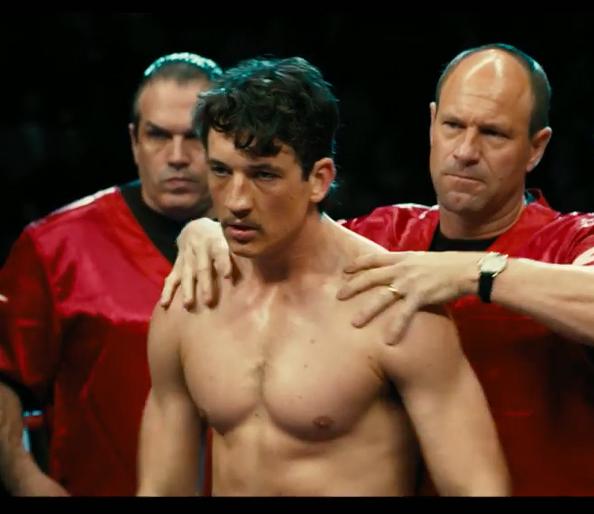
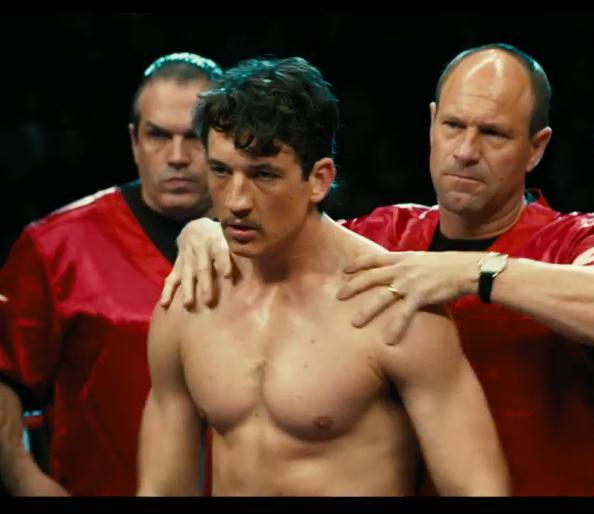
For his first film in more than ten years, writer/director Ben Younger (“Prime,” “Boiler Room”) tells the true story of one of the greatest comebacks of all time. Miles Teller, himself a survivor of a serious car accident, plays Pazienza, known as Vinnie Paz. We first see him sweating out the last few minutes before a weigh-in, swathed in plastic wrap, on a stationary bike, determined to make weight so he can still qualify as a lightweight. He just makes it, stripped down to a thong. That night, instead of getting some rest, he stays up most of the night playing blackjack and having sex. But the next day, he wins.
Vinnie loves his fights. After each one, he’s ready for the next. His mother listens from the next room, holding her rosary and lighting candles as his sister watches the fights on television. But his father (Ciaran Hinds) is literally in his corner, urging him on and arguing with his fight promoters. Vinnie switches to a new trainer, Kevin Rooney (Aaron Eckhart), who has a sometime drinking problem but who has taken fighters all the way to the top. Kevin persuades him to stop trying to qualify for the junior welterweight class and put on some extra weight to fight as a junior middleweight. Things go pretty well until the car accident.
And that is how he learns who he is. Vinnie has never stopped for anything and nothing has stopped him. He worked hard at boxing, but never considered why or whether it mattered to him. Literally and metaphorically immobilized, he discovers that the combination of recklessness and determination gives him a way to get back in the ring.
Teller is one of the best young actors working today, and he makes Vinnie’s physicality real. His chemistry with Eckert gives what could be yet another boxing story hold our attention, even without the usual romance. Younger makes the family scenes of a rowdy middle class Italian vibrant — you can almost smell the oregano. And the story of resilience and redemption is always welcome, especially when it is as well told as it is here.
Parents should know that this film includes very strong language, brutal fight scenes, and graphic and disturbing images including a fatal car accident, surgery, and other medical procedures. Characters smoke and drink, including alcohol abuse.
Family discussion: Who helped Vinnie the most? Why did fighting matter so much to him?
Copyright 2016 STXA psychiatrist once told me that just as an infant can have fevers that would be lethal in an adult, a teenager can have symptoms that would be evidence of psychosis at any other stage of life. Mood swings, the feeling that everyone is looking at you, disordered thinking, bizarre appearance: you might be having some sort of breakdown, or you just might be an adolescent. Stories about that intensely traumatic age connect to those of us who have been through it and those who are in the midst of it with a visceral sense of recognition, and, if we’re lucky, a bittersweet humor.
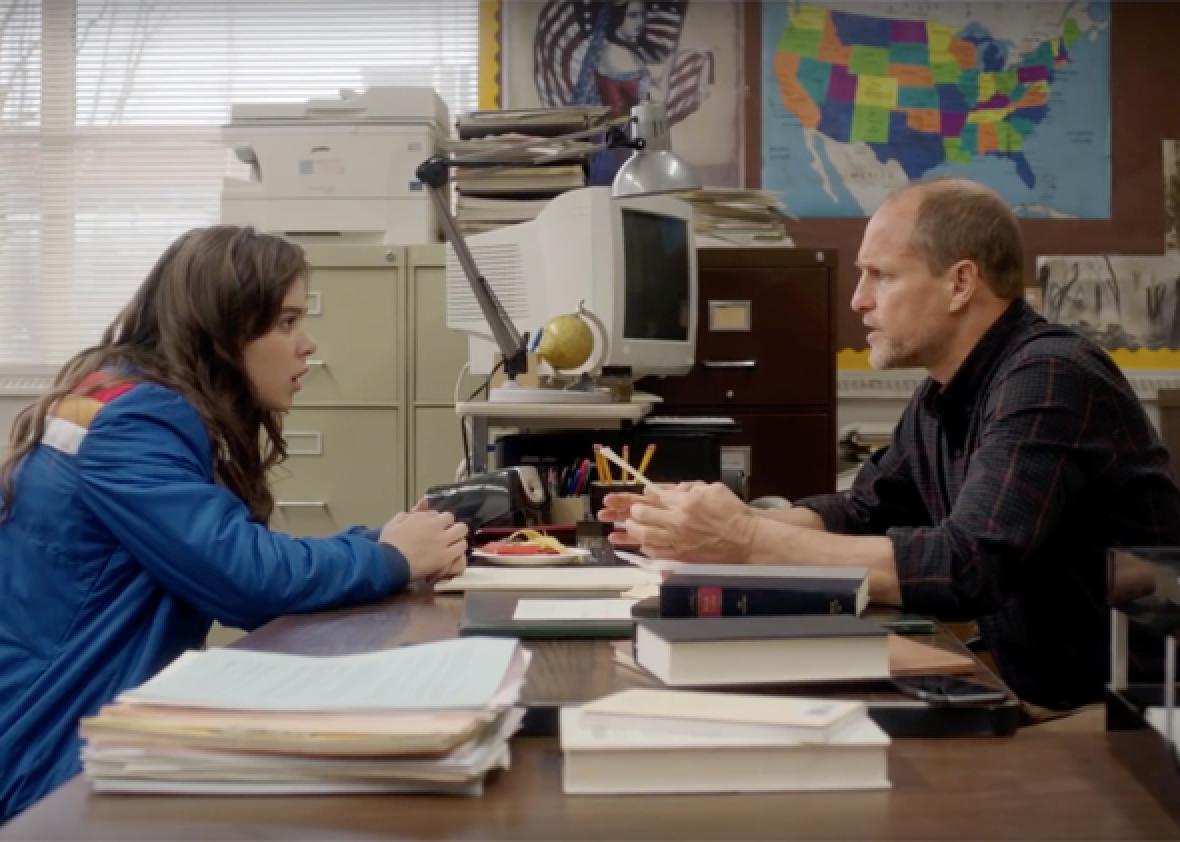
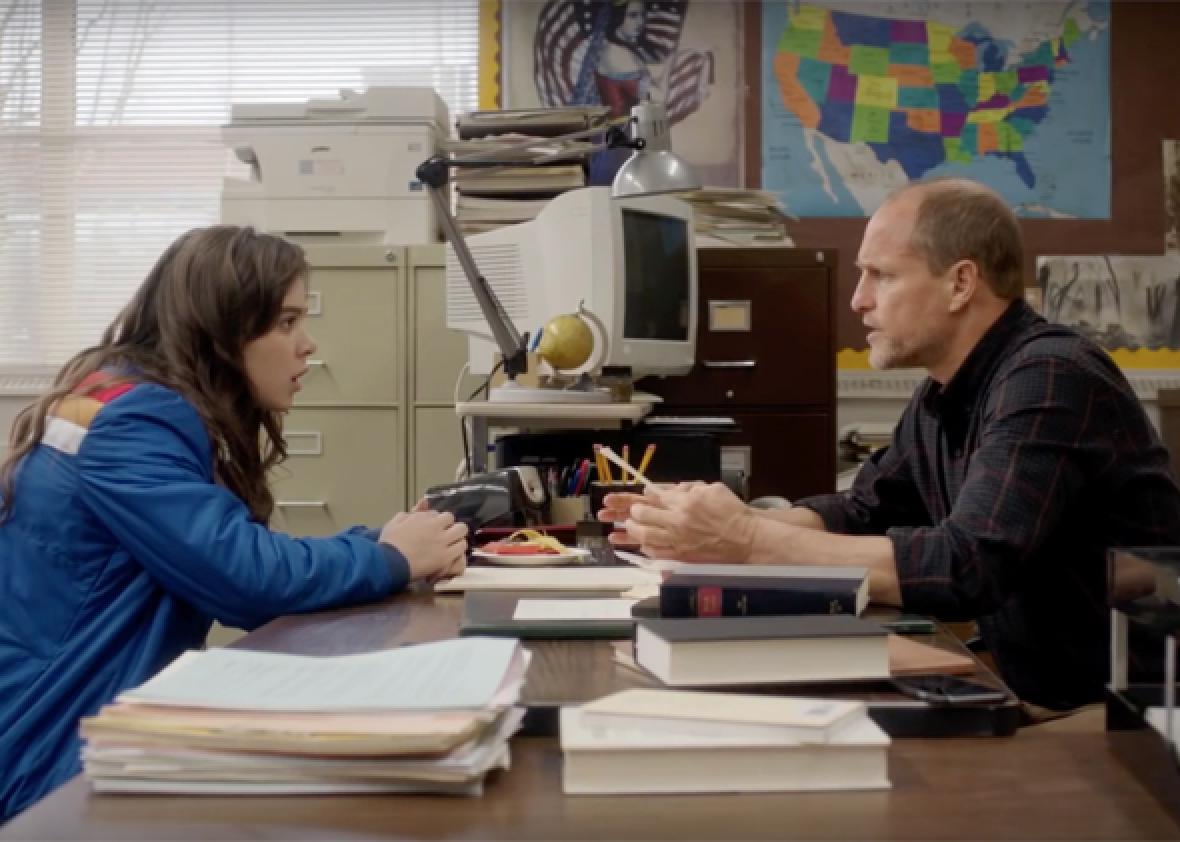
“Edge of Seventeen,” written and directed by Kelly Fremon Craig, captures the intensity and chaos and drama drama drama of this age. Hailee Steinfeld plays Nadine, who, like many 17-year-olds, is certain that she is the only person on earth who truly understands what it is to suffer. She actually has experienced a terrible loss, the death of her father, which has left her remaining family fragile. Her older brother Darian (Blake Jenner of “Everybody Wants Some!!”) compensates by being perfect in every disgusting way possible, from Nadine’s perspective. He is handsome, talented, athletic, and popular. That leaves nothing left for her but to be awkward and miserable.
The only thing good in her life, she thinks, is her endlessly supportive and understanding BFF Krista (Haley Lu Richardson), who sympathizes with Nadine about the misery of having no father, a perfect brother, and a crush on an unattainable boy who works at Petland in the mall (Alexander Calvert as Nick). She also has a teacher named Mr. Bruner, played with perfectly dry, understated wit by Woody Harrelson, who knows teenagers well enough to understand that the best way to reassure Nadine is not to try to comfort her. When she trounces into the classroom where he is eating lunch alone to tell him she has to kill herself, he responds by noting mildly that in fact she has just interrupted his own creation of a suicide note. “As some of you know, I have 32 fleeting minutes of happiness per school day during lunch which has been eaten up again and again by the same especially badly dressed student and I finally thought, you know what, I would rather have the dark, empty nothingness.” She thinks she wants everyone to be as fraught as she is. He knows how to strike just the right balance of detachment and sympathy.
So when she tries to cancel a sexually explicit invitation to Nick but accidentally sends it instead, Mr. Bruner is there to take a look and point out that she should be more careful about run-on sentences. The reason she is talking to him about it instead of Krista is that Krista, the single good thing in her life, has committed the ultimate betrayal. She and Darien are in a relationship. Nadine is in such a severe state of collapse that she does not notice that there is a smart, handsome, very nice boy interested in her (Hayden Szeto in a star-making performance as Erwin).
The film itself has that same perceptive sympathy for the agonies of adulthood, allowing us to laugh at Nadine only because we know she’ll be fine — she’s going to grow up and make this movie.
Parents should know that this movie has very explicit and crude language, sexual references, and non-explicit sexual situations, a car accident with a sad (offscreen) death of a parent), and teen drinking.
Family discussion: How did Nadine, Darien, and their mother express their grief differently? Is it easier being the perfect one? What do you do to feel better?
If you like this, try: “Rocket Science,” “Thumbsucker,” and “The Duff”
Interview: Stephen Apkon and Marcina Hales on “Disturbing the Peace,” a Moving and Inspiring Documentary about Israelis and Palestinians Working Together
Posted on November 17, 2016 at 3:28 pm
The song from “South Pacific” gets it right. Fear, bigotry, don’t come naturally. “You have to be carefully taught.” The moving and inspiring new documentary, “Disturbing the Peace,” tells the story of people who were “carefully taught” to hate each other, Israelis and Palestinians, but have learned that they share more than they could imagine, especially when it comes to to devastating grief and a deep sense of responsibility for causing grief to others. I first saw the film at Ebertfest last spring and have not stopped thinking about it. So I was especially grateful to get a chance to speak with the filmmakers, Stephen Apkon and Marcina Hales.
The title of the film refers to the irony that the activists portrayed in the film are often arrested at their non-violent demonstrations for “disturbing the peace” when what they are trying to do is send a message of peace to stop the killing that has been going on for decades. And it is a reference to the charges filed against Rosa Parks, Martin Luther King, Nelson Mandela, and others who have protested to make a more just world. “The really good question,” Apkon said, “is ‘Whose peace are they disturbing?’ That was a really profound one for us. And it also speaks to the idea that the first peace we need to disturb is our own and to really challenge the stories and the narratives that we accept as reality. One of the things one of the characters in the film told us that is not in the movie but he often talks about how if you want to grow up in a society with the mythology of the hero you have to create the villain. Hollywood films don’t exist without the hero and the villain and so we constantly do that within our own minds.” Hales added, “One of the narratives that we have to really pay attention to, to begin with, is the narrative of there being a hero and then a villain. I think that that is one of the ones that is predominant. You’ll see it in a narrative right here in America and all across the world.” Apkon said If you ask how those narratives get conveyed, it strikes me that it’s less in what we’re taught didactically than the soup that we swim in. I remember I was living in the region and my daughter was five years old at the time and she went off to kindergarten knowing not a word of Hebrew and some girl followed her all around the schoolyard and became her friend. And a few months into it my daughter was fluent in Hebrew. Her friend was sitting at dinner with her one night and she looks at her and said in Hebrew, ‘Who taught you to speak Hebrew?’ So my daughter, she looks at her and she said, ‘You did.’ She had no awareness of learning. She just absorbed it. So we pick up these narratives in the air that we breathe. It’s how memes are perpetuated and communicated throughout our society. ‘You can’t trust them.’ You do not know who taught you. It is all around you so it feels like the truth. It is not just in a book. It’s in our songs, it’s in our culture, it’s in what we say at the dinner table, it’s in our media.”
Hales said that one of the things they most wanted the film to do was “to actually get below the stories, the content and actually look at how it functions because it functions on a lot of levels. It functions on the individual level, just take a look at our own lives, and it functions at different levels having to do with our cities and our towns and in our political systems everywhere. So if we can see and show how it works, once you know you cannot not know, and it becomes apparent and we can look for them and actually create a different story.”
The film had its premiere at Ebertfest and was given the festival’s first-ever Ebertfest Humanitarian Award. Apkon said, “She was actually one of our first disturbers of the peace in a sense that, we were over in Israel finishing the edit and had an experience over there that we both wrote about in social media. Chaz immediately picked up on it and wrote us a letter saying, ‘When can I see this film?’ We literally finished the film around a window where Chaz could see the it. And so having her turn around and having at Ebertfest, having the courage to do that before it had been in any other festival was huge and she has really been an amazing.”
One especially affecting scene in the film is an argument, thoughtful, not heated, but reflecting real pain felt by both of them. I asked how they were able to film that very intimate conversation, which feels as though the couple is unaware of any cameras. Hales said that kind of honesty was their goal. “The idea was to get people comfortable enough to actually feel that vulnerability, that authenticity, that real conversation, and it is being able to hold that space of confidence and trust and admiration that Steve does.” The wife in that conversation was the last of the people in that film to see it, and Hales and Apkon were apprehensive about how she would respond to it. “When the film ended she was very emotional and she was really thankful that the film had been made. There was a sense of a tremendous relief in her ability to express where her angers came from, where her hurt came from. And as she talked about how her mother raised her with this hope that her children wouldn’t know an occupation and now here she is, her children are growing up that way. She wishes the same for them but understands the realities are different that they have never known a day not under occupation. And I think that’s a reality that very few can even imagine.”
Apkon said, “Two questions that come up quite often. First, ‘Is it Pro-Israeli or is it Pro-Palestinian?’ Our answer is yes. It’s pro humanity. As one person says at the end of the film, ‘Each person’s freedom and dignity is based on the other person’s.’ So we want for the other what we want for ourselves. The second thing is this question that comes up around balance people would often watch the film and they would be asking themselves especially in the first half of the film, ‘Is it balanced?’ We always look at that from our own cultural framework. For us it’s not a question of balance; it’s really the question of integration. The question is, can we integrate? Can we not look at the balance and the extreme but can we recognize our capacity for both extreme? Can we recognize as says in the film, “When we first find each other we found we have something in common, our willingness to kill people we don’t know” and she thought in essence we find that we both share the desire for peace?”