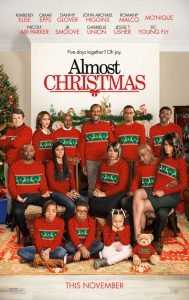
In “Almost Christmas,” Danny Glover plays Walter, a recent widower who spends a lot of time in the kitchen, trying over and over again to replicate his late wife’s legendary sweet potato pie. What he wants to replicate, of course, is the time when his family was all together, as shown in a heart-tugging, gracefully edited opening credit sequence, with the years melting into each other from 1971 to 2015. A young couple embraces on a mattress on the floor and, as it happens in life, an eye blink later they have three children, and then, as a bit of a late surprise, a fourth. The children are all adults now, coming home for the first Christmas since their mother died, and Walter wants it to be a time of reconnection. For that, he needs the sweet potato pie and it has to be just like hers.
Writer/director David Talbert (“Baggage Claim”) is trying for his own version of a sweet potato pie with this film, mixing in the standard ingredients for a Christmas family gathering comedy/drama movie. So, there are adult siblings with ongoing conflicts, a dad who is spending too much time on work, precocious kids (in this case, happily uploading every element of family dysfunction on social media), church, a guest star (though why you would put Gladys Knight in a film and not let her sing is beyond me), family traditions, a kitchen disaster, secrets to be revealed, a rekindled romance, a busted marriage, high maintenance in-laws, and, of course Christmas meaning and reconciliation magic and a lot of food. In other words, other than running into Gladys Knight, it is pretty much what goes on around the world at Christmas.
Talbert’s sweet potato pie of a movie has the right ingredients, and if they are not always combined just right, it still makes for a treat, with an exceptional cast and enough laughs to keep us going until the exact right moment for some tears.
Walter’s older son is Christian (Romany Malco), a husband and father of two who is running for Congress (none of this storyline makes any sense as Christmas is at least 11 months before the next election and the issue he gets caught up in is municipal, not federal, but okay). Malco is terrific in an unusually understated role. The look on his face as Walter asks him to speak at the homeless shelter his mother was devoted to shows endless tenderness and loss. His wife (an underused Nicole Ari Parker) is mostly there to remind him that he should not take time away from the family for his campaign. The youngest of Walter’s children is Evan (Jessie T. Usher), a college football player being scouted for the NFL draft, hiding an addiction to painkillers.
Their two sisters are Rachel (co-producer Gabrielle Union), a fiercely independent single mom and law student, and Cheryl (Kimberly Elise), a dentist married to a know-it-all former basketball player (J.B. Smoove), who is still a player, if you know what I mean.
Walter’s outspoken sister-in-law, a backup singer named May (Mo’Nique) arrives to wear a wild assortment of wigs and prepare an even wilder assortment of exotic foods that no one will touch. Rachel’s high school friend (Omar Epps) would like to renew their acquaintance. And Jasmine (Keri Hilson), Christian’s campaign manager (John Michael Higgins) and Evan’s friend (D.C. Young Fly) show up for various complications.
Like Walter’s pie, it’s not quite as good as the real thing. It would fit it well with Hallmark’s line-up of non-stop Christmas movies from Halloween through New Year’s Day. But there’s a reason those movies are so popular. They remind us of our own chaotic but still memorable holidays and our own difficult but still wonderful families.
Parents should know that this film includes some sexual references and a non-explicit situation, prescription drug abuse, sad offscreen death of a parent, offscreen car crash with injuries, gun, and some strong and explicit language.
Family discussion: What is your family’s favorite recipe? Why was it hard for the sisters to get along?
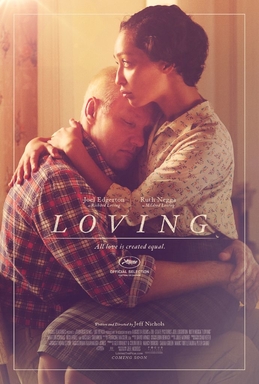
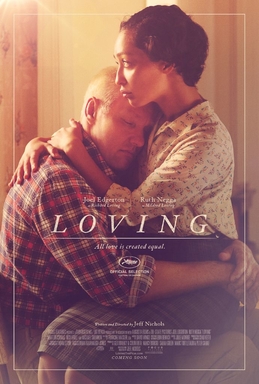
Copyright 2016 FocusWe don’t have to see how they met. We don’t have to see how he worked up the courage to ask her out or their first misunderstanding, or watch her try on different outfits before their big date. “Loving,” written and directed by Jeff Nichols (“Midnight Special,” “Mud”) brings us into the story of Richard and Mildred Loving (Joel Edgerton and Oscar nominee Ruth Negga) as they have a very short, very simple, but very meaningful conversation. She pauses, and we can see on her face that she does not know how he will react and is perhaps afraid to hope. Finally, she says it: “I’m pregnant.”
There is a pause, only a few seconds but it feels much longer. Finally he says only, “That’s great.” But it is clear that he is overjoyed that their love has created a child and he is fully committed to her. And it is clear, too, that they are not fully aware of the ramifications of having a child when the mother is black, the father is white, and the Commonwealth of Virginia, which shut down its entire school system just four years earlier in response to the Supreme Court’s Brown v. Board of Education decision, prohibits marriage or cohabitation between people of different races specifically because it does not want mixed-race children to be born.
Washington D.C. allows inter-racial marriage, so they are married there in 1958, and return home. One night the sheriff crashes into their home as they are sleeping in their bed, their marriage license on the wall, and arrests them. The judge suspends their sentence only if they will agree to leave the state and never return together.
They live with family in Washington, and raise three children. But Mildred wants to go home. Nichols conveys the Edenic quality of the countryside they love. The Civil Rights movement has begun, so she writes to Attorney General Robert Kennedy to ask for his help. He puts her in touch with the American Civil Liberties Union, a nonprofit that protects Constitutional rights. Two idealistic, if inexperienced, young lawyers (Nick Kroll and Jon Bass) want to take their case to the Supreme Court, which can invalidate all 16 state miscegenation laws.
Nichols keeps the legal stuff at the edges of the story. His focus is on the Lovings and their community, and the film is brimming with small, beautifully realized, evocative details. A dinner scene shows how completely Richard is accepted as a part of Mildred’s family. But we also see a frank conversation where a black man tells Richard that they may be alike, but Richard can “fix” his problem with the bigoted law by leaving Mildred while there is nothing they can do to “fix” theirs.
Richard’s mother, a midwife, only needs a few words to let Richard know that she did not give the police any information about where the Lovings were (and to let him know she was not entirely happy about the marriage, though she treats Mildred with kindness). We see a baleful glance from a defeated white competitor in a car race that could indicate the source of the complaint to the sheriff.
We see Richard’s careful, capable hands stirring mortar and laying concrete blocks and Mildred caring for the children and sitting at the kitchen table to write to the Attorney General. And, in a re-creation of the famous photo in LIFE Magazine by Grey Villet (a nice cameo by Nichols regular Michael Shannon), we see their quiet pleasure in each other as they laugh at the “Andy Griffith Show” episode about Aunt Bee’s pickles. He may need a lawyer to tell the nine old men on the Supreme Court he loves his wife. We see it in every frame.
Parents should know that this film depicts historic racism with some offensive epithets. The movie also includes a childbirth scene and an (off-screen) accident involving a child.
Family discussion: If you could take a case to the Supreme Court, what would it be? What do we learn about the Lovings from seeing them with their families?
“Loving,” opening across the country this week, is about the couple whose marriage became the Supreme Court case “Loving v. Virginia.” It is shocking today to think that it was not until 1967 that laws prohibiting marriage between people of different races were found unconstitutional. Today, there is a Supreme Court justice who is himself married to a woman of a different race.
Richard and Mildred Loving lived in a small Virginia community where the races mixed freely. Richard Loving was white and his father worked for a black man. Mildred herself was of mixed race, part black, part Native American, and probably part white as well. Virginia, which shut down the state’s school system for two years rather than follow the ruling in Brown v. Board of Education and integrate the schools, was one of sixteen states to prohibit interracial marriage. The Virginia judge who upheld the law wrote:
Almighty God created the races white, black, yellow, malay and red, and he placed them on separate continents. And but for the interference with his arrangement there would be no cause for such marriages. The fact that he separated the races shows that he did not intend for the races to mix.
The judge relied on an earlier court decision upholding miscegenation laws “to preserve the racial integrity of its citizens,” and to prevent “the corruption of blood,” “a mongrel breed of citizens,” and “the obliteration of racial pride.”
The Lovings were married in the District of Columbia, which permitted interracial marriage, and then they returned to their home. Police broke in while they were asleep and arrested them.
They were banned from the state. The judge told them that if they returned, they would be arrested. So, they moved to Washington D.C. and raised their three children. But they wanted very much to return to their rural community.
Mildred Loving wrote to Attorney General Robert Kennedy to ask for help, and his office referred her to the American Civil Liberties Union. Two young lawyers took the case. Ten years after they were arrested, their marriage made it possible for interracial couples — including President Obama’s parents — to be legally married.
The unanimous decision was stated in the strongest terms:
Marriage is one of the “basic civil rights of man,” fundamental to our very existence and survival. To deny this fundamental freedom on so unsupportable a basis as the racial classifications embodied in these statutes, classifications so directly subversive of the principle of equality at the heart of the Fourteenth Amendment, is surely to deprive all the State’s citizens of liberty without due process of law. The Fourteenth Amendment requires that the freedom of choice to marry not be restricted by invidious racial discriminations. Under our Constitution, the freedom to marry, or not marry, a person of another race resides with the individual and cannot be infringed by the State.
Later the Loving v. Virginia decision would be a significant precedent for the Obergefell v. Hodges decision in 2015, making it possible for same-sex couples to be legally married.
The “Loving” movie, written and directed by Jeff Nichols, stars Joel Edgerton and Ruth Negga. It is very much their story, with most of the legal issues and court appearances taking place off screen.
When the lawyer asked Richard Loving what his message was for the Supreme Court, he said one sentence that was more powerful and eloquent than all the legal arguments: “Tell the judge I love my wife.”
After you vote, take a break from red and blue maps to enjoy some of the portrayals of real US Presidents on screen.
Daniel Day-Lewis won an Oscar for Lincoln. I’ve already written about some of the many other movie versions of Lincoln’s life. “Wilson” stars Oscar nominee Alexander Knox in a dignified tribute to the 29th President. Gary Sinese gave a powerful performance in the HBO movie, Truman. Rough Riders has Tom Berenger as Theodore Roosevelt, leading Cuban rebels against Spain.
Perhaps the most fanciful portrayal of a real US President is “The Remarkable Andrew,” with William Holden as an honorable accountant who discovers a discrepancy in the town books and is visited by the ghost of his favorite President, Andrew Jackson (Brian Donlevy), who provides guidance and support.
President Kennedy’s WWII experience was the subject of PT 109, starring Cliff Robertson. He was also the subject of 13 Days, about the Cuban missile crisis. Oliver Stone has directed movies about Nixon, played by Anthony Hopkins (who also played a memorably cagy John Quincy Adams in “Amistad”), and George W. Bush, played by Josh Brolin. President Nixon has been portrayed in a number of other films, from the acclaimed Frost/Nixon to the humorous but touching Elvis and Nixon and the wild satire Dick. And of course he is the subject of the Oscar-winning Best Picture All the President’s Men, though he is only glimpsed in archival footage.
The Butler is based on the true story of a man who worked in the White House for eight Presidents, and we see everyone from Eisenhower to Reagan portrayed in the film. Of course Reagan himself was an actor before he went into politics. His best films include “King’s Row” (his own favorite), “Hellcats of the Navy” (co-starring with Nancy Reagan), and, yes, “Bedtime for Bonzo.”
There are some great President movies made for television: Gary Sinese gave a superb performance in Truman and Bryan Cranston was outstanding in the role he originated on Broadway, Lyndon Johnson in All the Way.
Interview: Gotham Chopra on the Audience Network Series “The Religion of Sports”
Posted on November 7, 2016 at 3:33 pm
Gotham Chopra talked to me about his new series for the Audience Network, “The Religion of Sports,” created with New England Patriots quarterback Tom Brady and NFL Hall of Famer Michael Strahan and premiering November 15, 2016.
Have you always been a big sports fan?
Yes, I have. I grew up in Boston Massachusetts during the 80’s and 90’s and so I’ve just always been a big Celtics, Red Sox, Bruins fan, really a diehard fan of those teams but I would say in general a lover of all sports.
It’s so different being a Red Sox fan now than it was prior to 2004. Not that I would ever go back but there was a sort of magic about that cursed existence. It created a sort of community that is very different than what it is now. They won three championships since then and they are one of those elite institutions now. They have become the Catholic Church where they were sort of the scrappy cults before then.
So what is it that makes sports so visceral and so tribal?
Yes, I think what’s unique about sports is that like religion they create a sense of community, a sense of belonging. Wrigley Field is a sacred space, like it’s a holy land. People go on pilgrimages.
So everything that we associate with religion actually happens in sports. Whereas traditionally religion requires faith and you have to believe in this and you have to do that and they have this dogma and everything, sports requires attendance. If you watch the World Series whether you are a Cleveland fan or you’re a Cubs fan, a miracle is going to happen. You just have to show up and I think that is pretty unique to sports. It is not a metaphor, it is not an allegory, it is a spiritual thing and even people who don’t aren’t even fans, they participate. That last game of the World Series people watched from all walks of life because it’s bigger than sports. That’s why I am very much a true believer. Being a fan is sort of something greater than yourself, it’s really is.
Do you think that there are cultural differences or temperament differences between say fans of baseball, football, basketball, hockey?
Yes, there definitely are. For sure it’s no different than politics, as we are watching some other holy war going on right now. If you come from different cultural backgrounds you are drawn to certain things. Part of what’s been fascinating about working on this series is I’ve been able to explore sports that I never really knew much about. So rodeo and NASCAR and stuff like that. It’s been fascinating to watch those.
One of the episodes is about a Scottish football league. The two city teams in Glasgow the Celtic and Rangers, one which is predominantly Catholic in terms of their fan base and one one predominantly Protestant. In this country let’s there are big rivalries but when you go to a place like that they say, “Wait, hold on, first let us talk about the Crusades, then let’s talk about the Reformation.” You have to go back several centuries to understand the roots of this rivalry. So that certainly has its different cultural complexion than what we necessarily see here.
That being said, there are also certain things that are very similar across all sports, not just from the fans’ perspective but from the athlete’s perspective.
What makes somebody a great athlete?
First of all, certainly they have a gifts, physical gifts, athletic gifts. I’ve been fortunate to work with Kobe Bryant, Tom Brady and David Ortiz, some of the most leading athletes in their respective sports, and I can see there is a competitiveness, there is a commitment, there is a discipline, there is a ambition to be the greatest that I think definitely unites the people at the top. Oftentimes you see with the best athletes that they are not the most physically gifted. There are guys who are and girls who are physically stronger, faster or that are more athletic or whatever but for whatever reason these ones that are so committed to their craft, the ones who are so disciplined no matter the consequence, that is what puts them over the top. And again to sort of spiritualize it there is a sort of almost like a martial arts discipline, even if you watch sort of Kobe Bryant go through a practice by himself it’s a monk in a monastery. I mean there is a routine there that is spiritual that I think is really admirable for me.
What were some of the biggest technological and production challenges of making this series?
We’ve been fortunate and a lot of credit goes to my executive producing partners, Michael Strahan and Tom Brady, you have guys like that who can help you get access but getting access both with athletes and but also in leagues can be very challenging. How do you get on the track at the Coca-Cola 600 NASCAR? Great storytelling depends on characters and in this case access and so that can be an incredible challenge. I think even once you get it because these are, even these more niche sports are so covered to death.
All of these athletes are used to cameras in their faces so trying to get something unique and true out of them can be challenging. And I think what I’ve been lucky about is that we tried to make this series less about just getting the biggest names in sports and instead it is very much about the culture around sports, and finding great fans around which you could tell their stories, those tend to be people who want to share their stories, who want to speak about why this thing is so important to them, that’s an incredible benefit.
Tell me about your project with David Ortiz.
I’ve been working with him all summer pretty much chronicling his last season. It’s a series for ESPN and they have run a number of digital shorts. I just drop in with him for 48 hours at a pivotal time in the season, so like opening day or his last series against the Yankees, stuff like that and just be with him as he was going through that.
And the greatest thing about the athletes especially at that level is like they physically can’t do it anymore even though David had an amazing year but they have to sort of give up something that they love as much as they ever did. I’m a filmmaker, you are a writer, we can kind of keep on doing this and get better at it and get passionate about it over and over again, pretty much for as long as we live. With athletes — I don’t even think David is 40 years old. They have to give it up and then what? And so I think it is fortunate to sort of be able to sort of chronicle a little bit of that over the last few months.
What have you learned about how people show their enthusiasm for teams and athletes?
People practice their faith in a lot of different ways. Attendance is probably the most common one but then of course the bigger the league the more difficult it is. It is super expensive to go to some of these games. Actually what I love is like going to the local dirt track in South Carolina on a Wednesday night. It’s the equivalent of going to the community church as opposed to sort of traveling to the Vatican, right? And you see people practicing their faith really at the grassroots level and so it’s inexpensive, it’s accessible, you can go touch the cars, you can really be a part of it, feel the dirt and again I’m not speaking in metaphors. You have to wash your clothes like eight times to get that dirt out once you come back from the race. So I think at the local level like our baseball episode is at the minor league level where the line between the athlete and the fan is a lot more blurred I guess that it necessarily is at the highest level, the professional level and I think for me to sort of be able to see the faith practiced at that level was pretty inspiring.
And superstition — when the Red Sox were in the World Series I couldn’t watch in a room I had to stand outside of my house and watch through the window holding my favorite baseball bat. There’s not a sports fan alive who doesn’t have some version of that, who wears only this jersey or eats only that food. The bigger the game, the bigger the superstition.
Some fan activities are totally ritualistic and the amazing thing about sports. There is a stereotype associated with the fans who paint their faces, that they come from a sort of economic class but I’ve seen deans of major universities do the same thing. You know they are the most sort of academic, intellectual people but then when they enter into this realm suddenly this tribe thing takes over and again they’re sitting side-by-side with people that they have nothing else in common with. I’ve not lived in Boston for years, like for actually more than half of my life, but I still go back every season, I try to go to an opening day or I go to a game or whatever and literally as I’m sitting there and listening, especially in like a political climate like this election, you listen to what people are talking about, I have nothing in common with these people except for this shared devotion to this thing and I think that’s a good thing. It’s fascinating to me, that sort of sense of belonging really cuts across everything.



 .
.  has Tom Berenger as Theodore Roosevelt, leading Cuban rebels against Spain.
 ,
,  ,
,  ,
,  ! (TIME notes that the only US President never to show up as a character in a movie is Warren G. Harding.)