
1776 — The Declaration of Independence
Posted on July 4, 2016 at 2:55 pm
From the great movie “1776” — the signing of the Declaration of Independence!
https://www.youtube.com/watch?v=uNOTozVp_i4
Posted on July 4, 2016 at 2:55 pm
From the great movie “1776” — the signing of the Declaration of Independence!
https://www.youtube.com/watch?v=uNOTozVp_i4
Posted on July 2, 2016 at 4:31 pm
Some good news from the Motion Picture Academy — the acceptance of a younger, more diverse group of highly qualified members, which should help with the embarrassingly narrow focus that led to the #oscarsowhite problem last year, not a single person of color nominated for an acting award. New members include actors Idris Elba, Brie Larson, John Boyega, America Ferrera, Michael B. Jordan, Emma Watson, Tina Fey, Oscar Isaac, Tom Hiddleston, Ice Cube, and directors Ryan Coogler, Julie Dash, Adam McKay and Patty Jenkins. and Chadwick Boseman. It is the Academy’s largest and most diverse new group of members, more than double the 322 invited last year. 41% of the new invitees are people of color. There are 283 new international members from 59 countries. Academy president Cheryl Boone has made good on her promise for prompt action. Here’s hoping we see this kind of improvement every year.
Posted on June 30, 2016 at 5:50 pm
B+| Lowest Recommended Age: | Kindergarten - 3rd Grade |
| MPAA Rating: | Rated PG for action/peril, some scary moments and brief rude humor |
| Profanity: | None |
| Alcohol/ Drugs: | Brief scene with drunken characters |
| Violence/ Scariness: | Extended fantasy-style violence, reference to off-screen violence, including death of children, but no characters injured |
| Diversity Issues: | None |
| Date Released to Theaters: | July 1, 2016 |
| Date Released to DVD: | November 28, 2016 |
| Amazon.com ASIN: | B01G4N5Q0A |
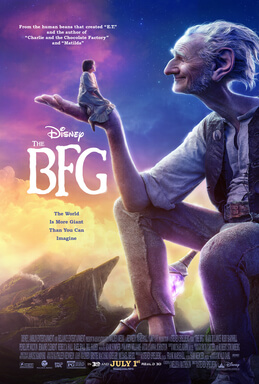
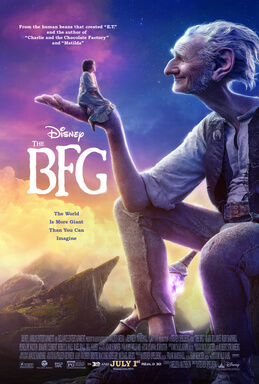
Steven Spielberg. the director who, with his partners, named their movie studio Dreamworks, understands that movies are like a guided dream. Roald Dahl’s story is about a Big Friendly Giant who collects, selects, edits, and delivers dreams to make people happy and conveys messages that are beyond the capacity of verbal human interaction. Clearly, this story connects with Spielberg profoundly, and it shows.
At 3 am one night in 1983, a girl named Sophie (Ruby Barnhill) is the only one awake in the horrible London orphanage where she lives. We can see right away that she is brave and smart, even fierce, as she threatens to call the cops on some drunken revelers making noise in the street. But then she witnesses a disturbance of another kind. Someone very, very large, as tall as her building, is walking quietly — no, stealthily — through the streets.
And then an enormous hand reaches silently and carefully into the window of the room filled with sleeping girls and the very awake Sophie, and grabs her, quilt and all. It is a giant.
He knows how to stay hidden. We see him employ some clever camouflage that keeps the Londoners from seeing him, and then takes off for Giant country, far, far away, but a matter of moments if you’ve got giant legs to leap with. Sophie is terrified. She is sure that the giant wants to eat her. But he does not eat children, he tells her, in his funny, corkscrew, word-twisting language. He has only taken her because she saw him, and he cannot risk her telling anyone about him. He has taken her to keep her from giving away his secret, which means she will have to stay with him forever.
Sophie is determined to run away. But that night, in the crow’s nest of a ship that is one of the many curios crowding his home, she dreams that she escapes, only to be captured and eaten by some even bigger giants. Through this dream, she begins to understand what her giant, soon to be known as the BFG, can’t explain any other way. She cannot be safe if she leaves his house. The other giants, who are as big to him as he is to Sophie, are uncivilized brutes and bullies. They eat “human beans,” including children (a bit less grisly than in the book, but still creepy).
The BFG, whose huge ears listen to everything, even the quietest whisperings of the heart, collects dreams. Sophie goes with him to the place where dreams grow, and she helps him deliver the happiest possible dreams to a young boy and his family. The lonely little girl and the lonely giant get to know one another, and become friends. But the other giants can smell her, and they won’t leave the BFG and Sophie alone. They have to come up with a plan to get rid of the child-eating giants forever. It will involve dreams. And corgis.
This is a slighter story than Dahl’s richly imagined Charlie and the Chocolate Factory, Matilda, and James and the Giant Peach, with much of its humor coming from the BFG’s mangled words and his affection for his favorite beverage, Frobscottle, a fizzy green drink with bubbles that float down, rather than up. The noisy and powerfully butt-lifting physical consequence of this downward gas is what the BFG calls a whizpopple. And there is also an extended scene with the BFG trying to fit into the “bean”-sized world, sitting on a bench on top of a piano and using a rake as a fork.
That almost doesn’t matter, given Spielberg’s gorgeously imagined world and the performances of Mark Rylance as the BFG and Barnhill as Sophie. Rylance, whose last collaboration with Spielberg won him an Oscar for “Bridge of Spies,” is transformed via motion capture into the BFG, and does not lose an atom of his ability to express the BFG’s melancholy, isolation, gentleness, and integrity.
Spielberg has always been superb in casting, especially with children. Barnhill’s performance would be remarkable if she were interacting in a built, rather than virtual world. Given that in much of the movie she was probably looking at a tennis ball hanging in front of a green screen, it is truly astonishing. She so clearly believes in what we see around her and to her character’s friendship with the BFG that we believe in it, too. Next-level special effects help, too, with utterly seamless interaction between the digital and practical effects and gorgeous, wonderfully intricate production design that makes the BFG’s home both cozy and strange. The setting for retrieving the dreams is enchanting, though the visualization of the dreams themselves is not up to the level of the rest of the design. But the friendship between the BFG and Sophie is real magic.
Parents should know that this film includes extended fantasy peril and some violence (no characters hurt), references to children being eaten by giants, and some potty humor.
Family discussion: What dream would you most like to have? Why wasn’t the BFG like the other giants?
If you like this, try: Roald Dahl books and movies including “Willie Wonka and the Chocolate Factory,” “Fantastic Mr. Fox,” “Matilda,” and “James and the Giant Peach”
Posted on June 30, 2016 at 4:15 pm
B-| Lowest Recommended Age: | Middle School |
| MPAA Rating: | Rated PG-13 for sequences of action and violence, some sensuality and brief rude dialogue |
| Profanity: | Some racist epithets and mild language |
| Alcohol/ Drugs: | Some social drinking |
| Violence/ Scariness: | Extended peril and violence, characters injured and killed, some disturbing and graphic images and scary animals |
| Diversity Issues: | Historical abuse and enslavement |
| Date Released to Theaters: | July 1, 2016 |

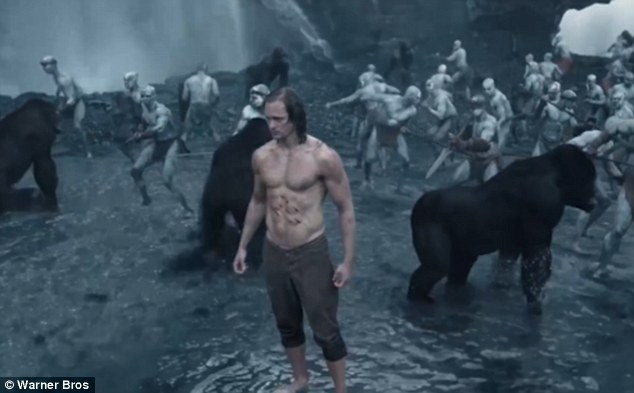
But there’s a lot the movie does not get right. It’s not terrible; it’s just oddly off, as though it was assembled by a committee that didn’t communicate with each other very well. The first problem is that Tarzan is depressed. I do not know why people seem to think that we somehow make classic literary characters more sophisticated or modern by making them depressed, but I’ve had enough of it. We’ve already had a depressed Batman and a depressed Superman this year. We don’t need a depressed Tarzan. Tarzan, now using his birth name of John Clayton, Lord Greystoke, is living in England when we first see him. Presented with an invitation to return to the Congo as the guest of King Leopold, he declines. Lifting a pinky as he sips from a porcelain teacup to demonstrate just how far he has come from running naked through the jungle, he explains simply, “It’s too hot.” He does not want to go back. But an American named George Washington Williams (played by Samuel L. Jackson and a toupee) persuades him to return, so he can investigate charges of abuse and enslavement. Jane is thrilled to return to Africa, and John reluctantly agrees to let her come along.
The invitation from the King was engineered by Leon Rom (Christoph Waltz, in his usual ultra-civil, ultra-evil mode). If he can deliver John to Chief Mbonga (a regal Djimon Hounsou) the chief will give him access to the diamond mines. When John escapes, Rom takes Jane and some of her tribal friends prisoner.
There’s an unfinished quality to the film. The tone shifts from a literally heavy-handed early image of a cruel hand wrapped in a rosary ripping a flower from its stem to some awkward and anachronistic attempts at humor (Samuel L. Jackson after a diplomatic speech: “And I thought the Civil War was long!”), and distracting random camera-swooping. But the real drag on the film’s momentum is Tarzan himself, who is so morose that the energy seeps out of the story. Reportedly, Skarsgård spent six months working out all day. He looks great, but to be honest he already looked great, and the fixation with male or female movie stars remaking their bodies for roles is barbaric. What needed the work was the script.
Parents should know that this film includes extended peril and violence, guns, spears, explosions, predator animals some disturbing images, characters injured and killed, some sexual references, and brief strong and racist language.
Family discussion: Why did John and Jane have different views about going back to Africa? How did John’s idea of honor change and why?
If you like this, try: the many other movie and television portrayals of Tarzan and the books by Edgar Rice Burroughs
Posted on June 29, 2016 at 1:55 pm
Johnny Simmons has the title role in The Phenom, an exceptionally intelligent and insightful film about a troubled young major league pitcher and the therapist who helps him understand the impact his abusive father has had on him. Simmons is one of my favorite young actors and it was a treat to get to talk to him about the role. The film was released in theaters and on VOD and digital June 24, 2016.
Simmons plays a character who does not speak much and through much of the film has very little insight about himself or the people around him. “It was challenge,” Simmons told me, when I asked him about acting when the character is so subdued. Writer/director Noah Buschel “kept constantly bringing it back and pulling it back and pulling it back and I think that that’s reflective in the outcome; you see that in the movie. So on the set, it was the first film where I ever left a set early because we got done shooting earlier that we even expected. I think we left like 1 or 2 o’clock in the afternoon which if you’ve ever been on set that is just unheard of. And I think it’s because Noah knew exactly what he was going for and it’s in his vision from the very beginning. So it was hard to do at times because you are going to want do something when you are an actor and I learned how to pull it all back honestly.”
I asked what Buschel first told him about Hopper, the character he would be playing. “The one thing that was a clicking moment for me was when he said if there was an empty chair in the corner of the room that’s where you would find Hopper. Once I heard that I was like okay. He is really shy.” It wasn’t so much that Hopper was trying not to feel anything. “I think he is unable to feel. I don’t know if it’s intentional but he is certainly cut off or removed.” Simmons loved the script the first time he read it. “I felt that I knew what I wanted to do with it at that point — which by the way totally changed. But I could see where I wanted to go right away. It’s like you start reading the script and you know what’s coming because you tapped into the way the writer’s head was when he was writing it. I feel like that very rarely happens but it does happen when you’re like – I know what he is about to say. And that’s such a cool feeling.”
He felt lucky that the original start date was pushed back, which gave him more time to work on the role. “So we had a lot of time to talk about it that’s one thing. More often than not especially on a smaller budget film you don’t have any time. So we have to kind of fall into each other’s arms and just trust each other. So you always wish your last day was your first day because what you know about the experience makes you feel like you are ready to begin.”
Hopper is caught throughout the movie between two symbols of masculinity: the therapist, played by Paul Giamatti and the father, played by Ethan Hawke. Simmons said that anyone can identify with the struggle to find a role model and the consequence of learning that someone you look up to is not all you had thought or hoped. “I know that I had to figure all that out as well and I think I’m still figuring it out. I don’t know if you ever arrive at the place where you are like, ‘Oh that’s who I want to be,’ because I have been lucky and also unlucky in that I’ve met a bunch of my heroes. It happened to me on this film. Luckily on this film everybody that I met was incredible but sometimes your hero can be a letdown if you let it be because you realize that they are just human. And then that teaches you something. At first it’s a bummer because you are like, ‘Oh damn, they are human.’ I think that Hopper is kind of in that group where he is just a complete anomaly, somebody who really makes it to the major leagues and he gets the opportunity to realize that having your dreams come true doesn’t necessarily mean roses and happy love songs. I don’t know if that’s the truth for everybody but it has definitely happened to me. I have a couple of friends who have gone pro in sports and if you are off by an inch it’s an entire mind game for the next week. That’s how it works, like your whole world is based around an inch. Being an actor but your whole world turns on an inch, too. I guess the goal would be to not let it be that. Everybody is going to have their own issues that they bring to the table but for me the best thing is just giving over to whatever is there and trusting whatever is there and enjoying it. It’s so easy to become caught up by ‘I’ve got to do this’ or ‘I’ve got to do that’ and most of the times the best stuff comes from when you are not trying to do anything and when you let go. Just trust those around you and trust yourself.”