Trailer: Love and Friendship from Jane Austen and Whit Stillman
Posted on March 28, 2016 at 8:00 am
Jane Auten’s unfinished novel Lady Susan is an epistolary story — told via letters. The title character is a scheming, manipulative woman determined to find rich husbands for herself and her daughter. It is the basis for “Love and Friendship,” the new movie from writer/director Whit Stillman, starring Kate Beckinsale.
Trailer: Miles Teller and Jonah Hill in “War Dogs”
Posted on March 25, 2016 at 3:11 pm
Based on a true story and from Bradley Cooper’s production company, “War Dogs” follows two friends in their early 20s (Jonah Hill and Miles Teller) living in Miami Beach during the Iraq War who exploit a little-known government initiative that allows small businesses to bid on U.S. Military contracts. Starting small, they begin raking in big money and are living the high life. But the pair gets in over their heads when they land a 300 million dollar deal to arm the Afghan Military—a deal that puts them in business with some very shady people, not the least of which turns out to be the U.S. Government.
I can’t say I recommend buying a ticket for Batman v. Superman: Dawn of Justice, but anyone who decides to go should check out this primer to bring you up to date. It has some interesting background (Jenna Malone as a future female Robin? Christian Bale turned down how much to play Batman again?) and some provocative thoughts on where DC will go next.
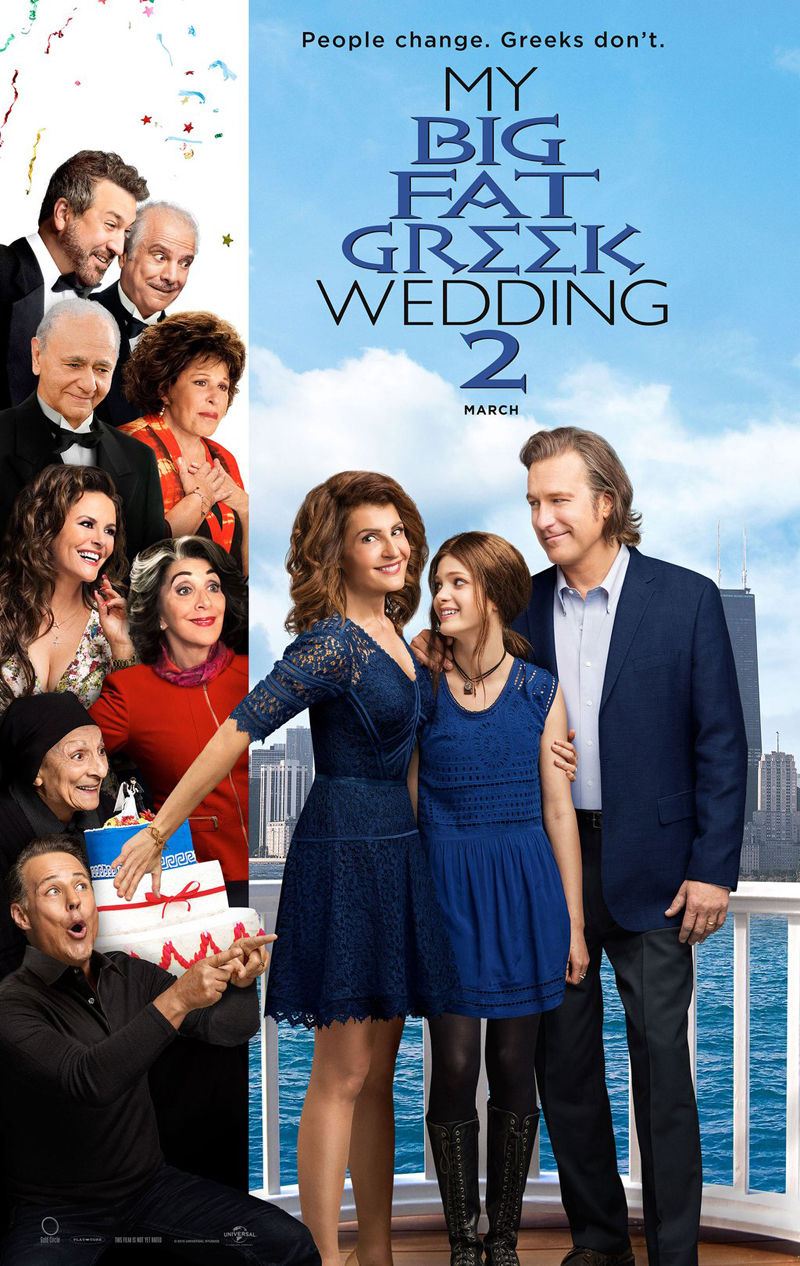
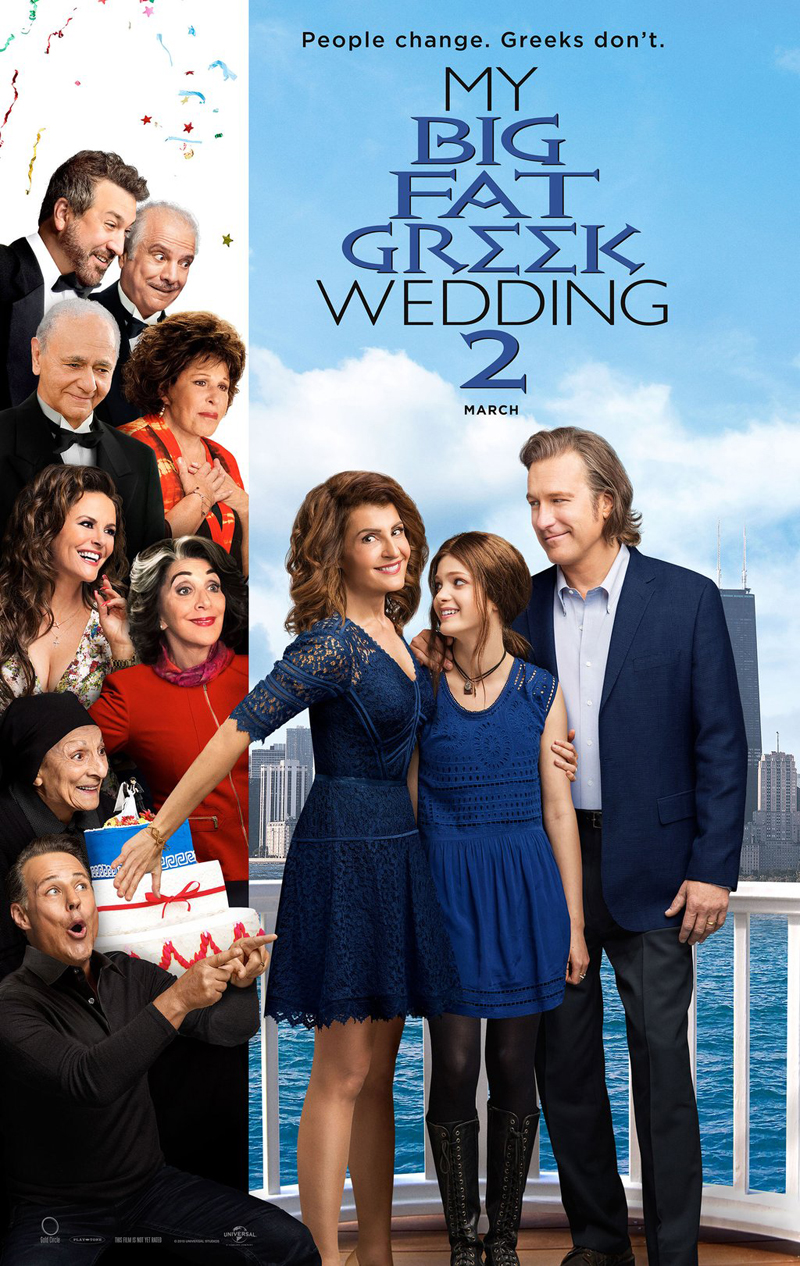
The original “My Big Fat Greek Wedding” was a charming surprise, a fresh, honest story about a young woman trying to find a way to be true to herself despite her loving but overwhelmingly intrusive Greek-American family. This 15-years-later sequel is an overstuffed, undercooked cash grab, operating at the low level of a basic cable sit-com with a juiced-up laugh track. There’s a big difference between finding it funny when a family has what therapists call boundary issues and bombarding the audience with overshares. Or, as Toula tells us just to make sure we understand, “We see no difference between hugging and suffocation.”
Copyright Universal 2016
The original was an exaggerated but affectionate portrayal of family dynamics that are familiar to anyone who struggled to find a distinctive individual direction despite family expectations to the contrary, which is pretty much everyone. The sequel is grotesque caricature, repeating and coarsening the humor of the first one, with repeated clunky set-ups for each of its obvious twists. The first one was a sleeper made for a shoestring that became one of the highest-profit films of all time, released in the same month as a big-budget special effects flop, “Pluto Nash,” with a mirror image record-breaking balance sheet — it lost almost as much as “Big Fat Greek Wedding” made. This sequel won’t set any records in either direction. It has some appealing characters and mild humor. But it devalues the franchise so badly that it is retroactive, diluting any remaining affection for the first one.
The couple who had the titular nuptials in the 2002 film were Toula (screenwriter Nia Vardalos), the daughter of Greek-American restaurant owners who dreamed of working with computers as a travel agent, and Ian (John Corbett), a WASP-y vegetarian teacher. At the engagement party, her parents brought a battalion of cousins named Nicky. His parents brought a bundt cake. An adorable culture clash! Is this a great country or what!
Fifteen years later, Toula, Ian, and their 17-year-old daughter Paris (Elena Kampouris, lovely even in ghoulish makeup) live next door to her parents, Gus (Michael Constantine), who still believes that the Greeks invented everything and Windex can cure anything, and Maria (Lainie Kazan), who still lets him think he runs everything. Toula tries hard to make everyone happy as she is sandwiched between a daughter who needs her less than she wants her to and parents who need her more than she wants them to. “Just when my daughter doesn’t want me around anymore, my parents need me more than ever.”
All the relatives live right nearby and everyone is up in each other’s business all the time and Hollywood Greek-Americans John Stamos and Rita Wilson, who produced the film, show up for an obvious gag and can the Stamos character, a TV newscaster really have a tagline involving shooting a finger-gun?
Toula’s big fat Greek family is supposed to be loveable, but they are just shrill and annoying. Either Aunt Voula (Andrea Martin) is going into excruciating detail on her sex life or her medical quirks or Gus is trying to find a nice Greek boyfriend for Paris to marry so she can have lots of Greek babies. Ian is now the high school principal and Tula is back where we first met her, working in her parents’ restaurant and even has to don her old glasses. They want Paris to stay near them in Chicago when she goes to college. Like Toula in the first film, Paris wants more independence. Like Toula’s parents in the first film, Toula and Ian do not want to let her go. Meanwhile, their focus on the family has led Toula and Ian to lose touch with one another. So, hey, why not another makeover for Toula?
And this is a Big Fat Greek Wedding film, so there must be another wedding. It turns out that Gus and Maria’s marriage license from half a century ago in Greece was never signed. So, Gus has to persuade Maria to marry him all over again and that means giving her the wedding of her dreams. Opa!
It is filled with the kind of stereotyping that would elicit howls of protest from anti-defamation groups if not made by Greeks themselves. That doesn’t prevent the ugly stereotyping of non-Greeks, all portrayed as thin-blooded and snobbish, except for Ian and the real-life Ian, the actor husband of Vardalos, as a kind-hearted cop who married into the family. A revelation about a family member who is gay could have led to some interesting moments, given the family’s very narrow concepts of masculinity, but it is too busy with jokes about how gross an old man’s nudity is. Even Gus would agree that this is beyond the powers of Windex.
Parents should know that this movie has some crude humor, sexual references, and a non-explicit situation. There is some scuffling, a non-serious medical emergency, social drinking, and tipsiness.
Family discussion: Ask family members about how they handled parent-child conflicts about independence — and weddings. Why was it important for Maria that Gus propose to her?
If you like this, try: the first film and another film from Vardalos, “Connie and Carla”