Military violence including terrorism, bombs, explosions, characters injured and killed, some disturbing images
Diversity Issues:
Diverse characters
Date Released to Theaters:
March 11, 2016
Date Released to DVD:
June 27, 2016
Amazon.com ASIN:
B01CUMHBJS
Copyright Bleeker Street 2016
“Eye in the Sky” is a rare thriller that grips the mind and heart equally. Drones take our military closer than we have ever been before to the people and the activities of the enemy as they remove us further than we have ever been before from the visceral reality of the actions we take based on what we have learned. This film takes us inside the tactical, political, legal, and moral choices faced by the international governments and military in combating terrorism. Director Gavin Hood and screenwriter Guy Hibbert show us the stakes rising and the options shrinking with each passing second, so we in the audience must constantly ask ourselves not just what the characters should do but what we would do.
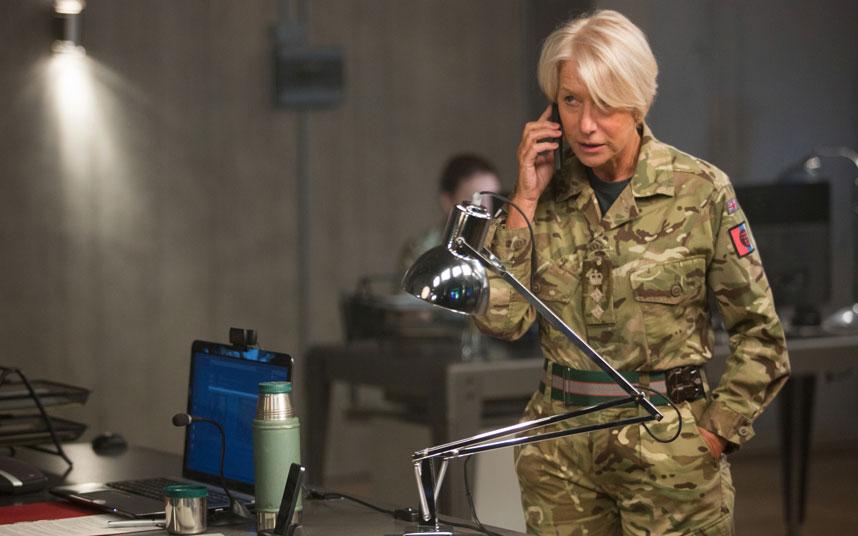
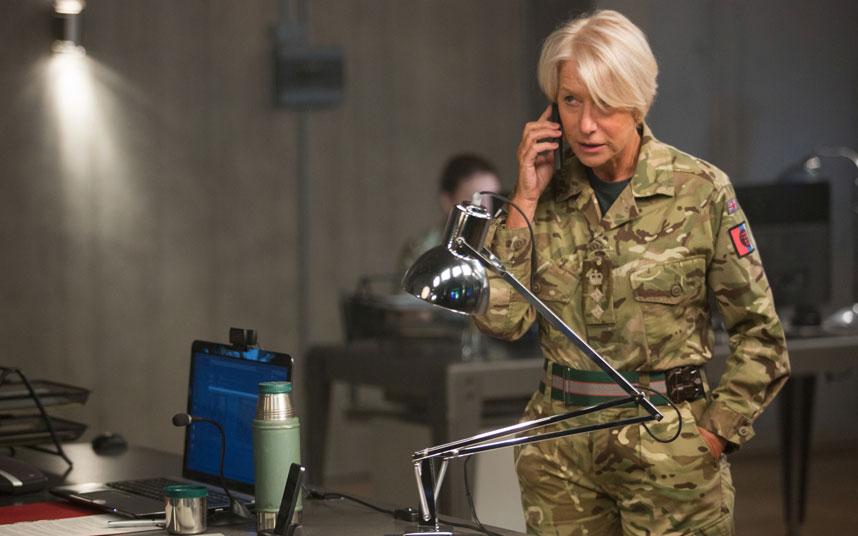
Colonel Katherine Powell of the British Army (Helen Mirren) is awakened by her phone. Intelligence received via drone indicates that three from the top ten international most wanted list of terrorists may possibly be together at a home in Kenya. The British and the US are especially interested in one couple they have been trying to find for six years. The wife is British and the husband is American. Both countries want them captured and tried at home.
If her team can positively identify the couple and the man they are meeting with, the mission will turn from reconnaissance to capture. But then the drone camera reveals that the danger is far more dire and imminent than they thought. The house is not just a meeting place. They are arming suicide bombers, taping their last statements, and presumably getting ready to send them into densely populated areas for maximum carnage. The people working on this are all over the world, with a military unit in Hawaii that analyzes images from a drone in Kenya, flown by a pilot in Las Vegas, commanded by military personnel in England, under the direction of elected officials who are both away from their countries on business.
The military has the capacity to prevent the suicide bombers from inflicting damage on civilians by blowing them up before they leave. But they are in the middle of a residential area. Is this warfare or an execution? Does it matter that two of the targets are British and US citizens? Does it matter that a little girl is selling bread just outside the house?
The international scope of the mission and the bureaucratic/political decision-making is fascinating. Information inside the house comes from a tiny mini-drone that looks like an insect, flown into the house by an operative nearby who is pretending to be both selling buckets in the open market and playing a video game on a phone. The operative is played by “Captain Phillips” star Barkhad Abdi, a very different and equally impressive performance of great intelligence and thoughtfulness. Information from the outside, including the biometric identification of the suspected terrorists, comes from drones monitored by Americans half a world away. Sitting at screens are Aaron Paul and Phoebe Fox as US military who are diligent and dedicated but not really prepared to blow up the people they’ve been spying on, especially that little girl.
There is a literal ticking time bomb in that house. We can see it. What should we do about it? Should we risk that child’s life to keep the suicide bombers from taking more lives? For the military, including Colonel Powell and her boss, Lieutenant General Frank Benson (the late Alan Rickman, making us miss him even more sharply), it is a mathematical calculus; not simple, but clear. They know they must consult the lawyers, who remind them of the criteria, almost a formula, they are required to apply. But the bureaucrats get nervous, and bump it up to the politicians. Calls must be made all over the world as the officials are participating in various diplomatic events; at one point it is even suggested that the question be put to the President of the United States.
But the film shows us that these questions have already been asked and answered. There is a calculus that is reassuringly quantitative and comprehensive but disturbingly clinical. As we see the people all over the world watching the people inside the house, trying to figure out how to apply those algorithms expressed in acronyms and percentages, the film forces us along with the characters to try to apply formulas to a world that will always confound them.
Parents should know that this movie features military violence including drones, guns, explosions, terrorism, suicide bombers, with some grisly and disturbing images, and very strong language. An extended part of the film focuses on potential “collateral damage” to civilians, including a child, from military action.
Family discussion: How would you improve the decision that was ultimately made? How would you improve the process for making it? Who should decide?
Copyright 2016 FocusWe have a very clear picture of Jesus’s birth, and it is endlessly re-enacted and depicted each year at Christmas time. But we know almost nothing about His childhood, other than his astonishing the elders with his depth of knowledge.
“The Young Messiah,” “inspired by scripture and rooted in history,” shows us His early years. It is a reverential, respectful portrayal of Jesus at age 7, as the Romans were trying to find and kill Him, and as He was just beginning to understand His power and purpose. It is based on the book by Anne Rice.
Jesus is played by sweet-faced Adam Greaves-Neal. We first see Him listening to a young girl who is teaching him to draw a camel. When a bully gives her a hard time, Jesus steps in to defend her and the bully starts attacking Him. A mysterious hooded figure tosses an apple core to trip up the bully, who falls, hits his head on a rock, and dies. No one else could see the man in the hood, and Jesus is blamed for the boy’s death.
The young Messiah insists on visiting the body, and it is there He performs His first miracle, bringing the boy back to life. This is an extraordinary moment because no one, even Jesus himself, knew such a thing was possible or that He was capable of it. And yet Jesus is so young, and his compassion so deep, that it seems completely natural for him. It confirms the greatest hopes but also the greatest fears of Mary and Joseph as it makes him a target for the Romans. And, like all parents, they have to find a way to protect their child and to answer His questions, though both are difficult and both at the same time seem impossible. “How do we explain God to His own son?” Even more difficult, how can they explain to Him a world in which the road is lined with crucified Jews and babies were murdered because the Romans were so afraid of Him? And how should they guide Him in using a power no one really understands? Mary can only say, “Keep your power inside you until your Father in Heaven shows you the time to use it.”
As Jesus and his family travel from Egypt to Jerusalem, Herod sends a soldier named Severus (Sean Bean) to find the boy and kill Him. Severus is not worried about reports that the boy can perform miracles. “There’s only one miracle,” he says, brandishing his sword. “Roman steel.”
Greaves-Neal is not really an actor, but his performance has an appealing dignity and tenderness. “Am I dangerous?” he asks, not “Am I in danger?”
It is especially good to see the young Jesus portrayed as compassionate but also intensely curious about the world. That thirst for knowledge and understanding is as inspiring to those around Him as His miracles.
Parents should know that this film include Biblical violence including crucifixion, bullying, and characters are injured and killed.
Family discussion: What do we learn about Jesus from his reaction to the bully? How did his curiosity about the world and scripture help him understand his purpose?
The Dinotrux have figured out a new building tool that helps Skya save the day. Watch Skya take on D-Structs head on when Dinotrux Season 2 comes to Netflix March 11, 2016 from Dreamworks Animation.
Ty and his best friend Revvit are back, building and battling in an all-new Season 2. The turf war escalates when D-Structs unveils a buzz-saw tail, battles with battering-ram Skya and kidnaps Revvit. Together the team saves the Ottos from a meteor crash, goes underground to escape the Desert Scraptors and builds a racetrack with Ton-Ton’s friends the Dumps. The fun never ends with the crew that’s half dinosaur, half truck.
Interview: Dawn Porter on the Abortion Documentary “Trapped”
Posted on March 8, 2016 at 3:20 pm
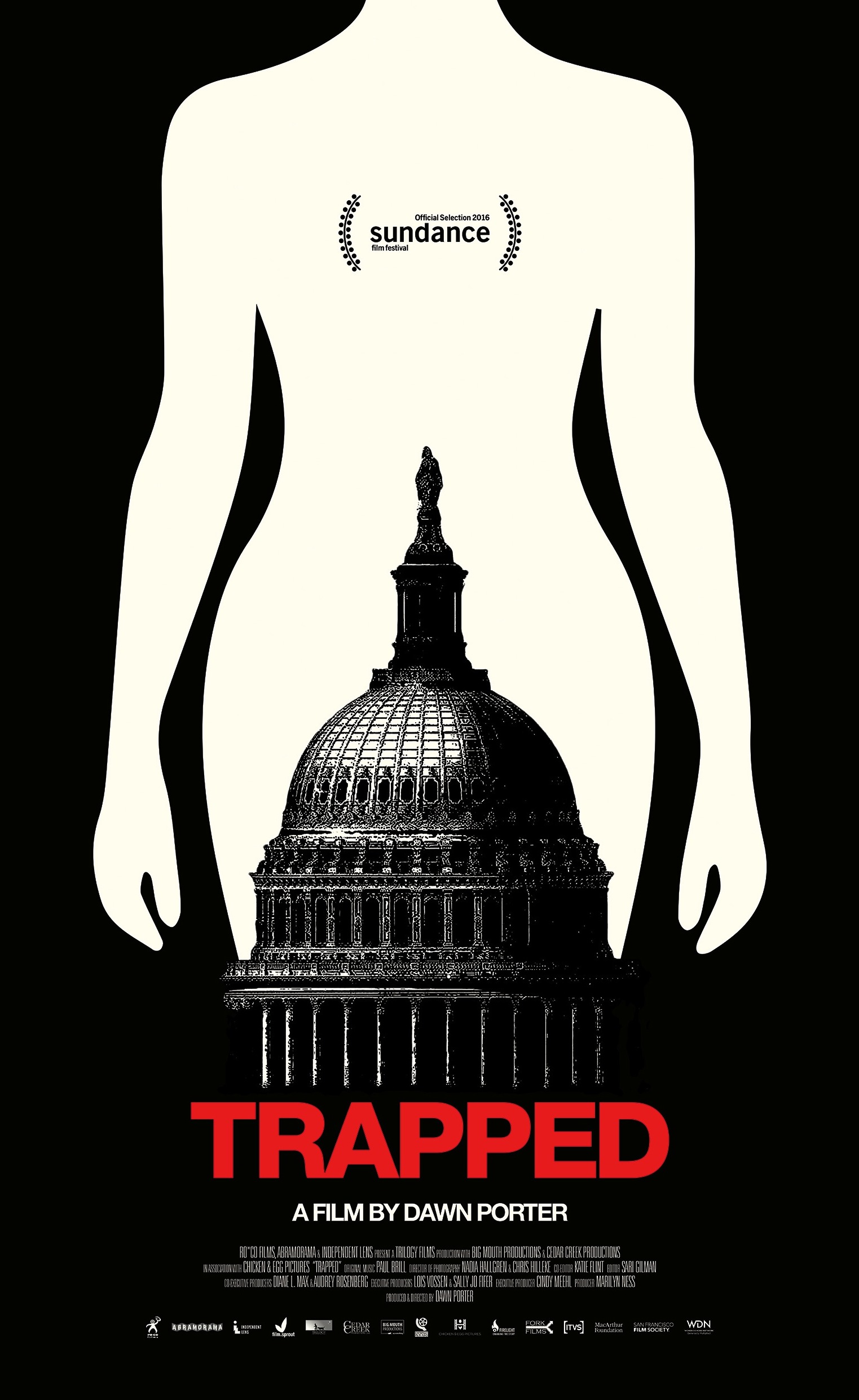
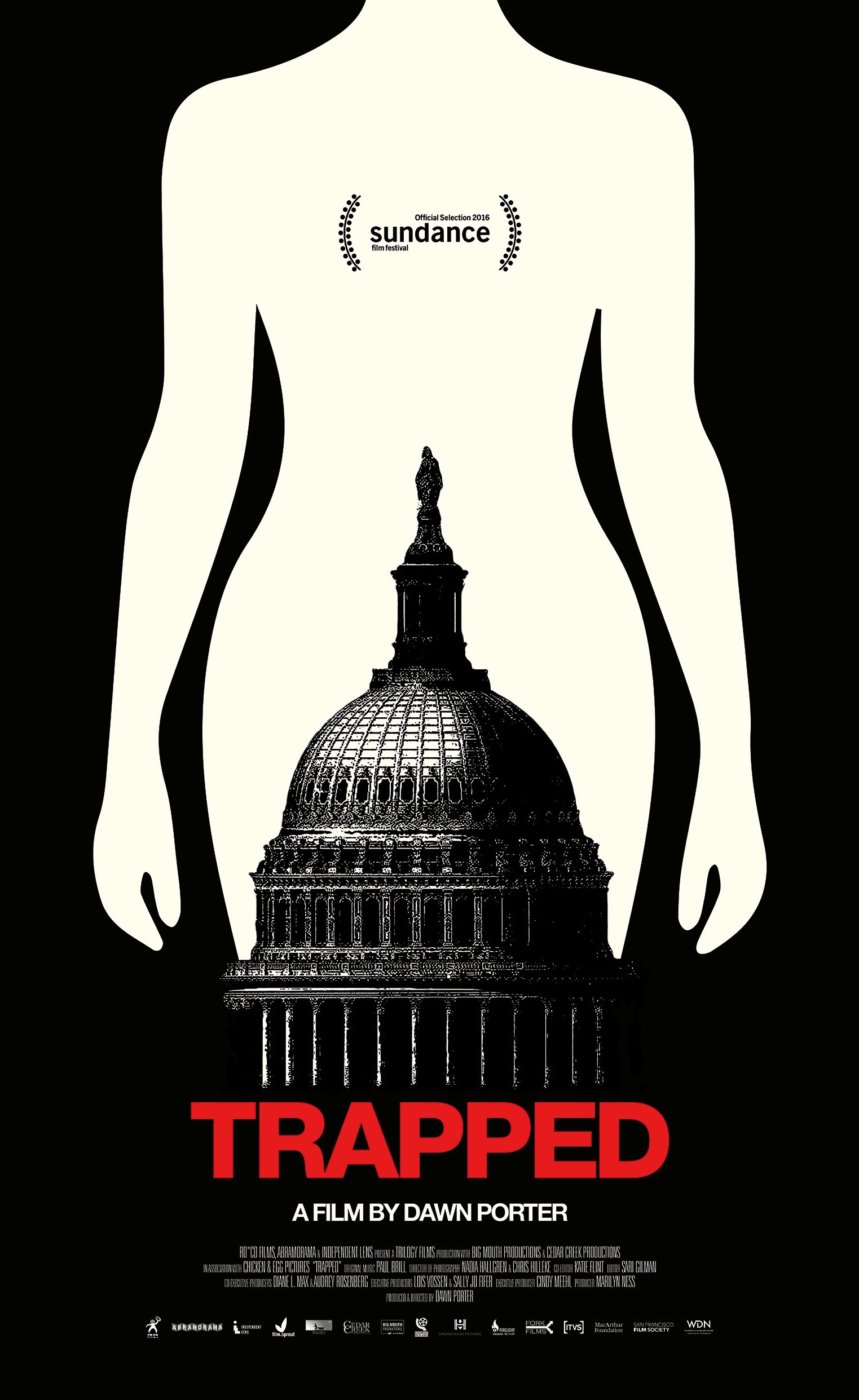
Dawn Porter is the lawyer-turned-documentarian who directed and co-produced Trapped, a film about the new laws limiting access to abortion. Known as TRAP (Targeted Regulation of Abortion Providers) laws, they are described by legislators as protecting the health and safety of women by imposing requirements that normally apply to hospital settings, waiting periods, and distribution of misleading or inaccurate information. The release of the film is very timely, in theaters the same week that the challenge to these laws was argued in the Supreme Court. As the movie shows, and as the arguments before the Court made clear, medical authorities do not support these requirements, which are not imposed on similarly risky or risky medical procedure providers (liposuction, colonoscopies). They have no medical benefit to women and are intended to and have the effect of limiting women’s ability to make their own choice to have a Constitutionally protected medical decision.
In an interview, Porter spoke about the impact of these laws, her compassion for the women’s reproductive health care providers in the film, and her decision about the portrayal of anti-abortion voices in the film.
How does the death of Justice Scalia affect the prospects for the Court’s decision on the challenge to the Texas TRAP laws?
This film has taken so many twists and turns. A lot of court watchers believed he might have actually pushed to re-examine Roe v. Wade and its legal underpinnings. With him gone, most people think there isn’t anyone who would push the Court that far. It’s probably doesn’t impact the ultimate decision except that if the Court splits 4 to 4, the Texas decision upholding the law will stand with no precedential value which in itself would be a huge issue because the court likes to take cases that will have some precedents. They look for cases that can actually help govern the law. And if the decision in this case doesn’t provide any precedent it means states across the country will still be in this legal limbo; we will still be fighting about TRAP laws. If Justice Kennedy votes with the more liberal members of the court, then it will be a 5/3 to strike down the laws and then that would be the law of the land. So Justice Scalia’s death is quite significant and the final chapter in this is certainly not written.Copyright 2016 Abramorama
How can legislatures enact laws directing doctors and patients to do things that are not medically recommended?
That’s one of the things that makes me the angriest. I read a report this morning that examined the materials that doctors are compelled to distribute to abortion patients and it estimated to 40 percent of the information in some of these pamphlets is inaccurate. I spent times in six different clinics over two and a half years and saw a lot of the patient populations. 60 percent of people in a number of clinics were under the poverty level. A lot of people were not getting any medical information. I saw Dr. Parker just listening to people’s hearts, checking blood pressure, routine medical care. There is a healthcare crisis in this country and the idea that the health department that bears the imprimatur of the state would knowingly distribute false and misleading information to people who do not have resources to help them understand what is happening is so manipulative and such a waste. Most of the equipment in that room is never turned on. And as you see in the film, they are required to buy $1100 of medication every month that is never used but it expires and so has to be thrown away and replaced. We are in a situation where the conservatives are requiring waste and wasteful medicine; that’s not good medicine. While we have people who can’t access healthcare we have this facility that is unused.
What did you learn about the opponents to abortion? Why don’t we hear more from them in this film?
When I first started filming I wanted to talk to the protesters and just see if there was anyone who would present kind of a non-hysterical point of view. There was either just outright misinformation or people who would not present very well, put it that way. And so I kind of had to make this editorial decision about how to give any kind of voice to people who are anti-choice. So what I tried to do was, I included the voices of the anti-choice people. We see protesters and we see the Chief Justice of the Alabama Supreme Court appear at an anti-abortion event. But I tried to make the film from the perspective of the providers as they tried to comply with the laws and their day-to-day experiences. And I wanted to show their compassion and commitment to the women who come to to their facilities. When we filmed in that center the thing that kept coming to me was how beautiful it is.
I thought it was incredibly important to put Justice Moore in because he is a Chief Justice of the Supreme Court of the Alabama. He is charged with enforcing the laws. A really important law that the Alabama courts have to enforce are the consents for minors. So in Alabama the only way that you can get an abortion is if your parents’ consent in writing, both parents or if you have a judicial bypass. The minor has to appear and states her reasons for having an abortion and have an Alabama judge decide whether or not that that is ok. So it’s quite relevant and that the the chief judge of the Supreme Court in Alabama is the person who decides what the administrative rules are. So if you have somebody who is violently anti-choice who is part of the funding operation for anti-choice activist, I felt like that was relevant. I also think it speaks to the political climate. A number of people have remarked to me that the legislators are not hiding their true intent. And as a lawyer as a person who is a poli-sci person I find that horrifyingly fascinating that people are open about this tactic.
Why don’t the opponents to abortion pursue initiatives that actually are proven to decrease abortion, like providing birth control and support for pregnant women and babies?
I think is a great question and but I don’t think that there is a good answer. What the anti-choice people would say is that they support adoption, that children are a gift from God and that sex is for procreation. I mean that’s really what it comes down to. There is the protester in the film who says that men are here to adore women and take care of them. And the way that he shows that is by screaming at them and shaming them. And we did not include the names that he calls women. He screams in front of his own children. Women were supposed to be adored but not the woman who were there for an abortion.So I think if you think the same states that are passing laws that are shutting clinics also do not take federal funding for the Affordable Care Act, do not support sex education, and do not support birth control. So the logical conclusion is they are more anti-sex, they are anti-non-procreative sex than they are anti-abortion. So that’s really what this conversation is about.
The irony there is that a number of the women I saw were married, I saw a number of women who wanted to have the pregnancy continue but were literally saying they cannot afford to bring this child into the world. One of the most heartbreaking things I saw was this woman who cried through her procedures and she cried in the waiting room. She wanted to speak with me but she didn’t want to be on camera. I never pushed anybody once somebody who said no but she did say she wanted to talk about it and she said she had a two-year-old, she had just gotten out of welfare she had gotten into school and a part-time job and she was so excited about her life. She was on birth control that failed and she had an unplanned pregnancy and this woman said, “I love my husband, I love my child, we would love to have a second child but if I have that everything we’ve worked for over the last two years would go away. I’d go back on welfare and I don’t know if I’d ever get off.” And so it was not that she still thought it was the right thing to do but it was horrific time for her to terminate a healthy wanted baby with her partner that she loved. And so not only did I watch her go through it but I watched her being screamed at about how she was a slut and a baby killer as she was already so torn up about this and her husband was in the waiting room. It was just such a range of emotions but the biggest thing that I took away from that was as much as I wanted to hear her story, I didn’t want to be the position of judging anyone’s abortion.
I have two kids and I know what kind of a mother I try to be. Why would I want anything less for somebody else? We were able to wait till we could to have kids. And why wouldn’t I give that same dignity to someone else to make that decision for herself?
There is a disproportionate impact on poor women and their families, too.
There is a deep contempt for poor people in these laws. Watching people count off money that was the equivalent of a month’s rent and know that they were literally taking food off the table and making this choice between having another child or being able to pay their bills that month was also infuriating. Because of these extra requirements you have to make these separate visits and take off from work, which is hard because a lot of people are on hourly jobs or if you’re lucky to have a job, then you have to get child care because more than half of the women already have a child. And also because of shrinking number of clinics so many people are traveling so far so then you have to have overnight costs so you have like the people were sleeping in their cars in the parking lot. And so there’s all these obstacles but there’s also the question of dignity and it was really distressing to see people who were already in some level of crisis have these added burdens. I don’t have to go through any of those things, I have good health insurance and I call and make a doctor’s appointment for a time that’s convenient for me. So if I had to have an abortion I would go to a state where I could be seen within a couple of days I wouldn’t be racing the clock. And half the people who are racing the clock need procedures that are more complicated and it becomes more expensive and it completely gets out of reach for people. So none of it is good health care policy which is why it makes me just also crazy when people say this is for the health and safety of women because there is just nothing to support that.
What led you to make the film and who do you think the audience for the film is?
I was working on another film, Gideon’s Army, and I was shooting interviews in Jackson, Mississippi and I read in the local paper that there was one clinic in the entire state of Mississippi. To give you a comparison in New York metropolitan area there are about 80 clinics. I was so floored by that. So I did what all documentary filmmakers do. I called them up and I said, “Can I come over?”
I met Dr. Parker that day. He just started talking about abortion access in a way that it just hit me like a lightning bolt that this was such a politicized, such a brilliant way of stopping clinic access is to attack the providers and attack the doctors in the name of women’s health which makes it very difficult for the general public to understand. I thought if there’s a way to show that political story through this individual person that that would be a film that would be accessible to the widest possible audience. And it’s also the kind of film that I like to make. I like films about people. He introduced me to the clinic owners and so the film really kind of unfolded really naturally.
It was complicated and it was challenging logistically because so much was happening and they were actively involved in litigation and the lawyers didn’t always want them to talk or comment so I had to kind of work around those restrictions. I hope and I do think that it will add a different perspective to the abortion conversation. I think most people understand about crazy people who kill doctors, they understand about people who bomb with clinics what they don’t understand is the greatest threat to abortion clinics is the state political process and I think in this presidential year focusing on the mechanics of government is really important. The state and local elections are really important. I really wanted to kind of introduce that this is not an accident that half the abortion clinics in America has closed in the last five years.
I hope this is a wake-up call. Most people support some form of right to abortion, more than 80 percent of Americans. So if that’s the case then my sincere hope is that people will pay attention to the process by which these rights are being eliminated and stop feeling like it’s some private screaming match issue they think they don’t want to get involved in. We can’t sit by the sidelines and allow that to happen. And so I am I’m enough of an optimist and not like so much a cynic that I feel like if people like Dr. Parker can get up and go to work every day, the least I can do is to talk about it.



 , and I was shooting interviews in Jackson, Mississippi and I read in the local paper that there was one clinic in the entire state of Mississippi. To give you a comparison in New York metropolitan area there are about 80 clinics. I was so floored by that. So I did what all documentary filmmakers do. I called them up and I said, “Can I come over?”