
Strange Magic

Posted on January 24, 2015 at 5:25 pm

Copyright 2015 Touchstone Pictures

Despite the big names behind it, including George Lucas, who came up with the story and produced, it feels like a straight-to-DVD, about the level of Disney’s Tinkerbell series. It’s bright, colorful, self-affirming, and bouncy. And, likely to be appreciated more by the adults than the kids in the audience, there is a Glee-style mix, or, perhaps re-mix, of assorted songs from the 60’s through today. But that isn’t enough to make it work on a big screen.

It is supposedly inspired by Shakespeare’s A Midsummer Night’s Dream, but the only similarities are the forest, the fairies, and the love potion.

It takes place in an enchanted world that is divided in parts, whose generic names are characteristic of the dim pilot light of the creative imagination at work  here.  The happy, colorful Fairy Kingdom is ruled by a king (Alfred Molina) with two daughters.  The Dark Forest is ruled by the gnarled, bitter Bog King (Alan Cumming) who hates the idea of love because it is chaotic. “Love is dangerous.  It weakens.  It rots.  It destroys order.  Without order, there is chaos.”

The fairy king’s oldest daughter is the brave and responsible Marianne (Evan Rachel Wood), who, as the movie begins, is thrilled that she is about to marry the handsome Roland (Sam Palladio). She flies through the kingdom singing a sweet, girl pop version of the Elvis classic, “I Can’t Help Falling in Love With You.”  Her younger sister is Dawn (Meredith Anne Bull), who has good intentions but is impetuous and a little naive. Her best friend is an elf named Sonny (Elijah Kelley), who patiently listens to Dawn talk about her various crushes and does not let her know that he is in love with her.  They have a cute duet to Bob Marley’s “Three Little Birds.”

Marianne discovers Roland kissing another girl and breaks their engagement. But Roland wants to be king, and that means he must persuade Marianne to be his wife. He persuades Sonny to cross the border into the Bog King’s domain to get a love potion from the Sugar Plum Fairy (Kristin Chenoweth), who was imprisoned by the Bog King. Sonny agrees so he can get some for Dawn, to make her fall in love with him. Sonny has a lot of adventures on the way to obtaining the potion, and the Sugar Plum Fairy insists on getting out of her cage in return for her services. Sonny gets the glowing green potion, but just as in Shakespeare, it does not work as intended.  The Bog King captures Dawn, demanding the potion as ransom.  Marianne flies in to the rescue, but so do Sonny and Roland, creating some confusion and misunderstandings.  And a lot of singing.  The well-chosen tunes include: “What Do You Get When You Fall In Love?,” “Marianne,” “I Want to Dance With Somebody,” “When You’re Strange,” “Love is Strange,” “Sugarpie Honeybunch,” “Crazy Little Thing Called Love,” “Tell Him,” and “Wild Thing.”

There is an unexpectedly endearing romance, and the usual kids-film messages about the importance of what’s inside us.  But the light-weight storyline is weighed down by sub-standard design and low-level animation that relies too much on algorithms and not enough on imagination.

This is where looks do matter, and this film cannot overcome the clunkiness of its design.

Parents should know that there is some fairytale peril and violence, including some scary creatures, some mild gender humor including an accidental same-sex kiss portrayed as gross (really? In 2015?), and brief potty humor.

Family discussion: Why did Marianne and Bog have trouble trusting others? Why did Bog start to be nice?

If you like this, try: “The Book of Life” and the Tinkerbell series of DVDs.
Related Tags:


Animation Fantasy Musical

Mortdecai

Posted on January 23, 2015 at 9:36 am

Copyright Lionsgate 2015

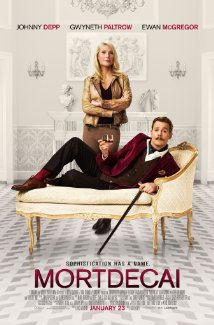
There’s a lot of noise in “Mortdecai” but what I remember most is the silences where everything pauses for a moment to allow the audience to laugh without drowning out the next witty riposte. Nope, just crickets, as there was no laughter, just grim resolve on the part of those of us professionally obligated to stick it out through the bitter end.

“Mortdecai” is based on series of 1970’s comic novels by Kyril Bonfignioli about an art dealer with connections to the upper class and the criminal underground, which provide him with many opportunities for mischief. I’m sure they are all high-spirited and merry and racy and fun, but by the evidence of this film they are also dated, overly precious, and not susceptible to translation into film. Perhaps it was possible decades ago and in print rather than on screen to find it funny when someone is repeatedly shot and injured, often accidentally by his employer, or when someone else is shot and killed. But not now and not like this.

Maybe gag reflexes brought on by Mortdecai’s mustache and widespread barfing brought on by tampering with a sumptuous buffet can be funny when left to the imagination. Not likely, but clever writing might just make it possible as our imaginations are very good at filtering descriptions according to our comfort levels. It’s another thing entirely when it is unavoidably seen and heard. Cue the crickets.

Over the past few years, with the exception of a brief appearance in “Into the Woods” Johnny Depp has made one catastrophically bad movie after another. As proof of the adage that no good deed goes unpunished, the success of his offbeat, fey Captain Jack Sparrow, initially objected to by the studio execs who were very unhappy with the early footage, has given Depp license to go way over the top with quirks and twitches in films like “The Lone Ranger” and “Tusk.” As I noted in my review, in “Transcendence” his performance was so robotic when he was playing a human that it hardly made a difference when he turned into a computer. Here, as the title character, a caricature of a pukka sahib colonial twit/Brit, embodies the fatal combination of profound unpleasantness with the expectation of being seen as irresistibly adorable not just by the other characters but by the audience.

Paul Bettany provides the film’s only bright moments as Jock Strapp, Mordecai’s Swiss army knife of a sidekick, as adept at ironing his lordship’s handkerchiefs as he is at hand-to-hand combat, getaway car driving, anticipating that Lady Mortdecai (Gwyneth Paltrow, looking like the cover of Town and Country in very fetching riding gear) will want the guest room made up for her husband as soon as she sees his new mustache, and bedding many, many, many ladies. Ewan McGregor does his valiant best but is wasted as the Oxbridge-educated MI5 official (and former classmate of Mortdecai, with a crush on Lady M). Director David Koepp, whose “Premium Rush” was a nifty little thriller with unexpected freshness and wit, has stumbled here with a film that is badly conceived in every way, like its title character imagining itself as clever and endearing when in reality it is dull and repellent.

Parents should know that this movie includes strong and crude language, drinking and comic drunkenness, sexual references and situations, some crude, bodily function humor, comic peril and violence including guns, with characters injured and killed.

Family discussion: What was the best way to resolve the issue of the mustache? Who should have the Goya painting?

If you like this, try: The Mortdecai Trilogy and the Austin Powers films

Related Tags:


Based on a book Comedy Crime Satire

Cake

Posted on January 22, 2015 at 5:58 pm

B+
Lowest Recommended Age: Mature High Schooler
MPAA Rating: Rated R for language, substance abuse and brief sexuality
Profanity: Very strong and crude language
Alcohol/ Drugs: Substance abuse including pills and alcohol
Violence/ Scariness: Some violence, themes of loss and damage
Diversity Issues: Diverse characters
Date Released to Theaters: January 24, 2015
Date Released to DVD: April 20, 2015
Amazon.com ASIN: B00TY6CM7U
Copyright 2015 Cinelou Films

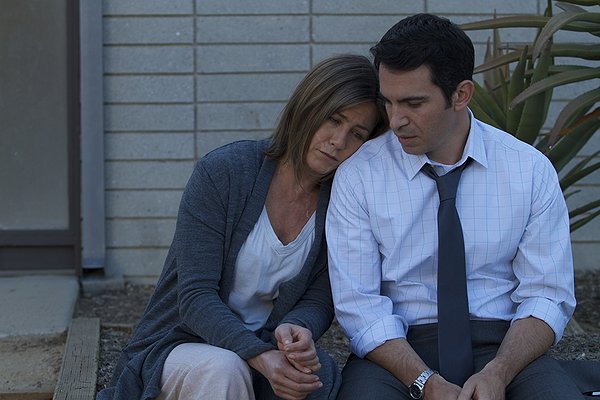
Two shrewdly-chosen elements separate this film from the typical Lifetime saga of a middle class white woman struggling to overcome a dire challenge. First is the way writer Patrick Tobin and director Daniel Barnz (the underrated “Beastly”) trust the audience, dispensing with the usual ten-minute “before” scene allowing us to fall in love with the main character before the bad thing happens. Claire (Jennifer Aniston) is already in a bad way when we meet her. The film is willing to take the risk of our not loving her, not even liking her, in part because it allows us to be drawn into the story because if America’s sweetheart Aniston is in the role, we know that this unhappy, uncooperative, woman must be worthy of our interest.

And that is the second element that elevates what could have been a soapy, formulaic story. Aniston, who also produced, gives a brave, vulnerable, nuanced, grimly humorous and deeply felt performance as Claire, a woman whose past we piece together only gradually as we also are discovering who she is now, how much she has lost, and, before she knows it herself, how much she has kept.

Claire lives in a lovely house with a pool and she has a housekeeper (Adriana Barraza, excellent as Silvana). We can see there was once more in her life but now it consists of therapy — group therapy (with Felicity Huffman as a leader not quite as sunny as she would like to seem), physical therapy (Mamie Gummer as the hydrotherapist who is losing patience), and the crucially important people who control access to the drugs (Lucy Punch as the cheerful if easily-misled keeper of the prescription pad). When finessing no longer works, Claire gets Silvana to drive her across the border to Mexico, where pharmacists are more persuadable and can also provide statues of the Virgin Mother with handy hiding places.

Claire has an ex-husband, Jason (the always-welcome Chris Messina, conveying worlds about what he and Claire once had in just a brief appearance). She has a handsome pool cleaner (just another form of drug). She has Silvana, who stays out of loyalty, pity, and limited other options. She also has Nina (a performance of great delicacy by Anna Kendrick), a fellow member of the Chronic Pain Workshop, whose sympathetic visits are problematic because she is not really there.

Nina committed suicide just before the movie starts, leaving a husband (Sam Worthington) and young son. Claire’s conversations with her are manifestations of her own dance with death, the numbness of drugged-out senses and overwhelming grief, or the ultimate choice to end it all.

We get small glimpses of who Claire once was and of how much of that she still has. When Silvana’s old friends behave like middle school Mean Girls, Claire knows exactly how to respond. With Jason and with a visitor played by William H. Macy, we see how much she has lost. Her humor can be grim, but it shows resilience. Her determination to get drugs may be focused on the wrong goal, but it shows her resolve. Aniston, who played the role with no make-up other than the scars applied to her face, shows with every grimace of pain, every attempt to contain a grimace, with movement that shows a world of understanding of physical pain, how fully she inhabits the character as Claire is learning how to return to her life.

Parents should know that this film has very strong language, some peril and violence, issues of loss and disability, substance abuse, sexual references and a sexual situation.

Family discussion: Why was Nina so important to Claire? Why did she go to see Roy?

If you like this, try: “The Good Girl,” “28 Days,” and “Inside Moves”

Related Tags:


Drama DVD/Blu-Ray Pick of the Week
THE MOVIE MOM® is a registered trademark of Nell Minow. Use of the mark without express consent from Nell Minow constitutes trademark infringement and unfair competition in violation of federal and state laws. All material © Nell Minow 1995-2026, all rights reserved, and no use or republication is permitted without explicit permission. This site hosts Nell Minow’s Movie Mom® archive, with material that originally appeared on Yahoo! Movies, Beliefnet, and other sources. Much of her new material can be found at Rogerebert.com, Huffington Post, and WheretoWatch. Her books include The Movie Mom’s Guide to Family Movies and 101 Must-See Movie Moments, and she can be heard each week on radio stations across the country.

Website Designed by Max LaZebnik