Unbroken

Posted on December 24, 2014 at 5:49 pm

A-
Lowest Recommended Age: Mature High Schooler
MPAA Rating: Rated PG-13 for war violence including intense sequences of brutality, and for brief language
Profanity: Some strong and offensive/abusive language
Alcohol/ Drugs: None
Violence/ Scariness: Intense wartime peril and violence, characters injured, abused, and killed, some disturbing images, parent strikes a child with a belt
Diversity Issues: A theme of the movie
Date Released to Theaters: December 25, 2014
Date Released to DVD: March 23, 2015
Amazon.com ASIN: B00HLTDC9O
Copyright 2014 Universal Pictures

Oscar-winning actress Angelina Jolie breaks into the top ranks of American directors with “Unbroken,” showing an exceptional understanding not just of actors, but of tone, scale, and letting the camera tell the story. Working with the magnificent cinematography of Roger Deakins (“True Grit,” “Skyfall”), she adopts a classical style well-suited to the WWII setting, but every choice is careful, thoughtful, and powerful.

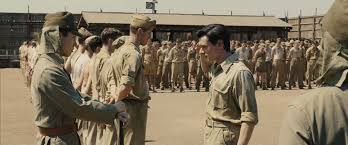
Based on the best-seller by Laura Hillenbrand, this is the story of Louis Zamperini, the son of Italian immigrants. He was a rebellious kid who became an Olympic athlete. His bomber plane crashed over the Pacific, and he survived for 47 days at sea, before being captured with one surviving crewmate, by the Japanese. In the prison camp, he was singled out for horrific abuse and repeatedly beaten.

The screenplay by the famously off-beat Joel and Ethan Coen is straightforward, direct, and sincere, keeping the focus on the war years, with the incidents from Zamperini’s past brought it primarily to show us how he relies on his memories to keep going. “Nobody’s chasing me,” he tells his brother who is urging him to run faster as he trains for a race. “I’m chasing you,” his brother tells him.

That internalized sense of mission helps him hold onto the idea of his own power as the brutal Japanese captors try to take everything away from him.

The opening scene puts us in the sky, and Jolie superbly evokes the thrill and the terror of flying on a bombing mission in aircraft that seem barely past the era of the Wright brothers. The crash scene is vertiginously disorienting. Jack O’Connell plays Zamperini with an effortless masculinity, understanding that it has nothing to do with macho posturing, just an imperishable sense of integrity, courage, and honor. O’Connell, Finn Witrock (“Noah”), and Domhnall Gleeson (“About Time”) perfectly capture the rhythms of an experienced crew, some amiable wisecracks and bravado to recognize the perilousness of their situation, but always focused, on task, and always, always, putting the team first.

We become so attached that it is sharply painful to see the characters experience such deprivation and abusive treatment. Japanese pop star Miyavi (real name Takamasa Ishihara) plays the sadistic Mutsushiro Watanabe, known as Bird. He knows of Zamperini’s celebrity as an athlete and sees that he is a symbol to the other prisoners.

If the Bird can break Zamperini, it will crush the morale of the whole camp. So, he singles Zamperini out for beatings and mind games. But Zamperini knows that “we beat them by making it to the end of the war alive.” He simply will not give up, and defining his own sense of what it means to win allows him to maintain a sense of control that is his most powerful weapon.

It is gorgeously filmed, superbly acted, and directed with great sensitivity and compassion, but the real impact of the film comes at the end, when we learn through a few simple titles, what happened to Zamperini after the war. Even Jolie recognizes that there is nothing she can put on screen to match the real-life footage of Zamperini, back in Japan at four days before his 81st birthday, running with the Olympic torch.

Parents should know that this movie includes very intense and disturbing wartime peril and violence, with a plane crash, an extended period lost at sea, and grueling prison camp abuse, and some strong language including racist epithets. School-age bullies harass and punch a character and a parent beats a child with a belt.

Family Discussion: What was the toughest challenge for Louis? Why didn’t he give up? Why did he forgive his captors?

If you like this, try: the book, Unbroken: A World War II Story of Survival, Resilience, and Redemption, and Zamperini’s own book, Don’t Give Up, Don’t Give In: Lessons from an Extraordinary Life, along with the films Stalag 17 and The Great Escape, also based on real-life WWII stories of American prisoners of war.

Related Tags:


Action/Adventure Based on a book Based on a true story Drama DVD/Blu-Ray Pick of the Week Sports War

Big Eyes

Posted on December 24, 2014 at 5:14 pm

Copyright Weinstein Company 2014

In Woody Allen’s 1973 film “Sleeper,” set in a decadent future, Diane Keaton plays a superficial socialite who tries to think of the highest compliment she can give to an amateurish painting.  “Oh, it’s Keane! It’s pure Keane!” she exclaims.  Audiences of that time would recognize that reference to Walter Keane, responsible for the wildly if inexplicably popular “big eyes” paintings of sad-looking waifs.  When the concept of “kitsch” (cheap, popular, low-brow, and corny “art”) first came to the United States in the 1970’s, the Keane images were often used as an example.

Note that word “responsible.”  Walter Keane (Christoph Waltz) was “responsible” for the success of the paintings but he was not responsible for producing them.  It was revealed in a dramatic trial that while Walter Keane claimed credit as the sole artist behind the paintings (and prints and books), he had never put a brush to canvas.  Every one of the paintings was created by the only artist in the family, his wife, Margaret (Amy Adams).

Director Tim Burton, whose film about notoriously awful movie director Ed Wood is one of his best, has created another very good film about very bad art.  Like that film, “Big Eyes” is highly stylized, with heightened period detail exaggerated to reflect and comment on the art that it depicts.  At one point, in some distress, Margaret pushes a shopping cart through a grocery story, seeing the big eyes in the faces of everyone she looks at.

This film also draws on the 60’s era beginning stages of the women’s movement to anchor the story.  Margaret took her daughter and left her first husband at a time when most middle class women were expected to stay home and defer to their husbands.  She arrived in San Francisco at the dawn of the “consciousness raising” era, at the epicenter of movements advocating more focus on individual needs and personal fulfillment.  But Margaret still thought of herself as powerless in her relationship with Walter, in part because it was her nature and the way she was raised to defer and get along, partly because she was dependant on him.  She married him in a hurry because her ex-husband was threatening to sue her for custody at a time when single mothers who left their husbands and had to find jobs had very few rights.  “I’m a divorcee with a child,” she tells a friend.  “Walter is a blessing.”

It was also partly because she loved him, at first.

Margaret was pretty good at painting the pictures, but Walter was undeniably a world-class genius at selling them.  He was very good at marketing up: he sold to movie stars and appeared as a guest on the Tonight Show with Johnny Carson.  He got a commission for a mural at the World’s Fair.  And he was even better at marketing down. When he noticed that people who could not afford the paintings were taking home posters from the gallery, he realized that there was an opportunity there.  “Would you rather sell one $500 painting or a million crappy reproduced posters?”  Pretty soon there were Keane images for every budget, with the originals in an art gallery and the copies in stores, alongside kitchen utensils and t-shirts.

Margaret signed her work “Keane,” and Walter slipped easily into taking credit for it.  He told Margaret (correctly) that no one took women artists seriously and that (also correct) that he was willing to do the kind of glad-handing and public appearances that she is not.  So, she stays locked in her studio painting all the time, increasingly isolated, finally even from her own sense of who she is.

The eerie look in the big eyes of the children in the paintings begins to seem haunting. Margaret realizes that she has to leave another husband. And she has to tell the truth.

Tim Burton has a story with the grotesquerie built in, not just the outlandish images but the turbulence of the era. Waltz has the showier role and delivers as a man whose ebullience mutates into a grandiosity from which there was no return. Adams, as the woman whose passion for expression grows — finally — into the ability to speak for herself with her voice as well as her brush.

Parents should know that this film includes some disturbing themes including emotional abuse, broken marriages, fraud, some sexual references, and brief strong language.

Family Discussion:  Who was responsible for the success of the big eye paintings?  Why did Walter lie and why did Margaret let him?

If you like this, try:  “Ed Wood” from the same director

Related Tags:


Based on a true story Drama

Pride

Posted on December 22, 2014 at 6:00 am

A-
Lowest Recommended Age: High School
MPAA Rating: Rated R for language and brief sexual content
Profanity: Very strong language, some crude
Alcohol/ Drugs: Drinking, smoking
Violence/ Scariness: Some peril and violence, bullying and harassment
Diversity Issues: A theme of the movie
Date Released to Theaters: October 9, 2014
Date Released to DVD: December 22, 2014
Amazon.com ASIN: B00OY7YNKI

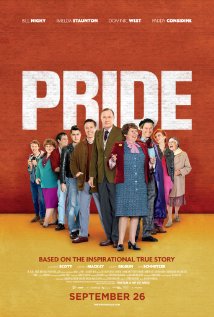
The ingredients for this film were so irresistible that it is a unexpected bonus to find that it is so much better than it needed to be.

It’s based on a true story of extraordinary kindness, generosity, and friendship and it stars a bunch of adorable English actors (Imelda Staunton, Bill Nighy) who could read the tax code out loud and make it cuddly and uplifting.  But it is also very smart, very touching, and very timely, and one of the best films of the year.

Copyright CBS Films 2014

Prime Minister Margaret Thatcher imposed a system of market-based economic changes that created massive upheavals, depicted in films like “Billy Elliot,” “Brassed Off,” and “The Full Monty.”  The miners were on strike from 1984-85 after the Thatcher government announced that it was shutting down many of the coal mines, and it was a bitter, angry time.

It was also the early stages of gay pride.  And one young activist, Mark Ashton (the enormously charismatic Ben Schnetzer) sees a connection between gay pride and the miners.  They have a common enemy.  He sets up something called Lesbians and Gays Support the Miners, and gets a couple of friends to join him in collecting money to help the miners on strike.

But most of the miners groups turn him down.  Only one responds, a group in Wales.  Their leader Dai (Paddy Considine) comes to London to pick up the money LGSM has raised, and his thanks is genuine and very moving.  “When you’re in a battle against an enemy so much bigger and stronger than you, to find out you had a friend you never knew existed, well, that’s the best feeling in the world.”

They invite the LGSM to visit, and the welcome ranges from warm to a bit stiff and uncomfortable, except for one woman who calls them perverts and tries to get them thrown out.  As one might predict, there are scenes of gay men dancing and cute country folk asking questions (“Is it true that all lesbians are vegetarian?  I heard that at the covered market!”).  And one of the local guys sheepishly asks one of the London gay men for a dance lesson to impress a girl.  There’s also a guy who’s not out to his family.  And, as time passes, the spectre of a far worse scourge than Thatcher will shift the focus of the gay pride movement to AIDS.

But for a brief moment, there was a connection that grew from a common threat to a unity of purpose to understanding and real friendship.  The final section is a reminder of how much difference we can make and how much that difference is needed.

Parents should know that this film has some mature themes and strong languages.  Characters drink and smoke and there is some peril and violence.

Family discussion: What did the gays and the miners have in common?  What groups seeking dignity and justice can you help?

If you like this, try: “The Full Monty,” “Brassed Off,” and “Billy Elliot.”

Related Tags:


Based on a true story Comedy Drama DVD/Blu-Ray Pick of the Week GLBTQ and Diversity Politics

Interview: Ava DuVernay of “Selma”

Posted on December 21, 2014 at 9:41 pm

Copyright 2014 Paramount Pictures

My favorite movie of the year is “Selma,” the story of the Reverend Dr. Martin Luther King’s march from Selma, Alabama to the state capital, Montgomery, to bring attention to the barriers the Southern states were using to prevent black citizens from registering to vote. It was a very great honor to talk to director Ava DuVernay, who is the first black woman to be nominated for a Golden Globe as Best Director and is a good candidate for an Oscar nomination as well.

I have read a couple of times that you were hoping that this movie would change the conversation. So tell me how you want it to change the conversation.

I don’t know if I want it to change the conversation but I do want to be a part of the conversation. I feel that art meeting this cultural moment is an important thing. It is a little surreal that the film is ready at this particular moment. And so I think that you can’t help but say as an artist – Can we meet this cultural moment? Do we have something to say in this piece that might add to the energy that’s brewing right now? I think so. I can’t say what that will be because everyone will bring a different part of themselves to the film but certainly you are hoping as a storyteller that this story has some impact. So that’s my desire. We’ll see.

Copyright 2014 Ava DuVernay

People are understandably unhappy right now about the persistence of racial divides in this country. But how do you convey to those too young to remember the Civil Rights era the pervasive bigotry and abuse of that era?

AI think the beautiful thing about with “Selma” coming out is that we don’t have to re-create what it’s like because they are feeling it right now. I don’t have to say in 1965 all this bad stuff was happening so people went on to the street. They are doing it. This is the energy that is ambient right now. It’s all over. The atmosphere right now is that of change, that of the power of people, that of unrest. And so even a year ago, you would have to really explain how this felt to be so outraged that you left your house and took to the street and it’s happening now, literally all over the country in vibrant ways.

So I feel like it’s a blessing that we don’t have to articulate tone because people are living in that right at the moment, right now.

One thing that is very striking to me about the film is the impact that television had on Dr. King’s message getting out and letting the rest of the world know what was actually happening in a way that would not have happened even five years earlier. How do you feel that today’s media environment has helped or hurt to the way we talk about race in this country?

Oh, it’s a good question. I am a proponent of social media because there is no barrier, there is no filter, there is no one interpreting what I say or what I mean. I can say it and broadcast it to whoever wants to listen and whoever is following and sometimes things are hitting your timeline or your radar on social media that you don’t want to listen to which is also interesting.  And so I just think this era where people can broadcast themselves, where people can really amplify their own voices is tied so much with what was happening during the time of 1965 in this film in particular.  King was a master of optics. Television was new and he used television as a tactic for protest for the movement.

We had to find now how to use social media, how to use twitter as a tactic for the movie and what we found with the uprisings in the Middle East and Hong Kong and the Solidarity happening through this technological broadcast from individual to individual and so now the question is can tactical … Can tactics, can tools, can strategy be applied to this way of communicating with each other that’s kind of leaderless, it’s more people lead. So there’s a lot of ideas around… And I don’t know the answers but I don’t it is an exciting time and you just hope that the energy that’s happening right now is turbulent, toxic, triumphant time that we are in will equate to something very tangible.
One of the things about the Selma movement is they had a very specific ask.  It was all about voting rights. And now we have extraordinary optics of people having spontaneous protests around the country, around the world; we are able to see it on television, we are able to see it online, we are able to get messages on our text but what is the ask? What is the goal? I don’t know if that’s been as carefully defined.

Congratulations on the Golden Globe nominations!

It was exciting to share it with David . It was exciting because it was recognition for a film that we had worked long and hard on. And the most exciting thing about it that I know that it will bring attention to the film in a way that will get butts on seats. My highest hope is that people will see the work.

So many films are made every year.  Not a lot of those are made by women, even fewer of those are made by black women. The odds of those films being seen particularly when you have a black man in the lead about topics that are very closely aligned with the history of black people in this country around the politics of protest, there’s a good chance that might not get seen. We are doing okay right now but every little bit helps. And so I know what those Globe nominations mean in terms of validation and some people need that to say, “Hey, it would be good to check that out.” And that is a big deal so we are very happy about it.

And, I love David and to see “The world’s Best actor” next to his name – because he is the best actor, he is the best actor — that is wonderful.

Oprah Winfrey helped produce and plays an important role in the film.  Is it intimidating to direct her?

The day that I directed her, the first time that I directed her, Maya Angelou had died that morning.  So my heart was with her in a different way and all of my nerves were out the window.  I just really wanted to take care of her and make sure that she was taken care of.  Whenever I am directing anyone, for me it is all about them, trying to make them feel as comfortable as possible, as a safe as possible, as supported as possible in the performance. It’s not about me yelling, you know what I mean? Getting exactly what I want all the time. Maybe it is about making it what I want but they need to feel a true partner in it and we can only do that if you trust someone.  I think with someone that’s had as much experience as she has, she was just, especially on that such a hard day, so generous, so lonely, so nourishing to all of us.

Related Tags:


Directors Gender and Diversity Interview Race and Diversity Writers
THE MOVIE MOM® is a registered trademark of Nell Minow. Use of the mark without express consent from Nell Minow constitutes trademark infringement and unfair competition in violation of federal and state laws. All material © Nell Minow 1995-2026, all rights reserved, and no use or republication is permitted without explicit permission. This site hosts Nell Minow’s Movie Mom® archive, with material that originally appeared on Yahoo! Movies, Beliefnet, and other sources. Much of her new material can be found at Rogerebert.com, Huffington Post, and WheretoWatch. Her books include The Movie Mom’s Guide to Family Movies and 101 Must-See Movie Moments, and she can be heard each week on radio stations across the country.

Website Designed by Max LaZebnik