We are proud to be able to present this exclusive clip from the new DVD release “When the Game Stands Tall,” the extraordinary true story of the high school football team with the longest winning streak in the history of any sport, professional or amateur, and what happened after they lost a game. The DVD will be available on December 9, 2014.
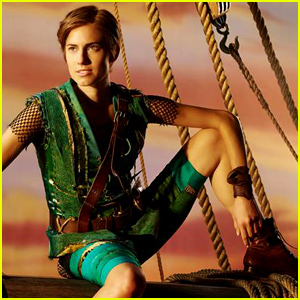
Peter Pan, the boy who would not grow up, has been enchanting children and their families for more than a century now. This week’s live broadcast of the Broadway musical version starred Alison Williams and Christopher Walken. And next year we’ll see Hugh Jackman as Blackbeard in “Pan,” which looks like a prequel that will tell us how Peter Pan and the Lost Boys made it to Neverland and how Hook (Garrett Hedlund) became Captain Hook.
Cheryl Strayed (Reese Witherspoon) adds the name of the author, Emily Dickinson, to the quote she has inscribed in a journal for hikers kept at her entry point on the Pacific Coast Trail. And then she adds her own name as well. It is her own name in a very real sense as she was not born with it and it was not her husband’s name. It was a name she chose from a dictionary at the end of her marriage as the name she wanted to go on with, a name for going above her nerve.
Copyright 2014 Fox Searchlight
Strayed was lost. Her mother Bobbi (a glowing Laura Dern), the “great love of (her) life,” died of cancer. Her husband Paul (“Newsroom’s” Thomas Sadoski) was loving and supportive but Strayed fell into a self-destructive death spiral, obliterating herself through “detached” sex with strangers and substance abuse that ultimately included shooting heroin. She and Paul recognized their divorce with matching tattoos to keep some part of the idea of permanence connecting them. And then, with nowhere else to go, she decided to take a walk, more than a thousand miles. It was a chance to reconnect with something she knew she loved to do and to get away from the bad choices she was making. The Chinese proverb says that the longest journey begins with a single step. Strayed wanted to take those steps between her old life and whatever was ahead, to begin to feel an un-obliterated life.
Her 60 pounds of equipment filled a backpack called The Monster. She did not practice putting up her tent or using her stove before she left. She was scared, and soon she was also hungry. She had brought the wrong fuel for her stove. A burly farmer driving a tractor gruffly agreed to give her a ride to some food, and then told her he was bringing her back to his house. She looked at him, trying to figure out if he was planning to attack her, hoping he was not. He was not. The farmer and his wife were kind and generous with her. She got the right fuel, and, a few stops later got some advice about getting rid of some of her load, down to burning each night the book pages she had finished reading. Plus, she didn’t really need all those condoms, did she?
Strayed’s book became an international-bestseller, so poetic and inspirational Oprah rebooted her Book Club to endorse it. Like other memoirs combining real and spiritual/emotional journeys, what makes it work is the narrator’s voice. This is as much an internal story as an external one. Screenwriter Nick Hornby (“High Fidelity”) and director Jean-Marc Vallée (“Dallas Buyer’s Club”) understand that this is not a travelogue, though there is some stunning scenery. It is about Strayed thinking back through her chaotic, messy life through the experience of putting one foot in front of the other on her way to a place called The Bridge of the Gods. As she thinks back on her life, we begin to understand the context for this trek at the same time that she does. As we expect from Hornby, there are some great song choices, too.
Strayed’s adventures and encounters along the way resonate with her memories. The farmer is not the only potential danger. The film understatedly but clearly shows how any woman in any sort of wild has to constantly calculate the threat level of the men she encounters. And, in a scene where Strayed comes across another hiker taking a bath in a lake, we get something we rarely see in films, a woman appraising, or maybe just appreciating, a male body. This is a character moment for Strayed, who as we see, has been too impulsive in sexual encounters. But here, she stands back and just savors the moment on its own, owning it without having to do anything about it. “I’m lonelier in my real life than I am out here,” she says.
Feeling your feelings can be painful. Strayed loses toenails and, at one point, her shoes. There are angry, raw patches of skin where The Monster digs into her. She thinks through painful memories of her mother’s illness, her father’s abuse. She remembers being inconsiderate of her mother, a woman who was thrilled to get a chance to go back to school, to think and question and learn. And for the first time, she begins to understand what her mother said about putting yourself in the line of beauty. Just because some things are terrible doesn’t mean everything is. “This has the power to fill you up again if you let it,” someone tells her.
Witherspoon gives a performance of quiet vulnerability and courage. In some ways, as producer as well as star, this was as daunting an undertaking for her as the hike was for Strayed. There was a real risk of making it a glamorized, soapy star vehicle. But as producer and actor, she gives this story the film it deserves.
Parents should know that this film includes explicit sexual references and situations and nudity, substance abuse, references to domestic abuse, and very strong language.
Family discussion: What do you think the quote means and why did Strayed use it to begin her hike? What does it mean to say that wounds come from the same source as power?
Rated PG-13 for some sexual references, mature thematic material and historical smoking
Profanity:
Some strong language
Alcohol/ Drugs:
Drinking, smoking
Violence/ Scariness:
Wartime violence
Diversity Issues:
A theme of the movie, homophobia, suicide
Date Released to Theaters:
November 21, 2014
Date Released to DVD:
March 30, 2015
Amazon.com ASIN:
B00RY85CQI
Copyright 2014 The Weinstein Company
Alan Turing was a brilliant mathematician with an enormous intellect, an almost equally enormous ego, and an almost equally enormous secret. He was one of the founding thinkers behind modern computing and it is his name that we use for the test that determines whether a computer has achieved true artificial intelligence status. The Turing test standard is human conversation. If a human cannot tell whether he or she is communicating with a person or a computer, than the program has passed the Turing test and is true artificial intelligence.
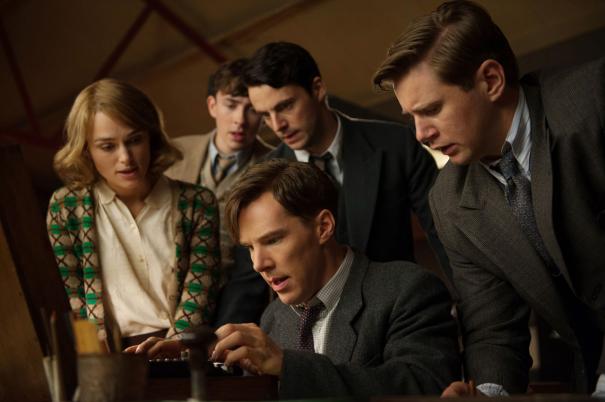
I’m not sure that Alan Turing could have passed the Turing test. Cumberbatch, who also plays a super-smart, arrogant, and obnoxious guy in “Sherlock,” creates a very different character here. Turing himself is an Enigma. In the opening scene, a sort of job interview nightmare in which Commander Denniston (Charles Dance) is trying to interview Turing (Benedict Cumberbatch) for a spot on the team working at the famous Bletchley Park estate to break the code the Germans were using to send orders to their troops. If passing as human means meeting even the most minimal standards of civility and responsiveness, Turing failed that interview. He seemed to think that it was he who was interviewing Denniston to determine whether the task was of sufficient interest and import to merit his attention.
Denniston begins to dismiss him. But when Denniston says that everyone thinks the code, known as Enigma, is unbreakable, Turing says briskly, “Let me try, and then we’ll know for sure.” Denniston does not have a better idea or a better option.
The German code is unbreakable because it is constantly changing, so by the time any one message has been decrypted, whatever was learned could not be applied to whatever comes next. The Allies are perpetually behind. [The process, complicated as it is, has been simplified for the purposes of the movie, glossing over the important work done by Polish mathematicians, the contributions of the French, and the challenges faced as the Germans continued to make the Enigma more complicated and impenetrable as the war continued.) While a bunch of brilliant mathematicians, scientists, and puzzle-solvers (including Joan Clarke, played by Keira Knightley) worked away, Turning realized not only that what made the code unbreakable was the inability of any then-existing computational mechanism to perform enough calculations fast enough to decrypt the messages before the code was reconfigured the next morning, but that he could create a machine to do it.
We know how it turned out. But director Morten Tyldum keeps the story gripping on several levels. First, there is the conflict between Turing and just about everyone, and the pressure for immediate results as he is spending a lot of time (years) and money on something no one has ever seen before. Second, there are the interpersonal struggles, and Turning’s internal difficulties. He did want intimacy, and we see in his memories of his first love, a boy at his school. He likes Joan, and is briefly engaged to her. But he was gay at a time when being gay was punishable by prison. Then there are other kinds of secrets. One of the people working on breaking the code may be a spy. And once the code is broken, the Allies have the wrenchingly painful decision about what to do with the information. It’s not just a puzzle. It is statecraft, and terrible compromises and terrible losses are part of the job.
The film adds some unnecessary drama and oversimplifies parts of the story. But it is a powerful, complex drama and a long-overdue tribute to a true hero and visionary.
Parents should know that this film includes wartime themes and images, some disturbing, wrenching moral choices, betrayal, the pressures of being a closeted homosexual when it was a crime, drinking, smoking, and some sexual references.
Family discussion: Do you agree with the decision to withhold the news that the code had been broken? To allow the mole to keep spying?
Copyright NBC 2014As NBC prepares for the live production of “Peter Pan,” they are doing a bit of updating to the play, originally produced as a non-musical 100 years ago. This version is the musical best remembered as the Mary Martin production first produced 50 years later (also performed by Olympic gymnast Sandy Duncan and Cathy Rigby), with songs by Mark “Moose” Charlap, with additional music by Jule Styne. Most of the lyrics were written by Carolyn Leigh, with additional lyrics by Betty Comden and Adolph Green.
Times have changed, and it is no longer considered appropriate to have the Indians in the story sing nonsense syllables like “ugga wugga.” (This is still better than the really embarrassing song in the Disney version, “What Makes the Red Man Red?” which includes a passage that explains that Indians say “Ugh” because they see their mothers-in-law.) So, with the permission of the rights holders, the producers have brought in Jerod Impichchaachaaha’ Tate, an Emmy Award-winning classical composer and the artistic director of the Chickasaw Chamber Music Festival, to advise them. An interview with Tate in Salon explains
There were three things that I was able to bring to the table to help reconstitute the piece.
The first thing is the opening rhythm. There’s this very clever col legno that’s done with the strings in the very opening that sounds drum-like but also sounds stick-like, which is actually accurate to the Northeastern part of the country with Indians. We adjusted the accents of these constant eighth-note beats so it sounded more like an Iroquois smoke dance, rather than a stereotypical ONE-two-three-four, ONE-two-three-four, ONE-two-three-four, you know, that kind of thing. So we adjusted the opening rhythm so it sounded more authentic. It’s a small cleanup….
Yes, and the trick is — to be honest with you, most Americans aren’t going to know the difference. But at least we do. Intellectually we know, and musically we know, there was a small adjustment. It still sounds a little stereotypical. That can’t go away. Because we were also preserving the integrity of the original compositions and those original compositions were very stereotypical, but they weren’t just stereotypical about Indians. They’re stereotypical about all kinds of things they address within “Peter Pan.” That’s musical theater. That’s something we accept about musical theater. Musical theater thrives on stereotypes. It just does. It always has. So, that being said, there are still ways you can improve it a little bit to where it has a little more integrity. We don’t want to interfere with the original compositions. We want to respect the original composers. But again, just bring a little more authenticity and integrity to the work.
The next example is what I call the “Indian Breakdown.” In the “Ugg-a-Wugg” song — it’s a really campy, British musical theater song, and then it has the “Indian Breakdown,” where you have that tune that goes . It’s this stereotypical, Indian-sounding thing. We were kind of looking for different tunes, but it doesn’t matter what tune you use because the flavor of it is that stereotypical Indian sound. So the musical director was brilliant. He added some different rhythms that were — he flavored it in a way that sounded more entertaining than specific. He kind of veiled it, I guess, a little bit, with some fun rhythms that sound more party-like. I think he had a great solution for that. I thought it was right on the target.
And then the really big thing that we worked on was the replacement of “ugg-a-wugg.” Just a little background: In general, what we all know is that the Indian tribe that’s represented in Peter Pan was influenced by knowledge of Northeast Indians of the United States. So we’re talking Iroquois, Huron, Wyandotte, Algonquin, these kinds of cultural regions. So what I did was I set out to find a replacement word for “ugg-a-wugg” that was literally a Wyandotte word.
The most recent road tour of “Annie Get Your Gun” made some changes to the portrayal of Native American characters, too, though that show will never reflect contemporary sensibilities (or accurately depict the very egalitarian relationship of Annie Oakley and Frank Butler).
I’ll be looking forward to hearing what Tate describes.


 ,
 , and
 , and another 2014 film about a real-life woman on a long, long walk,
 ,