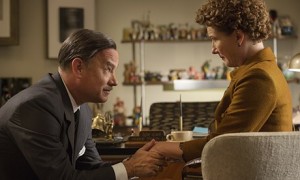
 For most of this story, Walt Disney (Tom Hanks) and P.L. Travers (Emma Thompson) are on opposite sides. He has been trying for twenty years to persuade her to let him make a movie based on her books about the magical nanny, Mary Poppins. She needs money, as her agent reminds her, which is why she has very reluctantly agreed to leave home and fly to Los Angeles to talk to him about it. But she cannot bear the idea of losing control of the characters who mean so much to her and she abhors everything about Disney and California, including sunshine, cheerfulness, twinkling, music, and calling people by their first names.
But there is one moment when, in the midst of some obvious culture clash jokes, there is a quiet moment that shows they are both on the same side. Disney tells Travers that he was in her position when someone wanted to pay him for Mickey Mouse and he simply could not bear the agony of allowing anyone else to make decisions about a character he had created. Travers says that Mary Poppins and the Bankses are her family. But in a very real way, the character these artist created are their own very souls. “We restore order with imagination,” Disney tells her. And, engagingly, throughout the film we see the process, the inspiration, the despair, the triumph, the necessity of creating art, from a father soothing his little girl with a story to songwriters puzzling out a way to show Mary Poppins’ upside down world by having the tune go up as she sings the word “down.”
We all know how it turned out. Disney’s “Mary Poppins,” celebrating its 50th anniversary next year, is one of the beloved and honored family films of all time, with five Oscars (Best Actress, Song, Special Effects, Score, and Editing) and eight more nominations. But anyone who has read the books knows that there are some major departures from the Travers version, and that the fears she expressed — as documented in tape recordings of her sessions with the screenwriter and songwriting team — were more than justified.
Some people have criticized this film as Disney’s burnishing of its own brand, with its founder portrayed as a decent man who is just trying to keep a two-decade old promise to his daughters to make a movie from one of their favorite books. Amy Nicholson writes in LA Weekly that “Saving Mr. Banks” is “a corporate, borderline-sexist spoonful of lies.” She says that Thompson’s “Travers is as unpleasant as a pine needle pillow, and she’s as far away from the actual woman as ‘supercalifragilisticexpialidocious’ is from being a real word” when in fact she was a “a feisty, stereotype-breaking bisexual.” I think this is a misreading of the film’s attitude toward Disney, Travers, “Mary Poppins” (the movie), and what it means to be a creative person in a world that is very imperfect when it comes to assigning monetary value to art (see also: “Inside Llewyn Davis”). To come to Nicholson’s conclusion, one has to assume that the movie wants us to believe that Disney somehow outsmarted Travers by improving her work. On the contrary, the movie makes it clear that the movie Mary Poppins was very different from Travers’ idea of the characters, moving them several decades earlier, for a start, and, crucially, as indicated in the title of this film, transforming an episodic storyline about children’s adventures with a magical nanny into a story about parents discovering the importance of being close to their children. It is Nicholson who underestimates Travers by suggesting she was somehow snookered. She made a decision that it was worth it to her to let that happen to get the money she needed to be as financially independent as she wished. As is shown in the very first scene, she could have made money another way — by writing more books about Mary Poppins, for a start — but she chose to consent to the movie, and then to make absolutely sure that no American would ever touch her characters again.
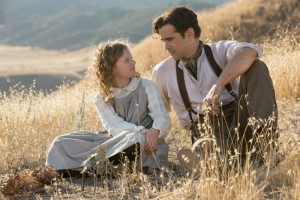 While the cute culture clashes and Travers’ resistance to Disney’s brand of pixie dust are featured in the movie’s trailers, the film itself devotes a substantial amount of time to Travers’ childhood, clearly taking her very seriously as a woman and an artist. We see her as a child dearly loved by the father she adored (a superb Colin Farrell), a man of great imagination and charm, but, perhaps in part due to those same qualities, not able to manage life as a banker in the far reaches of Australia. As we see him sink from manager at a bank to manager at a smaller bank to teller, fans of the Poppins books will remember her description of what Mr. Banks did at the office (it is not coincidental that he shares a name with his profession). He “made money.” Meaning that, at least in his children’s minds, he sat at his desk cutting out coins each day. Some days he was able to cut out many, and the family was quite comfortable. But other days he was not as productive, and there were fewer coins to go around.
We can see the origins of this idea and many other Mary Poppins book details in Travers’ past, a seemingly bottomless carpet bag, a crisp “spit spot” from an imposingly organized woman who arrives to put the household in order. But the most telling detail from the past is the key to the invention of Travers’ most important character: herself. Her name is not P.L. Travers at all. Nor is she Mrs. Travers, despite her insistence that Mrs. Travers is what she prefers to be called. The Australian girl who would grow up to be the ultra-English P.L. Travers is named Helen Lyndon Goff, called “Ginty” by her dad. His name was Travers Robert Goff. She took his first name as her last name and put a “Mrs.” in front of it to create the character she chose to be. This revelation, and Thompson’s brilliant portrayal of Travers show us a woman whose most important creation was the character she pretended to be — or became.
And of course Disney, too, played a character, the folksy host who was going to entertain you no matter how hard you tried to resist, and very well aware that these qualities were his best assets as a businessman. He insists on taking Travers to Disneyland (beautifully recreated as it was in 1961). Disney is persuasive enough to get Travers onto the carousel and canny enough to tell her the truth — that getting her on a ride won him a $20 bet. And he tells her a story about his childhood, showing that just because he promotes an idealized vision of the world does not mean that he is unfamiliar with its harshness and disappointments.
Thompson gives one of the best performances of the year, showing us the insecurity and humanity and wit of a woman who is far more complex than she wishes to appear. Jason Schwartzman and B.J. Novak as the song-writing Sherman Brothers and Paul Giamatti as the limo driver are all excellent as characters who underscore the theme of art as a path to meaning. The glimpses of the “Mary Poppins” movie are so entrancing (okay, I had to come home and watch it again and am still humming “Step in Time”) that it is easy to be temporarily distracted from the bittersweetness of the story. Hmmm, where have I heard that idea before?
Parents should know that this film includes the very sad death of a parent, substance abuse, a suicide attempt, tense confrontations, and some disturbing images.
Family discussion: What did Walt Disney and P.L.Travers have in common? What do you learn about her from her relationship with the driver? How can you take details around you and make them into a story?
If you like this, try: the Mary Poppins books by P.L. Travers and the Disney musical film and the documentary “The Boys,” about the Sherman Brothers

 “Contest” more than makes up for some first-time-filmmaker shortcomings with its sincerity and unexpected strengths in the storyline and cinematography.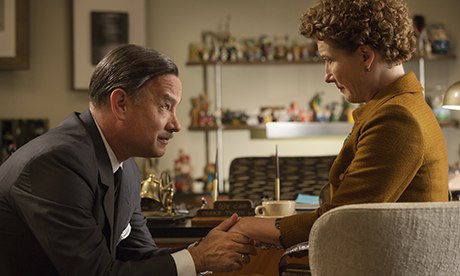


 .
. 
 One of the best animated movies in the last decade is this story of a Viking boy who learns that dragons are not as scary as the people in his village believe. The variety of dragon species is endlessly entertaining in this smart, exciting, and heartwarming film. I’ve seen clips from the upcoming sequel and it looks just as awesome.
 Peter MacNichol plays a young apprentice to a wizard who is sent to kill the dragon that has been devouring girls from a nearby community. The setting is at the end of the era of fantasy, as Christianity takes hold.
 a dragon who would rather write poetry than fight.
 Eddie Murphy provides the voice for a small dragon named Mushu in this classic Disney story based on the legend of a girl who disguised herself as a male soldier to save her people.
 In this delightfully skewed fairy tale, not only is the ogre the hero, but the dragon falls in love.
 When the evil fairy has to fight the gallant prince, to keep him from waking the princess, she transforms herself into a fire-breathing dragon and they have an epic battle.
 Hayao Miyazaki’s story about a girl who finds an enchanted land where she meets a dragon and recognizes that he is really a boy who has been transformed.
 Sean Connery provides the voice of the last dragon, who must work with a knight (Dennis Quaid) to defeat an evil king.