Black Nativity

Posted on November 26, 2013 at 5:00 pm

B+
Lowest Recommended Age: Middle School
MPAA Rating: Rated PG for thematic material, language, and a menacing situation
Profanity: Some strong language
Alcohol/ Drugs: References to substance abuse
Violence/ Scariness: Teenager threatens someone with a gun, references to violence
Diversity Issues: A theme of the movie
Date Released to Theaters: November 27, 2013

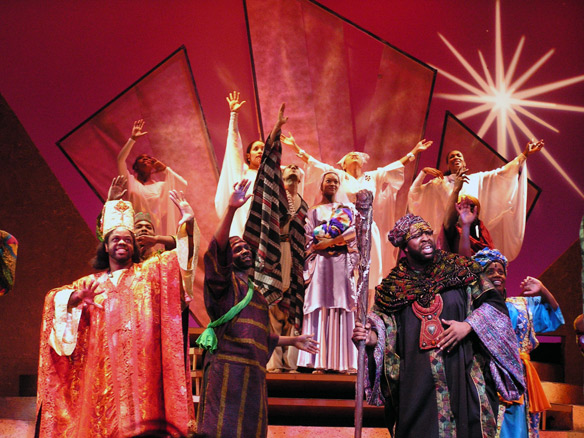
Black-Nativity-by-true-Colors-Theatre-Company-photo-courtesy-of-Soul-of-AmericaThe poet Langston Hughes wrote a play called “Black Nativity,” a joyous African-American retelling of the story of the birth of Jesus with gospel music, and it has become a holiday perennial. Now it has been adapted by writer/director Kasi Lemmons (“Eve’s Bayou”) with a framing present-day story of a prodigal daughter, estranged from her parents for 16 years, brought back home at Christmas as “Black Nativity” is being performed in her father’s church.

Oscar-winner Jennifer Hudson plays Naima, a single mother in Baltimore who has lost her job and is trying everything she can think of to keep her home.  But even with two jobs, she and her 15-year-old son Langston (17-year-old Jacob Latimore), named for the poet, are about to be evicted.  Niama has no other options left.  She puts Langston on a bus to New York to see the grandparents he has never met, knowing nothing about them or the cause of their estrangement.

Langston is hurt, lost, and angry.  He is frustrated that he cannot do more to help his mother and determined to find a way to get her the money she needs to keep their home.  Things go badly when his bag is taken by a kid as soon as he gets off the bus and he is arrested trying to return a man’s wallet because the police think he is trying to steal it.  In jail, he meets Loot (Tyrese Gibson), who jeeringly calls him “Lunch Money” and makes Langston feel powerless and disrespected.

His grandfather, Reverend Cornell Cobbs (Forest Whitaker), is formal and reserved.  His grandmother, Aretha (Angela Bassett) is affectionate but clearly in pain over the past and afraid of being hurt again.  Langston will do anything to feel that he is taking control of what is happening to him so he can return home.

Impressionistically told, with songs that serve as monologues, the movie becomes more powerful when Cornell’s church stages a gorgeous production of “Black Nativity” and Langston nods off to have a gospel-inspired dream that features Nas and, as an angel with white hair sticking up like a dandelion ready to make a wish, Mary J. Blige.  When Langston sneaks out of the service in a desperate attempt to get the money, it leads to a confrontation revealing in ways he could not anticipate.  The concluding scenes of redemption and reunion are tender and transcendent.  

Parents should know that the storyline concerns foreclosure and eviction, family estrangement, law-breaking, teen pregnancy, and abandonment.  A teenager uses a gun.

Family discussion:  Why didn’t Langston’s family want to tell him the truth? What did the watch symbolize to Cornell?  What did we learn from Langston’s dream?

If you like this, try: the poetry of Langston Hughes
Related Tags:


Based on a play Drama Family Issues Holidays Movies -- format Musical Stories about Teens

Frozen

Posted on November 26, 2013 at 5:00 pm

A-
Lowest Recommended Age: Kindergarten - 3rd Grade
MPAA Rating: Rated PG for some action and mild rude humor
Profanity: Brief schoolyard language
Alcohol/ Drugs: None
Violence/ Scariness: Scary wolves, snow monster, peril, sad death of parents
Diversity Issues: Strong female characters
Date Released to Theaters: November 27, 2013
Date Released to DVD: March 17, 2014
Amazon.com ASIN: B00G5G7K7O

frozen poster

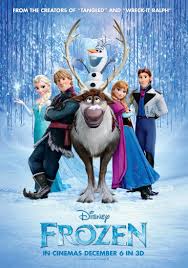
Smart, exciting, funny, sweet, tuneful, and gorgeously animated, the Oscar-winning “Frozen” adapts Hans Christian Andersen’s classic fairy tale into a story of two sisters kept apart by a scary secret.  Scary wolves, an enormous snow monster, a perilous journey, a warm (yes)-hearted snowman, a loyal reindeer, a sleigh ride, a sensational ice castle, and a little romance keep things moving briskly, but it is the relationship of the sisters that makes this movie something special.  There’s a surprisingly strong emotional connection.

The king and queen of Arendelle love their two daughters, Elsa and Anna, and the girls are best friends.  Anna loves to ask her big sister to “do the magic,” because Ilsa was born with the special power to create snow and ice.  But an accident almost becomes a tragedy, and the trolls who heal Anna remove her memory of her sister’s gift.

Their parents lock the gates around the castle and keep the girls apart.  They tell Elsa to “conceal it, don’t feel it.”  They want to protect her from those who might be afraid of her ability and protect those she might hurt as she grows up and her gift becomes more powerful.  She wears gloves all the time and stays in her room.  Anna wanders the castle alone, singing to the paintings, with no one to talk to.  Although she no longer remembers the details of their former closeness and the time they spent together, she is devastated that her sister will not see her.

Their parents are lost at sea, and three years later Elsa (Broadway star Idina Menzel) is about to be crowned queen.  Anna (Kristen Bell of “Veronica Mars”) is overjoyed to be seeing her sister and excited about meeting the people who will come through the gates that are opened at last.  She is charmingly awkward, having had no opportunity to learn any social skills, but that does not seem to matter to the very handsome Prince Hans (Santino Fontana), who proposes just a few hours after they meet.  Anna is overjoyed.

But Elsa forbids the marriage and when Anna objects, her frustration and  fury explodes, turning the balmy summer into a frozen winter.  Elsa runs away, locking herself into a dazzling palace made of ice in the mountains.  Anna follows, sure that she can make things right if she can just talk to Elsa about what is going on.  And that is where the adventure begins.  She meets a rough-hewn ice harvester named Kristoff (Jonathan Groff of “Glee”) and his reindeer Sven and a sunny-spirited, warm-hearted, and familiar-looking snowman named Olaf (Josh Gad of “Thank You for Sharing”).  And when they get to the ice palace, things do not turn out the way she expects.

Human animated characters tend to be bland-looking, but the voice talents have enormous spirit that gives them a lot of life.  Broadway stars Menzel, Groff (“Spring Awakening”), Bell (“The Adventures of Tom Sawyer”), and Gad (“The Book of Mormon”) make the most of a tuneful score featuring the Oscar-winning “Let It Go.”  The songs are beautifully acted as well as sung.  Highlights include an adorable ode to summer from Olaf, who is not quite clear on the physical properties of snow as temperatures rise, Kristoff’s “duetted” ode to reindeer with Sven (he sings both parts), and Menzel’s powerful “Let it Go.”  Bell’s sweet voice is lovely as she sings to the paintings in the castle about her longing for people and then exalts in her love for Prince Hans.  There is also a charming ensemble with trolls singing about how we’re all in our own way “fixer-uppers.”

The animation is everything we hope for from Disney, one “how did they do that?” after another, with ice and snow so real and so touchable you may find yourself zipping up your parka in the theater.   But the effects and action are all in service of the story, with a contemporary twist that is as welcome as summer’s return.

NOTE: Be sure to get to the theater in time as one of the highlights is the pre-feature short, starring a vintage Mickey Mouse voiced by Walt Disney himself.  It is a masterpiece of wit and technology that must be seen a couple of times to fully appreciate.  And be sure to stay through the end of the credits for an extra scene re-visiting one of the film’s most powerful characters.

Parents should know that this film include characters in peril, some injuries and action-style scares, monster, the sad deaths of a mother and father, some potty humor, and kissing.

Family discussion:  What’s a fixer-upper?  Why did Elsa’s parents tell her not to feel?  Why was she afraid of her power?  Why didn’t her parents want anyone to know the truth, and how did that make Elsa and Anna feel?  Who do you think is a love expert?

If you like this, try: “Tangled,” “Brave,” and “The Princess and the Frog”

Related Tags:


3D Action/Adventure Animation Based on a book DVD/Blu-Ray Pick of the Week Family Issues Fantasy For the Whole Family Movies -- format Scene After the Credits

Philomena

Posted on November 24, 2013 at 8:40 pm

B+
Lowest Recommended Age: High School
MPAA Rating: Rated PG-13 on appeal for some strong language, thematic elements and sexual references
Profanity: Very strong, frank, and explicit language for a PG-13
Alcohol/ Drugs: Drinking
Violence/ Scariness: Sad deaths and abuse
Diversity Issues: Diverse characters, issue of anti-gay bigotry is discussed
Date Released to Theaters: November 22, 2013
Date Released to DVD: April 14, 2014
Amazon.com ASIN: B00GSBMNOQ

Philomena-dench-movieDame Judi Dench has played many strong-minded, determined characters, from Queens (Victoria and Elizabeth I) to the even more imperious head of the MI6 who can take on James Bond with an air of crisp authority.  As the title character in “Philomena,” she shows us the radiance and inner core of strength in a woman we might otherwise find easy to overlook.

Martin Sixsmith (co-screenwriter Steve Coogan) underestimates her at first, too.  Sixsmith is a journalist-turned politician smarting from a public humiliation after he was fired for something he did not do.  He gets little sympathy from those around him and it seems clear that being aggrieved has only fed his sense of superiority, isolation, and entitlement.  He mutters something about writing a book on Russian history, though he realizes no one is very interested in reading it.  When he meets a young Irish woman who offers him her mother’s story of a half-century search for the son she was forced to give up for adoption, his first reaction is a haughty, “I don’t do human interest stories.”  The truth is, he is not really interested in humans, in part because they have not done a very good job of being interested in him.

Sixsmith did eventually write some books about Russia.  But first he decided to give human interest a try.  The result was Philomena: A Mother, Her Son, and a Fifty-Year Search.

When she was a teenager, Philomena (Dench) became pregnant and her parents sent her to the now-notorious Magdalene Sisters workhouse.  The girls were forced to work for years to pay (financially and spiritually) for their sins.  The abused and underage girls also signed away all of their rights to their babies, including access to information about where they were placed.  Philomena (Sophie Kennedy Clark as a young woman) was working in the laundry when her son was taken from her and adopted by an American family.  For half a century, as she became a nurse, married, and had more children, she missed him and worried about him.  Sixsmith found an editor to pay him to write the story, covering expenses for a trip to America to see if they could track him down.  She hopes the story will have some lurid details.  “Evil is good — story-wise, I mean….It’s got to be really happy or really sad.”

Coogan knows he is at his best playing slightly high-strung, slightly self-involved guys who are too smart for the room and usually end up outsmarting themselves (see “The Trip”).   It is especially satisfying to watch his character go from irritation to respect and then affection.  There’s a reason the movie is named for her.  Philomena is a surprise.  If she has awful taste in books and movies, it is because she has the gift of being able to be pleased.  When it comes to the big things, she is refreshingly clear-eyed and open-minded.  And  she understands what it takes to not let anyone make you a victim.

More improbable than any fictional story would dare to be, the journey taken by Philomena and Sixsmith is bittersweet and ultimately transcendent.  Performances by Dench and Coogan of great sensitivity illuminate this story of a quiet heroine and the man who was lucky enough to learn from her.

Parents should know that this movie was initially rated R and then given a PG-13 on appeal.  It concerns young teenagers put in a home for out-of-wedlock pregnancies and forced to give up their babies for adoption and there is frank discussion of sex and a childbirth scene, the abuse of the young women by the nuns who ran the home, and the life of a character as a closeted gay man.  Characters use very strong and explicit language and there is some drinking.

Family discussion: Why did Martin and Philomena feel differently about forgiveness?  Did she find what she was looking for?

If you like this, try: “The Magdalene Sisters” and “The Trip”

Related Tags:


Based on a book Based on a true story Drama DVD/Blu-Ray Pick of the Week Family Issues

Interview: Mark Henn of “Frozen”

Posted on November 24, 2013 at 3:59 pm

I always love talking to Mark Henn, one of the top animators in Disney history.  Previously, we spoke about young Simba in The Lion King and the most recent Winnie the Pooh.  This week, we talked about the adorable snowman character, Olaf (voiced by Josh Gad) in the Thanksgiving release “Frozen.”

http://www.youtube.com/watch?v=JqBU1aKTe6E

I’d think from an artist’s point of view it would be a real challenge to work with a character made of snow and backgrounds made of snow.  That’s a lot of white!

Snow is certainly a real challenge, but the effects team rolled their sleeves up and dove right in and it is amazing what they were able to do.  They spent a lot of time in the snow, quite a bit of research.  They spent a lot of time tromping around in Scandinavia and some of them also went to Jackson Hole.  And snow isn’t always white.  A lot of credit goes to our amazing art director, Michael Giaimo.  If you see paintings of snow, you will see that snow isn’t always depicted as white.  Depending on the lighting you can have orange, blue, pink — it’s like a piece of white paper, very reflective.  You have a lot of options, particularly in how you light the snow.

And you have a character whose limbs fly off and then reassemble all the time.  How do you make that feel believable when he is such a fantasy figure?

You do have some reality to him.  We’ve all built snowmen and they come together in parts and pieces.  He is the most fantasy, magical character in the film so we can take some liberties.  His arms and head can pop off.  He gets discombobulated a couple of times and has to be put back together, whether he does it himself or has someone do it for him.  Those were his assets, what the animators wanted to take advantage of and make him really unique.

There are several scenes where his head is detached and his body seems to have a life of his own.  He says in the movie that he doesn’t have any bones.  He’s just snow and twigs an a carrot and some coal, but he has a warm heart and he’s all about love and hugs.

How does Olaf fit into the story?

He’s comic relief in one sense.  But he’s also a link between the two sisters.  As children they create a snowman when they are playing and it is Olaf.  So he is integral to their relationship and to connecting them.  He is reintroduced when they are adults and Elsa has left but he is a reminder of what they shared as children.  There’s a simplicity to his design.  We all know snowmen, we’ve built them, we know about Frosty who came to life.  There’s something very fun and magical about Olaf.  He’s fun and non-threatening, and has an innocence like a small child.  He’s the character everyone wants to take home.

Do you have a favorite scene?

There are so many!  The music is so strong in this film, so a lot of my favorite scenes grow out of those musical pieces.  When he is dreaming of heat and summer, it is so funny.  You think there will be a rhyme with puddle but he is totally oblivious to the expectations and to what happens to snow in the middle of summer.  The high point of Elsa’s transformation is when she is being attacked by the palace guards and she has what I call her werewolf moment — she is that monster and then quickly realizes what she is becoming and starts to back off.  It’s quick but very powerful.  And I love the scene at the end with the blizzard.  You’ll be buttoning up your collar when you see it.

What do you want people to talk about with their families after they see it?

The story is about sisters, about family.  There are great lessons for families to talk about — the importance of communication.  There are elements of trust and faith for them to talk about.  It’s about taking the time to talk to each other.  If Elsa and Anna had a chance to sit down and talk things out, we would have had a very short movie.

Related Tags:


Animation Behind the Scenes Interview

Cute Clip from “The Naughty List”

Posted on November 22, 2013 at 5:38 pm

I’m delighted to present a clip from the cute new holiday film, The Naughty List. Two young elves, Winter and Snowflake, have a hard time following the rules and are prone to sneaking off for some good elf playtime. But after wrecking the North Pole’s official Christmas tree, the two elf brothers along with a rebellious reindeer named Sparkle find themselves on the dreaded Naughty List.  They are forced to do mundane horrible tasks like washing windows, cleaning bathrooms and more but seem to always make a bigger mess than they had to begin with. After the group is regulated to kitchen duty, they somehow manage to give the whole North Pole food poisoning including Santa!  Now with only hours to go before Christmas, they are the only ones left to help save Christmas.

Related Tags:


Animation Holidays Kids Shorts Trailers, Previews, and Clips
THE MOVIE MOM® is a registered trademark of Nell Minow. Use of the mark without express consent from Nell Minow constitutes trademark infringement and unfair competition in violation of federal and state laws. All material © Nell Minow 1995-2026, all rights reserved, and no use or republication is permitted without explicit permission. This site hosts Nell Minow’s Movie Mom® archive, with material that originally appeared on Yahoo! Movies, Beliefnet, and other sources. Much of her new material can be found at Rogerebert.com, Huffington Post, and WheretoWatch. Her books include The Movie Mom’s Guide to Family Movies and 101 Must-See Movie Moments, and she can be heard each week on radio stations across the country.

Website Designed by Max LaZebnik