Django Unchained

Posted on December 24, 2012 at 6:00 pm
How do you solve a problem like Tarantino?

The prodigiously talented writer/director is a master of style, sensation, and a uniquely muscular kind of cinematic storytelling that builds on a stunning ability to mash up high and low art in a singular and wildly entertaining combination shot through with pure cinematic testosterone and filled with saucy variations on dozens of other films.

But then there is the content of the films, which it seems that Tarantino looks at as just another tool for jacking up a movie’s adrenalin.  In “Pulp Fiction,” there was the shock of a literal shot of adrenalin to the heart of an overdosing character and the frisson of hired killers whose biggest concern about blowing someone’s head off is the challenge of getting the blood off the car upholstery.  The purest expression of Tarantino’s art is in the “Kill Bill” movies, where he wastes no time on plot, just the minimum nod to the simplest and most relatable of  motives — revenge.

In “Django Unchained,” as in his last film, Tarantino uses an actual historic atrocity almost as an afterthought or a placeholder.  Like The Bride’s revenge motive, the Holocaust and slavery — and endless uses of the n-word by both black and white characters — are used to justify massive carnage, and, apparently, for no other reason.  With “Kill Bill,” the less we knew about the specifics of the reason for the revenge, the better.  With “Inglourious Basterds” and “Django Unchained,” we are already aware of the horrors that give the characters license to wreak destruction (artfully).  But it is, ultimately, empty.  Put another way: sound and fury, check.  Signifying: nothing.

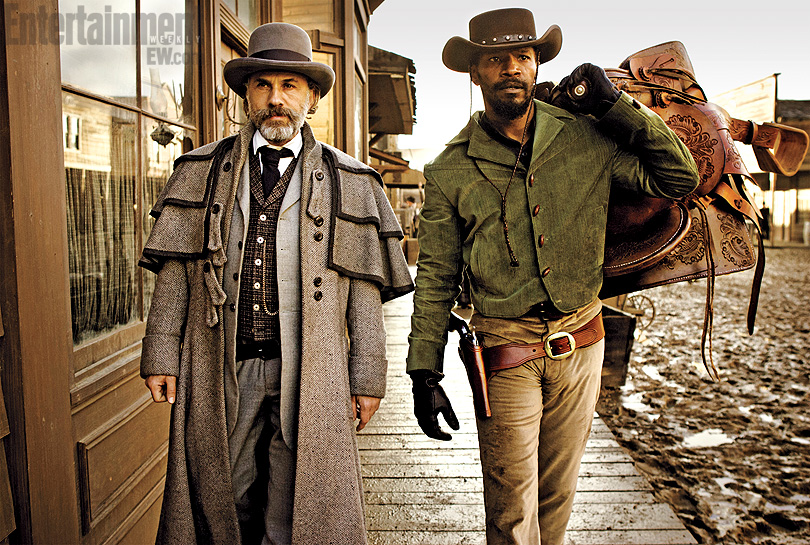
Foxx plays the title character.  As the movie begins, slave dealers are marching a group of slaves in leg irons and with the scars of whip marks along their backs, through the wilderness.  A cheerful man with an elegant, cultured manner pulls up in a cart with a big tooth mounted on a spring.  He is passing as a dentist.  He cordially offers to buy a slave but when the brutish, dull-witted men refuse, and the first massive slaughter of the story is underway, and all the other slaves set free.  The man is Dr. King Schultz (Christoph Waltz, who won an Oscar as a Nazi for Tarantino’s “Inglourious Basterds”).  He is a bounty hunter who hunts down “wanted dead or alive” men and kills them to collect the reward.  In those pre-Google image search days, he needs Django to identify three brothers.  The information on the wanted posters is not enough for a positive identification.  He is opposed to slavery, so he makes a deal.  He will keep Django a slave only long enough to complete the job.

Django proves so adept at the bounty hunter business that Schultz offers to bring him on as a partner.  “Kill white people and get paid for it? What’s not to like?” Django replies.  Django wants to rescue his wife, Broomhilda (Kerry Washington).  When they tried to escape from their owner, they were separated and sold.  Schultz says that Django will not be able to do it alone, and promises to help him get her back.  Their travels take them through several different adventures and many nods and winks to other films (Franco Nero, the original Django, shows up in a brothel bar), including a completely hilarious scene with a bunch of proto-Klan types who can’t get the eyeholes right in their masks and some completely horrifying scenes with a slave torn apart by dogs and a seemingly endless “mandingo fight” to the death.  Broomhilda is now owned by a man named Candy (his plantation is called Candyland).  He is utterly corrupt and despicable, but even worse is his house slave (Samuel L. Jackson), because he betrays other slaves.

Tarantino gets top marks for style, as always.  The violence and historical reversals are possibly intended to be empowering (oddly, Broomhilda is surprisingly less powerful than the usual Tarantino female characters).  On the contrary, it is dispiritingly disrespectful to the people who suffered unspeakable atrocities.  And Tarantino’s increasing distance between style and substance grows less palatable with each film.

Parents should know that this film includes extremely brutal, graphic, bloody, and disturbing violence with many characters injured and killed, an extended fight to the death, whipping and torture, prostitutes, slaves, some nudity, and constant very strong language including many uses of the n-word.

Family discussion:  Why did Stephen tell Calvin his suspicions about Django?  How does this movie show the influences of spaghetti westerns, American westerns, and “Blazing Saddles?”  Any other inspirations?

If you like this, try: “Inglourious Basterds” and “Kill Bill”

Related Tags:


Action/Adventure Drama Epic/Historical Western

Les Misérables

Posted on December 24, 2012 at 6:00 pm

Fair warning: I seem to be impervious to the appeal of “Les Misérables.”  I was not a fan of the stage show or the songs, but I understand that it is the most popular musical of all time, and I approached this movie version with an open mind.  My take is that it will make the fans happy, but I am still unpersuaded.

The musical is based on Victor Hugo’s vast novel about Jean Valjean (a magnificent Hugh Jackman), who served 19 years in prison for stealing a loaf of bread to feed his family and spends the rest of his life trying to do good and to avoid the relentless pursuit of Police Inspector Javert (Russell Crowe), who is trying to put him back in prison for violating his parole.

When Valjean is first set free, he is bitter and angry.  He repays the kindness of a priest who tries to help him by stealing valuable silver treasures from the church.  Immediately captured, he is returned to the priest (played by Colm Wilkinson, the foremost Valjean in the stage version).  But the priest insists that the items were gifts, and with the police watching, he encourages Valjean to take more.  Valjean is transformed by this compassion and generosity, and he vows to be as good, loving, and devoted to helping others as the man who cared for him.

Years later, Valjean, under another name, is prosperous and public-spirited.  He owns a factory and he is mayor of his town.  Fantine (a heart-breaking Anne Hathaway) works in his factory to support a daughter she boards with an innkeeper and his wife.  She loses her job because she refuses to sleep with a foreman and is forced into prostitution.  Valjean is horrified and feels responsible.  As she lies dying, he promises to care for her daughter, Cosette.

Valjean rescues Cosette from the corrupt innkeeper (Sasha Baron Cohen) and his wife (Helena Bonham-Carter).  But he has attracted the attention of Javert, and so he and Cosette must hide.  Ten years later, with Paris in the upheaval of a revolution, an idealistic young man named Marius (“My Week with Marilyn’s” Eddie Redmayne) sees Cosette (Amanda Seyfried) and instantly falls in love with her.  In the midst of uprisings and violent reprisals, Valjean tries to keep his promise to Fantine and keep Cosette safe and happy.

Production designer Eve Stewart has done a masterful job, making the setting as vibrant and as essential to the story-telling as any of the characters.  Director Tom Hooper (“The King’s Speech”) made a critical contribution by having the actors sing their parts while they were filming, instead of pre-recording them to be played back when the movie was being shot.  Since the movie is “sung-through” (all dialogue is sung rather than alternating speaking and singing), this gives the music a welcome organic quality and immediacy. Hathaway’s character is on screen for only a brief time, but her big number, the “I Dreamed a Dream” song memorably sung by Susan Boyle, is wrenching.  Hooper keeps the camera on her beautiful face, like the “Nothing Compares 2 U” Sinead O’Connor video, the better to feel her anguish, and it is a stunning moment.  Elsewhere, he over-does the artsy angles and sometimes assumes too much familiarity with the storyline.  Crowe’s voice is not up to the task and Seyfried’s is stretched beyond its capacity.  Newcomer to film Samantha Barks (from the London cast) as Eponine, the daughter of the innkeepers who also loves Marius, sings like an angel and lights up the screen.

It’s a long slog at nearly three hours, for a non-Miz-head.  But I came away with more understanding of those who are.

Parents should know that this is an epic story of struggle against oppression with disturbing and graphic abuse of prisoners and others, many characters injured and killed, sad deaths (including death of a child), and a woman accused of sexual misconduct and forced into prostitution.

Family discussion: How does the priest change Jean Valjean’s notion of what he should do? Why was Javert so conflicted? Why were the rebels willing to risk their lives?

If you like this, try: the PBS concert specials saluting the 10th and 25th anniversaries of the musical and the non-musical film versions

Related Tags:


Based on a book Based on a play Drama Epic/Historical Musical Tragedy

Parental Guidance

Posted on December 24, 2012 at 6:00 pm

D
Lowest Recommended Age: Kindergarten - 3rd Grade
MPAA Rating: Rated PG for some rude humor
Profanity: Some schoolyard language
Alcohol/ Drugs: Some alcohol
Violence/ Scariness: Comic peril and violence
Diversity Issues: None
Date Released to Theaters: December 25, 2012

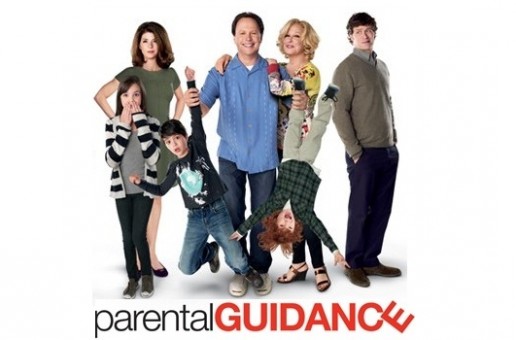
This shtick-y, utterly synthetic sit-com of a movie telegraphs its every joke and then pounds the audience over the head to make sure we get them.  Oh, we get them.  We just wish we didn’t.

Artie (Billy Crystal) is a minor league baseball announcer who always dreamed of announcing for the Giants.  He is fired at the end of the season because he is too old-school.  Insert “What’s Twitter?” and “What’s an Angry Bird?” jokes.  His wife, Diane (Bette Midler), teaches pole dancing in their living room for no reason except that it must be funny to see middle-aged ladies try to pole dance.  Their daughter, Alice (Marisa Tomei) is happily married to Phil (“That Thing You Do'” Tom Everett Scott), newly settled in Atlanta with their three children.

Phil’s new project is a super-duper high-tech home system that welcomes every family member when they come into the house, bids them farewell when they leave and talks to and spies on them in between.  When Artie and Diane arrive to babysit while Alice and Phil go to a business conference, we can expect to be treated to the conflict between Artie, whose ability with technology ended with the dial phone (until the script calls for him to pull up a track on an iPod) and the high-tech house.  And when Alice explains that their parenting philosophy is to say “remember the consequences” instead of “no” and insist on three “put-ups” to counter any “put-downs,” we can expect that, well, there will be consequences.  Everyone tries hard, but the talented cast is utterly wasted in a series of mind-numbingly obvious and heart-numbingly phony set-ups.

http://www.youtube.com/watch?v=_9nmIzCAMJQ

The oldest grandchild is Harper (Bailee Madison, giving the film’s best performance), a middle-schooler who is something of a perfectionist.  She has a big violin audition coming up, a teacher who thinks anyone who isn’t up to her standards should be shunned, and an increasing sense that she is missing out on some of the fun of the pre-teen years.  The youngest is Barker (Kyle Harrison Breitkopf), a high-spirited five-year-old perpetual flight risk who insists on calling his grandfather “Fartie,” which is even less hilarious than you might hope.  No good asking him to consider the consequences; there aren’t any.

Then there’s the middle child, Turner (Joshua Rush), a stressed-out, shy kid with a bad stutter.  The cynical sloppiness of this film is revealed in Turner’s miraculous transformation into a completely fluent speaker as the result of hearing the famous Russ Hodges “Giants win the pennant” broadcast, disrespectful in the extreme to those who struggle with speech impediments and to those who work with them.

It is filled with poorly staged slapstick and potty humor.  Artie gets hit in the crotch and throws up on the face of the kid who hit him.  Barker pees onto a half-pipe, causing Tony Hawk(!) to crash. There’s an extended nose-picking sequence.  The consequences of these moments — this movie is awful.

Parents should know that this film has extended and graphic potty and other bodily function humor, schoolyard language, comic peril, drinking, unrealistic portrayal of a “cure” for stuttering, and mild sexual references.

Family discussion: What are the biggest differences in the styles of parenting in this movie?  Which one do you agree with?  What did the three kids learn from their time with their grandparents?

If you like this, try: the “Wimpy Kid” movies

Related Tags:


Comedy Family Issues Movies -- format

Jack Reacher

Posted on December 22, 2012 at 1:02 pm

Jack Reacher, the hero of a series of books by Lee Child, is as much an idealized fantasy figure as any adorkable chick-lit single girl rocking her Jimmy Choos and self-deprecating quips until Mr. Perfect puts a ring on it.  The testosterone version has the observational and analytic skills of Sherlock Holmes, the “who was that masked man” righting-wrongs-and-leaving-town career path of the Lone Ranger, and the single-minded devotion to righteous indignation firepower of Rambo, and he will never, ever, ever put a ring on anyone.

Reacher is ex-military, and ex-pretty much everything else.  He has no strings, no relationships, no commitments — also, no id, no phone, no home, and no baggage, in both the literal and metaphorical sense.  When he needs to change clothes, he picks up something at Goodwill and throws away whatever he was wearing before.  When he needs a car, he has a very effective way of persuading people to let him drive theirs.  Or, he just takes one.  And he keeps moving.

http://www.youtube.com/watch?v=kK7y8Ou0VvM

In the books, Reacher is 6’5″ and 250 pounds and blond.  But that did not stop Tom Cruise, who is none of those things, from taking the role.  He more than makes up for the lack of physical stature with pure movie star charisma, a fair trade.

The movie is based on Child’s One Shot, written and directed by “The Usual Suspects” screenwriter Christopher McQuarrie. It opens with a scene of a sniper shooting random passers-by, and it is especially jarring when we see him aiming at a child.  I would say that it might have made sense to delay the release of the film because it is unfortunate to have it open a week after the shooting of children and teachers in Newtown, Connecticut, but it may be that after that horrible tragedy there will never be a good time for a movie that turns carnage into entertainment.  Within the world of the movie, a world people willingly enter because they want to see some guilt-free fights, chases, and shoot-outs, it is reasonably effective.  But if it is harder to enter that world these days, perhaps that is not a bad thing.
Law enforcement tracks down the sniper, a military vet, and the case seems open and shut.  But before he is beaten into a coma by other prisoners, he scrawls “Get Jack Reacher.”  Reacher can’t be contacted, but somehow he knows where he is needed, and he shows up.  The sniper’s lawyer Helen (Rosamund Pike) believes her client is guilty, but wants to do her best to represent him.  It turns out Reacher knew the sniper in Iraq.  He has reason to believe the sniper is guilty.  And, as Reacher tells us, he is not a hero.

Oh, who is he kidding, of course he is.  Surprise!  The case is not as open and shut as we thought.  There are some dreary detours into Helen’s relationship with her father, who happens to be the DA, and to a hideous torture scene with a bad guy known as “The Zec” (Werner Herzog, better known as a director), and a five-on-one bar fight, and than, thankfully, we meet up with Robert Duvall as a ex-Marine shooting range owner.  He is the only one who seems to understand what kind of movie this is, bringing a delicious zest to his scenes that almost make us forget that this is a movie in which a man is asked to bite off his own fingers and everyone seems to speak Russian.

It delivers what it intends to and what fans of the series are looking for.  But I’d say it’s too soon, and maybe it’s never going to be the right time for a mindless shoot-em-up again.

Parents should know that this film includes extensive, brutal and graphic violence including a sniper who kills innocent people and executions, many fights, many guns, car chases and smashes, torture, some disturbing images, characters injured and killed, some strong language (one f-word, crude epithets), drinking, and references to drug use and drug dealing.

Family discussion:  Why does Jack stay on the move?  Did Emerson have a choice?

If you like this, try: the Jack Reacher books by Lee Child

Related Tags:


Action/Adventure Based on a book Crime Thriller

Cirque du Soleil: Worlds Away

Posted on December 20, 2012 at 6:00 pm

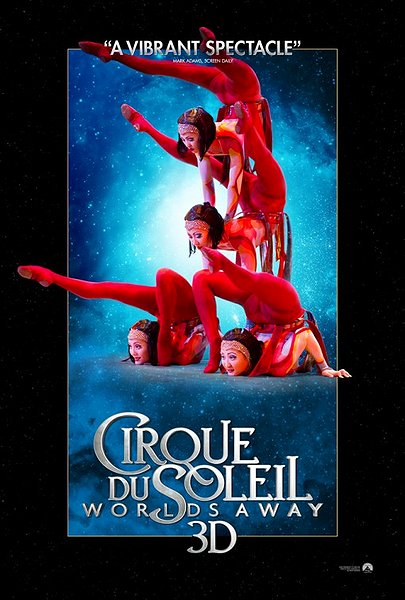
Her curiosity overcoming her shyness, a girl with big eyes and a gamine haircut (Erica Linz) walks through the gate for the “Circus Marvelous.”   She sees “The Aerialist” (Igor Zaripov), first smiling a welcome as he helps install the tent, then on a flier given to her by a clown, and then high above, performing with breathtaking ease and grace.  Suddenly he falls, hitting the sandy ground below, which collapses beneath him like quicksand.  The girl goes after him through an enchanted world of fantasy, splendor and feats of artistry, acrobatics, dance, music, and very firm, lithe bodies jumping, swirling, twisting, and bending, all in very tight costumes.  Plus there is an adorable tricycle powered only by a pair of small yellow galoshes, and a man on fire reading a newspaper.  He is not at all flustered when the flames creep up his body and onto his hat.  The fire is almost a dance partner.

Cirque du Soleil is an international phenomenon with shows on every continent but Antarctica.  Its founding principle is the immediacy and drama of live performance, the exact opposite of a movie.  Anything that can be imagined can be put on film; its very appearance of truth makes us marvel at the technology for fooling us so effectively.  We value Cirque for its old-school reality.  When we sit in the tent, we see performances in real time, with real peril, never to be seen exactly the same way again.  Producer James Cameron (“Avatar”) and director Andrew Adamson (“Shrek”) understand that they cannot replicate that experience and instead give us the chance to marvel by taking us up close and inside the action with immersive 3D.  The seamlessness and grace of the acrobatics adds to the dreamy quality.  In real life, we expect a sense of exertion and anxiety to underscore the sense of risk.  In the movie, the balletic movement adds to the fantasy that we are in a frictionless world unlimited by the laws of physics.

The girl and the aerialist wander, fall,  fly, and are chased through dreamlike — and occasionally nightmarish — scenes from seven of Cirque du Soleil’s Las Vegas shows: O, KÀ, Mystère, Viva ELVIS, CHRIS ANGEL Believe, Zumanity, and in one of the film’s highlights, the Beatles tribute show, LOVE.  An almost mythic inclusion of the four classical elements: fire, water, earth, and air, provide the settings for movement that flows seamlessly between dance, athletics, and stunts that do more than defy the laws of gravity; they transcend them.  In one stunning sequence, an enormous board studded with pins is tilted, distorting our perspective so that the performers swing as though they are weightless.

The costumes and make-up are dazzling, witty, and wildly inventive.  In one scene, a pair of girls are connected by a single Dr. Seuess-style hairdo.  In another, humans shaped like crustaceans skitter across the stage.  Many of the trippy visuals are accompanied by the kind of music they play in spas to relax people getting facials, but things pick up with an Elvis song and a medley of Beatles classics, including “Octopus’ Garden,” “Lucy in the Sky with Diamonds,” “For the Benefit of Mr. Kite,” that unmistakeable first chord from “Hard Day’s Night,” and a resounding “All You Need is Love.”

Zaripov has a striking purity when he performs.  It is beyond ease; it is serenity.  There is no sign of stress or exertion, even when he seems to be holding himself parallel to the ground with just one hand on a rope.  He juggles a giant cube as though he is balancing a prima ballerina.  And when Linz finally catches up, their exquisite aerial ballet is one of the most eloquently romantic moments on screen this year.

Parents should know that there are some mildly scary moments including a snake and a kidnapping.

Family discussion: How is Cirque du Soleil different from traditional circuses?  Which of the settings was your favorite and why?

If you like this, try: See Cirque du Soleil in person or watch the dance videos by LXD online

Related Tags:


3D Based on a play Fantasy For the Whole Family Musical
THE MOVIE MOM® is a registered trademark of Nell Minow. Use of the mark without express consent from Nell Minow constitutes trademark infringement and unfair competition in violation of federal and state laws. All material © Nell Minow 1995-2026, all rights reserved, and no use or republication is permitted without explicit permission. This site hosts Nell Minow’s Movie Mom® archive, with material that originally appeared on Yahoo! Movies, Beliefnet, and other sources. Much of her new material can be found at Rogerebert.com, Huffington Post, and WheretoWatch. Her books include The Movie Mom’s Guide to Family Movies and 101 Must-See Movie Moments, and she can be heard each week on radio stations across the country.

Website Designed by Max LaZebnik