The Real Story: “Zero Dark Thirty” and the Hunt for Bin Laden

Posted on January 8, 2013 at 8:00 am

Letter from Senators Feinstein, Levin, and McCain“Zero Dark Thirty” is a leading contender for the Best Picture Oscar.  Following her Best Picture and Best Director Oscars for “The Hurt Locker,” Kathryn Bigelow began work on what she thought would be a part journalistic, part feature film version of the hunt for Osama Bin Laden.  She did not expect that during the course of developing the film with “Hurt Locker” screenwriter Mark Boal Bin Laden would be found and killed, so that the entire direction of the movie would have to be revised.

The CIA was criticized for working with Bigelow and Boal, but insists that they did not provide the filmmakers with any classified information and has published a statement correcting what it says are inaccuracies in the film.  Now that the film is out in a few cities and preparing for its wider release on January 11, politicians and commentators on all sides are criticizing its depiction of torture. Senators Dianne Feinstein, John McCain, and Carl Levin have written to the film’s distributor outlining their objections to the portrayal of torture in the movie, calling it “grossly inaccurate” to portray information gathered as a result of torture as essential to determining Bin Laden’s location: “We are fans of many of your movies and we understand the special role that movies play in our lives, but the fundamental problem is that people who see ‘Zero Dark Thirty’ will believe the events it portrays are facts.”  Writer Glenn Greenwald was so eager to complain that the movie supports the use of torture that he decided to condemn it before actually seeing it for himself.  I will be addressing some of these issues in my review, but for now I will just say that it is hard to imagine that anyone who sees the movie will think it is an endorsement of torture and that while the movie depicts waterboarding and other high-pressure tactics that have been well documented and are — as the movie makes clear — not permitted any longer, and one or more characters may endorse torture, that does not mean that the movie is pro-torture.  When Bigelow accepted her New York Film Critics Circle Best Director award, she said, “I thankfully want to say that I’m standing in a room of people who understand that depiction is not endorsement, and if it was, no artist could ever portray inhumane practices. No author could ever write about them, and no filmmaker could ever delve into the knotty subjects of our time.”

I recommend this piece by Paul Miller, describing his reaction to the film as someone who was in the military on Sept 11, 2001 and later served as a CIA analyst, and this piece about a key interview that informed the screenplay.

Watching this movie made me both sad and angry.  Not angry at Kathryn Bigelow or Columbia Pictures.  I would have been if she had made a cheap and splashy film that exploited 9/11, my friend’s death, and the bin Laden raid as blockbuster fare.  This movie, if made by Michael Bay, would have been disgusting.

But Bigelow has made a sensitive and respectful film, one that honors the people who lived its story.  I told my wife after seeing Bigelow’s previous, Oscar-winning film,The Hurt Locker (2009), that it was the most faithful depiction of soldiers’ lives in a modern combat zone I’d ever seen.  I felt honored that someone took the time to tell our story, the story of a million veterans of Iraq and Afghanistan, and to tell it right.

Similarly, Zero Dark Thirty tells the stories of the countless  soldiers, sailors,  airmen, Marines, CIA officers, intelligence professionals, and special forces who have spent a decade hunting not just bin Laden, but all of al-Qaida and its murderous allies around the world.  It is the most accurate depiction of intelligence work I’ve ever seen in a movie–the painstaking detective work, the frustration, the dead-ends, the bureaucracy, the uncertainty, and the sudden life-or-death stakes.  There isn’t the slightest hint of James Bond or Jason Bourne here:  even the SEAL Team Six raid is done slowly, methodically, with more professionalism than flare….Bigelow resists the urge to sensationalize, and in so doing she elevates the material and demands that we pay attention to, and think carefully about, what we are watching….The right response to this film is not anger at the filmmakers.  It is, first, anger about 9/11, the wars, the death, and, for me, the casual ignorance among the vast majority of the population about the sacrifices borne by a tiny handful of heroes.  I was angry most of all at al-Qaida, at Osama bin Laden and his hateful jihad, at Humam Khalil Abu-Mulal al-Balawi for murdering my friend.  But the anger is muted by a pervading sadness:  Zero Dark Thirty is a profoundly melancholy, grim film.

The CIA is by nature, culture, and function inclined to keep secrets.  And any story-telling, even documentaries, selects some details, leaves others out, shifts emphasis, intentionally and unintentionally.  At least one commentator says that the real “Maya” is a man.  And the publicity from the film and the focus on the character played by Jessica Chastain, known only in the film as “Maya,” has led to some internal conflicts as well.  Now that story would make a great movie.


Related Tags:


Spies The Real Story

More about Fracking: Gasland

Posted on January 4, 2013 at 3:59 pm

This week’s release of “Promised Land,” with Matt Damon and Frances McDormand as representatives of a natural gas extraction company trying to persuade residents of a farm community to permit drilling, should inspire viewers to find out more about the controversial practice of “fracking.”  You can watch the 2010 documentary, Gasland, online.

And there are a number of books on the subject like Shale Gas: The Promise and the Peril, this progress report from EPA, and this report from the United States Senate Committee on Energy and Natural Resources as well as a fascinating episode of This American Life.

Related Tags:


Documentary Environment/Green

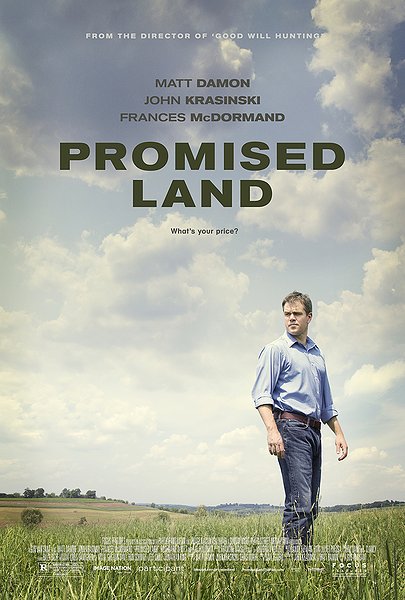
Promised Land

Posted on January 3, 2013 at 6:00 pm

“Promised Land,” written by stars Matt Damon and John Krasinski is smart, sincere, and timely, well directed by Gus Van Sant and with thoughtful, intelligent performances by everyone, especially Frances McDormand (“Fargo”) and Titus Welliver (“The Good Wife”). It’s a very good movie until it goes completely off the rails at the end.

Steve Butler (Damon) is about to get promoted for his outstanding record selling fracking to farmers.  He says what makes him successful is that he grew up in communities like the ones he is selling to (“football Fridays and cow tipping”), and he knows enough to stop at the local bar (Welliver is the bartender) when he gets to town to get acquainted and buy clothes from the local store to help him fit in.  He’s a modern day Professor Harold Hill, telling the people in the town that they’ve got trouble with a capital T and that rhymes with B — for bankruptcy.  The answer is a capital G for gas, and that may not rhyme with M for millionaire, but it still sounds pretty good.

But what really makes him successful is that he truly believes that he is helping them.  No, more than helping them; he believes he is saving them.  Steve saw his own farm community collapse when a factory closed down.  So when he sits across the kitchen table from a farm family and says he understands exactly what their financial struggles feel like, he is telling the truth.  “I’m not selling them natural gas,” he says, “I’m selling them a way to get back.”  When he tells the farmers — or lets them believe — that this is a great way for them to make money selling something they never even knew they had and will never miss, he almost believes that, too.

Steve’s partner is Sue Thomason (Frances McDormand), who cherishes very few illusions about what she is doing, and is very clear about why she is doing it — to support the son she Skypes with from too many hotel rooms.  She knows how to talk to the women, mom to mom, about what the fracking money can mean to the community.  “There’s no reason you shouldn’t have a state-0f-the-art high school,” she tells them.  More money means better opportunities for the next generation. And Steve and Sue have a couple of additional and very powerful means of persuasion.  When the local mayor says he might put up a fight, they pay him off (but not too much).  And when farmers hesitate, they bring up that special quality of the gas they want to “harvest.”  If the farmer says no, they can go to his neighbor and get it that way.  So, it isn’t will you or won’t you say yes.  It’s will you before they do?  And Steve reminds them that “if you’re against this, you are for oil and coal, period.”

All seems to be going smoothly until two people who are not going to be bought off start to object.  One is a local science teacher with a PhD (Hal Holbrook) who says that “the potential for error is just too high” and “money can lead very often to bad decisions.”  The other is an cheerful environmentalist named — wait for it — Dustin Noble (Krasinski) who says that he, too, is from a farm community, and he has pictures of dead cows that he says were killed by fracking.  He visits local schoolrooms and shows the children what it looks like when fields go up in flames.  And because this is a movie, it isn’t enough that Steve and Dustin are on opposite sides in the struggle for the gas drilling rights and the soul of the town.  There’s also a pretty teacher (Rosemary DeWitt) in town and both of them like her, too.

The battle escalates as Steve and Sue spread some money around and Dustin’s pictures shake up some of the local people.  There is a Frank Capra-esque gathering in the school gym as everyone gets together for a big vote and Steve has to examine his own soul. As soon as Steve says, “None of this can be true, right?  We would have heard about it,” we know that his essential goodness and passion for doing the right thing is creating an intolerable conflict.  Up to that point, the movie has some respect for its audience and the complexity of its subject.  But then it takes a big, dumb, veer into Hollywood nonsense that cheapens its message and leaves us feeling sullied.

Parents should know that this film has constant very strong language, some sexual references, drinking, a drinking game, and drunkenness.  A character throws a punch.

Family discussion:  How did Steve, Sue, and Dustin differ most in their priorities?  What made them effective in persuading people in the town?  Did you change your mind about who was right?

If you like this, try: “Gasland,” the documentary about fracking, and do some research into the extent of natural gas extraction and the scientific data about its impact.  The movie “Local Hero” is a lighthearted story about a similar situation.

Related Tags:


Drama Environment/Green

Washington DC Jewish Film Festival

Posted on January 3, 2013 at 8:00 am

The Washington Jewish Film Festival starts today with a spectacular line-up of movies that reflect Jewish experience and culture.  The opening night show is “Paris Manhattan,” a French film about a young woman obsessed with Woody Allen.

Other highlights include the newly restored 1937 film, “The Cantor’s Son,” “Off-White Lies” (a girl from California and her Israeli father pretend to be refugees and are taken in by a wealthy family in Jerusalem), documentaries about the song “Hava Nagila” and the Jews of Nigeria, the backstage story, “Romeo and Juliet in Yiddish,” and a love story between a French Jew living in Israel and a Palestinian that begins with a note in a bottle, “A Bottle in the Gaza Sea,” starring the mesmerizing Hiam Abbas.

http://www.youtube.com/watch?v=E3ERyTmaGl4


Related Tags:


Festivals Spiritual films
THE MOVIE MOM® is a registered trademark of Nell Minow. Use of the mark without express consent from Nell Minow constitutes trademark infringement and unfair competition in violation of federal and state laws. All material © Nell Minow 1995-2026, all rights reserved, and no use or republication is permitted without explicit permission. This site hosts Nell Minow’s Movie Mom® archive, with material that originally appeared on Yahoo! Movies, Beliefnet, and other sources. Much of her new material can be found at Rogerebert.com, Huffington Post, and WheretoWatch. Her books include The Movie Mom’s Guide to Family Movies and 101 Must-See Movie Moments, and she can be heard each week on radio stations across the country.

Website Designed by Max LaZebnik