‘Louder than a Bomb’ — Poetry Slam Documentary Tonight on OWN

Posted on January 5, 2012 at 8:00 am

I’m delighted that the brilliant documentary “Louder than a Bomb,” from director Jon Siskel, will be broadcast tonight on Oprah’s OWN network at 9/8 Central.  Every family with teenagers and everyone who loves words should be sure to tune in.  “Louder Than A Bomb” goes behind the scenes as four Chicago high school teams compete in the Chicago area teen poetry slam. Hopeful and heartbreaking, the film captures the young poets’ hopes, obstacles, and longing for a way to tell their stories and the way the very act of turing their stories into poetry transforms their world.  The result is electrifying and inspiring. Highly recommended.

Related Tags:


Documentary High School Teenagers Television

The Artist

Posted on January 3, 2012 at 6:14 pm

A-
Lowest Recommended Age: Middle School
MPAA Rating: Rated PG-13 for a disturbing image and a crude gesture
Profanity: No bad language, someone gives the finger
Alcohol/ Drugs: Drinking, smoking
Violence/ Scariness: Fire
Diversity Issues: None
Date Released to Theaters: January 3, 2011
Date Released to DVD: June 25, 2012
Amazon.com ASIN: B0059XTUMC

“We didn’t need dialogue,” said Norma Desmond (Gloria Swanson) unforgettably in Billy Wilder’s classic, “Sunset Boulevard.”  “We had faces!”  Swanson herself had been a silent film star, but she is best remembered for playing the actress driven mad by being made obsolete when the talkies shifted the spotlight from faces to a snappy way with a wisecrack.  Of course, “Sunset Boulevard” is a talkie, filled with brilliant dialogue from Wilder, Charles Brackett, and D.M. Marshman, Jr.  (“You used to be big in pictures.”  “I’m still big.  It’s the pictures that got small.”)  But Desmond was right about the faces.  Partly because they were silent for the first decades of film-making, the movies invented a new vocabulary of story-telling and new techniques of acting.  When D.W. Griffith pioneered the close-up, the declamatory, projecting to the back of the theater style of acting on the stage began to evolve into the subtle, intimate evocation of thought and emotion the way we see it in real life, with a flicker of an eyelid, the trembling of the corner of the mouth, more eloquent than the most lyrical and evocative words.

“The Artist” is a new film from French writer/director Michel Hazanavicius that evokes this classic era of Hollywood in form and content, set in the moment of transition to talkies, black and white and almost completely silent, with references to “Singin’ in the Rain,” “A Star is Born,” and even “Citizen Kane,” but very much of our moment, and so fresh and inventive that color and sound seem superfluous.

Jean Dujardin plays handsome silent film superstar Georges Valentin.  He appears at the opening of his latest film with his favorite co-star, his Jack Russell terrier, dancing, bowing, and basking in the adoration of the audience — and hogging the spotlight to annoy his human co-star (Missy Pyle).  Outside the theater, when an enthusiastic fan falls into his path, he laughs good-heartedly.  The next morning, a photo of Valentin and his fan appears in the paper and his wife (Penelope Ann Miller) does not find it amusing.  The charming whimsy and dazzling smile that work so well on screen do not mollify her.

The fan is a would-be actress named Peppy Miller (the very appealing Argentine actress Bérénice Bejo, wife of Hazanavicius).  She gets her first break as a dancer on Valentin’s new film.  In a captivating scene, they have to do repeated takes of a scene where they dance together because they keep getting distracted by their immediate sense of connection.  In the film within a film, he is a star and she is an extra.  But in their real story, it is clear she is a lead.

The sound era arrives and Miller becomes a star while Valentin, stubbornly insisting on making a new silent film, loses his wife, his money, and finally, at auction, everything he owns, including his dinner jacket and portrait.  Can there be a happy ending?  Well, it’s a movie!

There’s a bit of a backlash to this film, following its rapturous reception in Cannes and year-end awards, with some complaints that it plays to the affections of critics and movie insiders and that it is a nice enough film that benefits from being a valentine to cinema rather than on its own stand-alone merits.  That is unfair to the intelligence behind the film and the subtle qualities beyond the quaint settings.  Hazanavicius shifted the frames-per-second to be closer to the slightly jerky silent movie standard to invite us back into that world.  But it is not just a re-creation of an archaic technique.  The characters are real, vivid, and affecting.  As shown by its final moment, the movie transcends its story to be more than a tribute to a simpler time.  It is a lesson on the power of movies to re-invent a visual vocabulary for the universal language that goes beyond the borders of countries and cultures.

(more…)
Related Tags:


Comedy Drama DVD/Blu-Ray Pick of the Week Romance

Ring Out 2011 With the Marx Brothers

Posted on December 31, 2011 at 8:00 am

Hurray for TCM for a full day of Marx Brothers!  Tune in to put 2011 in context with the riotous anarchy of Groucho, Chico, and Harpo in “Duck Soup,” “Night at the Opera,” “Day at the Races,” “At the Circus,” “Animal Crackers,” “Horse Feathers,” “Monkey Business,” and more!

http://www.youtube.com/watch?v=EH7lfGtDlj0
Related Tags:


Classic Comedy
The War Horse

The War Horse

Posted on December 23, 2011 at 12:30 pm

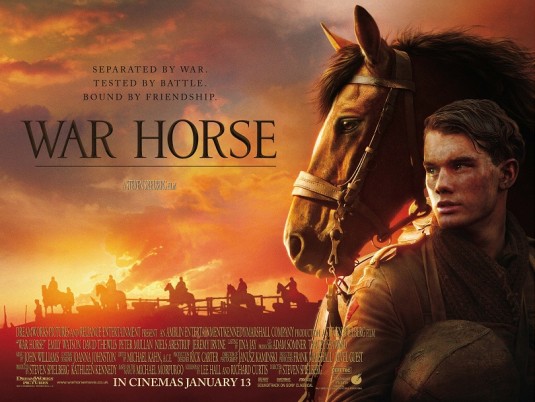
The second Steven Spielberg movie of the week opens on Christmas Day, a grand epic, is big, long, ambitious, and showy.  It is a work by a master, but it is not a masterpiece.  Every detail is carefully considered.  Every leaf on every tree is perfectly aligned so that every sunbeam and shadow fall perfectly across them.  Every equine muscle, every country cottage, every blade of grass, every puff of smoke from a discharged weapon is exquisitely framed and lit, but the visuals outweigh the story.  The result is serviceable but stodgy, stuffy, and static.  The poetry and symbolism of the stage play (with a multi-operator puppet as Joey) is replaced by postcard-picturesque images that are visually rapturous but feel thin in comparison to the movie’s aspirations.

It’s “Black Beauty Goes to War,” the story of a magnificent horse named Joey and Albert (a dull Jeremy Irvine), the boy who loves him.  When World War I begins, Albert’s father sells Joey to a gallant young officer (Tom Hiddleston), who promises Albert he will do everything he can to keep Joey safe and get him back home after the war.  But war has a way of changing everyone’s plans and soon Joey is on his own journey that will take him back and forth between the British and the German forces and, for a short idyllic time, a respite with a frail but brave little French girl and her affectionate Grandfather.  The horse can switch sides in a way that a human cannot, and the movie makes clear the difference between the soldiers who are taken prisoner and shot and the animals who are inherently neutral and thus commoditized.  The brutality of war affects the human characters differently as we see in their responses to the animal.

The sweep and grandeur and tragedy of the film pay homage to majestic WWII-era filmmakers like John Ford, with gorgeous cinematography by  Janusz Kaminski.  One quiet scene of breathtaking power recalling the real-life Christmas truce reminds us of our better angels.  But it also reminds us of Spielberg’s better films.


(more…)

Related Tags:


Action/Adventure Based on a book Based on a play Drama Epic/Historical War

An Oscar-Winning Animated ‘Christmas Carol’

Posted on December 23, 2011 at 9:52 am

I thought I knew of — and loved — every film version of Dickens’ “A Christmas Carol.”  But what a delight to discover a new one, and an Oscar-winning animated version by one of my favorite artists, Richard Williams (of “The Thief the the Cobbler”) and narrated by Michael Redgrave!  And Alistair Sim, my favorite Scrooge, reprises his role from the 1951 classic version.  Many thanks to Spencer Kornhaber of the Atlantic for this fascinating post, which includes the half-hour long movie in full.

Related Tags:


Animation Based on a book Holidays Shorts
THE MOVIE MOM® is a registered trademark of Nell Minow. Use of the mark without express consent from Nell Minow constitutes trademark infringement and unfair competition in violation of federal and state laws. All material © Nell Minow 1995-2026, all rights reserved, and no use or republication is permitted without explicit permission. This site hosts Nell Minow’s Movie Mom® archive, with material that originally appeared on Yahoo! Movies, Beliefnet, and other sources. Much of her new material can be found at Rogerebert.com, Huffington Post, and WheretoWatch. Her books include The Movie Mom’s Guide to Family Movies and 101 Must-See Movie Moments, and she can be heard each week on radio stations across the country.

Website Designed by Max LaZebnik