Roma Downey knows something about angels after playing one on television in the fondly remembered “Touched by an Angel” series. Now her Little Angels DVDs are a faith-based series for pre-schoolers to help them learn numbers and letters. Animated twins Alex and Zoe have eight little angels watching over them, living on the ceiling of their bedroom and guiding them through the challenges of learning and growing.
Downey says, “For many years I had the privilege of playing an angel on television, bringing the message of God’s love to millions of Americans. As a mother I have longed to be a part of a project that would help to bring that same message to children through the foundations of education.” She calls the series “critical learning skills through the lens of timeless and appropriate Bible stories,” including spiritual, moral, and ethical lessons along with the three R’s.
I have a “Little Angels” DVD to give away! Send me an email at moviemom@moviemom.com with “Angels” in the subject line and don’t forget your address! I’ll pick a winner November 26. Good luck!
In trying to balance the hopes of the passionately devoted fans of the Twilight series (are there any other kind?), who want to see every single word of the books up on the screen and the realities of cinematic storytelling that limit a feature length movie script to about 110 pages, Summit Entertainment has opted for a third priority, the maximization of ticket sales. The decision to split the fourth and last book of the series into two movies may satisfy the most avid of the Twihards but the result is a movie that is sluggish and dragged out. And when “Twilight” gets dragged out, that exposes the weakest parts of what even many fans acknowledge is the most problematic of the four books, with too much time to focus on some of the story’s most outlandish absurdities.
In the last episode, 18-year-old human Bella Swan (Kristen Stewart) became engaged to 100-plus-year-old vampire Edward Cullen (Robert Pattinson) and this one begins with the delivery of the wedding invitation. Bella’s mother is excited. Her father is resigned. And Jacob (Taylor Lautner), the wolf-boy who shares a mystical connection with Bella, is so angry that he has to take his bad wolf self up to run around Northern Canada for a while. Meanwhile, Bella has the usual wedding jitters — will she be able to walk in those high, high heels Alice is making her wear? Will the friends and family on both sides manage to get through the wedding without killing each other — literally? And will she survive a wedding night with a vampire? She does not have to worry about whether Jacob will take his shirt off because that happens in the first ten seconds of the film.
Even some Twilight fans admit that author Stephenie Meyer wrote herself into something of a corner by the time she started the last book. She has said that the idea for the human/vampire love story came from her commitment to writing about a loving relationship where physical intimacy was impossible. But in the last volume (so far), she decided to go there anyway. There are some things one can suspend disbelief for more easily in a book than more explicitly portrayed in film and a flashback to a 1930’s Edward watching Elsa Lanchester’s “Bride of Frankenstein” as he waits to pounce on human prey (meticulously chosen, Dexter-style — killers only) elicited laughter from the audience, as did the literally bed-smashing wedding night. A bigger problem is that four movies in, Bella and Edward still do not have much to talk about beyond how much they love one another and the logistics of their very mixed marriage. Edward actually researches vampire babies on the internet (a take-me-right-out-of-the-movie product placement from Yahoo search which should inspire nothing more from the audience than a Google search to see whether Yahoo still exists). And, frustratingly, Meyer begins to bend the rules of her own world, where blood means one thing in one scene and then everyone seems to forget about it in another. There is a very weird detour into a pro-life/pro-choice debate — is the creature Bella is carrying a child or a fetus? If, as it appears, continuing the pregnancy means certain death for her, should she have an abortion?
I’m enough of a fan to have enjoyed the wedding scene and even the honeymoon, even with the cleaning crew at the perfect getaway with an ocean view glaring at Edward because in their simple native way they can tell he is a demon. And I liked seeing Edward respect Bella’s relationship with Jacob. I laughed, but I was touched, too, when Bella, terribly sick with the pregnancy, is cold, and all three of them realize that only Jacob, the human furnace, can warm her up, and even when he and Edward do a sort of Vulcan mind meld to figure out what Bella and the baby need. But the best scene in the movie is the one that comes midway through the credits, featuring the much-missed Michael Sheen, letting us know that the final chapter will be less sap and more action.
Rated R for language including some sexual references
Profanity:
Constant very strong and crude language from adult, teens, and child
Alcohol/ Drugs:
Drinking, teen gets drunk, references to teen drug abuse
Violence/ Scariness:
Tragic fatal accident (no graphic images), grief and loss, discussion of taking someone off of life support, sad parental death
Diversity Issues:
Diverse characters, homophobic insult as evidence of crass, bullying behavior
Date Released to Theaters:
November 16, 2011
Date Released to DVD:
March 13, 2012
Amazon.com ASIN:
B004UXUX4Q
Just because he lives in Hawaii, don’t think he’s in paradise, Matt King (George Clooney) warns us. No one is immune to life. The first Alexander Payne film since “Sideways” gives us another damaged hero at a crossroads and as the King whose crown lies very uneasily on his head Clooney gives his most vulnerable and sensitive performance.
Matt’s wife Elizabeth, glimpsed briefly but vibrantly as she is out boating, is in a coma following an accident on the water. “If you’re doing this to get my attention,” he says to himself as much as to her, “it’s working.” All of a sudden he has to pay attention to a lot of things. He’s the one who gets called in to school when his 10-year-old daughter Scottie (Amara Miller) brings in photographs of her mother in a coma for show and tell and the one who has to drive her to apologize after she insults a classmate via text. “I’m the back-up parent,” he tells us, “the understudy.” He was. Now he’s first-string and the game is on the line.
Matt and his family live on his income as a lawyer but everyone knows that he has inherited land of almost unimaginable value and that he is about to decide whether he will sell it for a lot of money or for you-can’t-count-that-high money. The land is owned equally by Matt and his many cousins, all descendants (hence the title) of Hawaiian royalty and the son of missionaries. For legal reasons they cannot continue to hold it indefinitely. For financial reasons, the poorer relatives are pressing to make a deal. But Matt is the sole trustee. He has the authority to decide, and is trying to do what is best for everyone.
He impulsively takes Scottie to pick up his older daughter, Alexandra (Shailene Woodley), who has been away at boarding school because of problems with drugs and overall bad behavior. When they arrive, she is out after curfew, drunk, and hostile. At home, she tells him why she was so angry at her mother — Elizabeth was having an affair. And the doctor tells Matt that Elizabeth is deteriorating and there is no hope.
Matt begins to understand how little he knew and how little he has control over. He is clear, methodical, and deliberate on removing Elizabeth from life support, informing her brusque father (an excellent Robert Forster), her mother with dementia (Barbara L. Southern), and their friends and family about what is going on and urging them to visit her to say goodbye. He brings depositions to Elizabeth’s bedside so he can keep working. But in other areas he goes on instinct and impulse, taking Scottie, Alex, and Alex’s dim-witted, awkward boyfriend Sid (Nick Krause) to track down Elizabeth’s lover, all of them more sure that they need to do it than they are sure what they will do when they find him.
Alexander Payne (“Election” and “Sideways”) has a gift for life’s messiness, the mash-ups of pain, humor, anger, terror, and longing that collide in the midst of big moments and domestic dailiness. A man wants to get somewhere urgently so finds himself running in shoes that slip and with lungs that no longer let him forget he is getting older. A thoughtless teenager says the wrong thing to a tough old man and gets popped in the eye. There is an awkward encounter with the man who drove the boat in the accident (played by an actor who looks like he has lived his whole life on the beach because it is surfing champion Laird Hamilton).
But moments of grace that come from the wrong people and at the wrong time can still brighten spirits. Payne is also an actor’s director who has consistently given underrated performers a chance to show greater depth and breadth. This film is filled with beautiful performances from Clooney, Woodley, Forster, Matthew Lillard, Beau Bridges, and, as a character who does not even appear until about 3/4 of the way into the movie, the always-wonderful Judy Greer. Too often relegated to best-friend roles for whatever Jennifer and Jessica are in the latest forgettable romantic comedy, Greer is an actress of impeccable honesty and timing. At first her character seems like a nice person who has never needed or wanted to be anything else. But then Greer brings to the small but essential role a dignity and resolve that are unexpectedly touching.
There is a lot of crying in this movie, and not movie crying with one perfect sparkling tear welling up in the corner of one perfect eye. There is some messy, ugly crying. And there is messy, ugly behavior. This is a terrible, painful situation and people are fraught and scared and angry. Matt tells Elizabeth that even in a coma she can still be difficult. But he finds his way to some clarity about some of the problems that were making him feel powerless. And we recognize that acknowledging the messiness may be the closest to clarity anyone can get.
Rated PG-13 for mature thematic material and some disturbing images
Profanity:
Mild language
Alcohol/ Drugs:
References to drugs and alcohol
Violence/ Scariness:
The movie concerns the violent murder of three people and the aftermath, many references to violence
Diversity Issues:
None
Date Released to Theaters:
November 16, 2011
Amazon.com ASIN:
B0067EKZ62
Werner Herzog continues his exploration of the darkness and the light within the human spirit with “Into the Abyss,” a documentary about why and how we kill each other, in violation of the law and directed by it.
In Texas, where as many as two prisoners are executed each week, Herzog speaks to the people connected to one crime, the senseless murder of three people by a couple of teenagers, who were just trying to steal a hot car. Herzog remains off-camera as he interviews the men, now in their 20’s, who are in prison, one just days from his scheduled execution, the woman whose mother and brother were two of the victims, the chaplain and the correctional officer who are the last people the condemned prisoner sees, the police officer who investigated the crime, and others who help to tell the bleak story of loss and limits.
Herzog lets each of them tell us not just what they think but who they are. He lets us discover for ourselves the telling details like the sign that says “Dream” over the fireplace in the living room of the corrections officer as he tells us that after over 100 executions he just could not do it any more and the tree growing through the floorboards of the car once deemed worth three lives, now rotting in the police impound lot. We meet the father of one of the two prisoners whose only gift to his son was pleading with the jury not to sentence him to death. A woman describes falling in love with one of the men in prison and marrying him there. Both have surprises that confound our expectations. Many of the interviews present a bleak portrait of limited vistas and opportunities alongside limitless need for love.
Indeed, no matter what views you bring to this film, you will come away enlarged, moved, changed as much from the compassion and generosity of Herzog himself as from the people he interviews. Herzog, who had just an hour with each of his subjects and shows us his first and only conversations with them, has made a film that expands his consideration of the human struggle for connection and meaning.
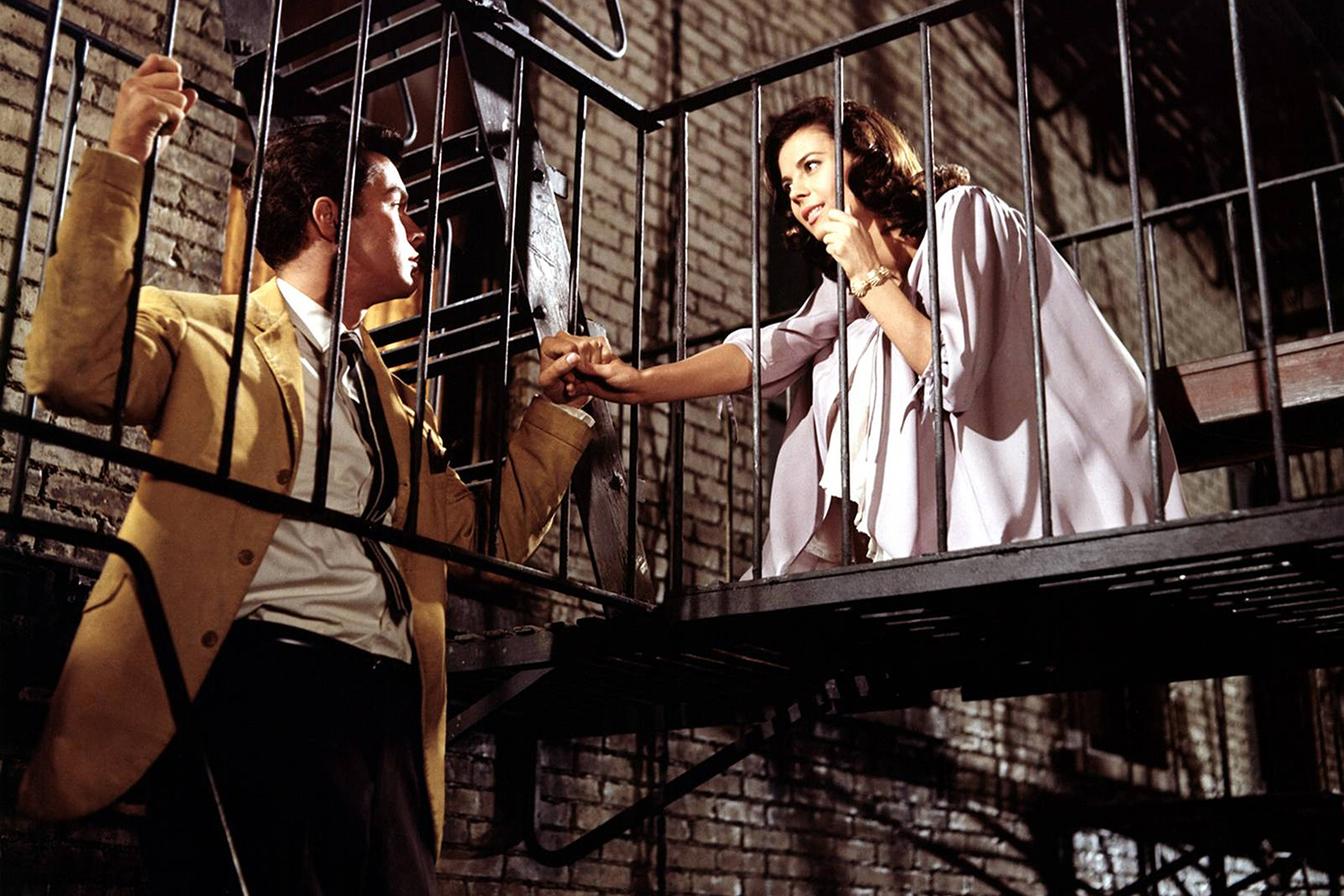
Actress Natalie Wood and Richard Beymer in a scene from the movie “West Side Story” (Photo by Donaldson Collection/Getty Images)
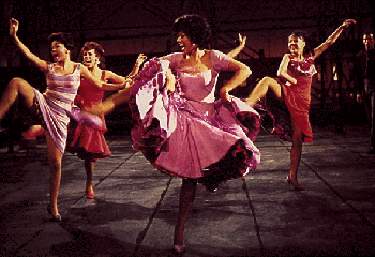
In honor of the 50th anniversary of this American classic there is a new Blu-Ray release of West Side Story: 50th Anniversary Edition. Modeled on “Romeo and Juliet,” this movie puts the star-crossed lovers in two warring gangs in the slums of New York. The opening dance number brings us up to date. The Sharks (Puerto Ricans) and and the Jets (Anglos) have blown up a series of petty insults and turf disputes into a war over who will rule the territory. The leader of the Jets, Riff (Russ Tamblyn), goes to see his best friend Tony (Richard Beymer), the former leader of the gang. Riff asks Tony to come to the dance that night to support him as he negotiates fight terms with Bernardo (George Chakiris), the leader of the Jets. Tony has outgrown the gang, and wants more from life, but he and Riff are friends “womb to tomb,” so he agrees to go. Moreno and Chakiris both won Oscars for their performances, two of the ten won by this movie, including Best Picture. The brilliant music and lyrics are by Leonard Bernstein and Stephen Sondheim.
Bernardo’s sister Maria, just arrived in the US, is getting ready for the dance, begging to have her dress cut just a little lower. Bernardo’s girlfriend, Anita (Rita Moreno), watches over her protectively. At the dance, well-meaning Mr. Hand tries to get the teenagers to mix with each other, but tensions are high. As each side dances furiously, everything seems to stop for Tony and Maria, who see each other and are transformed.
Bernardo is furious when he sees them together, and he takes Maria home. But that night, Tony visits her, and they declare their love for each other. She asks him to make sure there is no fighting, and he agrees. At the “war council” he persuades them to make it a fist fight only, and he feels successful. But Maria wants him to make sure there is no fighting of any kind, so he agrees to try to stop them. Things get out of control, and Bernardo kills Riff with a knife. Tony, overcome with grief and guilt, grabs the knife and kills Bernardo.
Running from the police and the Jets, Tony finds Maria. They dream of a place where they could always be safe and together. Anita agrees to take a message to Tony, but when she is harassed by the Jets, she angrily tells them that Maria is dead. Blinded by grief, he stumbles out into the night, and is shot by one of the Sharks. Maria holds him as he dies, and together, the Sharks and Jets carry him away.
The story retains its power, but the gangs are endearingly tame to us now. Can it be that once there were gangs who fought with fists and knives? This is a good opportunity to explore the reasons that people fight. Anita says that the boys fight like they dance, “Like they have to get rid of something, quick.” According to her, they are getting rid of “too much feeling.” Kids understand that idea and may like to talk about what “too much feeling” feels like to them. The music and dances in this movie do as much to tell the story as the dialogue and plot, and they illustrate this idea especially well.
One important difference between this movie and “Romeo and Juliet,” is that in Shakespeare’s play, the older generation plays an important role. In “West Side Story,” the few adults who appear are ineffectual and tangential, like Mr. Hand (John Astin), who thinks he can get the kids to be friends by having them dance together. Listen to the lopsided music-box song he plays for them, and see what a good job it does of expressing both what he is trying to accomplish and how hopeless it is.
And, of course, this is an important movie to use in talking about prejudice. See if you can get kids to watch carefully enough to figure out why the Sharks and Jets resent and mistrust each other.
Family discussion: If you were going to adapt the story of “Romeo and Juliet” today, what groups would the boy and girl come from? Where do you see the most prejudice today? Listen to the song about “America,” with the Sharks and their girlfriends disagreeing about whether America has been good or bad to them. Which side do you agree with? Are they both right? Why? In the song “Tonight,” both sides sing, “Well they began it!” Have you ever seen people act that way? One of the boys tells Doc “You was never my age.” What does he mean? Do all teenagers feel like that at times? Have you ever dreamed of a special place where you could always be safe? What would it be like? Tony has to decide how he can be loyal to his friend and loyal to Maria. Why is that hard? Who else in the movie has to make a decision about loyalty? If you could talk to Tony and Maria, what would you tell them to do?
Connections: This is a great double-feature with “Romeo and Juliet” or the 1997 version, “William Shakespeare’s Romeo + Juliet.” It is fun to see how much of the movie’s structure is taken from the play. In both, the lovers see each other at a party, and are immediately overcome. In both, the boy comes to see the girl later that night. Juliet speaks to Romeo from a balcony. Maria speaks to Tony from a fire escape. Romeo and Tony are both pulled back into the fight due to the deaths of their friends. In both movies, tragedy results from missed messages. There are some important differences, too. Juliet dies, but Maria does not.



 (are there any other kind?), who want to see every single word of the books up on the screen and the realities of cinematic storytelling that limit a feature length movie script to about 110 pages, Summit Entertainment has opted for a third priority, the maximization of ticket sales. The decision to split the fourth and last book of the series into two movies may satisfy the most avid of the Twihards but the result is a movie that is sluggish and dragged out. And when “Twilight” gets dragged out, that exposes the weakest parts of what even many fans acknowledge is the most problematic of the four books, with too much time to focus on some of the story’s most outlandish absurdities.
 -style — killers only) elicited laughter from the audience, as did the literally bed-smashing wedding night. A bigger problem is that four movies in, Bella and Edward still do not have much to talk about beyond how much they love one another and the logistics of their very mixed marriage. Edward actually researches vampire babies on the internet (a take-me-right-out-of-the-movie product placement from Yahoo search which should inspire nothing more from the audience than a Google search to see whether Yahoo still exists). And, frustratingly, Meyer begins to bend the rules of her own world, where blood means one thing in one scene and then everyone seems to forget about it in another. There is a very weird detour into a pro-life/pro-choice debate — is the creature Bella is carrying a child or a fetus? If, as it appears, continuing the pregnancy means certain death for her, should she have an abortion?
 . Modeled on “Romeo and Juliet,” this movie puts the star-crossed lovers in two warring gangs in the slums of New York. The opening dance number brings us up to date. The Sharks (Puerto Ricans) and and the Jets (Anglos) have blown up a series of petty insults and turf disputes into a war over who will rule the territory. The leader of the Jets, Riff (Russ Tamblyn), goes to see his best friend Tony (Richard Beymer), the former leader of the gang. Riff asks Tony to come to the dance that night to support him as he negotiates fight terms with Bernardo (George Chakiris), the leader of the Jets. Tony has outgrown the gang, and wants more from life, but he and Riff are friends “womb to tomb,” so he agrees to go. Moreno and Chakiris both won Oscars for their performances, two of the ten won by this movie, including Best Picture. The brilliant music and lyrics are by Leonard Bernstein and Stephen Sondheim.