
Happy 20th Anniversary Simpsons!
Posted on January 9, 2010 at 8:00 am
Posted on January 9, 2010 at 8:00 am

Posted on January 7, 2010 at 9:28 pm
B| Lowest Recommended Age: | Mature High Schooler |
| MPAA Rating: | Rated R for sexual content, language and drug use |
| Profanity: | Very strong and crude language |
| Alcohol/ Drugs: | Drinking, smoking, and drug use by teens and adults, people given drugs unknowingly |
| Violence/ Scariness: | Comic peril and violence, car crashes and explosions |
| Diversity Issues: | Diverse characters, some anti-Christian humor |
| Date Released to Theaters: | January 8, 2010 |
Those who want to see the Michael Cera they know and love and those who want to see him do something else can both find what they are looking for in “Youth in Revolt,” based on the popular epistolary novels
And at first this is the typical Michael Cera role — a sensitive teenager who is not sure of himself but whose hesitant delivery produces makes the surprisingly barbed coherence of his comments particularly winning. But then, when Nick meets Sheeni (appealing newcomer Portia Doubleday) and realizes that faint heart never won fair lady and nice guys finish last, etc. etc., he realizes he needs to up his game. And so, like the Dark Knight, Dr. Jekyll, and The Nutty Professor, he takes on another persona, one that manifests his darker impulses. Nick becomes Francois Dillinger, named for the fantasy Frenchman Sheeni says she hopes to marry and, well, you know. Francois has a mustache, he smokes, and he wears slim, European white pants. He gets Nick into a lot of trouble, but he coolly keeps pushing him forward. The two Michael Ceras interact like “The Parent Trap” on crack.
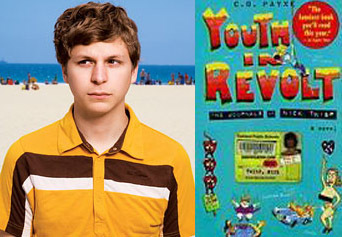
The exceptionally strong supporting cast includes the Mary Kay Place and M. Emmett Walsh as Sheeni’s very strict Christian parents and Fred Willard as a soft-hearted liberal neighbor. Jean Smart plays Nick’s perpetually-unlucky-in-love mother (her suitors are Zach Galifianakis and Ray Liotta) and Steve Buscemi is his BMW-loving father. The episodic nature of the story seems to drift toward an end that seems hasty and contrived. But Director Miguel Arteta (“The Good Girl,” “Chuck and Buck”) maintains a darkly comic tone, twisted but buoyant, that will feel authentic to anyone who has survived — or hopes to survive — adolescence.
Posted on January 5, 2010 at 8:00 am
B+| Lowest Recommended Age: | 4th - 6th Grades |
| MPAA Rating: | Rated PG for brief mild language |
| Profanity: | Brief schoolyard language |
| Alcohol/ Drugs: | None |
| Violence/ Scariness: | Comic peril and violence, no one hurt |
| Diversity Issues: | Issue of pressure on women to be cute and perky instead of strong and smart |
| Date Released to Theaters: | September 18, 2009 |
| Date Released to DVD: | January 5, 2010 |
| Amazon.com ASIN: | B002WJI2QQ |
When things go very, very wrong in this movie, as they so often do, we get to see a series of television news broadcasts from around the world showing the destruction of various iconic monuments, as we so often do. And then something different happens. One of the newscasters points out that this particular un-natural disaster seems inexplicably and improbably primarily directed at national landmarks. So this is a movie with a sense of humor about itself and its audience.
As long as you don’t expect it to have much to do with the story or illustrations in the classic book
It begins, as so many stories for children begin, with a kid who feels like an outsider. Flint Lockwood (as an adult the voice of Bill Hader of “Saturday Night Live”) is a curious kid who likes to invent things but does not always think things through. His spray-on shoes are so indescructable they never come off. His gadget to allow Steve the Monkey to speak works perfectly well; it’s just that Steve doesn’t say much worth hearing. His mom believes in him, but after she dies he just has his dad, all eyebrows and mustache (and voice of James Caan) thinks he should just give it up and come to work with him in his sardine shop.
Sardines are the sole product of Flint’s town, called Swallow Falls. But then, disaster happens. Everyone figures out that sardines are yucky. And so the town falls on hard times. Can one of Flint’s inventions save the day?
Well, not really. An invention to turn water into food goes awry when it is shot into the air and the next thing the town knows, what once was rain, snow, fog, and hail is now pancakes, sushi, BLTs, and jellybeans. The mayor (voice of B-movie star Bruce Campbell) sees this as a chance to revitalize the town’s economy through tourism. And as a chance to eat a lot of food and get very fat. The former mascot of the town’s previous sardine industry, the now-grown “Baby” Brent (voice of SNL’s Andy Samberg) sees this as a threat to his popularity. And a junior employee at the Weather Channel who wants to be a newscaster (Anna Feris as Sam Sparks) thinks she has to hide her brains and curiosity to get people to like her and sees this as her chance to show what she can do.
That is a lot to sort out, not to mention a fabulous mansion made of Jell-O and some action sequences involving space travel and a peanut allergy. But it is all handled well without getting frantic or losing its sense of fun. This is a fresh and clever film, with both wit and heart, a family delight, more fun than a hailstorm of jellybeans followed by pizza flurries.
Posted on January 3, 2010 at 10:40 am
In today’s Washington Post, Robert W. Butler writes about the increasing number of wide-release films that include themes of religion and spirituality.
It’s everywhere at the multiplex these days: religion. Or if that word makes you uncomfortable, you can go with the more general “spirituality.”
In movies as varied as the dead serious “The Road,” the uplifting family picture “The Blind Side,” the biting comedy “The Invention of Lying” and even James Cameron’s sci-fi opus “Avatar,” issues of faith and morality and mankind’s place in the universe are all the rage.
Not all of these movies embrace religion. Some question human gullibility. Some ask for evidence of a higher purpose in what often seems a random universe. But whether they encourage prayer or doubt, they’re all part of the zeitgeist.
Butler asked some thoughtful observers of the influence that religion and pop culture have on each other to comment on this trend, but, as usual, everyone forgets that it takes many years for a movie to be made — twelve years in the case of “Avatar” — and so it does not make sense to try to tie them to current economic conditions. It may, however, affect the audience response to those themes. “Up in the Air” is mentioned in the article as not specifically religious in its themes but compared to “A Christmas Carol” as a story of a man who finds that there is more meaning in personal connections than in money. It benefitted from the timeliness of its character’s job, flying from company to company to tell workers they were being laid off. But it was based on a book that was published nine years ago.
The portrayal of religious themes I have found the most meaningful this year was in “The Blind Side,” with its unabashed and explicit acknowledgement that Christian faith was a guiding inspiration and base of support in the real-life story of a wealthy family who adopted a homeless teenager. This — and the box office success of “Fireproof” and other modestly-budgeted films with Christian themes targeted to a Christian audience — should address some of Hollywood’s traditional skittishness about portraying people of faith in a positive way.
Upcoming films with themes of religion and spirituality include “The Lovely Bones” (told by a murdered girl from a sort of heavenly waiting room), “Legion” (a battle between angels for the future of humanity), and “The Last Station” (about writer Leo Tolstoy’s religious conversion and its effect on his wife).
Posted on December 29, 2009 at 8:00 am
An award-winning animated student film has been turned into a full-length feature with intricately-designed visuals but a story-line that feels stuck together with chewing gum and Scotch tape. Tim Burton protege Shane Acker has proven a better student of the letter of his mentor’s work than the spirit. Burton’s films are macabre, even grotesque. His characters may be haunted (literally or metaphorically), tortured (ditto), or murderous (ditto again), but they are as rich and complex as his strikingly imaginative visuals. Acker permits his images to overwhelm the story and the result is a film that is too dark for children and too thin for anyone else.
9 is a little burlap rag doll (voice of Elijah Wood) come to life who finds eight other doll-creatures who appear to be the only sentient survivors of an apocalypse that has extinguished all living things on earth. They are being stalked by the same murderous machines that wiped out their human creators and the movie’s greatest strength is the design and operation of these contraptions. Indeed, it is impossible not to think that the film is more interested in them than it is in its ostensible heroes.
The story keeps getting in the way of our connecting to the earnest little figures whose quest is murky at first and then undermined by an unsatisfying conclusion. “9” only gets a 6.