Harry Potter and the Half-Blood Prince

Posted on December 13, 2009 at 7:58 am

In his last two movies, Harry Potter (Daniel Radcliffe) was becoming an adolescent. In this gripping and atmospheric film, based on the sixth book in the series, Harry Potter is becoming a man. He knows who he is and what he must do. He is angry and at times he is still impatient. He is developing confidence and judgment. But he is not yet ready to admit to himself, much less to Ron Weasley’s sister Ginny (Bonnie Wright) that he likes her very much.

Once again, author J.K. Rowling and screenwriter Steve Kloves expertly blend the most intimate and personal of teenage feelings with the grander concerns about the fate of the world. Indeed the two themes do more than blend; they complement each other. The threats deepen and become more complex as the children grow up. The personal is political, and vice versa.

As the film begins, the disturbances in the wizard world have become so pervasive that even the muggle society is affected. In an early scene that highlights sleek, post-industrial London, we see a bridge collapse due to a form of terrorist attack by the Death Eaters, the followers of He Who Must Not Be Named. But then we are back to the Victorian intricacies of the wizard world of Diagon Alley and Hogwarts. Harry is reputed to be the “chosen one” who can defeat Lord Voldemort. But there is another chosen one. Draco Malfoy, his father disgraced and in prison, returns to Hogwarts having undertaken some task so dangerous that his mother and aunt have visited Professor Snape (Alan Rickman) to insist on his unbreakable vow to provide support and protection.

Director David Yates and “Amelie” cinematographer Bruno Delbonnel brilliantly evoke the magical world, narrow, constricting spaces emphasizing the dire circumstances and adult awareness closing in on the characters. The special effects are organic and absorbing. Oddly, just moments after a beautiful transformation from easy chair to wizard, the one effect that does not work as smoothly is the simplest, as the footage is run backwards to magically restore a room that has been trashed. But the more complex effects and the overall look of the film are superb.

There is a new teacher of Defense Against the Dark Arts, of course. This time it is Snape, his Potions class taken over by Professor Slughorn (Jim Broadbent), who shows a special fondness for “collecting” star students like Harry but whose memory holds a crucial key to Voldemort’s strength — and his vulnerability. An exposition-heavy entry in the book series that sets up the powerful final volume (being split in two for filming) is absorbing on screen due to its control of tone and atmosphere and some truly creepy moments involving Helena Bonham Carter, happily gruesome as Bellatrix Lestrange and a couple of marvelously-staged action sequences.

There are classroom scenes as Harry finds help in an old potions textbook with an inscription that says it belonged to the “Half-Blood Prince” and extensive annotations that help him become a top student. There is a Quidditch game and a battle in one of the huge Hogwarts bathrooms. But increasingly the activities of Harry and his loyal friends Ron (Rupert Grint) and Hermione (Emma Watson).expand beyond the classrooms. Dumbledore (Michael Gambon) relies on Harry for help in exposing Voldemort, their relationship developing into more of a partnership. Dumbledore’s most important lesson may be that Harry can do some things that even Dumbeldore cannot. This makes us, as well as Harry, all the more eager to see what comes next.

Related Tags:


Action/Adventure Based on a book Fantasy Series/Sequel
Hannukah on DVD and video

Hannukah on DVD and video

Posted on December 11, 2009 at 6:00 pm

menorah.jpg
When all the world is caught up in Christmas, it can help to have some DVDs on hand to explain that some people celebrate a different holiday at this time of year, especially when the stories and songs are told by familiar friends. Here are some of the best:
Lights: The Miracle Of Chanukah Judd Hirsch, Leonard Nimoy, and others tell the story of the Macabees in this 1987 animated story.
Lambchop’s Chanukah and Passover Surprise Sheri Lewis and her puppet Lambchop bring a sense of curiosity and wonder to the celebration, and a sense of fun, too as they sing while they make latkes.
A Rugrats Chanukah Unfortunately available only on VHS, this is a charming introduction that includes some historical context and prayers as well as the usual Rugrats silliness.
Chanuka & Passover at Bubbe’s A nice introduction to the history and traditions of the holiday.
chanukah%20bush.jpg
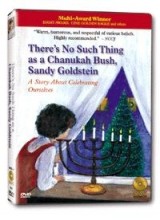
There’s No Such Thing as a Chanukah Bush, Sandy Goldstein This is a rare movie that frankly and sensitively portrays the pressure on kids to conform and how it feels to be left out of a celebration that seems to occupy the entire world in December. It gives families a way to acknowledge and even share the celebrations of others while feeling pride in their own traditions.
A Taste of Chanukah A delightful concert performance with Theodore Bikel.

Related Tags:


Family Issues Genre , Themes, and Features Lists Movie Mom’s Top Picks for Families

A Single Man

Posted on December 10, 2009 at 3:22 pm

B
Lowest Recommended Age: Mature High Schooler
MPAA Rating: Rated R for some disturbing images and nudity/sexual content
Profanity: Strong language
Alcohol/ Drugs: Drinking, drunkenness
Violence/ Scariness: Attempted suicide, aftermath of car crash with bloody body, themes of grief and loss
Diversity Issues: A theme of the movie
Date Released to Theaters: December 11, 2009

Designer Tom Ford has exquisite taste, and his first movie is an exquisite movie. Based on a story by Christopher Isherwood, as adapted by Ford, it is the story of one day in the life of a British literature professor in Los Angeles, shortly after the loss of his male lover in a car crash. It is November 30, 1962. And so the awful isolation of grief is multiplied by his inability to acknowledge what they were to each other and who he really is.

Ford’s images are so meticulously arranged they feel like a perfume commercial. There is a remote quality that distances us from what is going on. But there are moments, as when we see a flashback of the professor (Colin Firth) getting the news from a sympathetic relative who has to deliver the message that the funeral is “family only” where the grief and the pain of holding it in is raw and real and devastating.

Firth is revelatory as the professor who feels that his truest self and his deepest emotions are invisible in a world in which being gay is still “the love that dare not speak its name.” We see in memory the man he loved (the always-enticing Matthew Goode) and in the present his encounters with a curiously attentive but respectful student (Nicholas Hoult, all grown up since “About a Boy”). And he spends the evening with his closest friend, a boozy fellow British expatriate (Julianne Moore) with whom he believes he can be almost completely honest, but who still sees him as she wishes he was. There is a hint that all of what happens on this last day could be in his mind; I suspect that it is, but either way, we are caught up in his emotions and his story.

Related Tags:


Based on a book Drama Movies -- format Romance

From Swastika to Jim Crow

Posted on December 8, 2009 at 3:19 pm

Because this is the 20th anniversary of the Washington DC Jewish Film Festival, all of the previous festival directors were given the chance to pick their favorites from past years to put on this year’s schedule. That is how I got to see “From Swastika to Jim Crow” today.
Hitler came to power in January of 1933. In April of that year, Jewish professors started being dismissed from universities and within a month, most of them were gone. About 1200 came to the United States. And of that group, about 50 ended up at one of the traditionally black colleges. Finding themselves in areas segregated by law and culture, these “refugee scholars” were in “double exile.” They had lost their home, their country, their friends, their families, their jobs, and their language. And they were in a place where they were seen as triply suspicious outsiders — Jews, immigrants, intellectuals.
Interviews with the professors, their families, and their students and archival footage bring us into the world of these immigrants, who found they had more in common with their black students and colleagues than with the white members of the community. It is especially poignant when one explains that the black students were better able than whites to comprehend the information that came out about the Holocaust atrocities because “the notion of man’s inhumanity was not foreign” to them. The white community did not accept the refugee scholars but that does not mean they did not tell them how to live. One was threatened for entertaining students in his home. A newspaper headline notes: “White Professor Fined $25 for Eating with a Negro.”
One-time students, now distinguished scholars themselves, talk movingly about these professors, whose struggle, survival, and commitment to excellence and knowledge was itself an education.
An exhibit inspired by the movie is now at the New York Museum of Jewish Heritage and will go on tour.

Related Tags:


Documentary Festivals
Julie & Julia

Julie & Julia

Posted on December 8, 2009 at 8:00 am

“Julie & Julia” is — I can’t help it — a scrumptiously satisfying film about writer/director Nora Ephron’s two favorite subjects: food and marriage.It is based on two true stories. Julia Child revolutionized American notions about food with her cookbook and PBS series that brought haute cuisine to the “servantless” American housewife in the early 1960’s. Cookbooks and magazines in those days had recipes that included canned peas and crushed potato chips. But Child (Meryl Streep), newly settled in Paris with her diplomat husband, Paul (Stanley Tucci) fell in love with the fresh, subtle, deeply sensual quality of French cooking and decided to study at the Cordon Bleu. She was an unlikely epicure and an even more unlikely spokeswoman, over six feet tall and with a rather horsey quality, a voice with a trill that made her sound like a cross between Eleanor Roosevelt and Miss Francis of the Ding-Dong School. But she was passionate, knowledgeable, accessible, and completely fearless. She boned a duck with knives that could slice through granite and scooped up food from the floor and put it back on the plate, crisply assuring her audience that it was all right because no one could see them in the kitchen. Americans fell in love with boeuf bourguignon, chocolate mousse, and with Julia, too. Half a century later, Julie Powell (Amy Adams) was in need of some of Julia’s resolute forthrightness. While her “cobb salad lunch” friends made million-dollar deals on their cell phones, Julie had a half-finished novel and a job answering the phone in a cubicle, listening to the problems of people seeking help with their 9/11-related injuries and losses. She and her husband Eric (Chris Messina) lived in a tiny, dingy apartment over a pizza place, with a handkerchief-sized kitchen. But Julie wanted to do something big and important. She wanted to finish something. And so she decided to work her way through Julia’s famous cookbook, to take on every recipe including deboning a duck, to do it all in one year, and to do it in public, on the then-novel outlet of a blog. Both Julie and Julia were drawn to the literally hands-on nature of cooking, the sense of purpose and mastery, and the generosity of it. Ephron’s screenplay, based on memoirs by each of its main characters, touches on the parallels without overdoing it. And one of the sweetest is the rare portrayal of tender, devoted, and, yes, very passionate married love, even more palpably luscious than the abbondanza array of diet-busting delicacies.It is the Julia story that is the heart of this film and it is Meryl Streep who is at the heart of this story. A little bit of movie magic makes the 5’6″ actress tower over her co-stars and even the furniture. But it is sheer, once-to-a-planet acting that makes Child so touching and inspiring. No one is more adorable than Amy Adams, and she wrinkles her little nose and throws her little tantrums as a twinkly romantic movie heroine must. But Streep as Child is revelatory, real, and irresistible. In one scene, when she responds to some good news from her sister (wonderfully played by Jane Lynch), the mixture of emotions that cross Streep’s face in a moment tell us of decades of pain. In another, as the Childs and their friends celebrate Valentine’s Day, we see an expression of love and trust so deep and enduring and joyous and sexy that it makes most expressions of movie romance feel like whipped cream made with skim milk and fake sugar.This is a movie about food and love and courage and dreams and lots and lots of butter, and doing something — cooking or acting — brilliantly and with gusto. And it is delicious, nourishing, and good to the last drop. (more…)

Related Tags:


Based on a book Based on a true story Biography Comedy Date movie Drama Romance
THE MOVIE MOM® is a registered trademark of Nell Minow. Use of the mark without express consent from Nell Minow constitutes trademark infringement and unfair competition in violation of federal and state laws. All material © Nell Minow 1995-2026, all rights reserved, and no use or republication is permitted without explicit permission. This site hosts Nell Minow’s Movie Mom® archive, with material that originally appeared on Yahoo! Movies, Beliefnet, and other sources. Much of her new material can be found at Rogerebert.com, Huffington Post, and WheretoWatch. Her books include The Movie Mom’s Guide to Family Movies and 101 Must-See Movie Moments, and she can be heard each week on radio stations across the country.

Website Designed by Max LaZebnik