Peter S. Beagle, who write the novel and screenplay for this week’s DVD pick, The Last Unicorn, also wrote the screenplay for the animated version of “Lord of the Rings,” the movie that inspired a kid named Peter Jackson to read the books and then grow up and make the live-action movie trilogy. The last 600 copies of the 1978 animated version of Lord of the Rings on DVD are now available exclusively from Conlan Press.
Brad Pitt is a very fine actor (see “Twelve Monkeys” and “True Romance”) but in this epic fantasy his diligent and thoughtful performance contributes less to the film than his appearance, about two-thirds of the way through. I mean appearance in the broadest sense. It is not until that point that we feel that the Pitt we have been waiting for shows up on screen. And it is at that moment that Pitt’s appearance, meaning his golden movie star beauty, provides the essential jolt that propels the story forward into its final, heart-wrenching conclusion.
It takes its title from a story by F. Scott Fitzgerald about a man who lives his life backwards, born as an old man and getting younger every day. The movie begins with both of its main characters very, very old. One is Daisy (Cate Blanchett), dying in a hospital, with her daughter standing vigil. Daisy asks her daughter to read aloud from an old diary and we go back to the Armistice, the end of World War I. A baby is born and his mother dies in childbirth. The father is horrified by the child and leaves him on the doorstep of a home for the elderly where he is adopted by Queenie (the marvelous Taraji P. Henson), who works at the home. At first he seems like an exceptionally ugly baby. And then as he gets older he seems to be disabled. A nursing home is a perfect environment for young Benjamin Button. He’s just another person who needs help. He is raised in an atmosphere of unconditional love and acceptance and grows up to have a gentle and observant nature.
One day a little girl comes to visit her grandmother. It is Daisy. Benjamin looks like a very old man but he is really a little boy and he wants to play with her. As she grows up, he gets younger, but there are still decades between them. Benjamin leaves the nursing home to work on a ship and writes to Daisy from around the world.
The digital effects are very well done and by this time Pitt starts to become more recognizable, so almost-familiar that we almost believe that this is the way he looks now, that he’s getting a little older like the rest of us. And then, all of a sudden, there he is, the wind brushing his hair, a burnished glow on, around, and coming from him, the very personification of youth and promise and every possible kind of yes. Our hearts ache with the bittersweet longing for what he has that no one ever will, the look and energy of youth with the wisdom and experience of age. And then they ache again with what he shares with us and every human, the awareness of how brief it all really is and the need for connection to transcend life’s limits.
This is a film with the scope and reach of almost a century but its power comes from the smallest gestures and the simplest moments. And its ultimate conclusion is one of the most powerful and moving of the year.
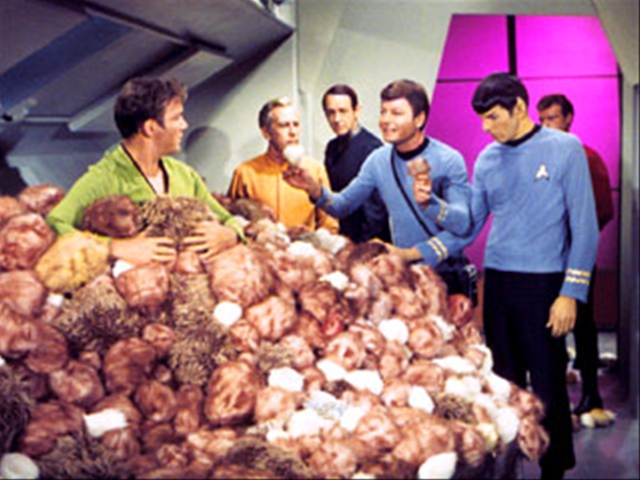
Get ready for this week’s rebooting of the “Stark Trek” saga by revisiting the original television series. How much do you remember about Captain Kirk and his crew, whose origins we will see in the new J.J. Abrams film?
1. What is Captain Kirk’s middle name?
2. Where is he from?
3. What is the name of the adorable creatures who came on board the Enterprise as pets but later came close to causing disaster and ultimately saved the day?
4. Creator Gene Roddenberry described the show by saying it would be like what successful series but “set in space?”
5. How long is its mission supposed to last?
6. What kind of crystals are necessary for fuel?
7. What is the name of the ring that was a doorway to any time and place and where (and when) does the crew go when they materialize on Earth?
8. Why did Spock’s father marry a human?
9. What was striking about the warring factions in “Let that Be Your Last Battlefield?”
10. In “Plato’s Stepchildren,” which cast characters shared a memorable kiss?
Low-key and mostly off-camera references to predators and life cycles
Diversity Issues:
Diverse species
Date Released to Theaters:
April 22, 2009
This stunning valentine to our planet’s plants and animals re-purposes some of the footage from the stunning documentary Planet Earth into a more narrative storyline, taking us through the seasons and across the globe to see nature’s eternal themes of renewal and connection. We see cooperation and nurture by parents across species. And we see the perils of the animal world as well.
The narration drags at times, mostly avoiding getting too cute but sometimes, even with the voice of James Earl Jones, sounding too much like an educational film for Social Studies classrooms. It alternates between almanac-worthy facts and figures and cozy folkish narratives about the animal families, never matching the grandeur of the visuals.
Parents should know that there are some discreet references to the life cycle and survival issues, some G-rated footage of predators (no blood), and not all of the animals make it to the end of the movie. There are also references to the consequences of climate change on the habitats of the animals.
Topics for discussion: Which of the animals are most like humans? Why?
If you like this, try: Planet Earth, Microcosmos, and Winged Migration.
It’s wonderful to watch young people falling in love for the first time. That’s why we get to see it so often in the movies. But it is even more wonderful to see people falling in love for the last time, and that is one of the three great pleasures of this touching grown-up love story.
It’s always romantic to see first love because we can share with them — just for a moment — the belief that happily ever after means that there will never be an argument or disappointment or loss. But it is even more romantic to see older people fall in love because they know there will be all of that and they go ahead anyway. That is the story of “Last Chance Harvey,” a man who has lost his job and whose daughter asks her step-father to give her away at her wedding because she feels closer to him. Which is what gives him a chance to think about what he really wants for the rest of his life — and then he sees Kate.
Not much more happens. They walk around. They dance at the daughter’s wedding reception. They think about whether they really want to take the risk of sharing themselves knowing in a way that young people cannot what it really means. And yet in those moments, everything happens, and we know it and they know it.
The other two pleasures of the film are Dustin Hoffman as Harvey and Emma Thompson as Kate. These two actors, so perfectly at home with themselves, fearlessly give us two people who are complicated, difficult, and very, very protective of their bruised hearts. And then they let us see them bloom, not all at once, more of a two steps forward, one step back opening up of their hearts to each other. And that leaves our hearts just a little more open, too.



 into a more narrative storyline, taking us through the seasons and across the globe to see nature’s eternal themes of renewal and connection. We see cooperation and nurture by parents across species. And we see the perils of the animal world as well.
 , and
, and  .
.