Contest: Win Free Passes to the Romantic Comedy “What If” with Daniel Radcliffe and Zoe Kazan
Posted on August 13, 2014 at 10:17 pm
Daniel Radcliffe and Zoe Kazan star in this R-rated romantic comedy about a medical school dropout who meets a girl who could be the one — only to find himself relegated to the friend zone. And I have five pairs of free tickets! To enter, send me an email at moviemom@moviemom.com with What If in the subject line and tell me your favorite movie romantic pair. Don’t forget your address as I will be mailing you the tickets! (US addresses only.) I’ll pick the winners at random on August 18, 2014. Good luck!!
Rated PG for thematic elements, some violence, language and brief sensuality
Profanity:
Brief strong language
Alcohol/ Drugs:
Wine
Violence/ Scariness:
Fires, sad death of parent, characters injured, vandalism
Diversity Issues:
A theme of the movie
Date Released to Theaters:
August 8, 2014
Date Released to DVD:
December 1, 2014
Amazon.com ASIN:
B00MI56UI6
Copyright 2014 DreamWorks Studios
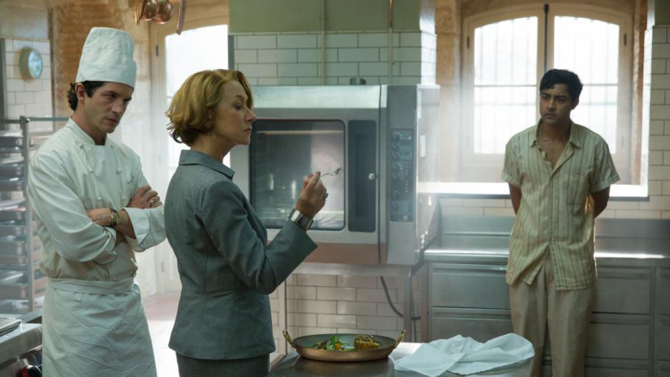
Shakespeare famously made fun of the notion of a sighing lover creating an ode “to his mistress’ eyebrow.” But it would take Shakespeare to do justice to Helen Mirren as a French woman of impeccable bearing who is able to punctuate her declarations with a perfect circumflex of that divine eyebrow, exquisitely conveying the steely authority that comes not just from being the boss but from being right.
Producers Oprah Winfrey and Steven Spielberg, screenwriter Steven Knight, and director Lasse Halström have adapted the book by Richard C. Morais into a cozy saga along the lines of Halström’s “Chocolat,” about a cross-cultural competition that turns into an alliance. Every sunbeam, every garnish, and yes, every eyebrow is presented exactly comme il faut, and it has Mirren’s splendid performance. And yet, for a story that is about the importance of excellence and innovation, it feels a little, well, under-spiced and overcooked.
Manish Dayal plays Hassan, the son of an Indian family that has been in the restaurant business for generations. His mother was the first to recognize his gift for food, and brought him into the kitchen to teach him her skill with seasonings and her understanding of food as a sacred gift that shares memories as well as nourishment for the spirit and the body. She knew that before one could cook, one must know how to taste. When she is killed in a fire set by a rioting mob, Hassan’s father (Om Puri) moves the family to London. But he is restless and no one likes the dreary weather. “In England, the vegetables had no soul, no life.” Papa took the family to find a new home.
Their van breaks down in a small French village, and, as Papa says, sometimes brakes break for a reason. There is an abandoned restaurant for sale. And if it is across the street from one of the most renowned restaurants in all of France, the proud awardee of one coveted Michelin star, well that is not a reason to be wary; it is a challenge. The red Michelin guide awards one star to a restaurant that is worth a visit, two for a restaurant that is worth a detour, and three, the ultimate prize, for one that is worth a special journey. Or, as a character puts it in this film, “One is good, two is amazing, three is for the gods.”
That is Margaret (the bewitchingly lovely Charlotte Le Bon), who rescues the Hassan family and gives them food so delicious that they wonder if they died in the accident and went to heaven. The olive oil is pressed from her trees. The cheese is from her cows. And she, too, is a would-be chef. She works in the kitchen of the Michelin-starred restaurant, owned by the imperious Mme. Mallory (Mirren). The world may be filled with chaos and mediocrity and disappointment, but the portion that is under the control of Mme. Mallory strives for perfection and almost always achieves it.
The Hassans open up their restaurant, even though there is no reason for anyone but eternal optimist Papa to believe that anyone in a small town in France wants to eat Indian food. At first, there is war between the two restaurants. But when Mme. Mallory realizes that it has gone too far, she admits that Hassan’s great gifts as a chef give them a connection far deeper than any commercial rivalry could obscure. The hundred foot journey is from the Hassans’ home to Mme. Mallory’s establishment on the other side of the road.
The cinematography by “American Hustle’s” Linus Sandgren is luscious, the charming countryside dappled with syrupy golden sunshine, the food almost tactile and fragrant. Mirren’s performance, from the steely resolve of the early scenes to the softening as she opens her heart, is always splendid, and, in contrast to the rest of the film, never overdone. Maybe it’s just that the combination of Spielberg and Winfrey is just too potent. They are going to warm your heart whether you want it or not. It isn’t just the sunlight that is syrupy; the story is, too, much more than the book, with not one but two romances. They may be sweet, but they also throw the theme off-balance, with collateral damage to the abilities and ambitions of the two key female characters, shrinking them to the role of love object/cheerleader. The chef characters would know better than to allow such a sour flavor in anything so sugary.
Parents should know that this film includes themes of racism and cross-cultural conflicts, vandalism, riot, fires, and a sad death of a parent.
Family discussion: What is the difference between a cook and a chef? Which of the restaurants or dishes in this film would you like to try?
If you like this, try: “Chocolat” by the same director, and some other foodie movies like “Chef” and “Julie & Julia”
Woody Allen’s 44th film is an amuse bouche without a meal, a dollop of whipped cream without the dessert underneath. In last year’s film, “Blue Jasmine,” the strength of the performances (especially Oscar-winner Cate Blanchett) and the resonance of its Bernie Madoff-ish crossed with “Streetcar Named Desire” plot line provided a simulacrum of seriousness of purpose that suggested a deeper meaning. But this year’s pastiche has no such pretensions and no such weight as entertainment or as ostensible exploration of one of Allen’s favorite themes, the battle between faith and reason. And of course exploration of his even more favorite theme, the generative power of an adoring young woman in the life of a desiccated and lonely older man. Even without the queasy context of the allegations of child abuse and the reality of Allen’s marriage to the daughter of his one-time romantic partner and co-parent, this theme feels increasingly icky.
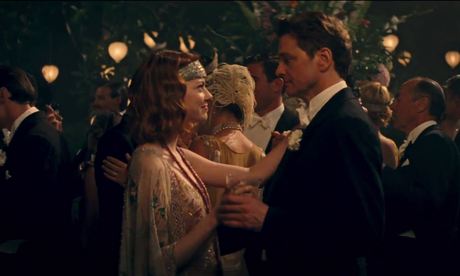
The jazz age 1920’s setting among rich Americans on the glamorous French Riviera (the same setting as Hitchcock’s classic “To Catch a Thief”) may resemble a fancy chocolate box, but the candy inside is strictly low grade. Allen’s greatest advantage at this point is that everyone wants to work with him. Two of the hottest stars in Hollywood, Colin Firth and Emma Stone play the leads in this story of a man of reason, empiricism, and proof who is (for a while at least) trumped by faith in things unseen.
Firth plays Stanley Crawford, a magician who performs on stage as a caricature of a mysterious man from China called “Wei Ling Soo.” Not only his tricks are illusions — his very persona is as well. He is abrasive and judgmental and prides himself on being committed to pure logic and debunking those who pretend to do real magic, including mediums with claims of contact with spirits and ghosts.
An old school friend and fellow magician named Howard (Simon McBurney) appears just as Stanley is about to go on vacation with his level-headed fiancee. He has a proposition. Some wealthy friends are being taken in by a young American named Sophie Baker (Stone) who claims to commune with the spirit world, and their relatives want her to be revealed as a fraud. Stanley is enticed less by the prospect of a reward than by the chance to triumph over someone making false claims and the chance to triumph over Howard, who admits he has been unable to find a flaw in the medium’s act. In addition, he will get the chance to visit his favorite relative, who lives on the Riviera, Aunt Vanessa (a superbly vinegar-y Eileen Atkins, who steals the film).
So Stanley and Howard visit the rich widow (Jacki Weaver as Grace) and her son Brice (Haimish Linklater), who is besotted with Sophie, and hopes to win her heart by serenading her with his ukelele. Also in the house is Sophie’s mother (Marcia Gay Harden), who is interested in nailing down the details of the foundation Grace plans to endow for Sophie.
It’s all pretty jolly for a while, though Stone and Firth have no chemistry as antagonists or otherwise. Stone is utterly beguiling, as always, despite Allen’s inability to situate the camera to get the most from her lovely face. (She is already working on his next film; here’s hoping they do better.) Other than Aunt Vanessa, though, the characters are all thinly, even limply imagined. Even Stone’s natural effervescence cannot give Sophie the necessary depth to make her interesting either as a fraud or as a genuine medium. Linklater and Weaver are both criminally underused.
There are some sharp lines, but the structure is by-the-numbers, including a visit to a celestial observatory for shelter from a rainstorm and a last-act hospital scene to raise the stakes on the faith vs. science debate. The problem is that most of the time, we need access to both, and this film’s shortcomings are proof in both categories.
Parents should know that this film includes smoking, drinking, and sexual references.
Family discussion: Does there have to be an absolute line between reason and faith? How do you decide which is appropriate in particular circumstances?
If you like this, try: “Blithe Spirit,” “Midnight in Paris,” and “The Curse of the Jade Scorpion”
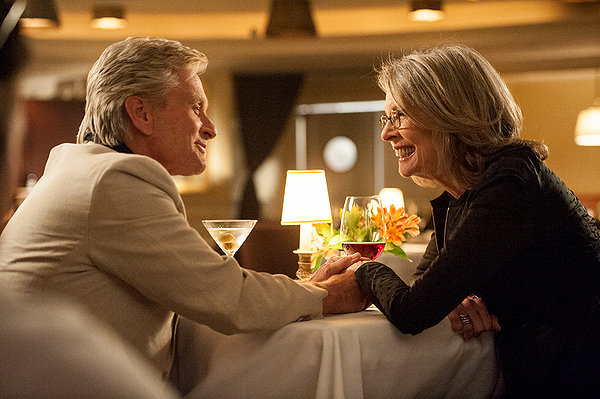
A second marriage is, as Samuel Johnson famously said, “The triumph of hope over experience.” And as lyricist Sammy Cahn wrote in the song Bing Crosby sang in “High Time,” “Love is lovelier the second time around.” In this slight but endearing new film, director Rob Reiner and screenwriter Mark Andrus (“As Good as it Gets”) bring us an autumn-years love story. Oscar-winners Michael Douglas and Diane Keaton play two characters with little in common but the experience of great loss, the knowledge that love carries great risks, and the fear that there may not be another chance.
Douglas is Oren, a successful realtor and even more successful misanthrope. He insults people. He is bitter. He shoots a dog with a paintball gun. He does not like anyone and no one likes him, with the exception of his longtime colleague played by the invaluable Frances Sternhagen. Keaton plays Leah, a widow experimenting with singing at a restaurant. She is universally beloved, especially by her neighbors in a fourplex and her loyal accompanist (played by the director himself). Oren lives in the fourplex, too, ironically named “Little Shangri-La,” and is revealed early on to be the owner as well. He hopes for one last big-ticket house sale so he can retire and move away and never deal with anyone ever again.
But life has a way of entangling those who most try to rid themselves of obligations and relationships — at least in movies. Oren’s long-estranged son arrives to inform his father that (1) he is no longer a drug addict, (2) he has a daughter, and (3) he needs Oren to care for her while he serves a prison term.
Oren refuses, saying “I already tried to raise a kid and it didn’t work out.” So Leah steps in and says the girl can stay with her. She is Sarah (Sterling Jerins). And anyone who has ever seen a movie (or read “Heidi”) knows that the girl will charm her grandfather and open the hurting hearts of both Oren and Leah to her and to each other. Oren finally admits to Leah, “I like you and I don’t like anyone.”
Despite contemporary references like “Duck Dynasty” and “Hoarders,” this film has a musty, retro feel, like a script that has been sitting in a drawer for a couple of decades. The plot is predictable and creaky. An attempt to return Sarah to her mother goes exactly the way you think. The caterpillar Sarah collects is exactly the metaphor you think. The pregnant neighbor provides exactly the opportunity for Oren’s showing what he is capable of that you thought but hoped you could avoid. The racial humor is painfully out of date, so you didn’t predict it, but that does not make it a good surprise. Far from it.
What the movie does have, though, is Douglas and Keaton, and they triumph over the limitations of the material, making us believe that the greatest love in our lives may still be waiting for us.
Parents should know that this film includes sexual references, some crude, childbirth scene, some strong language, some racial insults, drinking, drug abuse, references to sad deaths
Family discussion: Why was it so hard for Oren to be nice to people? How did Leah make Sarah feel at home?
If you like this, try: “As Good as It Gets” and “Something’s Gotta Give”
The intelligence-enhanced ape from Rise of the Planet of the Apes takes center stage in this sequel, which begins ten years after the last film. The virus we saw infecting the human population has now wiped out almost all human life. The assorted apes, led by Caesar, have asserted their primacy over other animals. In the opening scene, we see them hunting with spears they have crafted, killing a bear, and riding on horses. They live in homes they have constructed from logs, communicate — mostly via sign language — teach their children the alphabet in school, and have an organized society, with Caesar as their leader. They demonstrate loyalty and tenderness. They adorn themselves; Caesar’s mate wears a small crown.
Ceasar is played by the brilliant motion-capture actor/artist Andy Serkis and the CGI work of the geniuses at Weta Digital. The seamless integration of the CGI characters and the human characters and the subtlety of the apes’ eyes and facial expressions brings us straight into the story, underscored by the immersive 3D. It is dramatic, not stuntish, with the possible exception of some spear-throwing toward the screen.
The film recalls old-school cowboys-and-Indians westerns, with the apes riding into battle on horses and the humans and their armory holed up in the ruins of San Francisco like it is Fort Apache. Then the apes get the guns, and everything escalates fast. The film wisely gives both groups of primates a range of characters, some wise and trustworthy, some bigoted and angry. Both species have to learn that respect has to be based on character and actions, not on genetics. The division is not between man and ape but between those who can envision a future with cooperation and trust and those who cannot.
There are some thoughtful details. The destroyed city tells the story of a decade of unthinkable loss and also of great courage. A dropped sketchbook conveys information that in a world without mass communications is revelatory. A long-unheard CD plays The Band and we see the humans react, thinking of where they were the last time they heard it and what access to electricity could mean for them now. The humans have the advantage of knowing how to create and use power; they also have the disadvantage of needing it.
In the midst of the battle, there is a quiet moment when a small mixed group hides out together in a location with a lot of resonance from the previous film. It lends a solemnity to the story, even a majesty, that gives it weight. Even those who seem from our perspective to be making decisions that are disastrously wrong do so for reasons we can understand. The action is compelling but it is the ideas behind them that hold us.
Parents should know that this film includes constant peril and violence, post-apocalyptic themes and images, many characters injured and killed, guns, fire, drinking, smoking, and some strong language.
Family discussion: Why were there so many different opinions within both the ape and the human communities? How did they choose their governing structure? Why didn’t Carver want to listen to Ellie’s explanation of the source of the virus?
If you like this, try: the original “Apes” movies to compare not just the stories but the technology used by the filmmakers

 into a cozy saga along the lines of Halström’s “Chocolat,” about a cross-cultural competition that turns into an alliance. Every sunbeam, every garnish, and yes, every eyebrow is presented exactly comme il faut, and it has Mirren’s splendid performance. And yet, for a story that is about the importance of excellence and innovation, it feels a little, well, under-spiced and overcooked.