A Movie With A Prayer for Peace: ‘Friendly Persuasion’
Posted on September 21, 2009 at 8:00 am
As we observe today’s International Day of Peace and A Million Minutes for Peace, an initiative to get 1 million people to pledge to pray for peace, I would like to recommend a film called Friendly Persuasion, set in the United States Civil War. It is the only movie I know where the characters not only pray for peace, they pray for guidance on how best to achieve it. Gary Cooper plays a farmer who struggles with his religious commitment to non-violence when his neighbors risk their lives for his family and property. All he asks is that “the will of God be revealed to us and we be given the strength to follow his will.” It is a beautiful depiction of a loving and respectful family who find strength in their faith during one of this country’s direst and most divisive moments. And it recognizes that prayer is important, but that it is the choices it inspires that make a difference.
Here is the peace pledge:
I will unite with people all over the world in observing the United Nations International Day of Peace. On September 21, I will pause at noon and, in my own way, pray for peace for one minute. May my one minute, magnified a million times, create a culture of peace that will change the future of humanity. My name will appear in the Peace Pledge Book to be presented at the United Nations on September 18.
Ellen Leventry’s list of post-1990 angels on movies and television got me thinking about some of my favorites from the old days. Hard to believe that performers from Jack Benny to Cary Grant to Donald Duck have taken on an angelic role. Angels have appeared in comedies, dramas, cartoons, television series, and even in musicals. They are usually in the story to guide the main character, but quite often they end up learning something, too.
1. Claude Rains and Edward Everett Horton in Here Comes Mr. Jordan. This was the first version of a story later remade with Warren Beatty in “Heaven Can Wait” and Chris Rock in “Down to Earth.” Robert Montgomery (father of “Bewitched’s” Elizabeth Montgomery) plays a boxer whose soul is prematurely taken by an apprentice angel (Horton). Mr. Jordan (Rains), the supervising angel, has to help find a new body for the boxer’s soul. This gentle comedy has a sweetness and kindness that makes it touching as well as entertaining.
2. Clifton Webb in “For Heaven’s Sake.” The impeccable (if slightly fussy) Webb plays an angel who is sent to earth on an important task. There is a special place in heaven for the souls of babies waiting to be born, and two of them are getting anxious. Their prospective parents are postponing parenthood because they are too wrapped up in themselves. Webb appears as a rancher and another kind of angel — a theatrical backer — to get them to change their minds. It is fun to see the ultra-urbane Webb trying to look like a cowpoke and the story is charming.
3. The invisible (except to a little girl) baseball players in Angels in the Outfield. The 1994 remake has its pleasures, but I still prefer the 1951 original with Paul Douglas as the temperamental manager of the Pittsburgh Pirates and Janet Leigh as the reporter who befriends him after a little girl from an orphanage announces that she sees angels on the baseball diamond. Douglas is wonderfully appealing as he tries to learn to control his temper and finds himself falling for Leigh.
4. Henry Travers in It’s a Wonderful Life. Probably the most-loved angel in the history of movies is Clarence, who has a very unconventional way of helping George Bailey (James Stewart) — by showing him what life would have been like if he had not been born. Travers has just the right warmth and twinkle to make us believe that every time a bell rings an angel gets its wings.
5. Cary Grant in The Bishop’s Wife. The handsomest angel in movie history is Grant’s Dudley, who arrives at Christmas to guide a clergyman (David Niven) who has neglected his family and his faith and become too caught up in the effort to build a cathedral. The most touching moments come from the look in Dudley’s eyes as he understands that even heaven does not match the pleasures of home and family.
6. Gordon MacRae in Carousel. A carnival barker who is desperate for money to care for his pregnant wife dies in a failed robbery attempt. He is sent back to earth to help his teenage daughter, now graduating from high school, to let her know she will never walk alone.
7. Henry Jones in “The Twilight Zone” episode “Mr. Bevis.” Even angels make mistakes. And in this charming episode of the Rod Serling classic television show, Orson Bean plays a lovable loser whose guardian angel (Jones) offers to turn him into a “normal” upright citizen with a responsible job and a solid credit rating. But once Bevis becomes “normal,” he isn’t Bevis anymore, and he and the angel learn that the only way to be happy is to be yourself.
8. Jack Benny in “The Horn Blows at Midnight.” Benny loved to make jokes about this film and considered it a low point of his career. But it is actually a lot of fun. Benny plays a trumpet-player who dreams that he is the angel Athanael, who has been ordered to blow his horn at midnight to signal the end of the earth. Two fallen angels try to steal it from him so they can continue to experience earthly pleasures. The story is softened a bit from the studio-added dream structure, but it still manages some sharp observations and endearing characters. The celestially beautiful Alexis Smith makes a fine angelic companion as well.
9. Donald Duck in “Donald’s Better Self.” Even the irascible Disney duck can be persuaded to listen to what Abraham Lincoln called “the better angels of our nature.” In this animated short Donald is a schoolboy who is tempted by the devil to skip school and try smoking but is rescued by the angel, who has not only a shining (and waterproof) halo but a righteous punch.
10. Conrad Veidt in “The Passing of the Third Floor Back.” Awkwardly filmed but still very moving, this film is based on the story by Jerome K. Jerome of a stranger who changes the lives of the residents of a boarding house. Veidt often played bad guys, but here he truly shines as a character whose quiet dignity and courteous kindness bring warmth, self-respect, and inspiration to the other tenants.
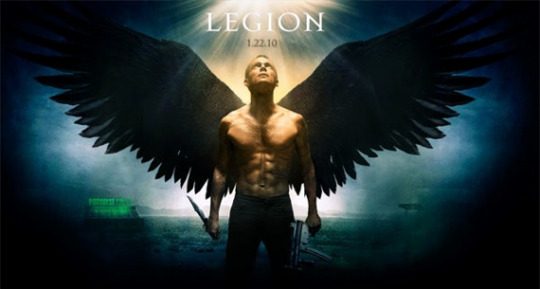
Paul Bettany plays the Archangel Michael in “Legion,” a new film opening in early 2010, also starring Dennis Quaid, Lucas Black, Tyrese Gibson, and “Gray’s Anatomy’s” Kate Walsh. In the film, he fights on the side of humanity when God has given up on earth. Much of it takes place in a diner, where a pregnant waitress may be carrying a child who may have special qualities.
The Biblical Michael is a character (or more than one character) with many interpretations, and even appears in the Qu’ran as an angel bringing peace and plenty. The film version is sure to be provocative; I hope it will be thoughtful as well.
“C Me Dance,” the first film produced by Uplifting Entertainment , a new faith-based motion picture company, will open in 200 theaters across the country on April 3. The film is being endorsed by the Leukemia Foundation and the Dove Foundation for excellence in filmmaking. The press release says: “C Me Dance” tells the story of a teenage girl named “Sheri,” played by new actress Christina DeMarco, who has trained her entire life to dance for the Pittsburgh Ballet. As her dream comes true, she finds out she is dying from a rare blood disease. Through the illness, God uses Sheri to bring people to Christ, but the devil tries to intervene. Sheri and her father Vince, played by veteran actor, writer and film producer Greg Robbins, are sent on a spiritual adventure to bring revival to America. The movie’s soundtrack features such recording artists as Lincoln Brewster, Eowyn, Stephanie Fraschetti and Terri Shamar.
In conjunction with the film’s release, Uplifting Entertainment is sponsoring an essay contest for middle- and high school-level students.
I like Uplifting’s stated goal: “To Inform With Delight” And I like its mission statement: “Create, produce, package, and distribute Christ centered family entertainment.” I wish them success.
Instead of just complaining about sex and violence, Phillips says, Christians must make films that reflect their own values. He says he started the film festival five years ago when he realized that Christians were losing the hearts and minds of the young.
“What is the single biggest influence on our families?” he asks. “I wish I could tell you the biggest single influence were churches, but that regretfully is not the case. The truth of the matter is, it is the media the people take in which are shaping and forming ideas.”
If Christians want to compete in the world of ideas, he says, they have to make great movies. This festival is putting up a $101,000 top prize — the largest in the United States, and larger than Cannes or Sundance — to help them get there. Phillips says this is only the beginning.
The winner of that award is a movie called “The Widow’s Might,” a timely story about a community support for a woman who lost her home to a foreclosure. It was written and directed by its star, 19-year-old John Robert Moore.
This is all enormously encouraging. I hope that the combination of spiritual and financial returns from producing films with messages of faith, hope, compassion, and integrity will inspire the production of more films for people of faith.


 . This was the first version of a story later remade with Warren Beatty in “Heaven Can Wait” and Chris Rock in “Down to Earth.” Robert Montgomery (father of “Bewitched’s” Elizabeth Montgomery) plays a boxer whose soul is prematurely taken by an apprentice angel (Horton). Mr. Jordan (Rains), the supervising angel, has to help find a new body for the boxer’s soul. This gentle comedy has a sweetness and kindness that makes it touching as well as entertaining.
  . The 1994 remake has its pleasures, but I still prefer the 1951 original with Paul Douglas as the temperamental manager of the Pittsburgh Pirates and Janet Leigh as the reporter who befriends him after a little girl from an orphanage announces that she sees angels on the baseball diamond. Douglas is wonderfully appealing as he tries to learn to control his temper and finds himself falling for Leigh.
 . Probably the most-loved angel in the history of movies is Clarence, who has a very unconventional way of helping George Bailey (James Stewart) — by showing him what life would have been like if he had not been born. Travers has just the right warmth and twinkle to make us believe that every time a bell rings an angel gets its wings.
 . The handsomest angel in movie history is Grant’s Dudley, who arrives at Christmas to guide a clergyman (David Niven) who has neglected his family and his faith and become too caught up in the effort to build a cathedral. The most touching moments come from the look in Dudley’s eyes as he understands that even heaven does not match the pleasures of home and family.
 . A carnival barker who is desperate for money to care for his pregnant wife dies in a failed robbery attempt. He is sent back to earth to help his teenage daughter, now graduating from high school, to let her know she will never walk alone.