
Travis: A Soldier’s Story
Posted on May 24, 2014 at 2:02 pm
For Memorial Day, take a look at this short film about the documentary, “Travis: A Soldier’s Story” and see if you can arrange a screening in your area.
Posted on May 24, 2014 at 2:02 pm
For Memorial Day, take a look at this short film about the documentary, “Travis: A Soldier’s Story” and see if you can arrange a screening in your area.
Posted on April 24, 2014 at 6:00 pm
Why do we keep making movies about the Holocaust?
Because we are still trying to understand one of the most shocking, inhumane tragedies in history. Because it is the essence of heightened, dramatic storylines, with the most depraved real-life villains, the bravest heroes, and the direst moral dilemmas, the most devastating sacrifices. Because we have to ask ourselves, “What would I do?”
And because there are still stories left to tell. “Walking With the Enemy” is inspired by the true story of Pinchas Tibor Rosenbaum, a Hungarian student who escaped from a labor camp to help the “Glass House” workers forging Swiss citizenship papers to get Jews out of the country. He impersonated an SS officer to rescue Jews they were about to execute.
This first movie from the brand new Liberty Studios and first-time director Mark Schmidt is a tense and exciting story of a part of the Holocaust not widely known. Because Hungary’s Regent (played by Sir Ben Kingsley) made an alliance with Germany, the Nazis did not interfere with the country or its Jewish citizens for the first years of World War II. “I aligned Hungary with what I thought was the lesser of two evils.” 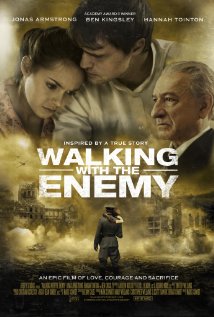
But then, as Germany started to be hemmed in by the Allied forces, it took over Hungary and began to send Jews to labor camps and concentration camps. A heroic Swiss diplomat named Carl Lutz (played by William Hope) was given permission to issue 8000 passes to Hungarian Jews with family in Switzerland. He managed to get those passes to tens of thousands, who were able to escape the Nazis.
Handsome and likeable Jonas Armstrong (television’s “Robin Hood”) plays Elek Cohen, a character based on Rosenbaum. While his uncle worked with Lutz in the “Glass House” (called that because it had been a glass factory), helping to hide Jews, Elek wore a Nazi uniform to infiltrate Nazi offices and operations to free Jews about to be sent away or killed. Over and over, he takes terrible risks, knowing that even if he survives, he will fail more than he succeeds. “Why does it have to be you?” someone asks. “Because I have one thing left.”
The first-time director wisely worked with experienced filmmakers, especially cinematographer Dean Cundey (“Apollo 13,” “Jurassic Park”) and a capable cast of top British actors. The film is ably scripted, shot, and edited. The sound effects are exceptional; I don’t remember ever hearing gunshot sounds so sharp and directed. The story is very affecting. One oddly sterile note is that for a story about Jews, there is very little Jewish activity other than a blessing over a family dinner. Reminiscences of the Holocaust include many stories of Jews praying together and doing their best to observe rituals and worship, reciting the Shema as they were led to the gas chambers. Here, even those about to be shot by a firing squad do not say a prayer, an odd oversight in a story that is about those who were trying to preserve their right to maintain their religion and their community.
Parents should know that this is a WWII movie depicting events of the Holocaust. There are many scenes of wartime and anti-Semitic violence and many characters are injured and killed.
Family discussion: What was Elek’s toughest decision? Is it hard to help, knowing how much more cannot be fixed? What can we learn from Elek and Lutz? Who is most like them today?
If you like this, try: “Schindler’s List” and “Conspiracy”
Posted on April 3, 2014 at 5:59 pm
B+| Lowest Recommended Age: | Middle School |
| MPAA Rating: | Rated PG-13 for some disturbing images and brief nudity |
| Profanity: | Mild language |
| Alcohol/ Drugs: | None |
| Violence/ Scariness: | Wartime violence, terrorism, |
| Diversity Issues: | A theme of the movie |
| Date Released to Theaters: | April 3, 2014 |
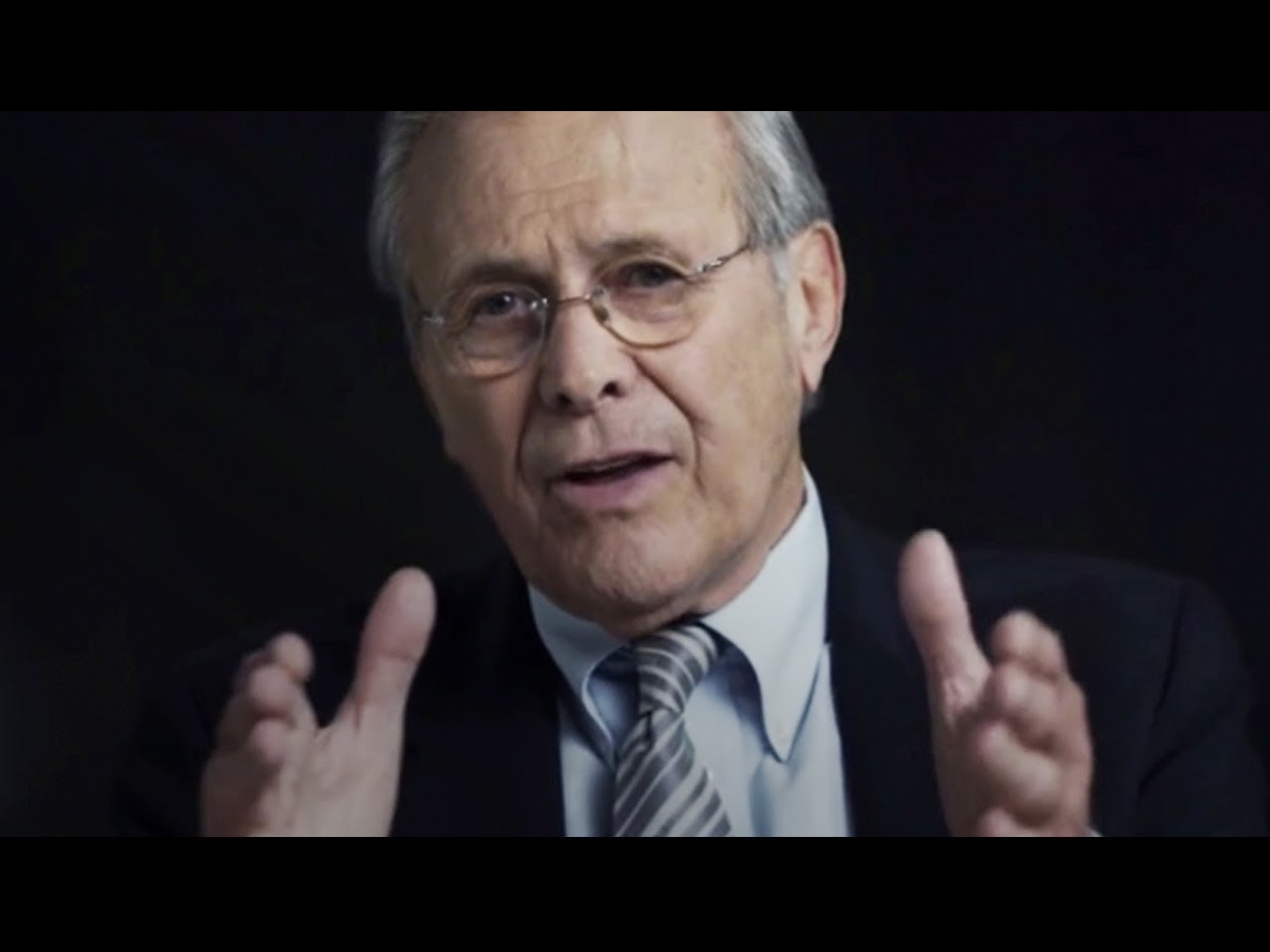
Errol Morris turns his famous “interrotron” camera on two-time Secretary of Defense Donald Rumsfeld for something between a bookend and a counterpoint to his Oscar-winning The Fog of War: Eleven Lessons from the Life of Robert S. McNamara
He says, in the movie’s final exchange, that he is not sure why he agreed to submit to more than 30 hours of what must have felt more like the cross-examination in “A Few Good Men” or even a detainee interrogation than the back-and-forth press briefings Rumsfeld conducted during the early days of the wars in Iraq and Afghanistan. We see many clips from those celebrated exchanges, at the time referred to as the best show in Washington, and still undeniably entertaining. Rumsfeld’s good humor and confidence were bracing and reassuring at a time when everything seemed to be what he would call an unknown unknown. Like Jack Nicholson in “A Few Good Men” he does not think we can handle the truth. He may be right.
He’s not here to explain. What he is here to do is to repeat the same version of the story, despite the fact that the audience has had the benefit of making some of those unknowns more known.
Rumsfeld’s constant memos, perhaps 20,000 by his count over his final term at Defense, were called “snowflakes” by the staff, based on their color and frequency. It must have seemed like an avalanche. Morris shows us long shelves of folders filled with snowflakes. He has Rumsfeld read some portions aloud, beginning with his famous taxonomy of information. There were known knowns, things we know and know to be true. There were known unknowns, things we do not know and wish we did. There were unknown knowns, things we do not realize that we know. And unknown unknowns, things we don’t know and don’t know that we need to know. Yes.
But what we do with those categories is the tough part, especially when assigning facts. The boxes and labels are nice and neat. The things we do and do not know are not. Rumsfeld often seems Wittgensteinian when he calls for dictionary definitions or makes a distinction between a Pentagon term and standard English. But definitions are not answers.
“Pearl Harbor was a failure of imagination,” Rumsfeld says. So, we gather, was 9/11. Vietnam was “the inevitable ugly ending of an unsuccessful effort.” How do we not make that mistake again? How do we destroy terrorists without a Hydra effect, creating two more for every one we cut down? We might think those answers are known unknowns. But Rumsfeld does not have the luxury of waiting to be sure.
He tells us he found out the US was going to invade Iraq when he was called into a meeting with then-Vice President Dick Cheney (Rumsfeld’s former assistant in the Nixon White House), along with Saudi Ambassador Prince Bandar. And that he never read the Justice Department legal memos about “enhanced interrogation.” He insists that he never said and the American people never thought there was a connection between Saddam Hussein and the 9/11 attacks. Cut to tape of the press conference where he called Saddam a liar for denying there was a connection.
Rumsfeld is aware of the inherent conflicts. He cheerfully acknowledges the inconsistency between two principles: Belief in the inevitability of conflict can be one of its causes. And if you wish for peace, prepare for war. Plus: all generalizations are false, including this one. He sounds like a zen master, but a jolly one. His good humor can be disconcerting, but not chilling. At the time, it was reassuring to us and undeniably disconcerting to our enemies. Rumsfeld often seems exceptionally forthright, as when he calmly discusses his two offers to resign following the revelations of abuse at Abu Ghraib. Would you rather have someone in that job who is grim?
His demeanor comes across today as oddly disengaged. He tears up once, telling about a visit to a gravely injured soldier who was not expected to live, but who did. There are no stories about those who did not.
Morris sometimes overdoes it, with a celestial choir and a snow globe of the Washington Monument as repeated commentary/symbols. Repeated sped-up shots of traffic in Washington, obviously far after the events being discussed, add little.
One can’t help thinking that part of what draws Morris to this story is his own belief in the capacity for absolute truth, in its way as limited as Rumsfeld’s belief that he can tie down the unknown unknowns tightly enough to support a military strategy. Or disinfect a morally compromised decision. But then, how many decisions in wartime or in time of terrorism are not morally compromised? There are unknown knowns, and unknown unknowns, and there are also political and historical quagmires.
Parents should know that this film has disturbing subject matter and some graphic images of the victims of “enhanced interrogation” and abuse.
Family discussion: Once you have created the categories of “known knowns” and “known unknowns,” how do you know when you have enough information to decide? What qualities should one have to serve as Secretary of Defense? What surprised you about this version of the story and why?
If you like this, try: The Fog of War
Posted on March 13, 2014 at 6:08 pm
B+| Lowest Recommended Age: | Mature High Schooler |
| MPAA Rating: | Rated R for language, some sexual content, and violence |
| Profanity: | Strong and crude language |
| Alcohol/ Drugs: | Drinking, drugs |
| Violence/ Scariness: | Murder, wartime violence |
| Diversity Issues: | Diverse characters |
| Date Released to Theaters: | March 8, 2014 |
| Date Released to DVD: | June 16, 2014 |
| Amazon.com ASIN: | B00JAQJNN0 |
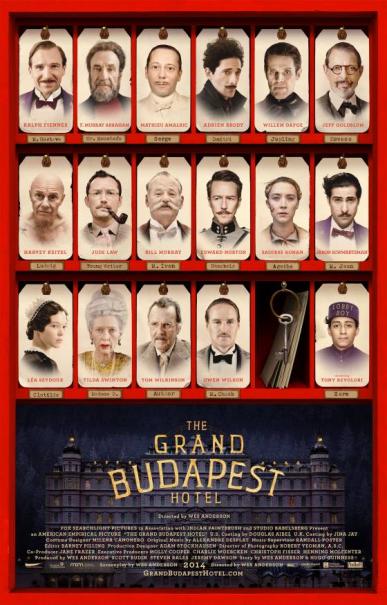 Writer/director Wes Anderson loves precious little worlds and his movies are not just created, they are curated. There’s a reason that this film is named for its location, not its characters or plot. Anderson is the master of “saudade,” the nostalgia for something you never had or that never existed. The Grand Budapest Hotel is as romantically imagined as its name, more vividly realized than any of the human characters in the movie, and we instantly feel the pang of its loss.
We enter through a Sheherezade-ian series of nesting narratives. A girl visits the grave of a writer, and we go back in time to see that writer (Tom Wilkinson) as an older man, talking about where writers get their stories (from real life), and then back again further as a younger man (Jude Law), actually getting the story in a bleak, bordering on seedy distressed version of the hotel, from an old man named Zero Mustafa (F. Murray Abraham). And then we go further back in time to see Zero as a young man, a proud lobby boy in the titular edifice, a gorgeously splendid, elegant, and luxurious resort in the mountains of a fictitious European country called Zubrowka, somewhere in the midst of Switzerland, Luxembourg, Austria-Hungary, and the Balkans. Anderson invites us into the artificiality of the memory within a memory within a story told by a stranger. He does not bother with cinematic tricks to make the hotel look real. We see it made out of paper, with a paper finicula pulled by a string to bring the guests up the mountain, as though it is part of a puppet show, which, in a way it is. At times it feels as though it is being put on with the marionettes from the “Lonely Goatherd” number in “The Sound of Music.” There is no effort to make the actors playing the younger and older versions of characters look alike. But the detail work is as meticulous as ever, so that must be intentional, and meaningful.
In the era of the Jude Law storyline, the hotel’s inept concierge is M. Jean (Jason Schwartzman). But, as Zero tells the story, in the heyday of the hotel, the concierge was the legendary M. Gustave (Ralph Fiennes). A concierge is there to be the all-purpose fixer, finder, and minder, like the entire staff of Downton Abbey in one. M. Gustave is infinitely attuned to the needs of the hotel’s wealthy, important, often noble (as in duchesses, not heroes), and always demanding clientele. There is a reason they are always referred to as guests. And if they require a particularly specialized and personal form of service, he is willing to oblige, even if the guest in question is a titled termagant in her 80’s (an hilariously unrecognizable Tilda Swinton as Madame D.) Fiennes gives a performance as perfectly precise as his character, whose flawless demeanor evokes exquisite deference, competence, and discretion. Like Anderson and Anderson’s autobiographical stand-in played by Schwartzman in “Rushmore,” M. Gustave is a showman, and one with an extravagantly grand and very ambitious sense of mise-en-scene. Early on, we see M. Gustave striding through the hotel lobby, a gracious farewell to a guest on one side, sharp but not unkind directions to staff who are not up to standard on the other. Later, in two intrusions by this story’s version of the Nazis and later, as a prisoner, he responds as though he is in a drawing room comedy. Fiennes pulls off the tricky balance between farce and drama as the story takes him through murder, art theft, love, war, and delectable pastries. And he is matched by newcomer Tony Revolori as the young Zero, a refugee who aspires to M. Gustave’s savoir faire, and who becomes first his protege and then his friend.
As always in a Wes Anderson film, starting with the very first scene of his first movie, “Bottle Rocket,” there is an escape. M. Gustave is imprisoned, but still strives to maintain an aura of gracious living. After a rough encounter with another prisoner, he is bruised but airily assures the visiting Zero that they are now dear friends. He confronts the direst of situations — or tries to — as though they are at the level of an errant lobby boy. But when he is deprived of his beloved fragrance, L’Air de Panache, he begins to crumble.
The details of the various time periods are, as expected, exquisitely chosen, well worth a second viewing. Ant it is a bit warmer than Anderson’s previous films, less arch, less removed, softer toward its characters, even tender. Anderson often makes objects more important than people but in this one, with the painting and the pastry almost character themselves on one side and Zero and his true love Agatha (Saoirse Ronan) still stylized but still heartfelt on the other, they’re getting closer.
Parents should know that this film includes wartime violence, with characters injured and killed, some graphic and disturbing images, strong language, sexual references and an explicit sexual situation.
Family discussion: Did M. Gustave and Zero have the same priorities? What is added to the story by seeing the author and Zero later in their lives?
If you like this, try: “Moonrise Kingdom” and “Rushmore”
Posted on March 5, 2014 at 10:52 pm
B-| Lowest Recommended Age: | Mature High Schooler |
| MPAA Rating: | Rated R for strong sustained sequences of stylized bloody violence throughout, a sex scene, nudity and some language |
| Profanity: | Some strong language |
| Alcohol/ Drugs: | Wine |
| Violence/ Scariness: | Constant very graphic peril and war-time violence with many graphic and disturbing images and sad deaths |
| Diversity Issues: | Diverse characters |
| Date Released to Theaters: | March 7, 2014 |
| Amazon.com ASIN: | B00BEJL6Q8 |
Here’s a new term: this movie is neither a sequel nor a prequel to 300, the story of the 300 Spartans who died battling the vastly greater army of the Persians. This is a “side-quel,” a “meanwhile” story about what was going on in a sea battle led by Spartan’s rivals, the Athenians. While “300” was based on a graphic novel by Frank Miller, itself based on historic events in ancient Greece, this side-quel was written at the same time as Miller’s still-uncompleted follow-up, to be called “Xerxes.”
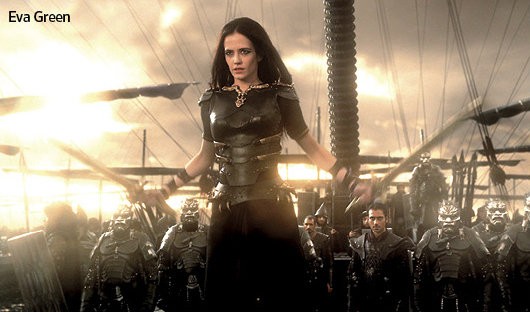
We get a bit more backstory this time, too. In a previous battle, Athens’ great warrior Themistokles (hunky Sullivan Stapleton) killed the Persian king. His furious son, Xerxes (returning Rodrigo Santoro) traded his humanity for godlike powers to get his revenge by invading Greece. The leader of the Persian forces is the even-more-furious Artemisia (Eva Green), who can kiss the lips on the head she has just severed, enjoying the kiss just slightly less than the kill. She is tougher than any of her generals, more lethal than any of her soldiers, and even hungrier for inflicting desolation on Greece than her king. And she has the kind of fearlessness only found in those who have nothing left to lose and who will never win enough to feel that they have succeeded.
Themistokles needs to get the support of the resolutely independent city-states if they are to hold off the far greater Persian forces. He knows that his men have heart and dedication, but they are not trained warriors like the Spartans. I could say more about the story, but let’s face it — like the first film, this is about abs, swords, and lots of blood spurting in artistic slo-mo, drenching the screen.
The primary differences are the absence of Gerard Butler and the shift from battles on land to battles on water. We feel Butler’s loss, as he brought a bit more to the original in terms of acting and managed to give his character some depth and personality in the midst of the carnage. But that works for the story, as the death of his character Leonidas is felt deeply in Sparta. The only thing that stands out from the carnage, though, is Green, whose Artemisia cranks up the cray-cray as one of the most evil-relishing villainesses since Cruella De Vil. There’s a sizzling sex-and-fight scene (hmmm, Green did something very similar in “Dark Shadows“) that is way over the top of whatever point over the top used to be. Green has a blast striding around casting laser beams of hatred at everyone, and wipes everyone else in the cast off the screen more thoroughly than her character does to to the “farmers, sculptors, and poets”-turned soldiers of Athens.
Parents should know that this film has constant very intense, graphic, and bloody violence with many battles, swords, fire, drowning, executions, rapes, disturbing images, nudity, sexual references and situations, and some strong language.
Family discussion: What are the biggest differences between the Greeks and the Persians? Do we think about war differently today?
If you like this, try: “300” and “Gladiator”
