Memorial Day 2018: Movies About Military Sacrifice and Valor
Posted on May 24, 2018 at 1:52 pm
For Memorial Day, take a look at these documentaries about our military:
War of 1812
The History Channel Presents The War of 1812 The young country proved its commitment to independence with this war against Britain that gave us a President (Andrew Jackson), and our national anthem.
Civil War
The Civil War Ken Burns’ series for PBS is meticulously researched and compellingly presented.
The World at War This classic is considered the definitive history and a landmark of television reporting. It was created long enough after the war ended to have perspective but close enough in time to have access to the participants, with eyewitness accounts by civilians, enlisted men, officers, and politicians as well as historians. The 30th anniversary DVD set issued in 2004 has three hours of new material and additional documentaries.
GI Jews Fifty thousand Jewish American fought in WWII, often struggling with anti-Semitism in the military. They look back on their experiences and how it affected their lives.
In Their Own Words: The Tuskegee Airmen The first African-American pilots of the US military faced bigotry at home and in the military, but fought with extraordinary skill and dedication.
Korean War
Korea, The Forgotten War It was the Cold War era, but a real war was being fought in Korea that embodied the geopolitical conflicts. This documentary covers that story, from Inchon to Pork Chop Hill.
Vietnam War
Vietnam War: America’s Conflict Many documentaries cover the politics and the protests, and that is covered here, too, but this series focuses on the stories of the battles and the men who fought them.
Desert Storm
Hidden Wars of Desert Storm Interviews with General Norman Schwarzkopf, former US Attorney General Ramsey Clark, former UN Iraq Program Director Denis Halliday, former UNSCOM team-leader Scott Ritter and many others help tell the story of the American response to the invasion of Kuwait.
Afganistan/Iraq
Restrepo This is the award-winning story of one of the most dangerous postings in the U.S. military, covering the deployment of a platoon of U.S. soldiers in Afghanistan’s Korengal Valley. The remote 15-man outpost was named after a platoon medic who was killed in action.
The War Tapes Three National Guardsmen (“citizen soldiers”) document their time in Iraq.
Extended wartime violence, characters injured and killed, some disturbing images
Diversity Issues:
None
Date Released to Theaters:
January 19, 2018
Date Released to DVD:
April 30, 2018
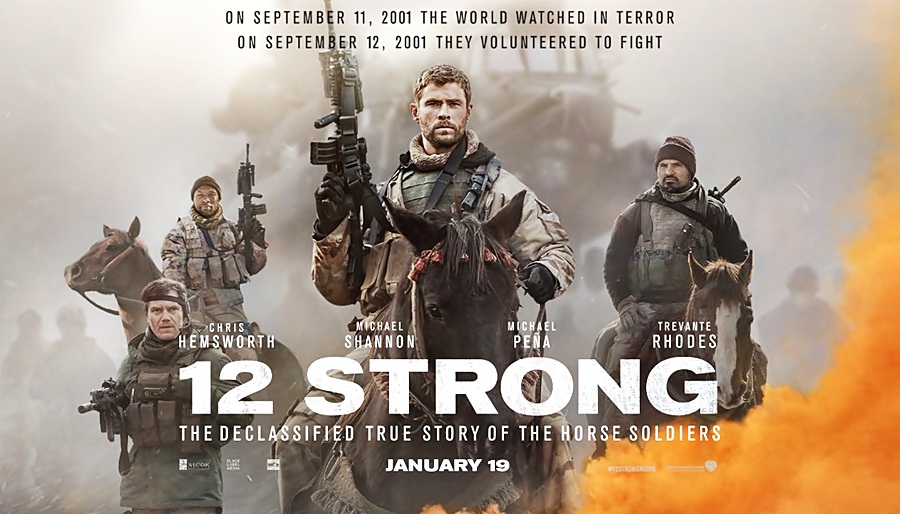
Copyright 2017 Warner BrothersIf it was fiction, you’d dismiss 12 Strong as too far-fetched. But this recently declassified military mission following 9/11, with a tiny Special Forces group, just twelve men, led by an officer who had never been in combat, were sent to Afghanistan to take out a Taliban outpost. They were vastly overmatched in terms of men and weapons. And, most improbable of all, they had to travel by horseback. Men trained to use the very latest of technology were riding the mode transportation used by knights and cowboys. These guys are the best of the best, nothing but courage, patriotism, skill, and determination all the way through. Think of them as The Clean or rather Sandy Dozen.
This film begins with a brief reminder of the terrorist attacks leading up to the airplanes that flew into the World Trade Center and Pentagon on September 11, 2001. And then, as in all films of men about to go into danger, we see happy families, just enough to make sure we care about these loving husbands and fathers. We know that Captain Nelson (Chris Hemsworth, back to being mortal after “Thor: Ragnarok” but no less heroic) is not going to be able to keep his promise to pick that adorable ladybug-drawing daughter after school, and pretty soon he knows it, too.
There are wives who bravely say that this is what they signed up for. One says, “Some wives cry; I clean,” as she scrubs her oven. Another looks at her husband grimly, insisting he give their son the bad news himself. Nelson has to undo his plans for a desk job to go back to his team. He also has to prove himself to his commanding officer, who selects him over five other teams because he seems to have the best understanding of the challenges, especially the weather that will make their mission impossible if they don’t complete it before winter makes the route impassable.
And then the twelve are on their way with just the briefest and sketchiest debrief from a CIA officer. There are three warlords in the area who all oppose the Taliban but otherwise are in mortal combat with each other. One of the challenges for the American team will be to keep that fragile alliance in place as they need the support of all of them to reach the outpost, liberating several locations along the way.
It is hard to follow at times. There are so many “the whole world depends on this next impossible thing” moments, so much bro talk, so much tech talk, so many reminders of how many days “in country,” so many similar-looking explosions and shoot-outs. But Hemsworth, Shannon, and Pena create real, relatable and yet heroic characters, and seeing them ride into battle on horseback against daunting odds is genuinely moving and inspiring. The most intriguing part is the developing relationship between Nelson and his local counterpart, General Dostum (Navid Negahban). The outcome revealed before the credits is appropriately both reassuring and disturbing.
Parents should know that this film includes extensive wartime peril and violence including guns and explosions with many characters injured and killed, some grisly and disturbing images, references to child abuse, strong language, and some sexual references.
Family discussion: What is the difference between a soldier, a warrior, and a warlord? How did Nelson and Dostum learn to trust one another? What can we tell about the man by the way they said goodbye to their families?
If you like this, try: the book by Doug Stanton and the movies “Act of Valor,” “Lone Survivor” and “Charlie Wilson’s War”
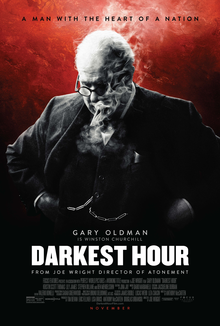
A bitter debate is going on in Parliament. The Prime Minister, Neville Chamberlain (Ronald Pickup) has responded to Hitler’s invasion of other countries with appeasement and many of the politicians are with him. A combination of denial and sun-never-sets-on-the-British-Empire smugness of those who have colonized a quarter of the planet and are situated on the other side of the Channel makes them confident that they can work with Hitler. But it is increasingly clear to at least some of the politicians believe it is time to take a stronger stand. Is there someone they can call on to lead them in that direction?
There is, and he is still in bed, “insuring his fingerprints are not on the murder weapon.” He is Winston Churchill (Gary Oldman, disappearing into the character and giving a dazzling performance worthy of the real-life man he portrays). The very inevitability of Churchill’s selection, no one’s first choice, a man who “has a knack for drawing out the very worst in those who are trying to help him,” according to his devoted but perceptive wife Clementine (Kristin Scott Thomas), increases the frustration of the elected officials around him, who continue to plot to undermine his determination to to go to war, if necessary, to fight Hitler’s takeover of Europe. “I’m getting the job only because the ship is sinking,” he says glumly but grimly. “It’s not a compliment. It’s revenge.”
Earlier this year, Christopher Nolan’s “Dunkirk” gave us a bracing look at the turning point that ends this film, when certain catastrophic defeat was turned into a victory just by escaping, rescued with the help of a citizens’ armada of boats. That film paid tribute to the ordinary men who retreated to come back stronger. This film gives us another side of the story in a more traditional “great man” portrayal of history and it could not have a better subject. Churchill was a master of language, grandiloquent at a time when people needed to be inspired by a leader of vision, a deep knowledge of history, and shining integrity. The benefit of having a central character in Churchill is that he pretty much spoke in movie dialogue, hyper-articulate, wryly witty, and with an underlying patriotism rooted in compassion, not jingoism.
Churchill knows that it is not enough for him to be right about Hitler. He has to get the support of the other politicians and he has to get the support of the population. He knows what he will be asking them to do will involve unimaginable sacrifice. And there is no time. “We are looking at the collapse of Western Europe in the next few days,” says a general. “Should the public be told?” There is no time. And, as yet, there is no plan for a counter-attack and Franklin Roosevelt, Churchill’s good friend in the United States, tells him that Congress has prevented him from being of help.
Churchill also knows what it is to fail, publicly and miserably. Will he make mistakes again? Clementine assures him that he is wise because he has doubts. Even if Hitler wins, Churchill knows it is better to give him as much of a fight as possible. “Countries that go down fighting come back.”
The compressed time period and the urgent conversations with Clementine, member of Parliament, and the king (superbly played by Ben Mendelsohn) are riveting, bolstered by an urgent score by
Dario Marianelli and masterfully sinuous camerawork by Bruno Delbonnel and editing by Valerio Bonelli. The camera maneuvers through Churchill’s legendary wartime cabinet rooms (a must-visit for London tourists), showing us the cramped quarters and the fierce energy of what is going on.
Oldman disappears into the role, a performance like the famous Karsh portrait come to life. His Churchill is crafty, sometimes impatient, sometimes uncertain, but compassionate, and always sure of what his values are. The Churchills had a famously devoted love match, and Kristin Scott Thomas is impeccable in showing us Clementine’s elegance, and resolve.
“He mobilized the English language and sent it into battle,” a character says. And with this film, director Joe Wright mobilized the language of film and presents us with an uplifting reminder of what the right person at the right time can do even under the direst circumstances.
Parents should know that this is a wartime story with tense peril and reference to violence and loss, some strong language, and smoking and drinking.
Family discussion: What should be factors in deciding when to intervene and when to negotiate? Why did the king change his mind? Read My Early Life, Churchill’s autobiography of his youth. Which self will you be today?
If you like this, try: “The King’s Speech,” “Dunkirk,” and some of the other movies about this towering figure of the 20th century, including the “First Churchills” miniseries about his ancestors.
Rated R for language throughout including some sexual references
Profanity:
Very strong and crude language
Alcohol/ Drugs:
Drinking and alcohol abuse, smoking, references to drug abuse
Violence/ Scariness:
Themes of military service in wartime, sad deaths offscreen
Diversity Issues:
Diverse characters
Date Released to Theaters:
November 10, 2017
Date Released to DVD:
January 29, 2018
Copyright 2017 Amazon Studios
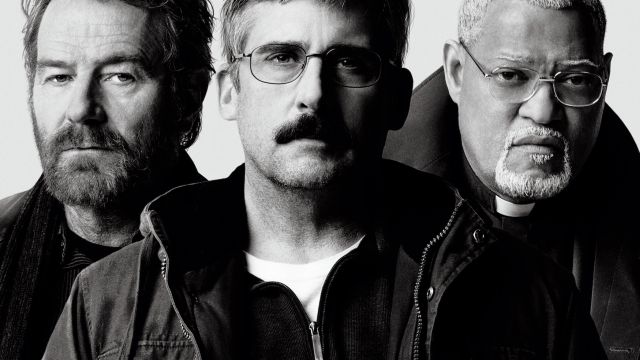
Three of the best actors in the world give immense depth and humanity to characters who might so easily have been caricatures in “Last Flag Flying,” about three veterans on a sad personal mission. It’s got a backstory that might be worth a movie of its own. “The Last Detail,” based on the book by Darryl Ponicsan, starred Jack Nicholson and Otis Young as Marines ordered to escort a naive teenaged sailor (Randy Quaid) to serve an eight-year prison sentence for a trivial offense. It was a critical and commercial success due to Nicholson’s performance and a picaresque tone that suited the era. 4 years later, another Ponicsan book about three military men (now long retired from service) on a sad journey with some comic detours comes to the screen, directed by Richard Linklater (“Boyhood”). It is not a sequel, though some of the characters have the same names and some similar histories.
It is 2003. A man carrying a manilla envelope walks into a dodgy little dive bar and orders a beer. The bartender barely glances at him, in the midst of a one-sided conversation with the bar’s only other customer, a regular. “You don’t remember me, do you?” asks the man with the envelope. The bartender, who is also the owner of the bar, takes a good look. “Doc!” he crows. “No one has called me that in years.” Doc is Larry Shepherd (Steve Carell) and the man behind the bar is Sal Nealon (Bryan Cranston). They eat pizza, talk about old times, and fall asleep in a booth. The next day, Larry takes Sal to a church, where the Reverend Richard Mueller (Laurence Fishburne) is conducting services. The men have not seen each other in decades, but they served together in Vietnam, Nealon and Mueller in the Marines and Shepherd in the Navy.
Mueller is not especially happy to see friends from the days when he was known as Mueller the Mauler, but he invites them to dinner at his home with his wife, Ruth (a splendid Deanna Reed-Foster, warm and wise). It is there that Shepherd explains why he wanted to find them. His son has been killed in action and he wants Mueller and Nealon to accompany him to the funeral. Nealon goes because he wants to do something different. Mueller goes, reluctantly, because he wants to be of service. “They represent a dark period in my life,” he tells Ruth, “a very dark period.” “And you represent God,” she replies.
And so the odyssey begins, with many adventures along the way, and, as Linklater does so well (the “Before” trilogy, “Waking Life”), many wide-ranging conversations, here including discussions of the past and present, the newish technology of the cell phone, sex, sleep, race, order, chaos, war, lies, choices, and consequences. Accompanying them for part of the trip is a Marine who was a close friend of Shepherd’s son (J. Quinton Johnson of “Everybody Wants Some!!!” excellent).
Near the end, Linklater gives us two scenes showing that what might have seemed episodic and slight was deliberate, thoughtful, and meaningful. It is his actors’ respect for the flawed characters they play and Linklater’s own respect for their choices, challenges, and regrets, that show us what we ask of the people who go to war on the other side of the planet because someone thought it would keep us safe, and what we owe them as well.
Parents should know that this film includes very strong and crude language, drinking, smoking, references to drug abuse, references to wartime violence, and very crude sexual references including prostitution.
Family discussion: What should they have told Mrs. Hightower? Why did Larry want to bring his son home? Who would you call for a journey like that one?
If you like this, try: “The Last Detail” and “Taking Chance”
Martha Raddatz on National Geographic’s “The Long Road Home”
Posted on November 9, 2017 at 4:58 pm
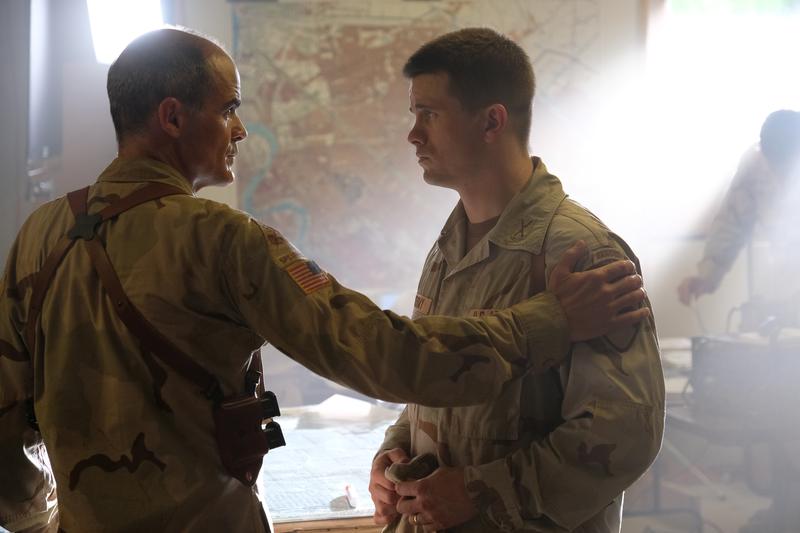
Michael Kelly(L) portrays Lt. Col. Gary Volesky and Jason Ritter(R), Capt. Troy Demony on set of The Long Road Home at U.S. Military post, Fort Hood, Killeen, Texas. (Photo: National Geographic/Van Redin) Ep1
National Geographic’s new series “The Long Road Home” is based on the best-selling book by journalist Martha Raddatz about soldiers sent to Iraq on a peacekeeping mission in 2004 who were ambushed on a day that came to be known as “Black Sunday.” The series is powerful, inspiring, and deeply moving as it lets us into the lives of those who were there and their families. In an interview, Raddatz talked about how she got the story, what she learned, and what she hopes the series, premiering as we prepare to observe Veterans’ Day, will teach us about the people who risk their lives — and give their lives — for our freedom and for each other.
The news footage from Vietnam on the news every night played a significant role in eroding the support for the war. We do not see that kind of coverage of what our troops are doing in Iraq and Afghanistan.
We did in the beginning. It was it was on all the time and take it from me because I was covering it. But it hasn’t been more recently and never in this way, in the way we tell this story about U.S. soldiers and their families and particularly families. It’s a really realistic, really raw, really warts and all, very nuanced look at war, if you can imagine nuanced war, this has got it.
What does nuance mean when you’re talking about war?
These aren’t a bunch of action figures. There is lots of breaking down doors and things like that. But they’re also very distinct people, regular people, real people. These are not Navy SEALs. These are not elite forces. These are soldiers who went over there thinking they were involved in a peacekeeping mission and found themselves ambushed and the other men in the battalion who reached out to rescue them in whatever vehicles they could find. Some of them are still serving on active duty, and I can’t remember a time when a series has portrayed soldiers still on active duty.
Was that an impediment to you in reporting on the story? Were there a lot of restrictions on what the soldiers were allowed to talk about?
They shared everything they possibly could with me. And one of the most remarkable things about this series is that the Army gave it its blessing and cooperated with us. They allowed us to shoot on base and build a 12 acre set with 85 buildings.
I think in so many ways right now Americans are ready to see this. And the Army is ready to see this. The Army is ready to say, “This is what we did and this is how we fought. This is where we went into places where we were totally unprepared for what was to come.” They saw everything before we shot it, including scenes with anti-war protesters. There’s an entire episode about a soldier who became a very outspoken war protester. So that is the kind of eye-opening experience you have with this series.
We see very clearly in the series that this is a war that’s being fought in the streets and in people’s homes.
It’s about as hand to hand combat as you can get. You look each other in the eye. There are some remarkably intimate scenes with soldiers facing down an enemy.
What have you learned about courage through reporting and telling this story?
Sometimes the people who are most courageous are the ones you never expect to be. You cannot predict it. But I also learned that courage is defined in different ways. It’s not always the ways you think. When we walk into a situation sometimes it takes a little while to find the courage to find that leadership or to find that bravery that keeps them going. Everyone finds it in a different way. And again some people don’t. And that’s the kind of broad spectrum you have.
Why was it important for you to talk to the families as well as the soldiers who were directly involved?
It’s the soldiers who told me to go talk to family because they said, “If you think it’s bad for us you should see the families and what they went through and what they have to experience and just not knowing.” The soldiers know what’s happening; they know what’s coming next. Those families just have to wait and their courage and their bravery every day, starting with that day of the ambush and years that follow this unit is I think really eye-opening for people. One of the wives would not drive into the garage behind the house without driving by the front of her house first just to make sure there was not a car up there that was going to notify her of her husband’s death.
Your work has been in television. What could you do in a book and now in a series re-creating the events that you cannot do in television news?
When I first began reporting on the story, we never had was any video. From the descriptions from the soldiers and the survivors of that battle we can see it come to life in the miniseries. It is the first time I’ve seen that come alive.
What is it that you want people to talk about with their families after they watch this show?
I want people to talk about the cost of war and to understand what it means to go to war. I want people to think about their responsibility to be informed and to have a voice to vote to do whatever it is that involves them in those life and death choices because fewer than one percent of our country serves in the military. Ninety nine percent do not. And the very least people who do not serve can do is understand the consequences.