
Happy Thanksgiving 2013!
Posted on November 28, 2013 at 8:00 am
I am, as ever, deeply grateful to all of my friends and family and to my wonderful readers.
Posted on November 26, 2013 at 5:00 pm
B+| Lowest Recommended Age: | Middle School |
| MPAA Rating: | Rated PG for thematic material, language, and a menacing situation |
| Profanity: | Some strong language |
| Alcohol/ Drugs: | References to substance abuse |
| Violence/ Scariness: | Teenager threatens someone with a gun, references to violence |
| Diversity Issues: | A theme of the movie |
| Date Released to Theaters: | November 27, 2013 |
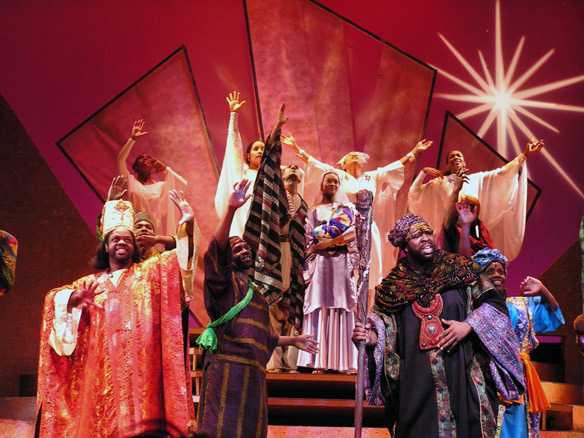 The poet Langston Hughes wrote a play called “Black Nativity,” a joyous African-American retelling of the story of the birth of Jesus with gospel music, and it has become a holiday perennial. Now it has been adapted by writer/director Kasi Lemmons (“Eve’s Bayou”) with a framing present-day story of a prodigal daughter, estranged from her parents for 16 years, brought back home at Christmas as “Black Nativity” is being performed in her father’s church.
Oscar-winner Jennifer Hudson plays Naima, a single mother in Baltimore who has lost her job and is trying everything she can think of to keep her home. But even with two jobs, she and her 15-year-old son Langston (17-year-old Jacob Latimore), named for the poet, are about to be evicted. Niama has no other options left. She puts Langston on a bus to New York to see the grandparents he has never met, knowing nothing about them or the cause of their estrangement.
Langston is hurt, lost, and angry. He is frustrated that he cannot do more to help his mother and determined to find a way to get her the money she needs to keep their home. Things go badly when his bag is taken by a kid as soon as he gets off the bus and he is arrested trying to return a man’s wallet because the police think he is trying to steal it. In jail, he meets Loot (Tyrese Gibson), who jeeringly calls him “Lunch Money” and makes Langston feel powerless and disrespected.
His grandfather, Reverend Cornell Cobbs (Forest Whitaker), is formal and reserved. His grandmother, Aretha (Angela Bassett) is affectionate but clearly in pain over the past and afraid of being hurt again. Langston will do anything to feel that he is taking control of what is happening to him so he can return home.
Impressionistically told, with songs that serve as monologues, the movie becomes more powerful when Cornell’s church stages a gorgeous production of “Black Nativity” and Langston nods off to have a gospel-inspired dream that features Nas and, as an angel with white hair sticking up like a dandelion ready to make a wish, Mary J. Blige. When Langston sneaks out of the service in a desperate attempt to get the money, it leads to a confrontation revealing in ways he could not anticipate. The concluding scenes of redemption and reunion are tender and transcendent.
Parents should know that the storyline concerns foreclosure and eviction, family estrangement, law-breaking, teen pregnancy, and abandonment. A teenager uses a gun.
Family discussion: Why didn’t Langston’s family want to tell him the truth? What did the watch symbolize to Cornell? What did we learn from Langston’s dream?
If you like this, try: the poetry of Langston Hughes
Posted on November 26, 2013 at 8:00 am
I admit it. I’m not a fan of “Planes, Trains, and Automobiles,” which always strikes me as nasty and mean-spirited. For me, the two movies that best sum up all that is stressful and complicated and wonderful about Thanksgiving are:
Pieces of April
What’s Cooking?
Posted on November 22, 2013 at 5:38 pm
I’m delighted to present a clip from the cute new holiday film, The Naughty List
Posted on November 21, 2013 at 9:58 am
B-| Lowest Recommended Age: | 4th - 6th Grades |
| MPAA Rating: | Rated PG for mild thematic elements |
| Profanity: | None |
| Alcohol/ Drugs: | None |
| Violence/ Scariness: | Mild peril, sad stories, tense confrontations |
| Diversity Issues: | None |
| Date Released to Theaters: | November 22, 2013 |
Former Presidential candidate Rick Santorum is now in the faith-based movie business and his first film is based on  The Christmas Candle by Max Lucado

Just before the holidays, a progressive young clergyman named David (Hans Matheson) takes over a church in a small village called Gladbury in late 19th century England. The town is known for its miracle — every 25 years an angel appears to touch one of the candle maker’s Christmas candles. Whoever lights that candle receives a miracle. This year, there is tremendous anticipation and there are many in the town who want the miracle for themselves, including the candle maker and his wife. David encourages his parishioners not to wait for a miracle but to help each other through kindness, generosity, humility, and love. And soon the village creates a more connected community and a more welcoming environment.
The evident sincerity of the production is appealing but it cannot disguise a not-ready-for-prime-time amateurish quality in the superficiality of the writing and pedestrian direction. It is awkward and uneven, but it is also a little less sugary than most faith-based family fare. Lesley Manville gives a subtle and touching performance that transcends the clunky dialogue and over-constructed plot and Susan Boyle looks very natural in 19th century garb and sings beautifully. The emphasis on helping others rather than wishing for a selfish miracle is most welcome, though disappointingly undercut in the final half hour.
Parents should know that there are some mature themes, including an out of wedlock pregnancy and family estrangement.
Family discussion: What would you wish for? Who can you help?
If you like this, try: “Christmas with a Capital C”