Tea With the Dames

Tea With the Dames

Posted on September 19, 2018 at 12:00 pm

A-
Lowest Recommended Age: Middle School
MPAA Rating: Not rated
Profanity: Some strong and salty language
Alcohol/ Drugs: Champagne
Violence/ Scariness: None
Diversity Issues: A theme of the movie (gender and aging)
Date Released to Theaters: September 21, 2018

Copyright 2018 IFC Films
Fair warning. It was about ten seconds into this film when the first “Hello, darling” dissolved any critical distance I could muster, and by the time about five minutes later when we got to a “How ghastly,” as only Dame Maggie Smith can say it, I melted into a little puddle of pure happiness. So if seeing four of the greatest actresses in the world talk about their decades of experience and friendship is not for you, then ignore my gushing about how much I love them and how much I loved this film.

Dame Judi Dench, Dame Maggie Smith, Dame Joan Plowright, and Dame Eileen Atkins all came of age in the late 1950’s, beginning in theater and then movies and television. Director Roger Michell (“Notting Hill”) gives us a chance to eavesdrop on one of their get-togethers “to gossip, to remember, and to laugh.” They talk about acting, of course, but also about navigating show business and what they think of critics, and about husbands (everyone agrees that Dame Joan’s husband, Lord Oliver, was the most difficult), beauty, fear, competition, awards (we see each of them being Dame-d, by either Prince Charles or Queen Elizabeth II), Americans, Shakespeare, and aging, with the advice each of them would give their younger selves, though Dame Maggie (I would not dream of any other form of address, given the disdain they show for American clumsiness with titles) admits that her younger self would never have listened. And they do it all with such impeccable diction and classically trained technique in the exquisite timing of le mot plus juste.

In the early days, “you went to reps and you stayed in digs and things,” Dame Judi remembers. And if the landlady was unkind, “you nailed a kipper under the table.” Dame Joan Plowright talks about joining her first company, where another actor warned, “She can’t play queens, you know,” and the director replied, “I should think the last thing we want in a theater for contemporary writers is girls born to play queens.”

The Dames began acting as the “Kitchen Sink” era of postwar Britain was evolving into the swinging 60’s. There are some knowing looks and nostalgic smiles as they recall that era. There is a marvelous camaraderie and warm memories of working together that is unmarred by a continuing competition. Everyone remembers that Judi Dench was the first to be Dame-d. (When Dame Maggie got the word of her award, Dame Judi assured her that “It won’t change anything; you can still swear.) And the octogenarian Dame Maggie makes the kind of pointed comment that only the portrayer of the Dowager Duchess can master; her agent assures her that “We’ll look around for a nice little cameo that Judi does not have her paws on.”

Dame Eileen is less well known in the US, and I hope very much that this film and the marvelous archival clips will inspire American audiences to learn more about her. All of the Dames are exceptionally well represented with a remarkable range of clips, showing once again that one of the key differences between US and British actors is the British actors’ willingness to weigh in with equal enthusiasm to everything from classic dramas to avant garde to sitcoms. The glimpses of their work also provide a subtle but clear contrast between their delicious inability to take themselves seriously in real life and their obvious, visceral commitment to their performances, their characters, and the scripts and screenplays they bring to life.

None of them was willing to play Cleopatra (Shakespeare’s version), though all were asked repeatedly. Dame Judi challenged the director Peter Hall: “Do you really want a menopausal dwarf?” (But she did it.) Dame Maggie did it, but in Canada. But Cleopatra is a rare role that is the center of the play. Dame Joan describes “that rare exhilaration when you know you’re in charge.”

They talk about aging, and about fear, not of illness or death but, endearingly, enduringly, about the very thing they have devoted their lives to, acting. “Are first days still scary?” Michel asks, off camera. “All days,” Dame Maggie says immediately. But it is their relish for exactly that challenge that keeps them so vibrant. “Fear is petrol,” says Dame Judi. “It generates such an energy. If you can somehow handle it, it can be a help.”

As marvelous as they are playing other people, it is pure delight to see them as themselves.

Parents should know that the ladies use some frank and salty language and there are some sexual references.

Family discussion: What advice would you give to your younger self? Why didn’t they want to play Cleopatra?

If you like this, try: the films starring the Dames
Related Tags:


Actors Documentary movie review Movies -- format Movies -- Reviews
An Actor Prepares

An Actor Prepares

Posted on August 30, 2018 at 12:20 pm

B
Lowest Recommended Age: Mature High Schooler
MPAA Rating: Not rated
Profanity: Very strong and crude language
Alcohol/ Drugs: Alcohol and drug abuse, psychedelics
Violence/ Scariness: Mild peril, medical issue
Diversity Issues: Discussion of feminism
Date Released to Theaters: August 31, 2018
Copyright 2018 Gravitas Ventures

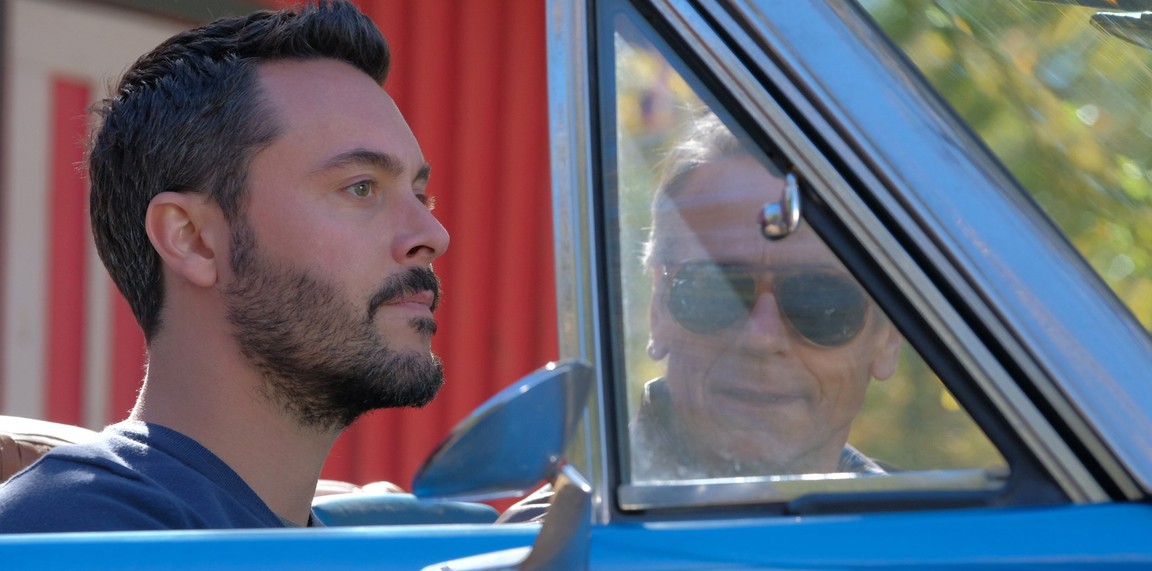
The third movie this year with an acclaimed older actor playing a selfish, negligent father who must be driven across country by an angry, estranged adult child has some familiar tropes, but also some distinct pleasures. Following “Kodachrome” (Ed Harris, Jason Sudeikis), and “Boundaries” (Christopher Plummer, Vera Farmiga) we have “An Actor Prepares,” with Jeremy Irons and Jack Huston. The title comes from the legendary book by Constantin Stanislavski that is a core text for method actors. The joke here is that Jeremy Irons plays a three-time Oscar-winning, substance-abusing actor named Atticus Smith who seems to have no method to his madness and does not really prepare for anything.

Atticus is a mess. His agent (Ben Schwartz) is trying desperately to keep him together so he can literally play God in a movie. Atticus is looking forward to the wedding of his “favorite child” (Mamie Gummer). But both the movie and attending the wedding are in jeopardy when he has a heart attack and his doctor says he needs surgery. She reluctantly agrees to delay it for a week so he can go to the wedding, but he has to take his medicine, refrain from sex, drugs, and alcohol, and he cannot go by plane. That is how Adam (Jack Huston) ends up on a road trip with the father he despises, as a favor to the sister he loves.

The road trip is one of the oldest of all stories, going back to The Odyssey and before. It’s a lovely metaphor of life’s journey and provides opportunities for characters to have many seemingly random interactions, from happy to scary to moving, that help them resolve their differences by working together and learning about one another. This one involves bickering and recrimination, many opportunities for Atticus to do or say wildly inappropriate things and Adam to disapprove, a switch of vehicles/drivers, a cellphone tossed out a window, an old love, jail, and an campfire-lit trip on the hipster psychedelic ayahuasca.

So, no big surprises and at least one too many plot contrivances and at least one too few reasons to believe in the resolution. Irons and Huston make it work. Irons is clearly overjoyed to have a chance to break out of Serious Actor mode and perhaps have some fun at the expense of some of the master thespians he has had the chance to observe. He makes the most of the silly scarves, the cluelessly self-involved constant stream of free-association, and the endless series of hilarious fake movie titles for Atticus’ resume, from “Throwdown at Bitch River” to “Cops and Slobbers.” And Huston is marvelous in what could have been a thankless straight man role. I counted at least a dozen different ways of looking exasperated. His reaction to the ayahuasca is funny and very specific to the character. Mamie Gummer and Schwartz make the best of small roles, and Huston and Irons remind us why all these reconciliation road trips are worth taking.

Parents should know that this film includes extremely strong and crude language, substance abuse, psychedelic drugs, smoking, drinking, very explicit sexual references, medical issues, and tense family confrontations.

Family discussion: Why was the car meaningful to Adam? Why did Adam and his sister have different responses to their father?

If you like this, try: “Kodachrome” and “Boundaries”

Related Tags:


Drama Family Issues movie review Movies -- format Movies -- Reviews
Operation Finale

Operation Finale

Posted on August 29, 2018 at 5:49 pm

B +
Lowest Recommended Age: High School
MPAA Rating: Rated PG-13 for disturbing thematic content and related violent images, and for some language
Profanity: Some strong and hateful language
Alcohol/ Drugs: Drinking, smoking
Diversity Issues: A theme of the movie
Date Released to Theaters: August 31, 2018
Date Released to DVD: December 3, 2018
Copyright 2018 MGM

Operation Finale considers what is, perhaps, the ultimate conundrum, one that echoes throughout all of human history. How can good guys defeat the bad guys without becoming bad themselves? If the bad guys do not play by any rules at all, the good guys have two choices: to stay within the rules themselves, which can be high risk because it is like going into a fight with both arms tied behind your back, or decide that the ends justify the means and violate the rules to improve their chance of winning. Can it really be a win if you abandon your principles to get there?

Sometimes there is ambiguity about who exactly are the good guys and the bad guys. That is not the case with the Nazis in WWII. Among the worst of the worst, certainly the worst to survive the war, was Adolf Eichmann, the head of the “Department of Jewish Affairs” and the man responsible for creating the system that led to the murder of millions of people, including six million Jews. The other top Nazi leaders, Hitler, Himmler, and Goering, killed themselves at the end of the war. Then there were the Nuremberg trials for many others. But Eichmann and a few others escaped to Nazi-friendly Argentina. Fifteen years later, agents of Israel’s Mossad intelligence agency captured him and brought him back to Israel for a trial that was broadcast around the world. This is the story of how that happened, so tensely presented that we hold our breath even though we know that Eichmann made it to Israel, where his “man in a glass booth” (for security) trial was broadcast as it happened throughout the world, giving most people their first chance to hear testimony from Holocaust survivors.

Director Chris Weitz and screenwriter Matthew Orton skillfully portray the people of the young state of Israel, just 12 years old, still defining itself internally and still justifying its existence to the world. When someone approaches Mossad with evidence that Eichmann has been identified in Argentina, the first reaction is that the atrocities are old news, and they don’t have the resources to go after him because they are too busy fighting for the right to exist now. They ultimately decide to get him less from a sense of justice or even revenge than from the notion that at this stage, everything they do is definitional; every choice they make shows the world what it means to be a Jewish state after the Holocaust, an atrocity so unprecedented that the term was not even in widespread use for several more years.

We see what it is to have a country made up of displaced people, each of whom has suffered unthinkable trauma and grief. In one scene they almost start to have a grim “who lost the most” conversation before they stop. Their focus has to be on what happens next, and that is the risky, complicated plan to get Eichmann out of Argentina, even though there is no extradition and they don’t have access to military aircraft capable of transporting him.

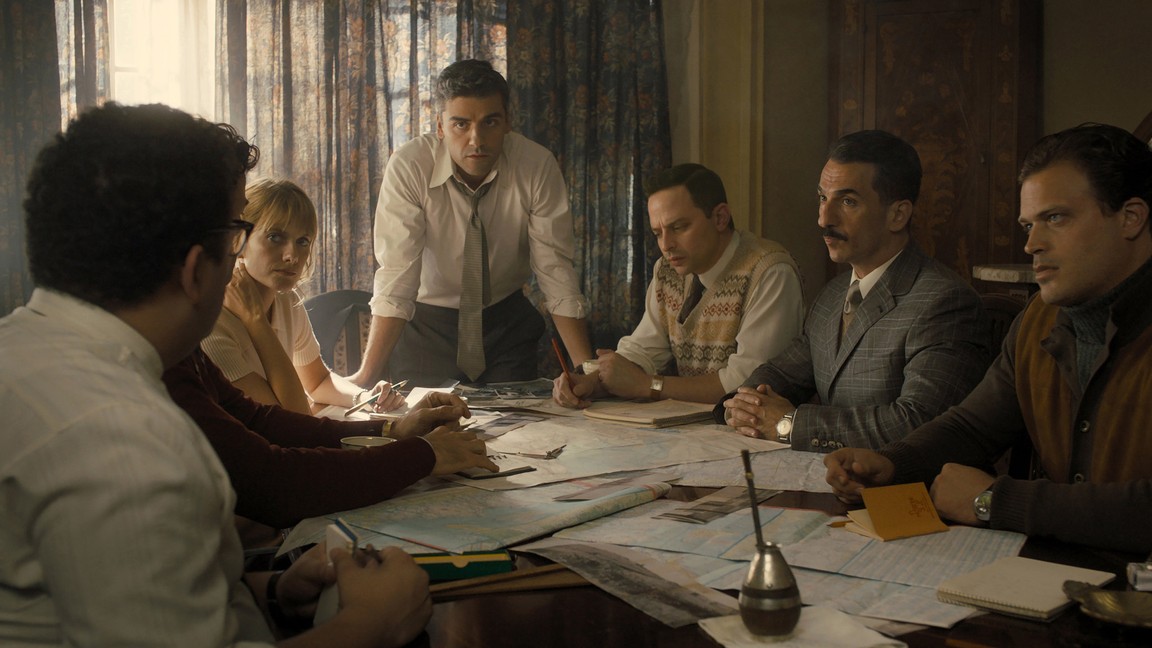
Sir Ben Kingsley plays Eichmann, living under an assumed name, working at a Mercedes factory, living with his wife and sons, and speaking often to groups of other escaped Nazis about his wartime experiences. Oscar Isaac plays Peter Malkin, the Mossad agent who actually tackled Eichmann, and who, with his colleagues, had to keep him captive until he could be extracted and put on a commercial flight to Israel.

There is a wisp of a love story, and there is some exploration of the moral dilemmas. But it is the electrifying scenes between Kingsley and Isaac that are even more riveting than the “can they get him” and “will they be caught” moments of spycraft.

It was Eichmann himself who inspired Hannah Arendt’s term “the banality of evil,” and disconnect is jarring between Eichmann’s deeds in overseeing the mechanics of rounding up Jews and transporting them to their execution and torture and the bland, civilized factory foreman who loves his wife and children. Eichmann is not bothered by the slaughter of millions, even when a murdered baby’s brain was splattered over his coat. Malkin is still deeply wounded by the loss of one person, his adored sister, who was killed with her children. He is still anguished by a fatal mistake on a previous mission. We see that the very conscience that keeps Malkin from “putting a bullet between eyes,” as he said he would gladly do, can make it much harder to bring him to justice.

Eichmann, a master manipulator, tries to put them both in the same category of following orders to save their country. Malkin tries to manipulate Eichmann into signing the necessary consent form for leaving the country. Each tries to gain ground over the other, usually through appearing to be conciliatory, to find some point of vulnerability. The action scenes, especially toward the end, have a ramped-up “Argo” rhythm, but what is far more engrossing is when two people talk to each other.

The stakes are incalculable and inherently dramatic, but Kingsley and Issac take it to another level as characters and as actors, and it is fascinating to see them challenge each other. Two of the greatest actors alive, each with endless screen magnetism, superb control of acting technique, and the ability to tell a lifetime with an almost imperceptible shift of the eyes or slight additional huskiness in the voice, put all of that to show us a massive historical event can come down to two people in a room.

Parents should know that this film includes footage of Holocaust atrocities, including mass murder, with some graphic and very disturbing images, some peril and violence, drinking, smoking, and some strong language.

Family discussion: Why is it important to give someone a fair trial when the crime is unimaginably big and the evidence against him is overwhelming? Is it possible for a trial under those circumstances to be fair? Why did Eichmann sign the agreement?

If you like this, try: “Argo,” “Munich,” and “The Eichmann Show,” a film about the trial, and read Peter Malkin’s book, Eichmann in My Hands.

Related Tags:


Based on a true story Drama DVD/Blu-Ray movie review Movies -- format
The Happytime Murders

The Happytime Murders

Posted on August 23, 2018 at 5:35 pm

C
Lowest Recommended Age: Adult
MPAA Rating: Rated R for strong crude and sexual content and language throughout, and some drug material)
Profanity: Very strong, crude, and offensive language
Date Released to Theaters: December 3, 2018
Copyright STX Films 2018

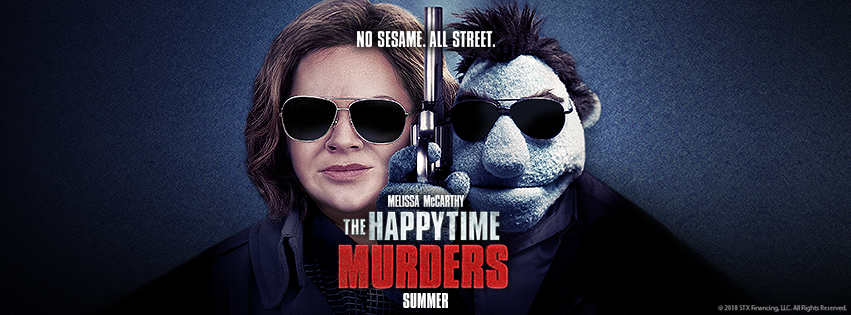
A couple of minutes into “The Happytime Murders,” an adorable Muppet-like puppet says the f-word. If that strikes you as funny, think very carefully about whether it is funny enough for 90 minutes of pretty much the exact same joke to justify the price of a movie ticket. If you want to hear puppets swear and talk about porn, see “Avenue Q.” If you want to see a detective try to solve a murder in a show business community where entertaining non-human characters are second-class citizens, see “Who Framed Roger Rabbit?” If you want a good time at the movies, do not go to see this.

It might have made a pretty good Funny or Die video. But it is not enough to sustain even a less-than 90-minute running time. It is vastly less entertaining than the behind-the-scenes credit sequence showing how some of the scenes were filmed. And it is vastly less interesting than a movie about adults trying to trash the imperishable legacy of a legendary father, as is the case here with the Henson kids making a hard-R movie with characters from the Muppet world their father created.

Phil Philips (Bill Barretta) is a disgraced cop-turned private detective with a comely receptionist named Bubbles (Maya Rudolph, the movie’s highlight). A beautiful new client (Dorien Davies) asks Phil to find out who is blackmailing her. Phil investigates a possible connection in a porn shop (where a puppet cow is having her udder massaged by a puppet octopus) just as a gunman arrives and kills everyone else in the store. One of the victims was an actor on a popular television show called “The Happytime Gang,” featuring Phil’s brother and a bunch of other puppets, along with a human named Jenny (Elizabeth Banks), once Phil’s girlfriend.

Phil’s former partner, Connie Edwards (co-producer Melissa McCarthy) shows up, and her lieutenant (Leslie David Baker) assigns them to work together on what turns out not to be a simple robbery but a plot to kill off all of the Happytime Gang. Phil and Connie track each one down, bickering along the way, and failing to protect any of them. This is an opportunity to show many puppets engaging in extremely depraved behavior including substance abuse and prostitution and brutal murders with bits of fluff and disembodied puppets everywhere. Fun!

What makes the Muppets magical is the vivid personalities. We don’t love Kermit and Miss Piggy and Statler and Waldorf and Elmo and Oscar and Big Bird and the Swedish Chef and Fozzy Bear because they are puppets. We love them because they are characters, as vivid and engaging and real as any human. The puppets here, are expertly made but bland. And so, despite all the naughty talk and truly filthy behavior, is the script. It is too lazy to even think through its premise, beyond “it’s funny to have characters usually designed for children say and do R-rated things.” A human has a transplanted puppet liver. Puppets and humans apparently have sex with each other. Puppets have puppet children and, if the puppets who have children are cousins, those children do not have the correct number of eyes. Hilarious! And on top of regular old fashioned bad taste, it has the extremely poor judgment to have a “puppet lives matter” element.

A brief pause before my conclusion to mention Maya Rudolph, who almost packs a whole movie’s worth of watchability in her irresistible performance. As Bubbles, she manages to pay tribute to and slightly parody the classic hard-boiled but soft-hearted dames who used to work for detectives like Bogart’s Marlowe and Spade. The timbre of her voice, she way she holds her shoulders, the way she walks, the way she picks a lock, the way she thanks Phil for bringing her a candy bar — each moment is a small chamber piece of exquisite choices. McCarthy is great. She’s always great. But she is not always great at picking projects, and this one, despite her crackerjack timing and remarkable focus, is a big, fluffy, dud.

Parents should know that this film includes constant extremely strong, vulgar, and crude language, very explicit sexual references and situations, drinking, smoking, drugs, violence including guns and fire, and characters injured and killed.

Family discussion: What parallels is this movie suggesting about today’s political issues? Why did the humans feel superior to the puppets?

If you like this,try: “Avenue Q”

Related Tags:


Comedy Crime DVD/Blu-Ray Fantasy movie review Movies -- format
The Wife

The Wife

Posted on August 23, 2018 at 3:24 pm

B +
Lowest Recommended Age: Mature High Schooler
MPAA Rating: Rated R for language and some sexual content
Profanity: Very strong language
Alcohol/ Drugs: Drinking and drunkenness
Violence/ Scariness: Tense emotional confrontations, medical issues, sad death
Diversity Issues: Gender issues
Date Released to Theaters: August 24, 2018
Date Released to DVD: January 28, 2019
Copyright Sony Pictures Classics 2018

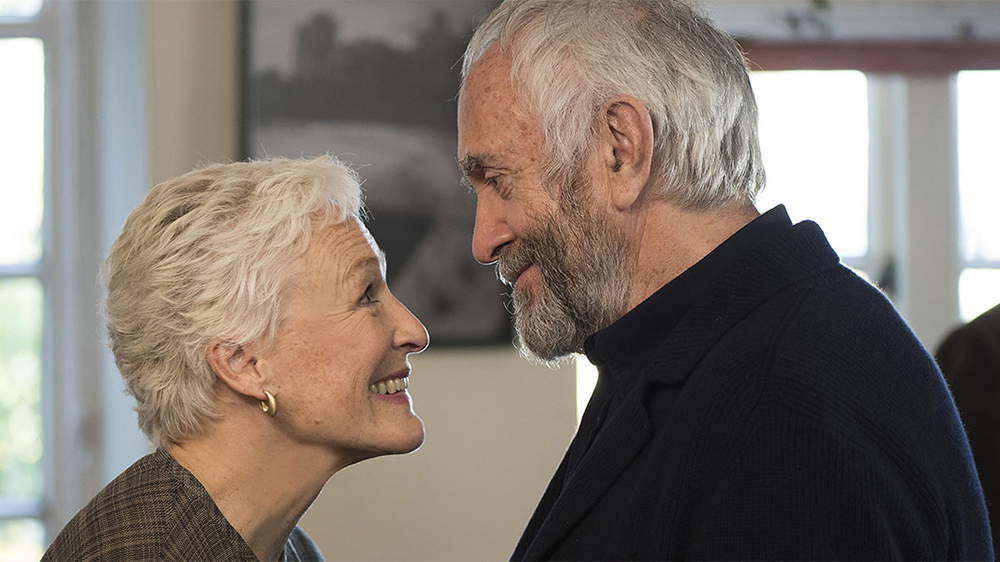
The title The Wife is telling. The lead character is not even identified by name, just by her role as helpmeet and support system for her husband, a lauded literary figure who has just been awarded the Nobel Prize. Her name is Joan and his name is Joe, suggesting that the boundaries between them are blurred. It is that blurring this movie explores, with a performance of mingled rage, guilt, passion, and integrity by the magnificent Glenn Close.

When the call comes in from the Nobel committee, Joe (Jonathan Pryce) will not hear the news until his wife, Joan (Close) is on the line to hear it, too. They celebrate by jumping on the bed together. “I did it!” he crows! There is a reception in his honor, and then they are off to Stockholm for the ceremony.

On the plane, a reporter named Nathanial Bone (Christian Slater) approaches them with some questions. Joe dismisses him abruptly but Joan is more conciliatory. Is she genuinely sympathetic? Does she think that a touch of courtesy will result in a a more favorable article? Or has she just been mediating Joe’s interactions with everyone for so long she barely even notices it anymore?

There are flashbacks, with the young Joan played by Close’s daughter, the very appealing Annie Starke, and the young Joe played by Harry Lloyd. She was a talented college student and he was a handsome and charismatic young professor. And it’s the 50’s. It seems natural for her to subordinate her own ambitions to his. In Stockholm, though, she becomes increasingly unwilling to continue to hide her contributions to the work that has made him respected and famous.

Joe and Joan are accompanied on the trip by their son, David (Max Irons), an aspiring writer who is bitter and deeply hurt when his father fails to support his work. But we will see that Joan failed him as well. And in the movie’s most powerful moment, Joan shares a drink with Nathanial, who tells her that he has collected evidence from her college days suggesting that at least some of Joe’s published writing was really Joan’s.

Joan also has to ask herself what she got from the relationship, including her contributions to Joe’s work. Flashbacks reveal reasons that she might have preferred to be the silent partner. As the blending of their names suggests, they may be two sides of one whole, one writing for the approval of the world, one relishing the purity of writing without the burden of being a public figure. Close shows us the steely control of a woman who has not been honest with the world but also has not been honest with herself. Did she ignore her young son to help her husband, or to satisfy her need to write?

The film explores these themes less than it should, but the dynamic between both the older and younger versions of Joe and Joan make it a compelling drama, with a stunning performance by Close as a woman who told other stories for decades and may now need to tell her own..

Parents should know that this movie includes strong language, a medical crisis, a sad death, and sexual references and situation.

Family discussion: Why did Joe and Joan perpetuate the lie? Why was it so difficult to give David what he needed? What will happen next?

If you like this, try: some of Close’s other films including “Fatal Attraction,” “In the Gloaming,” and the television series “Damages” and also “What Every Woman Knows,” by the author of “Peter Pan”

Related Tags:


Based on a book DVD/Blu-Ray movie review Movies -- format
THE MOVIE MOM® is a registered trademark of Nell Minow. Use of the mark without express consent from Nell Minow constitutes trademark infringement and unfair competition in violation of federal and state laws. All material © Nell Minow 1995-2026, all rights reserved, and no use or republication is permitted without explicit permission. This site hosts Nell Minow’s Movie Mom® archive, with material that originally appeared on Yahoo! Movies, Beliefnet, and other sources. Much of her new material can be found at Rogerebert.com, Huffington Post, and WheretoWatch. Her books include The Movie Mom’s Guide to Family Movies and 101 Must-See Movie Moments, and she can be heard each week on radio stations across the country.

Website Designed by Max LaZebnik