Only the Brave

Only the Brave

Posted on October 19, 2017 at 5:19 pm

B
Lowest Recommended Age: High School
MPAA Rating: Rated PG-13 for thematic content, some sexual references, language and drug material
Profanity: Some strong and crude language
Alcohol/ Drugs: Drinking, drugs, substance abuse
Violence/ Scariness: Extended peril and violence, many characters killed, snake bite
Diversity Issues: None
Date Released to Theaters: October 20, 2017
Date Released to DVD: February 5, 2018
Copyright 2017 Sony

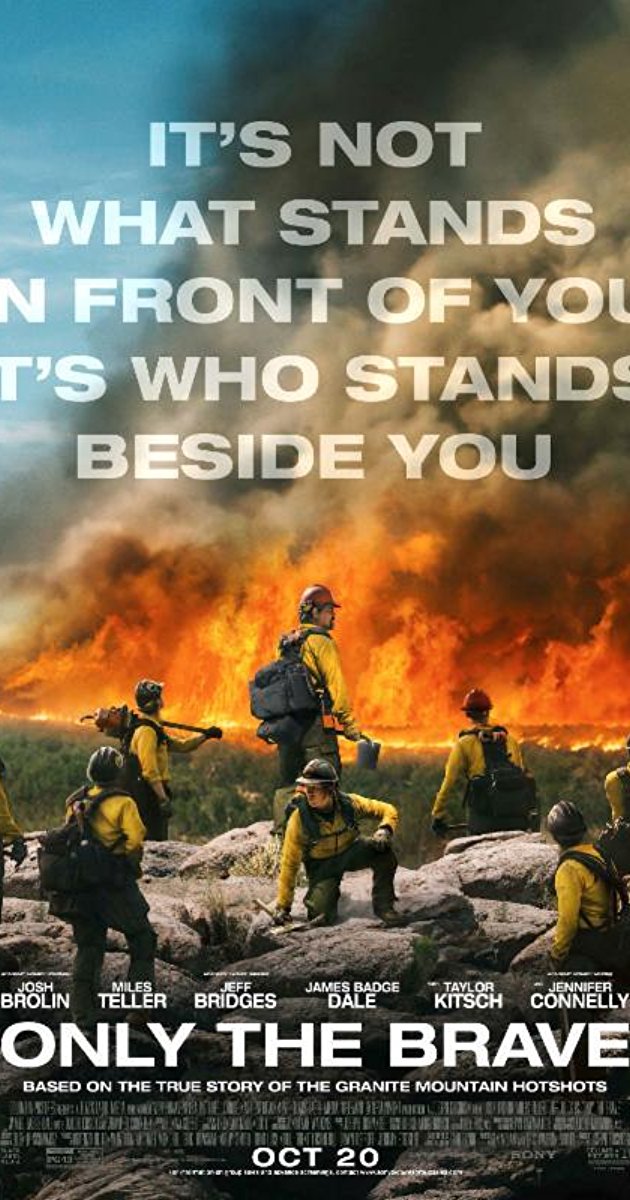
They literally fight fire with fire. Unlike “structure fires,” burning buildings doused with water, wildfires in non-residential areas are contained by setting a line of fire to stop them from spreading. Sometimes it does not work. “Only the Brave” is the story of the Granite Mountain hotshots, the “alpha” team of 19 Arizona firefighters who were killed in 2013. Like “The Perfect Storm,” this is a real-life story that spends three-quarters of its time making us love the characters and then heart-wrenchingly shows us how painful it was to lose them.

Josh Brolin, who has spent some real-life time as a firefighter, plays Eric, the leader of the group that, as the movie begins, is the second team, not allowed to set the fires on “the line.” “You guys are type two and we’re hotshots so why don’t you do what deucers do best, which is stay in the back and mop up our ?” sneers the leader of the alpha team. Eric and his group want very much to be certified as alphas and they train hard, the more experienced members of the team as the newcomer, Brandon (Miles Teller), good-naturedly dubbed “Donut” by the team for his zero score when quizzed on the rulebook.

“It’s not easy sharing a man with a fire,” a wife explains. The same qualities that make these men (they are all men) good at what they do can make it difficult for them to be the good husbands and fathers they strive to be.  For Brandon, the discipline and support of the team makes it possible for him to stay away from his past life of slacking and substance abuse.  But for some of the others, the intensity of the fire fighting experience is something of an addiction and it is difficult for them to go back to normal life with their families, who can never really understand what they face and what they do.

The moments of struggle are touching, as Brandon’s discovery that he is going to be a father inspires him to change his life and Eric’s wife Amanda (Jennifer Connelly) tries to stay close to a husband who is not ready to share what he has been through. The movie’s greatest strength is in its presentation of the music of man-talk, indirect, mock-aggressive, often crude, but always in service of the most profound commitment and loyalty.  For a moment, we get to be a part of that group of hotshots, and it is piercingly sad to lose them.

Parents should know that this is the true story of firefighters with a lot of peril and many sad deaths, some strong language, sexual references (some crude) and situations, pregnancy, drinking, and some drug use and references to substance abuse.

Family discussion: What qualities does someone have to have to be a hotshot? Why didn’t Brendan want painkillers at the hospital?

If you like this, try: “The Perfect Storm,” “Backdraft,” and “Ladder 49″

Related Tags:


Based on a true story Drama DVD/Blu-Ray Pick of the Week
Marshall

Marshall

Posted on October 12, 2017 at 5:25 pm

B +
Lowest Recommended Age: Mature High Schooler
Profanity: Some strong language
Alcohol/ Drugs: Alcohol, smoking
Violence/ Scariness: Allegations of rape and attempted murder, fights and beatings, gun
Diversity Issues: A theme of the movie
Date Released to Theaters: October 13, 2017
Date Released to DVD: January 8, 2018
Copyright 2017 Open Road

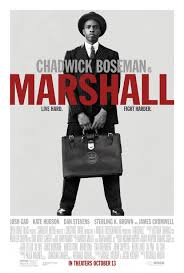
“It’s a real life Bigger Thomas,” says a character describing the new case assigned to a young lawyer named Thurgood Marshall (Chadwick Boseman). Bigger Thomas was the young black protagonist who could not escape the fundamental racism of American society in Richard Wright’s novel, Native Son, accused of rape and murder. In this real-life case, a black chauffeur named Joseph Spell (Sterling K. Brown of “This is Us”) was accused of rape and attempted murder of his employer, Eleanor Strubing (Kate Hudson), a wealthy Connecticut socialite. Marshall, then the entire legal staff of the NAACP, was going from town to town representing black defendants, many whom “confessed” after being beaten and starved, but, Marshall insists, only those who are innocent. They do not have time or resources to devote to those who did what they are accused of.

This case is unusual because it is in the North and because it is so high-profile. It has been a front page story in the newspapers and many white families are firing their domestic employees because they are so terrified.

Connecticut may not have the overt, explicit racism of the Jim Crow laws, but in some ways that makes fighting its version of bigotry more difficult. The judge (James Cromwell) refuses Marshall the normally automatic courtesy of allowing him to represent Spell in court without being a member of the state bar association. Instead, a local lawyer named Sam Friedman (Josh Gad) must argue the case, even though he has no experience in criminal trials and is very reluctant to get involved. “That must be difficult,” Marshall tells him wryly. “To have a reputation to think of.” Marshall may sit at the counsel’s table but may not address the judge or examine witnesses. He says that not being allowed to speak is the worst blow he has had as a lawyer, worse than having to enter the courthouse by the back door.

This is an absorbing drama on many levels, working purely as an “Anatomy of a Murder”-style courtroom mystery, as a historical depiction of the roots and mechanics of social change, and as the personal story of the two young lawyers facing enormous professional and personal challenges, developing a friendship, and becoming better at what they do.

The screenplay by father and son Michael and Joseph Koskoff is forthright in addressing the complicated ethics of preparing a defense for an individual client that many not always be consistent with the larger political imperatives. It also delicately if not always sucessfully skirts the complicated problem faced by contemporary films based on real-life events: if the white character teaches the black character, it’s condescending, but if the black character teaches the white character it’s “magical Negro.” In real life, Samuel Friedman was already active in civil rights cases before the Spell case, and he was slender and athletic. But for dramatic purposes, here he is played by Josh Gad and his character only takes insurance cases. We first see him winning for an insurance company on a technicality that leaves the disabled plaintiff without any damage payment. And Marshall’s character changes very little over the course of the film. He is sophisticated, tough, smart, and confident all the way through which is great as a tribute to one of the towering figures of the 20th century, but without some kind of character arc like the one given to Friedman, the risk is that he becomes a supporting character in the movie that has his name in the title. Fortunately Boseman is intensely charismatic and a gifted actor who is able to bring a great deal to the role, and he and Gad have a strong chemistry that benefits and is benefited by director Reginald Hudlin’s gift for understanding when comedy is needed to lessen the tension. Brown is also excellent in a role far removed from the high educated and successful characters on “This is Us” and “People v. O.J.” Indeed, the entire cast is outstanding, especially Hudson, Ahna O’Reilly as a juror, and Barrett Doss as Marshall’s host and friend.

The film balances the personal, the political, and the professional lives of its heroes and is frank about the opportunism — and the opportunity — of their choices. It places it in the context of its time, as Friedman’s family in Eastern Europe is captured by the Nazis and white thugs attack both lawyers. It makes its case as effectively as Friedman and Marshall make theirs — that courage and persistence bring change and that there are good people out there who will work, with all of our help, to make it happen.

Parent should know that this story concerns a real-life trial for rape and attempted murder with sexual references and situations, themes of racism including beatings and police brutality, some strong language, domestic violence, and some strong and racist language.

Family discussion: Why did Marshall represent only innocent clients? Did Spell have a fair trial? What has improved since that time? What has not?

If you like this, try: “Separate But Equal” and “Mr. Civil Rights: Thurgood Marshall and the NAACP”

NOTE: Read my interview with Boseman and director Reginald Hudlin at rogerebert.com

Related Tags:


Based on a true story Courtroom Drama DVD/Blu-Ray Pick of the Week movie review Movies -- format Race and Diversity Race and Diversity
Battle of the Sexes

Battle of the Sexes

Posted on September 21, 2017 at 9:53 pm

B +
Lowest Recommended Age: Mature High Schooler
MPAA Rating: Rated PG-13 for some sexual content and partial nudity
Profanity: Some strong language
Alcohol/ Drugs: Drinking, cigarettes
Violence/ Scariness: None
Diversity Issues: A theme of the movie
Date Released to Theaters: September 22, 2017
Date Released to DVD: January 1, 2018
Copyright Fox Searchlight

“You’ve come a long way, baby!” was the 1970’s slogan for a cigarette for women. Virginia Slims were marketed as a badge of liberation and sophistication. They had a woman’s slightly naughty-sounding name and a word with a lot of appeal to female consumers (and a suggestion that they would aid in keeping weight down). They had a kicky advertising campaign. And they were the only commercial product willing to sponsor the brand new Women’s Tennis Association, founded by tennis champion Billie Jean King to protest the pay differential in professional tennis, with women making a fraction of the prize money awarded to the men. When they raised the issue, they were told that women’s tennis was not as interesting (even though they sold as many or more tickets at the same price as the tickets to see the men play) and because the men had families to support. It may now seem absurd, or at least off-brand to have a women’s athletic competition sponsored by a cigarette, but probably no more absurd than the argument that “the men’s tennis is more exciting to watch; it’s biology.”

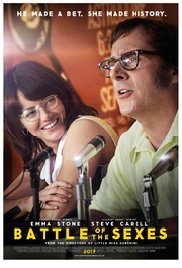
One-time men’s tennis champ Bobby Riggs (Steve Carell) was a bit of a sexist and more than a bit of a showman, and much more than a bit of a gambler. And so he bragged that even in his 50’s he could beat the top-ranked women’s player. Margaret Court accepted the challenge, and he triumphed in a humiliating defeat. And so, Billie Jean King agreed to play him in something between a sporting event and a three ring circus, complete with marching band, scantily dressed cheerleaders in Sugar Daddy outfits, and the ceremonial presentation by King to Riggs of an actual pig.

So, not your usual night on ESPN, which, of course, had not been invented yet. This was front-page news in the midst of the fight for what people were still calling “women’s liberation.” This was consciousness raising whether you liked it or not.

It is especially suitable that this film was directed by a female/male team: Valerie Faris and Jonathan Dayton (“Little Miss Sunshine”). They found the human story, the vulnerability, the drive, the fear, the resolve behind the hoopla and hyperbole, and they have made a film about real people that is moving and, even though we know the outcome of the game, suspenseful.

Bobby Riggs would have been a public feminist if he could make a dollar at it. (A dollar, by the way, is what the original players in King’s Women’s Tennis Association were paid to sign up.) He would cheerfully admit, except possibly to his wealthy wife (Elisabeth Shue), that he was more of a showman and a huckster than an athlete. Billie Jean King was a determined, disciplined athlete at the forefront of the Gloria Steinem era of feminists. She was companionably married to Larry King (not the TV show host), but she was beginning to admit to herself that she was attracted to women. Her hairstylist, Marilyn (Andrea Reisborough), leans in and brushes her hand on Billie Jean’s cheek. The woman who never allowed herself any distractions has met a distraction she cannot ignore.

Faris and Dayton create the environment of the 70’s without any air quotes. The cinematography, the score, the deft use of Howard Cosell’s actual commentary during the match (at one point, he says approvingly that King moves like a man), evoke the era without exaggeration or snottiness. Every performance shines, including Sarah Silverman in the Eve Arden wry sidekick role. The film is generous to all of its characters, even the real and metaphorical pigs.

Parents should know that this film includes sexual references and an explicit situation with some nudity, issues of sexual orientation, some crude language, alcohol, cigarettes, sexism, and homophobia.

Family discussion: What is different today and what hasn’t changed? Why did Billie Jean King decide to play Bobby Riggs?

If you like this, try: Footage of the real King/Riggs game

Related Tags:


Based on a true story DVD/Blu-Ray Pick of the Week Gender and Diversity GLBTQ and Diversity movie review Movies -- format Sports
Detroit

Detroit

Posted on August 3, 2017 at 2:10 pm

B +
Lowest Recommended Age: Mature High Schooler
MPAA Rating: Rated R for strong violence and pervasive language
Profanity: Very strong language including racist epithets
Alcohol/ Drugs: Drinking, smoking, drugs
Violence/ Scariness: Very intense and graphic violence including murder and brutal beatings, disturbing images
Diversity Issues: A theme of the movie
Date Released to Theaters: August 4, 2017
Date Released to DVD: December 11, 2017

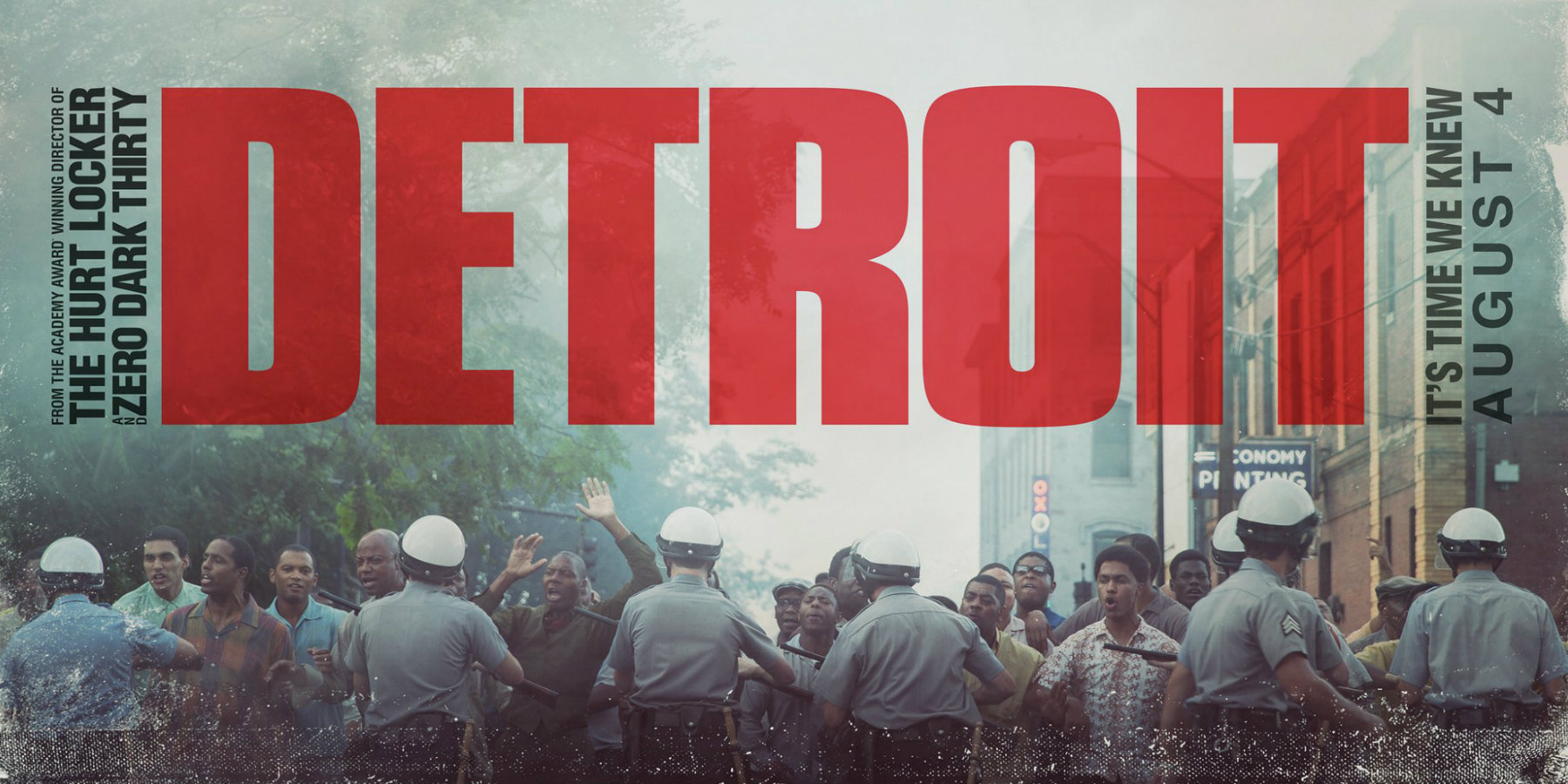
If a newspaper is the first draft of history, perhaps it is art that conveys the truth of the past with context, nuance, and power. And so “Detroit,” Kathryn Bigelow’s story of a horrifying, tragic murder of three black men during the Detroit riots of 1967, meaningfully begins with the paintings of Jacob Lawrence documenting the migration of black families from the rural South to northern urban centers and the unrest triggered by the fear and flight of the white residents. “The promise of equal opportunity for all turned out to be an illusion.  Change was inevitable.” And, for some people who were happy as things were, terrifying.

And so “Detroit,” directed by Bigelow’s and scripted by her “Zero Dark Thirty” and “The Hurt Locker” screenwriter Mark Boal aspires aspires to be art that tells the story of one incident that illuminates not only its own time but ours as well. It is based on intensive research including court transcripts and interviews with people who were there.

Television news in the 1967 featured footage of riots, with looters smashing windows, even at stores with “Soul Brother” spray-painted in hope that being owned by black neighbors would keep them safe. There was not much, if any coverage of an incident at the Algiers Motel, where white cops abused a group of young black men and two white women and murdered three unarmed teenagers. This was before the time that a bystander could record the beating of a Rodney King, and so it had to wait for the Hollywood version.

The threat of anarchy and violence was so unsettling during the Detroit riots that Lyndon Johnson sent 1100 National Guardsmen — to protect the police. The state police were there, too, and we see one officer recognize that horrible abuse is taking place, but leave, saying, “I don’t want to get in any civil rights mixup.” The pervasive chaos and fear inspires one character to say, “Now everybody knows what it’s like to be black.”

Reportedly, Bigelow encouraged her actors to develop their own dialog so it would be more authentic to their own perceptions and experience. She has a gift for conveying urgency and putting the audience in the middle of the action. The characters who take us through the story include a mild-mannered security guard (“The Force Awakens'” John Boyega), a just-returned Vietnam vet (Anthony Mackie), and a young white cop in way over his head, who has no hesitation about planting a weapon on a murder victim (“The Revenant’s” Will Poulter). It is in no way excusing his behavior to say that his behavior here is as much based on fear, anger, and ignorance as in racism.

I hope the film will not always feel as timely as it does now. If that is true, it will be in part because films like this provide context that helps us understand not only the origins of Black Lives Matter but the lives of the parents and grandparents who were unable or unwilling to tell their own stories.

NOTE: I recommend the thoughtful responses to this film from African-American critics, including Angelica Jade Bastien, who found the portrayal of brutality exploitive (“It wasn’t the relentless violence inflicted upon black bodies or the fiery devastation of the riots ripping apart Detroit but the emptiness behind these moments that got under my skin.”)

Parents should know that this film includes explicit depiction of a real-life incident of police abuse and brutality including murder of three unarmed teenagers, with rioting and looting, many disturbing and graphic images, very strong language, drinking, smoking, drugs, sexual references and brief nudity.

Family discussion: What would make you believe that justice had been done in this case? How does this story help us to understand some of today’s conflicts?

If you like this, try: documentaries about this era including “4 Little Girls,” “Eyes on the Prize,” and “12th and Clairmount”

Related Tags:


Based on a true story Drama DVD/Blu-Ray Pick of the Week movie review Movies -- Reviews Race and Diversity
Valerian and the City of a Thousand Planets

Valerian and the City of a Thousand Planets

Posted on August 1, 2017 at 4:55 pm

B +
Lowest Recommended Age: Middle School
MPAA Rating: Rated PG-13 for sci-fi violence and action, suggestive material and brief language
Profanity: Brief strong language
Alcohol/ Drugs: Alcohol
Violence/ Scariness: Extended sci-fi/action violence, guns, chases, characters injured and killed including genocide
Diversity Issues: A theme of the movie
Date Released to Theaters: July 21, 2017
Date Released to DVD: November 21, 2017

Copyright 2017 STX Films
Yes, the visuals and special effects in Luc Besson’s “Valerian and the City of the Thousand Planets” are next-level, dazzling, stunning, and themselves worth the price of a ticket (3D please). But let’s be honest. The best special effect in the movie is the lovely real face of Rihanna as Bubble, a shape-shifting alien our hero meets in an inter-galactic strip club.

That hero would be Valerian (Dane DeHaan), who has gone to the strip club in search of the disguise he needs to infiltrate an alien compound and rescue the woman he loves, his space partner Laureline (Cara Delevingne). She was captured as the two of them were on a mission to…oh, who cares what the mission was? It’s your basic save the universe stuff. You know and I know and they know you are not there for the subtleties of the space city that incorporates, “Zootopia”-style, every possible creature and culture, a veritable Pepperland of comity and the exchange of learning. In the opening scenes, we see the history of the place, as human astronauts welcome aboard an increasing variety of visitors with a warm handshake, first from other countries, and then from other planets and galaxies, still with something as close to a handshake as possible.

This is the movie Luc Besson has wanted to make since he was a teenager, base on a French comic book series from the 1960’s with a visionary aesthetic that inspired Besson’s own “5th Element” and George Lucas’ “Star Wars.” He had to wait decades until the technology made it possible to do the ravishing visuals justice. That is the good news and the bad news. The good news is that the visuals are indeed ravishing, worth a couple of viewings on the biggest screen you can find and then a couple more when you can watch it at home and hit “pause” to see every detail. The bad news is that the storyline has not held up as well over the years as the settings, in part because much of it has also been appropriated, too, over the years, partly because times have changed, and partly because it wasn’t that great to begin with. Valerian and Laureline banter back and forth about whether he can make a commitment to her as they try to save the world. It is supposed to be part of the fun of the story that they are cool and casual. Valerian even wears a Hawaiian shirt at one point instead of his spiffy spacesuit (they are undercover as tourists). But their characters are so bland, especially by contrast with the wildly imaginative world they are racing through, that it drags on the storyline. That’s disappointing because it distracts from some promising flickers of substance.

Parents should know that this film includes extensive sci-fi peril, action, and violence with many guns and blasters, characters injured and killed, sad deaths, references to genocide, corruption, brief strong language, provocative dance and references to prostitution.

Family discussion: Why do Valerian and Laureline disagree about the converter? How do you know when to break the rules?

If you like this, try: “Avatar” and “The Fifth Element”

Related Tags:


3D Comic book/Comic Strip/Graphic Novel DVD/Blu-Ray Pick of the Week Fantasy movie review Movies -- format Science-Fiction
THE MOVIE MOM® is a registered trademark of Nell Minow. Use of the mark without express consent from Nell Minow constitutes trademark infringement and unfair competition in violation of federal and state laws. All material © Nell Minow 1995-2026, all rights reserved, and no use or republication is permitted without explicit permission. This site hosts Nell Minow’s Movie Mom® archive, with material that originally appeared on Yahoo! Movies, Beliefnet, and other sources. Much of her new material can be found at Rogerebert.com, Huffington Post, and WheretoWatch. Her books include The Movie Mom’s Guide to Family Movies and 101 Must-See Movie Moments, and she can be heard each week on radio stations across the country.

Website Designed by Max LaZebnik