Men in Black International

Men in Black International

Posted on June 13, 2019 at 5:49 pm

B-
Lowest Recommended Age: High School
MPAA Rating: Rated PG-13 for sci-fi action, some language and suggestive material
Profanity: Some strong language
Alcohol/ Drugs: Drinking and drunkenness
Violence/ Scariness: Extended sci-fi/comic book style peril and violence including weapons and explosions, some graphic images
Diversity Issues: None
Date Released to Theaters: June 14, 2019
Date Released to DVD: September 9, 2019

Copyright 2019 Columbia Pictures
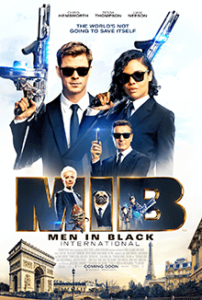
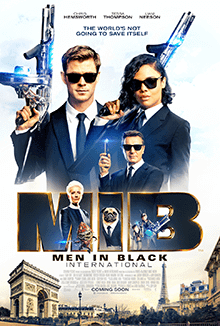
So, you watch “Thor Ragnarock” and you say, “Boy, I’d watch Chris Hemsworth and Tessa Thompson in anything!” And you watch the original “Men in Black” and you say, “Boy, this is one of the best movies ever, funny, smart, exciting, with wonderfully vivid and engaging human and non-human characters. I’d like to see more of this world.” And so, someone put it together and we have Hemsworth and Thompson taking over for Will Smith and Tommy Lee Jones, and F. Gary Gray (“Straight Outta Compton,” “The Fate of the Furious”) taking over as director from Barry Sonnenfeld, and it turns out “Men in Black International” is just okay.

For example, among the many understated, near-throwaway jokes in the first movie, we saw a bank of television monitors tracking people on Earth who are in reality aliens. Unless you were watching it on a DVD player with a pause button, you would miss most of it, but the “aliens” included “Today’s” Al Roker, singer and psychic promoter Dionne Warwick, Tony Robbins, Sylvester Stallone, and fashion designer Isaac Mizrahi. They use the same joke again, but it’s just Ariana Grande. Really? That’s the best you’ve got? Much of what made the first film such a wonder was the sense that there was a fully-imagined, world where supermarket tabloids were the only non-fake news, that somehow made more sense than the one we think of as real. It never winked at its characters or the audience. This one goes for a cheap laugh by having Hemsworth reach for a sledgehammer. He’s Thor, get it?

Thompson plays Molly, who had an alien encounter as a child and was accidentally not neuralized with the MiB’s memory eraser. She helped the fuzzy green alien escape and even learned a couple of words of its language. Since then, she has been so obsessed with learning more about the way the universe works that most people, including the man who was impressed with her record on the tests for government service, dismiss her as nutty.

By tracking an alien arrival, she sneaks into the MiB office, where the director (Emma Thompson as Agent O) agrees to take her on for a probationary period and sends her to the London office, where the top agent is H (Hemsworth), whose character seems to be based on the roles Rock Hudson played in “Pillow Talk” and “Lover Come Back,” a rakish playboy who hangs out with aliens at card games and nightclubs. While he is a legend in the office for having defeated The Hive with his then-partner, Agent T (Liam Neeson), he has pretty much checked out, sleeping at his desk and annoying his play-by-the-rules colleague, Agent C (Rafe Spall). H takes a visiting alien dignitary out for a night of drinking and debauchery but things go wrong and the alien is killed, with just enough time to pass on to Molly, now Agent M, a small object that seems to be very important, but he does not tell her why.

This fourth in the “Men in Black” series owes as much to James Bond as to its original (in both senses of the word) off-best, off-kilter, world-building story-telling. Our heroes hop around glamorous and exotic settings: Paris, London, Marrakech, a mysterious fortress on an island. Characters and incidents from the past are confronted and characters from the present may not be what they seem. A new character, voiced by “Silicon Valley’s” Kumail Nanjiani nearly steals the film with a reminder of the understated but pointed humor of the first film.

It has an awkward twist that indicates some struggles over rewrites, but H and M are so blandly conceived that even two of Hollywood’s most versatile and appealing performers can’t make them vibrant.

Parents should know that this film includes action/comic book-style peril and violence, powerful weapons, mayhem, characters injured and killed, monsters, disturbing images, some strong language, and a non-explicit inter-species sexual situation and sexual references.

Family discussion: Why did H change after his experience with the Hive? What did M want to understand about the universe and were her questions answered? Which alien was your favorite?

If you like this, try: the other “Men in Black” movies and the comics, “Guardians of the Galaxy,” and “Paul”
Related Tags:


Comedy Comic book/Comic Strip/Graphic Novel DVD/Blu-Ray movie review Movies -- format Science-Fiction Series/Sequel
The Last Black Man in San Francisco

The Last Black Man in San Francisco

Posted on June 13, 2019 at 5:34 pm

A-
Lowest Recommended Age: Mature High Schooler
MPAA Rating: Rated R for pervasive language, violence, sexual content, some drug material and brief nudity
Profanity: Very strong language
Alcohol/ Drugs: Drinking, references to drug abuse
Diversity Issues: A theme of the movie
Date Released to Theaters: June 14, 2019
Date Released to DVD: August 26, 2019

Copyright A24 2019
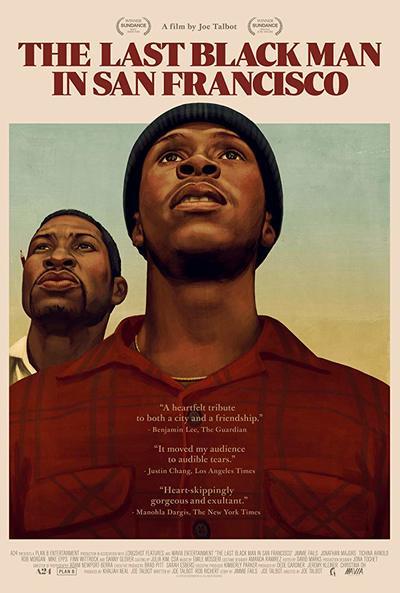
The Last Man in San Francisco” is an exquisitely filmed story about love and loss, beauty and pain. The star of the film is a young black man named Jimmie Fails, played by a writer and actor named Jimmie Fails, and the script is based on a story by Fails and director Joe Talbot, friends since childhood, based on incidents in Fails’ life.

The movie Jimmie has a best friend named Montgomery (Jonathan Majors) who lives with his blind grandfather (Danny Glover). Jimmie has been sleeping on the floor next to Mont’s bed. Every two weeks, they visit the Victorian home Jimmie’s family once lived in. Over the strong objections of the middle-aged white resident couple (she objects more than he does, but she seems to be the one with a real ownership stake), they perform small touch-ups to maintain the trim, fixtures, and garden. The middle-aged white owners see it as intrusive (and possibly as criticism). But for Jimmie, who is determined to live there again some day, it is a chance to care for the house that is a legend in his family, built by his grandfather, and a symbol of an idea of home that seems to be gone for good.

The film creates a poetic, dreamlike mood that almost floats over the story, an astonishingly assured debut that trusts the story and trusts the audience to let us fill in the details and come to our own conclusions, especially refreshing in an era of multi-national financing where specifics are smoothed over and everything has to be explained two or three times to meet the expectations of an international audience.

Instead, here, we have the infinitely expressive faces of Fails and Majors, as eloquent as any performances you will see this year. We first see them waiting for a bus that never comes, as telling a moment as the entire text of “Waiting for Godot.” So they hop on Jimmie’s ever-present skateboard, the perfect freedom of their ride in tandem in sharp contrast to the restrictions they face everywhere else. We get glimpses of what has made the house so important to Jimmie in his encounters with his father and mother, each disconnected and making clear that those relationships are not able to give him any sense of home. We see Jimmie and Mont talking to a group of guys who hang out on the street tossing insults at each other and everyone else, their only way to create a sense of camaraderie and belonging. In one of the film’s highlights, he approaches the group with his own version of the dozens — some directorial notes about the meta-impact of what is quite literally their performances.

The residents have to move out of the house and, like the characters in the film, it falls into a kind of limbo. Jimmie knows this is his moment. He retrieves his family’s furniture from his aunt, who has been storing it, and returns to what he will always think of as his home.

In a film like this, the house itself has to be a character in the story, and this one is, a grand old place with a witch’s hat roof, a library filled with vintage leather-bound classics, an organ and a piano, and all of the original architectural finishings of the era perfectly preserved. We see a Segway tour go by (led by Jello Biafra), and Jimmie correcting him about the history of the house. This is a place for dreams to come true, including Mont’s dream of writing a play. Jimmie tells him the play will be performed in the house, and they invite everyone they know.

But a treasure like this house must go to someone who can afford it, and that is not the only terrible loss in the film. While Jimmie mourns what is gone, Mont mourns with him. The depiction of a deep and tender friendship between two men who are always sad, sometimes lost, seldom angry, and always open to love and beauty, echoes movingly throughout the story and the story-telling in this unquestionable cinematic masterpiece.

Parents should know that this film includes very strong language, some violence, family tensions and dysfunction, and graphic non-sexual nudity.

Family discussion: Why are Jimmie and Mont friends? How can communities prosper without pushing out lower-income residents? What do we learn from the guys on the street? Where will Jimmie go?

If you like this, try: “Blindspotting” and “Sorry to Bother You”

Related Tags:


Drama DVD/Blu-Ray movie review Movies -- format Race and Diversity
Shaft

Shaft

Posted on June 13, 2019 at 5:25 pm

C
Lowest Recommended Age: Mature High Schooler
MPAA Rating: Rated R for pervasive language, violence, sexual content, some drug material and brief nudity
Profanity: Very strong language including the n-word and many crude terms
Alcohol/ Drugs: Drug dealing, drinking and drunkenness
Violence/ Scariness: Extended and graphic crime-style peril and violence, characters injured and killed, graphic and disturbing images
Diversity Issues: A theme of the movie
Date Released to Theaters: June 14, 2019
Date Released to DVD: September 23, 2019

Copyright New Line Cinema 2019
Cheerfully retro past the point of winking at us, through the point of smirking at us, up to the point of pushing back in favor of toxic masculinity, the new “Shaft” is an above-average summer chases, wisecracks, and shoot-out movie, thanks to its cast, its heritage, and of course the most memorable movie soundtrack theme of all time, a Grammy and Oscar winner.

Like two of the previous films in the series, this one is just called “Shaft.” The 1971 original starred Richard Roundtree, who also appeared in “Shaft’s Big Score” and “Shaft in Africa.” Then Samuel L. Jackson appeared in a 2000 film just called “Shaft,” playing the nephew of the Roundtree character. (In this film, it turns out the original Shaft was not his uncle but his father.) This “Shaft” brings the story up to the present day, with Roundtree and Jackson returning to their roles and the third generation, J.J. (for John Junior), played by Jessie T. Usher (“Survivor’s Remorse”).

The first Shaft film, based on a tough with the bad guys/catnip for the ladies private investigator in the novels of Ernest Tidyman, was among the best of the “Blaxploitation” films of the 1970’s.

The character in the book is white, but director Gordon Parks cast Roundtree, to “see a black guy winning,” and, toward the end of the Civil Rights movement era, that gave audiences a hero that had not been seen before, a strong, confident, supremely capable black man who operated by his own set of rules and applying his own form of justice. This had enormous appeal in an era where pretty much the only black actor in films was Sidney Poitier, who nearly always played characters who were near-saintly, designed to appeal to white audiences. Shaft did not care about appealing to or appeasing anyone. In the words of a black politician of the era named Shirley Chisolm, he was “unbought and unbossed.” He exemplified Hollywood cowboy-style notions of masculinity, supremely secure in his own power and control, and in the context of the movie that included his relationships with women, if using them as sexual objects could be characterized as a relationship.

Director John Singleton’s 2000 version with Jackson was an affectionate tribute to the original. Shaft is first seen as working for The Man as a police officer, but he quits in disgust and sets up an office as a private investigator. As this film begins, it is 1989 and Shaft (Jackson) is arguing with his significant other (Regina Hall) in a car when a gunfight breaks out. “This time it’s different,” she tells him, after it is all over and he’s the last man standing. In the back seat of the car is a baby. She knows that in order to keep their son safe, she will have to leave him.

The ensuing years are amusingly zipped through in a montage with pauses for the occasional and always-inappropriate gifts Shaft sends to JJ, wrapped in plain brown paper, including a box of condoms when he is 10 and a collection of porn when he is leaving for college at MIT. After graduation, JJ works as a data analyst at the FBI, where he is frustrated at not being assigned to take the lead on big cases like a possible terrorist cell at a local mosque. He lives in a tastefully furnished apartment with a Lord of the Rings poster on the wall and lacrosse sticks over his bed. He treats women with respect — with so much respect he has not been able to get out of the friend zone with Sasha (Alexandra Shipp), a doctor he has known since he was a child. He does not like guns, but he has mad skills as a hacker.

When another childhood friend, a Muslim veteran named Karim, is found dead from an overdose, JJ thinks it is murder, and he visits his father for the first time to ask for his help. A naked stripper covered with glitter answers the door, and Shaft appears with glitter in his beard. This is supposed to be funny and to convey how manly he is. Anyway, he agrees to help, and we’re suddenly in a buddy cop movie, with senior bashing junior every step of the way for not being many enough and junior giving it back about his not having been there as a dad. Much of that happens as they are being chased, shot at, or fought with, including the inevitable scene at a nightclub, with a dance/fight that puts the “tip” in “tipsy” and is actually pretty fun.

Someday people will look back on this movie as an exemplar of its moment. The exaggerated masculinity of 1971 may have been humorous and empowering, but in 2019 it seems creaky and skeezy, especially when JJ finally picks up a gun and the strong, capable female character suddenly melts into a puddle of adoration. It’s too soon to be a parody, too late to be ignored. The exaggerated bravado makes them seem fragile and over-compensating.

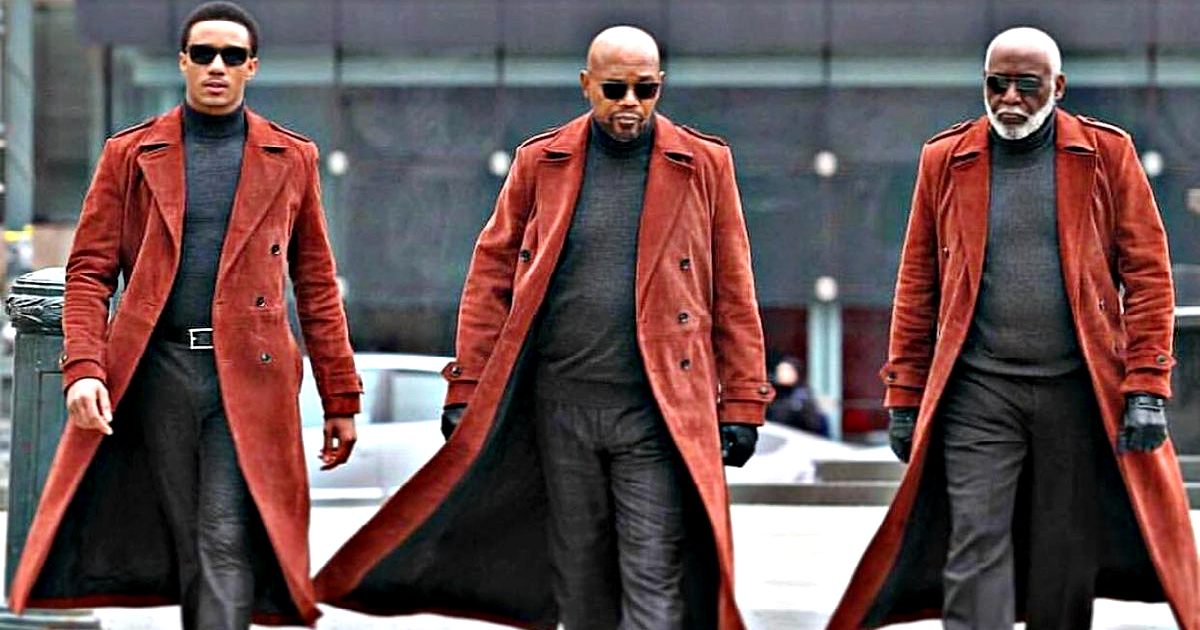
I admit, though, that Hayes theme still makes me melt into a puddle, and it is fun to see the three generations striding without regard to the oncoming cars in their shades and long coats. While it does not succeed in the same terms as the original or as an affectionate update, there are moments when it is an entertaining popcorn movie with appealing performances, when I can dig it.

Parents should know that this film has a lot of intense, graphic peril and violence including shoot-outs fights, and torture, with many characters injured and killed and some graphic and disturbing images. Characters use strong and crude language, including the n-word and the p-word, and there are vulgar sexual references, homophobic and transphobic jokes, and nudity, with a casually exploitive attitude toward women and a prove-it notion of masculinity. The movie also includes drinking and drunkenness and drugs and drug dealing.

Family discussion: Why wasn’t JJ a field agent? Why was his father so dismissive of his clothes and apartment? How do the Shaft movie’s attitude toward women and masculinity hold up today?

If you like this, try: the earlier “Shaft” movies and “Jackie Brown”

Related Tags:


Action/Adventure Crime DVD/Blu-Ray movie review Mystery Race and Diversity Series/Sequel
Dark Phoenix

Dark Phoenix

Posted on June 6, 2019 at 4:42 pm

C
Lowest Recommended Age: Middle School
MPAA Rating: Rated PG-13 for intense sequences of sci-fi violence and action including some gunplay, disturbing images, and brief strong language
Profanity: Some strong language, one f-word
Alcohol/ Drugs: None
Violence/ Scariness: Extended comic-book action peril and violence with some disturbing graphic images, guns, explosions, superhero fights, characters injured and killed
Diversity Issues: A theme of the movie
Date Released to Theaters: June 7, 2019
Date Released to DVD: September 16, 2019

Copyright Disney 2019
The Marvel Avengers movies showed surprising range for very different characters operating in a single universe, from the outright comedy of “Thor Ragnarok” and “Guardians of the Galaxy” to the “Captain America: Winter Soldier” hark back to the political paranoia films of the 1970’s, the grappling with historical divides and cultural identity in “Black Panther” and the existential issues of “The Hulk.” But “Dark Phoenix,” this latest entry in the not (yet) integrated X-Men franchise, also based on Marvel comics, veers unwisely into a genre best left out of the superhero category: soap opera.

In this version of the X-Men universe (don’t try to tie it too closely to the original series or we would have to try to understand how Professor X and Magneto could age several decades in seven years, not to mention several other major disconnects), Jean Gray is brought by Professor X (James McAvoy) to his school, a sort of Hogwarts for mutants, when she is a child. Devastated by the loss of her parents in a car accident and terrified by powers she does not understand or control, she at first refuses. Professor X assures her that he can fix whatever she breaks, and that she herself is not broken. Note that just before the car flips over and crashes, which Jean survives without a scratch, the radio plays two significant songs: “By the Time I Get to Phoenix” and “Werewolves of London.” The first is a reference to the regenerating mythical bird that will give Jean her new nom de superhero/persona. The second is likely a nod to Jean’s relationship with Wolverine, otherwise not referred to in this film.

By the time Jean grows up (played by “Game of Thrones'” Sophie Turner), she is in a strong romantic relationship with Cyclops (Tye Sheridan) and very much a part of the group of young adult X-Men. (Raven/Mystique, played by Jennifer Lawrence, points out that the women have been saving the men so often they should consider changing the name to X-Women). The team goes on their first mission to outer space, to rescue a crew of American astronauts. Jean is almost killed, but is exposed to and possibly saved by some mysterious cosmic radiation. She says she is fine and nothing shows up in a quick medical examination, but later that day she faints, and when she is tested again, her powers are literally off the charts. As in, so far past anyone else they need to build a new machine to measure.

Whatever she has learned from the trust, guidance, and support of Professor X dissolves as the new powers bring back the same feelings of guilt, shame, defiance, and being out of control that we saw in her just before her parents’ car flipped over. She will try to find answers from her past, including a visit to the secret place where Magneto (Michael Fassbender) and his team are hanging out, a hidden safe zone that is off the grid.

As in all X-Men movies (and in last week’s “Godzilla” except with monsters), the core tension is between those who want to find a way for humans and mutants to live together in peace and mutual support (astronaut rescue!) and those who want to wipe each other out. This war seems to be going on inside of Jean, as she discovers that her real and substitute fathers lied to her and as she fears she will not be able to control her new powers.

Meanwhile, some aliens have landed and taken over human bodies. Their leader (Jessica Chastain) is searching for Jean to help them take over the planet. It is a shame to see this versatile, classically trained actor relegated to one of those roles where all of her lines are recited in the same languid but threatening monotone and her superpowers is primarily striding around in stilettos without mussing her impeccably shaped blonde hair.

The action scenes are capably staged, but the non-action scenes are close to inert and some of the special effects look cheap and insubstantial. Can we just all agree never to ask an alien character to say that emotions make humans weak? This is a disappointing placeholder that suffers by comparison with the vastly more dynamic and imaginative superhero movies we’ve already seen this year.

Parents should know that this film has extended fantasy/comic-book peril and violence with characters injured and killed and some disturbing and graphic images including characters being impaled, shot, and dissolved, and some strong language including one f-word.

Family discussion: Why did Professor X lie to Jean? Did he “fix” her? Would you like to have Jean’s powers and what would you do if you had them?

If you like this, try: the “X-Men” movies and comics and “Captain Marvel”

Related Tags:


Action/Adventure Comic book/Comic Strip/Graphic Novel DVD/Blu-Ray Fantasy movie review Movies -- format Series/Sequel Superhero
Rocketman

Rocketman

Posted on May 30, 2019 at 5:42 pm

B +
Lowest Recommended Age: Mature High Schooler
MPAA Rating: Rated R for language throughout, some drug use and sexual content
Profanity: Very strong language
Alcohol/ Drugs: Extended substance abuse including drugs and alcohol
Violence/ Scariness: Suicide attempt, family issues
Diversity Issues: A theme of the movie
Date Released to Theaters: May 31, 2019
Date Released to DVD: August 26, 2019
Copyright 2019 Paramount

Elton John strides purposively down a corridor dressed in what looks like devil costume for Liberace’s Halloween party. But he is not moving toward a stage or recording studio. He is not going to sing or compose. He is going to tell his story to a different kind of audience, a support group in a drug rehab facility. And to us.

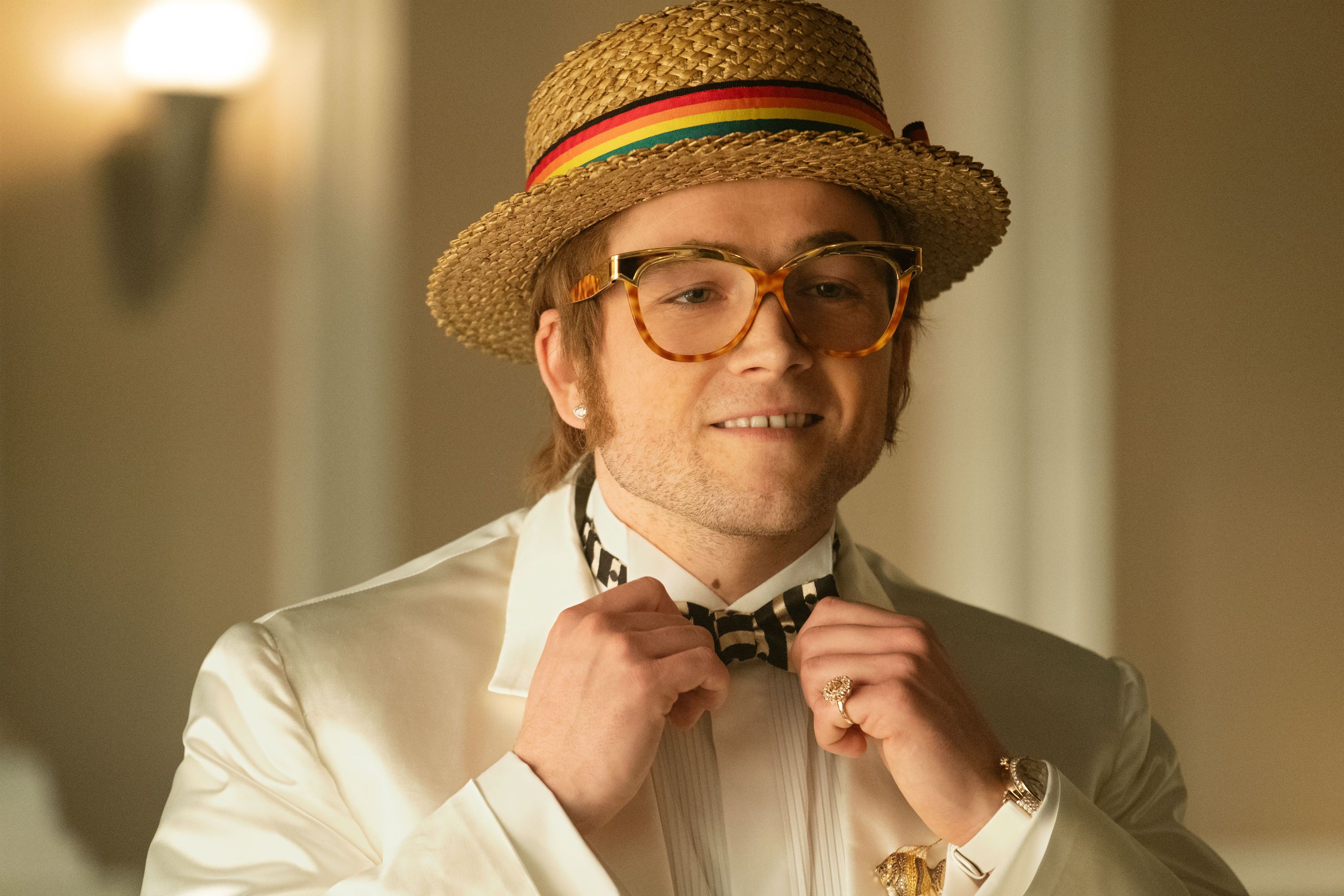
Rocketman,” produced by Sir Elton himself, is a sometimes-impressionistic retelling of the classic VH1 “Behind the Music” story of sex, drugs, and rock and roll. Instead of “and then I wrote” with a chronological rehash of hits, celebrity encounters, romantic ups and downs, and AA-style amends, it is a dramatic version of a jukebox musical, with full-on dance numbers and songs that match the mood of the moment. Director Dexter Fletcher, who also finished up “Bohemian Rhapsody” after the original director was fired, wisely uses the more flamboyant elements of the story as a backdrop and keeps the camera focus on Taron Egerton (the “Kingsman” movies and “Eddie the Eagle,” also directed by Fletcher). He makes us see the energy and magnetism of Sir Elton as a performer, but it is in the most intimate close-ups that we see Sir Elton the person, vulnerable, scared, and longing to be truly accepted.

As Sir Elton tells his story to the support group, he removes the costume, a piece at a time (the horns come off first), and he reveals his own layers as well, starting with the child then known as Reg Dwight (an impressive Matthew Illesley), who lives with his distant father (when Reg asks for a hug, his father says, “Don’t be soft.”) and his self-involved mother (Bryce Dallas Howard), and his kind-hearted grandmother (Gemma Jones). Reg’s musical gifts are evident immediately; he can play anything he hears. He gets a scholarship to the Royal Academy of Music (his grandmother takes him there when his mother can’t be bothered).

And then he hears Elvis, and it’s all about rock and roll. His band plays back-up for touring American acts, and he changes his name (“Elton” was nicked from a bandmate; in the movie John comes from John Lennon but in real life it was from his mentor, “Long John” Baldry). And then he answers an ad for singers and songwriters and, when he says he composes and does not write lyrics, an unopened envelope is handed to him and it turns out to be from Bernie Taupin (Jamie Bell of Billy Elliot and Film Stars Don’t Die In Liverpool). They form a close working and personal relationship.

And then there is the breakthrough performance at LA’s legendary Troubadour club. The future Sir Elton at first refuses to leave the bathroom when he hears that musical legends are in the audience: some of the Beach Boys, Leon Russell, Neil Young. But then he comes on stage and it is magical. We see him, and then the audience literally float up into the air, an exquisitely lovely moment that perfectly translates the euphoria of the performance.

Then there is a troubled romantic and professional relationship with a new manager (smoldering Richard Madden as John Reid) and unimaginable excess as he still struggles for acceptance from his parents. In a particularly wrenching scene Sir Elton sees his father, who will not see him perform, warmly affectionate with the children of his second wife. As we return to the scene at rehab, we see him finally able to accept the love he so desperately wants.

Egerton showed us in the “Kingsman” movies that he has what it takes for the performative side of this story, but this is the first time we have had a chance to see just how sensitive and subtle an actor he is. There are moments when we can see three or four different emotions on his face at once, as in his phone call to his mother to tell her he is gay or when he is mesmerized, terrified, and flickering back and forth between being open and hiding his feelings with Reid.  In one split second he goes from drugged-out, depressed, and anxious back stage to full-on rock star as he walks out toward the audience.  It is hard to imagine there will be a better performance on screen this year.

Sir Elton wanted the focus of this story to be on his personal life and his feelings, interpreted by the music, rather than his story as a composer and performing artist. For that, of course, we have Sir Elton himself, his music videos and recordings of his live performances, and the songs which over decades have said so much.

Parents should know that this movie includes extensive substance abuse, a suicide attempt, family dysfunction, addiction issues, sexual references and situation, and very strong language.

Family discussion: What person did he want to be? Which is your favorite Elton John song? How do you like this more subjective form of storytelling?

If you like this, try: the music of Elton John and other real-life stories of musicians including “Bohemian Rhapsody,” “Coal Miner’s Daughter,” and “Walk the Line”

Related Tags:


Based on a true story Biography DVD/Blu-Ray movie review Movies -- format Musical
THE MOVIE MOM® is a registered trademark of Nell Minow. Use of the mark without express consent from Nell Minow constitutes trademark infringement and unfair competition in violation of federal and state laws. All material © Nell Minow 1995-2026, all rights reserved, and no use or republication is permitted without explicit permission. This site hosts Nell Minow’s Movie Mom® archive, with material that originally appeared on Yahoo! Movies, Beliefnet, and other sources. Much of her new material can be found at Rogerebert.com, Huffington Post, and WheretoWatch. Her books include The Movie Mom’s Guide to Family Movies and 101 Must-See Movie Moments, and she can be heard each week on radio stations across the country.

Website Designed by Max LaZebnik