Hunter Killer

Hunter Killer

Posted on October 25, 2018 at 5:44 pm

B
Lowest Recommended Age: Mature High Schooler
MPAA Rating: Rated R for violence and some language
Profanity: Some strong language
Alcohol/ Drugs: None
Violence/ Scariness: Extensive military action, peril, and violence, guns, explosions, many characters injured and killed
Diversity Issues: None
Date Released to Theaters: October 26, 2018
Date Released to DVD: January 27, 2019
Copyright 2018 Summit Premiere

Submarines provide instant drama because they are as closed off from the rest of the world as it is possible to be in the era of instant global communications. The officers have to make life and death decisions not only for themselves but sometimes for the whole world with limited information and ability to get orders from their commanders. They are stuck with each other in a setting that combines the maximum of isolation with the highest of stakes. That is why there are so many memorable submarine movies, from “The Hunt for Red October” to “Crimson Tide” to “U-571,” “Das Boot,” and even “20,000 Leagues Under the Sea.” There are also often fascinating details about the technology involved. And that is why Gerard Butler‘s latest movie about saving yet another world leader from personal and geopolitical catastrophe, “Hunter Killer,” holds our interest, despite the preposterousness of the plot.

The president of Russia has been kidnapped in a coup, and according to this film the only chance of rescue is up to the US Navy Seals and the captain of a US Navy submarine. If you can get on board with that idea, the mechanics and action should keep you on board through the end.

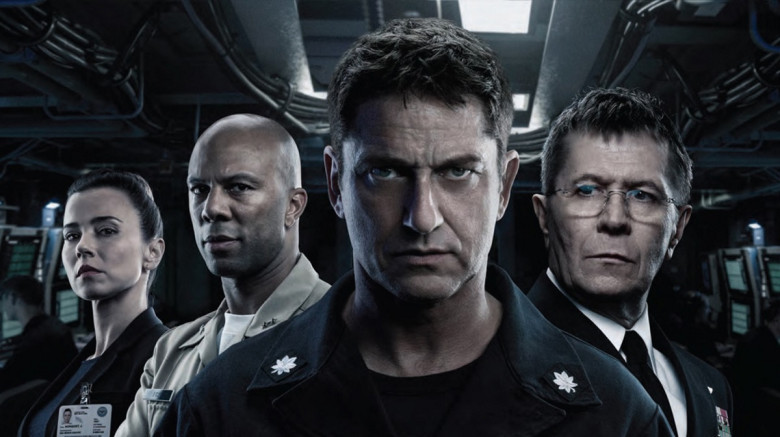
Butler plays Captain Joe Glass and we know he is a good guy because we first see him about to shoot a deer with a very manly bow and arrow but then decide not to when he sees the deer’s sweet mate and their baby. We see he is scrappy and tough but fair as he introduces himself to his new crew. He explains that he is not one of those fancy-pants Annapolis grads who learned what they do in a classroom. He’s an up-from-the bottom scrapper who will demand the best because he has had their jobs and knows what is possible.

It is really three movies in one as four Navy Seals enter Russia, first to get intel, and then, after their cameras reveal the coup, to rescue the kidnapped Russian president, the top brass in the Pentagon, including a skeptic (Gary Oldman), an intelligence officer (Linda Cardellini), and the decent guy trying to hold it together (Common), and then the attack sub led by Captain Glass. The other name for an attack submarine is hunter-killer.

The action scenes are powerfully staged, with outstanding sound and visual effects. And the film skillfully balances the big booms with the small moments between the (mostly) men. The film’s most compelling scene is when Glass has to find a way to gain the trust of a Russian captain (the late Michael Nyqvist, showing canny grizzled wisdom) very quickly and the two men recognize that they have more in common with each other than they ever will with the guys back home giving them orders based on politics and computer screens. Toby Stephens is also excellent as the leader of the Navy Seals.

There’s a lot of tech talk and tough talk and thousand yard stares. But there’s also some impressive action and a storyline that, let’s face it, is no more outlandish than current headlines and much more satisfying.

Parents should know that this film includes extended military peril and violence, guns, bombs, explosions, kidnapping, political coup, characters injured and killed, a brief crude reference, and strong language.

Family discussion: What difference did it make that Captain Glass had served as a crewman? What made the Russian and American captains trust each other?

If you like this, try: “Under Siege” and “The Hunt for Red October”
Related Tags:


Action/Adventure DVD/Blu-Ray movie review Movies -- format
Can You Ever Forgive Me?

Can You Ever Forgive Me?

Posted on October 25, 2018 at 5:23 pm

B
Lowest Recommended Age: Mature High Schooler
MPAA Rating: Rated R for language including some sexual references, and brief drug use
Profanity: Pervasive strong language
Alcohol/ Drugs: Alcohol and drug abuse
Violence/ Scariness: Tense emotional confrontations
Diversity Issues: None
Date Released to Theaters: October 26, 2018
Date Released to DVD: February 18, 2019

Copyright 2018 Fox Searchlight
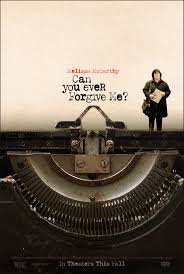
It is important to note that it is not Lee Israel (Melissa McCarthy) who is asking for forgiveness in “Can You Ever Forgive Me?” It is the acerbically witty Dorothy Parker, author of a jaunty poem about the downsides of the various options for committing suicide that ends “You might as well live.” Okay, it is not exactly Dorothy Parker. It is Israel pretending to be Dorothy Parker. Lee Israel, best-selling author of popular and respected biographies of mid-century celebrities Dorothy Kilgallen and Tallulah Bankhead found herself desperate for money — and for some sense of a place in the world — when her next biography flopped and no one would work with her. The book’s failure with the critics and the public was only part of the reason. Lee Israel had become a bitter and unpleasant person and, both cause and effect, she had also become an alcoholic.

And so, instead of immersing herself in the lives of those more talented and successful to write about them, she immersed herself in the lives of famous authors to write for them. After a chance opportunity to steal and sell a genuine piece of correspondence, she began to forge others. Collectors love to own signed letters from their favorite writers, and Lee Israel loved writing them and getting away with it. She even went out and bought vintage typewriters and mastered the art of duplicating their signatures. At last, she is a successful writer again!

Well, for a while.

The movie is uneven, sometimes sordid, as Lee and her only friend, Jack Hock (Richard E. Grant) go from genteel poverty to near-squalor. Uncomfortably, the movie seems to suggest near the end that all of this had some merit as a way for Israel to find her own voice. After she was caught and after her guilty plea, she wrote another book, the basis for this film, finally in her own voice, telling her own story.

The performances are what make the movie worth seeing. Every one of them is a gem. McCarthy and Grant show us the flickers of raw honesty from near-feral people who mostly cannot bring themselves to acknowledge how far they are from where they think they deserve to be. Dolly Wells, as the trusting soul who purchases some forged letters, Jane Curtain as Israel’s businesslike but not unkind agent, and Anna Devere Smith in a knockout of a scene as Israel’s ex are all thoughtful, nuanced, committed, and compelling.

In Israel’s forged Dorothy Parker letter, “Can you ever forgive me?” is coy, self-consciously self-mocking, but mocking the recipient, too. That is the voice of Israel, too, and even an actor as irresistible as McCarthy cannot make us feel sympathetic for her.

Parents should know that this film includes pervasive very strong language, sexual references and non-explicit situations, drinking and alcoholism, drugs, and criminal activity including fraud and theft.

Family discussion: Why was Lee proud of the letters she forged? Why was it hard for her to get along with people? What do we learn from Elaine?

If you like this, try: Lee Israel’s books and “84 Charing Cross Road”

Related Tags:


Based on a book Based on a true story Drama DVD/Blu-Ray movie review Movies -- format
Beautiful Boy

Beautiful Boy

Posted on October 18, 2018 at 5:18 pm

B +
Lowest Recommended Age: High School
MPAA Rating: Rated R for drug content throughout, language, and brief sexual material
Profanity: Very strong language
Alcohol/ Drugs: Extended and explicit substance abuse
Violence/ Scariness: Tense family confrontations, peril, serious medical issues
Diversity Issues: None
Date Released to Theaters: October 19, 2018

Copyright Amazon Studios 2018
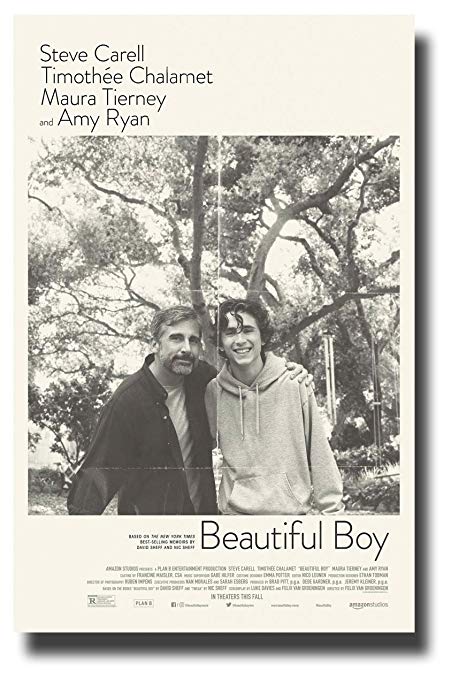
Timothee Chalamet gives one of the most sensitive and compelling performances of the year in “Beautiful Boy,” based on the books by journalist David Sheff (Beautiful Boy: A Father’s Journey Through His Son’s Addiction) and his son Nic Sheff (Tweak: Growing Up on Methamphetamines). The story is a conventional tale of a prodigal son almost lost to drugs, but Chalamet’s performance is extraordinary, more than fulfilling the promise he showed last year in “Call Me By Your Name.”

While both books formed the basis for the film, most of it is from the perspective of the father, David (Steve Carell), who lives in a dream of a home in Marin County with his artist/earth mother of a second wife (Maura Tierney, great as always) and two angelic small children. David lives a dream writer’s life, with profiles of the world’s most accomplished and interesting people in publications like Rolling Stone. He has a warm, loving relationship with his son from the first marriage, Nic (Chalamet). Perhaps because he likes to think of himself as young and does not want Nic to think of him as out of touch, perhaps because he and Nic’s mother are divorced and he wants to make sure his time with his son is pleasant, perhaps because he is too indulgent, when Nic offers him some weed, he laughs and takes a couple of hits. After all, Nic is doing so well in school and is so gifted and so, well, beautiful (even Chalamet’s stunning performance cannot distract us from the wonder of his hair), and it’s a beautiful day, so why not?

David does not know that Nic has gone past some recreational marijuana use. He is addicted to methamphetamines, and as we will learn from the expert David consults (Timothy Hutton), that drug changes the brain chemistry to make the addiction especially intractable. Apparently he has not been truthful about why he is there. The doctor thinks it is for a magazine story. But when David explains he is there for personal reasons, the doctor is sympathetic. David says he has just two questions: What is this doing to Nic and how can he help? Both answers are far from what he had hoped.

The movie goes back and forth in time, intended to show us David’s painful memories of happier times and his increasing understanding of how little he can do to fix this problem. But it gets discursive and distracting, making it difficult for the story to gain momentum.

And it never gets past the privileged, secular version of revival meeting testimony, another “was blind but now I see” story of a prodigal son who hit bottom, then went lower, then went even lower, and then found his way home, in part because he was born into a family that made it possible to treat his addiction as youthful folly and a medical problem and not a crime.

Carell is very good as the anxious, frustrated, and embarrassed father, who keeps trying to insist that he and Nic were closer than most fathers and sons, and that “this is now who we are” until he has to admit that this is exactly who they are. But it is Chalamet who takes this out of the category of just another Lifetime movie about heartbreak in suburbia. While the movie goes back and forth in time, Chalamet is always astonishingly precise about where Nic is on his slide to the bottom, whether he is strung out, in denial, trying to manipulate his family, terrified, or just whacked out of his head. It’s a dozen performances in one, each one a complex, beautifully observed portrait.

It is too bad it is not in a better movie. Perhaps because it tries to cover both books, it lacks focus. What is the lesson here? That parents have to accept that they cannot fix their children? That this country needs a better drug policy? Most likely it is that if you’re going to be a teenage drug addict, it’s better to be from a white family with money to pay for repeated stints in rehab.

Parents should know that this film focuses on drug addiction, with extensive and explicit substance abuse, strong language, medical issues, and sexual references and a situation.

Family discussion: Could Nic’s parents have done anything different to help him? How do the lyrics of the title song help to explain the movie’s themes?

If you like this, try: “thirteen,” “Ben is Back,” and “Augusta Gone”

Related Tags:


Based on a book Based on a true story Drama Family Issues Illness, Medicine, and Health Care movie review Movies -- format Movies -- Reviews
Goosebumps 2: Haunted Halloween

Goosebumps 2: Haunted Halloween

Posted on October 12, 2018 at 1:00 pm

B
Lowest Recommended Age: 4th - 6th Grade
MPAA Rating: Rated PG for scary creature action and images, some thematic elements, rude humor and language
Profanity: Some schoolyard language
Alcohol/ Drugs: None
Violence/ Scariness: Extended action-style fantasy/mild horror peril and violence, creepy creatures. boo-scares
Diversity Issues: None
Date Released to Theaters: October 12, 2018
Date Released to DVD: January 14, 2019

Copyright 2018 Columbia
My review of Goosebumps 2: Haunted Halloween is on rogerebert.com.

The first “Goosebumps” movie was a lot of fun, with Jack Black playing real-life author R.L. Stine, whose hundreds of spooky-fun books for tweens have sold hundred of millions of copies. This sequel, with only a brief appearance by Black, is blander, with lower-wattage talent on and behind the screen. But the special effects are still top-notch and it is a pleasant little scare-fest for the Halloween season.

Parents should know that this film includes extended spooky-scary content with scary monsters, ghosts, witches, boo-scares, peril, action/cartoon-style peril and violence, some potty humor and schoolyard language.

Family discussion: Which is the scariest monster in the movie? Why do people like scary movies?

If you like this, try: “Monster House” and “Paranorman” and the Goosebumps books and first film

Related Tags:


Based on a book Comedy DVD/Blu-Ray Fantasy movie review Movies -- format Series/Sequel Stories About Kids Stories about Teens
First Man

First Man

Posted on October 11, 2018 at 5:54 pm

B +
Lowest Recommended Age: Middle School
MPAA Rating: Rated PG-13 for some thematic content involving peril, and brief strong language
Profanity: Brief strong language
Alcohol/ Drugs: Alcohol and smoking
Violence/ Scariness: Intense peril, characters injured and killed, sad death of a child
Diversity Issues: None
Date Released to Theaters: October 12, 2018
Date Released to DVD: January 21, 2019

Copyright Universal 2018
On September 12, 1962, nine months after his inauguration, President John F. Kennedy issued a daunting challenge to America, already behind the Soviet Union in the space race. He promised to send a man to the moon before the end of the decade so that the first trip to space would not be “governed by a hostile flag of conquest, but by a banner of freedom and peace.” He said,

We choose to go to the moon in this decade and do the other things, not because they are easy, but because they are hard, because that goal will serve to organize and measure the best of our energies and skills, because that challenge is one that we are willing to accept, one we are unwilling to postpone, and one which we intend to win, and the others, too.

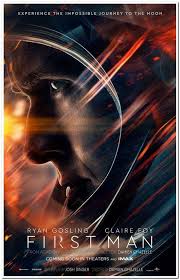
The extraordinary story of the space race that followed has been covered by many books and movies. But none have taken us so literally inside the trip to the moon like “First Man.” Ryan Gosling, working with his “La La Land” director Damien Chazelle, plays Neil Armstrong, the first man to walk on the moon. Gosling is one of the few actors who could bring such humanity to the famously reserved Armstrong. Chazelle wisely spends much of the movie focusing on Gosling’s face, and he conveys infinite courage, integrity, and dedication, and more. Armstrong did not talk about the tragic loss of his toddler daughter to cancer. When he is asked about whether it affected him in his interview for the space program, he answers calmly that it would be impossible not to be affected. But we see so much in the way he touches her hair, and in the way he thinks of her in an important moment near the end of the film.

When we think of space travel, we tend to think of spacious flying machines like the Enterprise or the Millennium Falcon, with sleeping chambers and holodecks and chess games. This movie takes us inside the actual space capsule, all built with practical (real-life) effects, not CGI and it’s as though they launched a metal container the size of a car trunk with an atom-bomb-fueled catapult, in a process that shakes it up like a paint can at the hardware store. We can feel the pressure on the screws as they jiggle and threaten to pop. And we hear — wow, the sound design in this film, from Ai-Ling Lee — the hum, the rattle, the breathing. Armstrong is always strong, contained, and capable, but this movie gives us the intimacy and vulnerability around him. One of the film’s most powerful scenes is the fire that killed the Apollo 1 crew. A small puff of smoke through the hatch is more telling than a special effects inferno.

We see the modest simplicity of the Armstrong’s home as well, slightly more comfortable once they are in the space program and living near the other astronauts. Claire Foy is outstanding as Janet Armstrong, a very traditional mid-century suburban wife but in her own way as honest and determined as her husband. She insists that he sit down with their sons before the moon voyage to answer their questions about the dangers he was facing.

There are a number of nice touches that remind us of some of the other work that was going on. The interviews touch on the selection process shown in “The Right Stuff.” Kyle Chandler as astronaut chief Deke Slayton draws an illustration that takes two blackboards, an indicator of the unprecedented calculations shown in “Hidden Figures.” The calm, analytical response to unexpected peril reminds us of “Apollo 13.” It is not so much, as in that film, that failure is not an option. What Armstrong says in this film is, “We fail here so we will not fail there.”

“First Man” puts us inside one of the greatest explorations in human history, respecting the technical achievements and the breathtaking scope of the vision, but always keeping it real and personal. Archival footage of people reminding us that many Americans thought that the money for the space program would be better spent in solving the problems at home remind us that arguments about priorities have been around as long as people have had impossible dreams. And this movie reminds us that sometimes impossible dreams should be a priority, too.

Parents should know that this film includes severe risk and peril with characters injured and killed, a very sad death of a child, disturbing images, some strong language, smoking, and drinking.

Family discussion: What made Neil Armstrong the right man for this mission? What do we learn by the way he responds to danger? Why did he bring something special to leave on the moon?

If you like this, try; “Apollo 13,” “The Dish,” and the excellent HBO series produced by Tom Hanks, “From the Earth to the Moon

Related Tags:


Based on a true story Drama DVD/Blu-Ray movie review Movies -- Reviews
THE MOVIE MOM® is a registered trademark of Nell Minow. Use of the mark without express consent from Nell Minow constitutes trademark infringement and unfair competition in violation of federal and state laws. All material © Nell Minow 1995-2026, all rights reserved, and no use or republication is permitted without explicit permission. This site hosts Nell Minow’s Movie Mom® archive, with material that originally appeared on Yahoo! Movies, Beliefnet, and other sources. Much of her new material can be found at Rogerebert.com, Huffington Post, and WheretoWatch. Her books include The Movie Mom’s Guide to Family Movies and 101 Must-See Movie Moments, and she can be heard each week on radio stations across the country.

Website Designed by Max LaZebnik