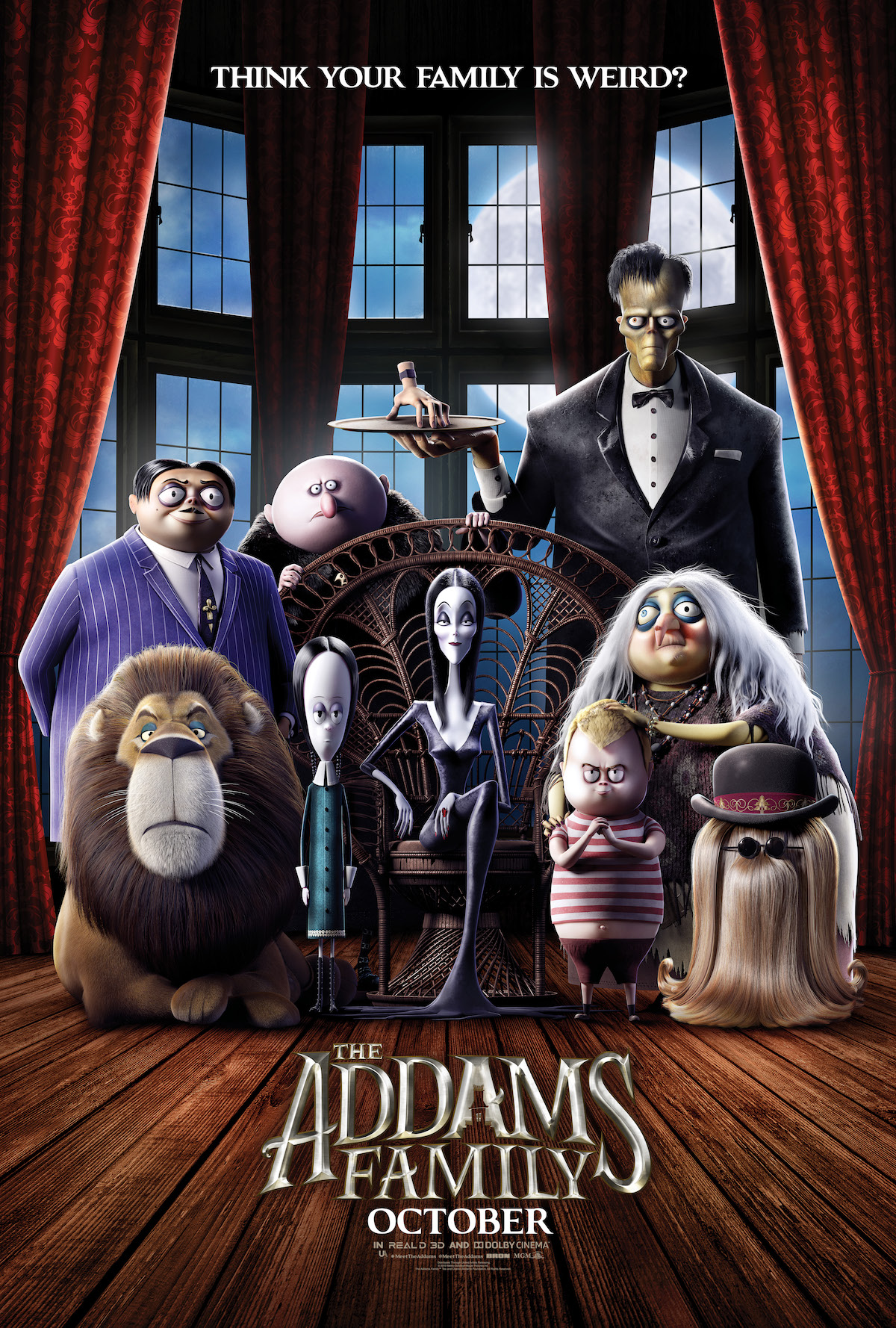
There are about half a dozen bright spots in the new animated feature “The Addams Family,” but in between them is the unbright and unoriginal storyline about how the real monsters are the ordinary people, not the weird people.
Parents should know that this film includes monsters and peril. It is more funny-scary than scary-scary but there are some images that might disturb sensitive viewers, as well as comic/action-style peril with no one hurt, bullies, a neglectful parent, potty humor. Some may be disturbed by a casual portrayal of child who decides to live with a different family
Family discussion: Which characters are really scary? What does “assimilation” mean? What does your family do to recognize adulthood?
If you like this, try: “Hotel Translyvania,” “Igor,” and the “Addams Family” television books, series and films
Copyright 2019 Warner Brothers“Joker” tries hard to be dark, disturbing, and meaningful. It is dark, but it is sour, superficial and gross, the darkness not especially significant and therefore not especially meaningful. Its call-outs to past and current real-life events and other movies are not illuminating in any way; they just seem like training wheels borrowed to keep the movie from falling over. And we’re stuck once again with the tired trope of disability leading to criminality.
One of the highest compliments an actor can give another actor is “committed.” And for sure Joaquin Phoenix is fully committed to the role of Arthur Fleck, a clown for hire and would-be stand-up comic who experiences repeated abuse and betrayal. After he is fired, learns a family secret, and then is cut off from counseling and medications, he spins out of control.
This is a non-canonical version of the origins of Joker, not connected to any of the previous depictions of the character in comics, movies, or television. In this version, Gotham resembles the New York City of the 70’s, when the city was teetering on financial insolvency. As it opens, they are in the midst of a garbage strike. Piles of trash are everywhere and large rats are running through the streets. Arthur is twirling an Everything Must Go sign in front of a store that is going out of business. Some boys grab the sign and, when he chases after them into an alley, they beat him with the sign until it shatters. Later, Arthur’s boss takes the cost of the sign out of his pay. Yeah, this movie is not subtle. The boys beat Arthur with the sign and the movie beats us with the metaphors.
Arthur lives in a squalid apartment building with his frail mother (Frances Conroy), and he cares for her tenderly. bringing her food, giving her baths, and sharing their favorite television shows including a late night talk show hosted by Murray Franklin (a badly miscast Robert De Niro). Arthur dreams of being on the show.
Arthur’s mother always told him his purpose in life was to make people happy. And he tries hard. He makes funny faces to get a toddler to laugh on a bus, but the child’s mother snaps at him. He gets fired for bringing a gun to the hospital where he is entertaining sick kids. He struggles with mental illness that undermines his grip on reality and a nervous condition that causes grotesque involuntary laughter when he is under stress. He has a little laminated card he hands out to explain this unsettling symptom to bystanders.
His fragile support system unravels. He loses his job. The city cannot afford a social safety net, so even the haphazard counseling he has been getting is cut off and he no longer has access to the seven different psychotropic medications. He loses his job. He feels betrayed by his mother. And then, on the subway, he is confronted by three arrogant finance bros.
Crossing the line to breaking the law feels liberating to Arthur and to similarly resentful protesters throughout Gotham, leading to some expressions of concern that this portrayal itself could inspire copycats. It does draw from current conflicts in the news to attempt a gravitas that this film cannot sustain, leaving only sensation and a bitter sense of entitlement in those who consider themselves victims. It teeters on the brink of telling us that if only we were all nicer to (listening to, having sex with) people who weird us out, they wouldn’t be weird anymore. Director Todd Phillips’ bitter comments recently about how it’s no fun to be funny now because you have to be so sensitive all the time underscore the resentment on display here.
Similarly, it litters the film with pieces (I’m sure they would call it homage, but it’s just stealing) from two Martin Scorsese classics, “Taxi Driver” (the descent into madness triggered by the despair and corruption around him) and “The King of Comedy” (the descent into madness triggered by a distorted obsession with acceptance and celebrity). Significantly, in case we miss the unmissable point, the star of those two movies, Robert De Niro, plays someone very much like the talk show host his “King of Comedy” character was obsessed with. As we saw in “Comedian,” De Niro, for all his immeasurable gifts, is not able to convey the oily geniality or vocal rhythms of a stand-up comedian, even if this one were far better written.
This movie wants to be daring and provocative but it is just depressing, less for the degrading, sordid storyline than for the failure of all of the time and effort and money that went into making it to produce anything worthwhile.
Parents should know that this film includes very disturbing and graphic images, peril and violence, mental illness, murders, stabbing, guns, strong language, sexual images
Family discussion: Could anyone have helped Arthur? What stories in the news or history or other movies inspired some of the plot developments? How does this Joker compare to other depictions of the character?
If you like this, try: Tim Burton’s “Batman” and “King of Comedy” and “Taxi Driver”
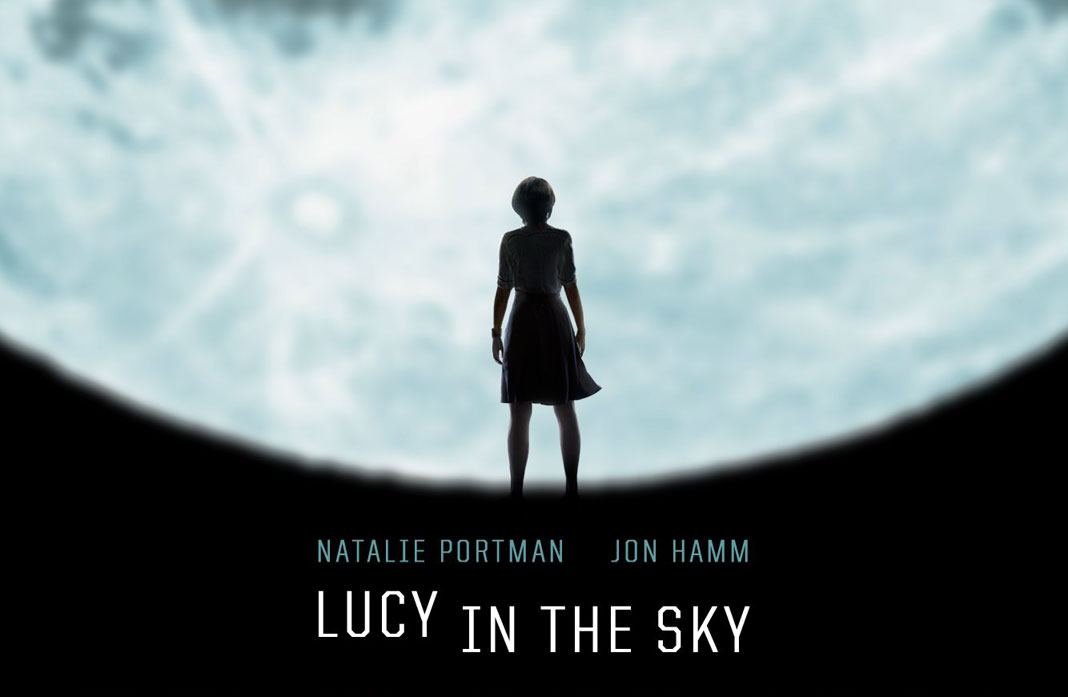
In 2007 a female astronaut furiously jealous because the male astronaut she was sleeping with was also sleeping with someone else, drove from Texas to Florida with the intention of attacking the other woman. “Lucy in the Sky” tells us it is inspired by a true story, and while it draws some of its details from what really happened, there is very little inspiration evident on screen.Copyright Fox Searchlight 2019
Natalie Portman plays Lucy Cola, who has made up for the chaos and dysfunction of her family by being competitive and ultra-capable. Her mother drank, her father was a deadbeat, her brother is an irresponsible single dad who disappears now and then, leaving his teenage daughter with Lucy and her husband (Dan Stevens). Lucy is intensely competitive, always keeping her eye on triumphing over whatever challenge is next. “You’ll just have to work harder,” the grandmother who raised her (Ellen Burstyn) advises, and we can tell that is her standard advice. She has succeeded at everything because she refuses to stop until she does.
We first see her floating in space. Ordered to return to the ship, she insists on a little more time to absorb the vastness of the universe. (With “Ad Astra,” this is the second film in a month to show us a personal and existential crisis in outer space.)
On her return, Lucy is in that most mundane of ordinary tasks, waiting in the carpool lane to pick up her niece at school. She has a routine debriefing with a counselor (Nick Offerman) who gently asks her whether the experience was disturbing. He quotes Apollo 11’s Michael Collins, who wept as he piloted the rocket behind the moon while Neil Armstrong and Buzz Aldrin made their historic landing. He was “consumed by darkness” and said he was profoundly alone. “It’s hard to put into words,” Lucy says. But she liked it and wants to go back.
He urges her to take a break. “Can you stop?” But she only knows how to achieve mission objectives. Without a fixed mission, her mind starts spinning.
And then, another astronaut invites her to go bowling with others in “the club” — those who have looked at Earth from outer space and have had their perspective permanently changed. He is Mark Goodwin (Jon Hamm), recently separated and a bit of a mess, unlike Lucy’s stable, sweet, hand-holding-grace-before-meals husband (Dan Stevens). They have an affair. And then things spin out of control. And so does the movie.
There might be an intriguing story here about how seeing things from a — literally — broader perspective could make someone rethink choices and priorities or how the pressure of being perfect can stem from deep insecurities which can cause distortion and collapse. This film touches on all of that but we keep being distracted by Portman’s efforts at a cornpone accent, some camera tricks with the aspect ratio of the frame, and shifts in tone. The actors do their considerable best, but at times they seem to be acting in different movies. The overly cutesy idea of naming the character Lucy so that The Beatles song can play on the soundtrack is jarring and out of place.
The story could have made a pretty good Lifetime television film, a soapy melodrama starring some third-tier actors. Instead, it is an awkward, wildly uneven film that shoots for the stars — quite literally — and falls far short.
Parents should know that this film include very strong language, some peril and threats of violence, sexual references and a brief explicit situation.
Family discussion: Why was Lucy so different from her parents and brother? How did being in space affect her? What did it mean to be “in the club?”
If you like this, try: “Ad Astra” and “The Martian”
Copyright 2019 Dreamworks/PearlI’m not sure what the fascination is with animated films for kids about mythical big furry primates, but “Abominable” is the third animated film in a year about the animal we call the Yeti or Sasquatch or Bigfoot. If you’re only going to see one, I’d suggest “Smallfoot” or “Missing Link,” but “Abominable” is good, too. It is not as imaginative visually or narratively as the others, but it is a nice family film with some lovely visuals and appealing characters.
Yi (Chloe Bennet) lives with her mother and grandmother, who worry about her because she has become distant and uncommunicative since the death of her father. She leaves the apartment most of the day, won’t eat dinner with her family, and refuses to play the violin for her mother. They do not know that she spends time in a makeshift tent she has set up on the roof of her building and plays her father’s violin.
At the same time a yeti has escaped from a facility owned by the very wealthy Mr. Burnish (Eddie Izzard), an elderly rare animal collector who has been looking for a yeti since he glimpsed them as a young man. No one believed him then and he has never gotten over the humiliation of being laughed at. He wants to be able to prove that he was telling the truth. He has a small army of SWAT-team-like security guards and he has hired an animal specialist named Dr. Zara (Sarah Paulson) to assist him.
When the Yeti lands on Yi’s rooftop retreat, she realizes quickly that he (apparently a he) is not scary; he just wants to go home, which he identifies by pointing to a billboard image of Mount Everest. So, Yi dubs him Everest, and soon she is on her way to take him there, accompanied by her neighbors, the selfie-taking, keep-my-kicks-immaculate Jin (Tenzing Norgay Trainor) and his neglected young basketball-loving cousin Peng (Albert Tsai). On the way to Everest with Everest, as they try to evade Burnish and Zara and overcome the obstacles of the terrain, they will learn a lot about themselves and each other, and appreciate what they left behind.
The Chinese settings, both urban and rural, add a lot of visual interest and it is satisfying to watch Yi find something outside herself to care for, and see how that helps her process her grief and start to reach out to others. Jin’s realization of his superficiality and selfishness is more formulaic and Peng, Everest, and Burnish are one-dimensional, well, maybe one and a half. The action scenes are dynamic, especially the use of drones, and nicely balance the tension with the humor, as the group is chased by giant blueberries and wafting on a giant dandelion. But the storyline, soundtrack songs, and lessons learned are predictable — Yi watches koi fish swimming upstream and is inspired to be persistent, and, like Dorothy, Yi learns that there’s no place like home. These are unquestionably good lessons, but they have been and will be taught with more imagination and less formula in the future.
Parents should know that this film includes cartoon-style action and peril, grief over death of a parent, and brief potty/bodily function humor.
Family discussion: Why didn’t Yi want to be home with her family? Why did Burnish change his mind? What does the word “abominable” mean? What would you do if you met Everest?
If you like this, try: the “Madagascar” movies and “Smallfoot”
Rated PG-13 for some violence and bloody images, and for brief strong language
Profanity:
Brief strong language
Alcohol/ Drugs:
None
Violence/ Scariness:
Peril and violence, characters injured and killed, some startling and disturbing images
Diversity Issues:
None
Date Released to Theaters:
September 20, 2019
Date Released to DVD:
December 16, 2019
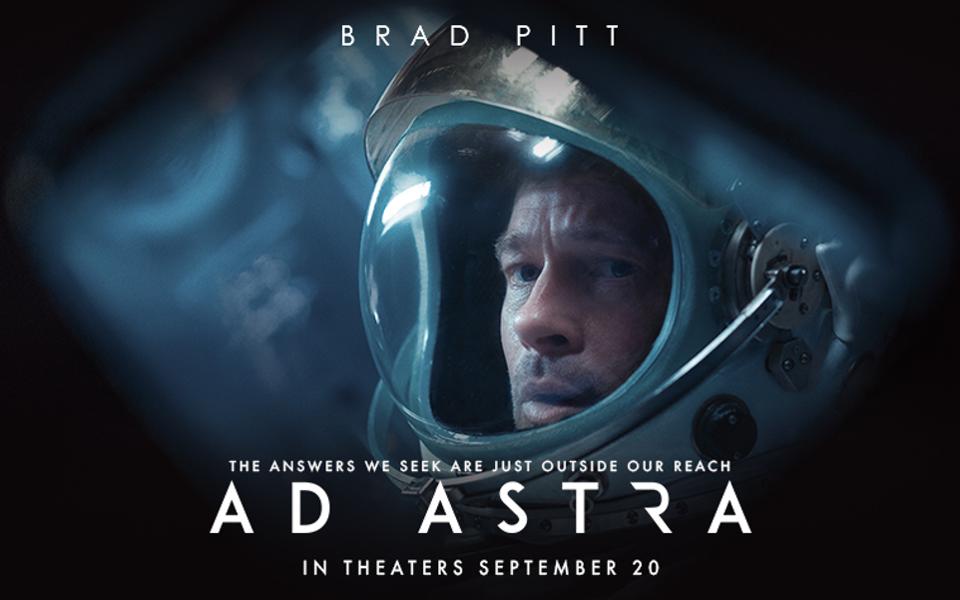
Copyright 20th Century FoxJames Gray, the writer/director of Lost City of Z. has given us another story of a father and son who leave women behind to explore unknown territory. “Lost City of Z” was based on the true story of Percy Fawcett, who traveled through South America in search of the legendary city of gold, inspiring a generation of adventurers. In “Ad Astra” (“to the stars”) an astronaut goes to the farthest reaches of the solar system in search of answers that range from the most cosmic and existential to the most deeply wrenching and personal.
In both films, Gray is better with the settings than the characters and better with the characters than the storyline. And Brad Pitt’s acting is better than every other part of the film.
The look and sound of “Ad Astra” is spectacular. It creates a completely believable, fully-imagined near-future look and feel of an era of space travel and planetary colonization. It is difficult in a sci-fi movie not to want to show off the coolness of the technology, and make the most of the extrapolations of our time into the worst (or occasionally best) possible outcomes, for example, Earth destroyed by human failings or hubris. But this film makes its imagined future all the more believable by making it fit seamlessly into a world that seems just minutes from where we are now. So of course there will be bomb-sniffing dogs in the rocket hanger; just because we develop the technology for routine travel to outer space does not mean we will develop a safer world at home. And of course there will be a Subway (the sandwich place, not the mode of transportation) in a space outpost because why wouldn’t fast food corporations line up whatever territory they can.
I will not spoil the adventures along the journey; I will just say that the characters acceptance of them as ordinary and expected also underscores the vastness of the imagined world and deepens the impact of the dangers Roy faces.
The score by Max Richter, cinematography by Hoyte van Hoytema (“Intersteller”), and the sound design by Grant Elder shape the story-telling, making the exploration seem so completely realistic that we can believe it is already an ordinary part of our daily lives, but keeping things exciting and suspenseful when the time comes.
And then there is the story. Roy McBride (Brad Pitt) is an astronaut, like his father Clifford (Tommy Lee Jones), who disappeared on a voyage to Neptune when Roy was a child. Now someone needs to go to Neptune to investigate a mysterious electrical surge that is creating great damage on earth. And it seems possible that Clifford is involved somehow, that he has survived all this time.
The astronauts are required to do regular self-assessment check-ins on their mental and psychological states to determine whether they are stable enough for space travel. But it is not at all clear as Roy goes through the list of questions whether he is saying what he really feels or what he knows they want to hear. “I am focused only on the essentials,” he says, “I do not allow my mind to linger on that which is not important.” Can anyone believe that is possible? Or that it should be possible? What Roy’s superiors know is the data that they have received, showing that his pulse never goes above 80, even when the situation is very dire. So, should he have one of those “Houston, we have a problem” complications, they believe they can count on him to be level-headed and focus on practical solutions instead of getting emotional, frightened, or angry.
And so he seems to be the right choice for “a crisis of unknown magnitude,” unprecedented electrical surges that put all human life at risk and that seem to be connected to Clifford’s long-ago mission. Roy agrees to go to Neptune, requiring stops on the moon and Mars, to see if he can find and stop the surges. But there’s a warning. “We have to hold out the possibility that your father may be hiding from us.” “I remain mission ready,” Roy assures them.
But we learn that Roy understands rage. He has seen it in his father and he feels it in himself. There will be sacrifices along the way, and decisions with tragic consequences. I found the ultimate encounter less than satisfying, not up to the ambitions of the premise and the settings. But Pitt’s performance and the world of the film provide more than enough reason to watch and wonder.
Parents should know that this film includes sci-fi style violence with peril and some disturbing and graphic images, themes of parental abandonment, characters who are injured and killed, and some strong language.
Family discussion: Was Roy honest in his answers about his emotional state? How was he like his father and how was he different? Would you like to explore space?
If you like this, try: “2001,” “Gravity,” “The Martian,” and “Silent Running”