Toy Story 4
Posted on June 18, 2019 at 12:16 pm
A-| Lowest Recommended Age: | Kindergarten - 3rd Grade |
| MPAA Rating: | G |
| Profanity: | Some schoolyard language |
| Alcohol/ Drugs: | None |
| Violence/ Scariness: | Fantasy/action peril and violence, character sacrifices a part of his body |
| Diversity Issues: | None |
| Date Released to Theaters: | June 21, 2019 |
| Date Released to DVD: | October 7, 2019 |
 Let’s get right to the big three questions about “Toy Story 4.” Yes, it’s good, yes, you’re going to cry, and yes, you have to stay ALL the way to the end for one final blink-and-you’ll-miss-it moment that is worth the wait.
The small miracle of the “Toy Story” series is that a film that would have been memorable for its technology alone as the first fully computer-animated feature film, the shiny, plastic toy characters the focus because Pixar had not yet developed the technology to animate hair, fur, or more expressive faces, was smart, heartfelt, and genuinely moving. Woody (Tom Hanks) was a retro cowboy doll with a pull-cord attached to a voice box and said things like “There’s a snake in my boot” and “You’re my favorite deputy!” When their boy Andy was away and the toys came to life, Woody was their natural leader, looked up to by the other toys, including Mr. and Mrs. Potatohead, the T-Rex (Wallace Shawn), the slinky dog, and Bo Peep (Annie Potts).
And then a new toy arrived, a shiny spaceman named Buzz Lightyear (Tim Allen), with flashing lights and pop-out wings, and a digital voice to proclaim, “To infinity and beyond!” But Buzz did not know he was a toy, creating an existential conflict. He thought he really was a space explorer who could really fly. The conflict in the film came from Woody’s jealousy over Andy’s affection for the shiny new toy and his frustration in not being able to persuade Buzz that he was not “real” in the way he thought he was. His purpose was not to explore space and fight the evil Emperor Zurg. His purpose was to be a companion and inspiration and comfort to Andy, a boy we barely glimpse in the film. The excitement comes from the toys’ efforts to escape the mutilations of the boy next door and to be reunited with Andy when they become separated. The heartwarming theme of the film, though, is about the friendship that develops between the rivals and their mutual understanding of the meaning of their existence as Andy’s toys.
These themes continued through the next two films. The second raised the issue of value — the difference between a mint condition toy still in the box that can be sold for a good price and a well-loved toy that might be scuffed and missing some pieces but meant something to a child, even a child who has grown up and has other interests. The third film gracefully and very poignantly saw Andy leave for college but give his toys to the imaginative pre-schooler Bonnie, so they could continue to fulfill their purpose. The first image in the original film was of clouds in a blue sky that turned out to be painted on the ceiling of Andy’s room. The final image of the third one was the real sky, showing that Andy’s world had opened up.
So, how to move on from that perfect ending? With another existential crisis, or maybe two. Woody has always defined himself by being important to a child. But increasingly Bonnie is leaving him in the closet, even taking his sheriff star and pinning it on Jessie (Joan Cusack). When Bonnie is nervous about her first day of kindergarten, Woody sees a chance to be useful and he sneaks into her backpack so he can to with her.
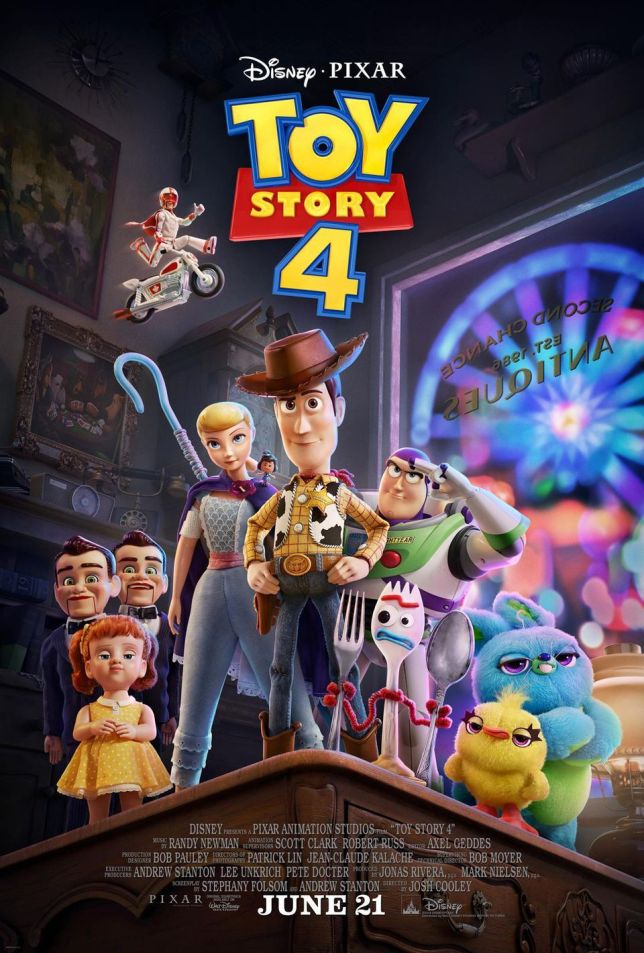
But what comforts Bonnie at school is creating something new. From a plastic spork and a broken popsicle stick she makes a…something she calls “Forky” (Tony Hale). When Woody tells the other toys back at home that Bonnie made a friend at school, he is speaking literally. But, in a parallel to Buzz in the first movie, Forky does not know he’s a toy. He cannot adjust to the notion that he is more than a single-use plastic utensil whose destiny is to be thrown in the trash. He keeps trying to throw himself away. But Woody sees Forky as a chance to be useful to Bonnie. If Woody can’t be important to Bonnie, he can teach Forky how to be.
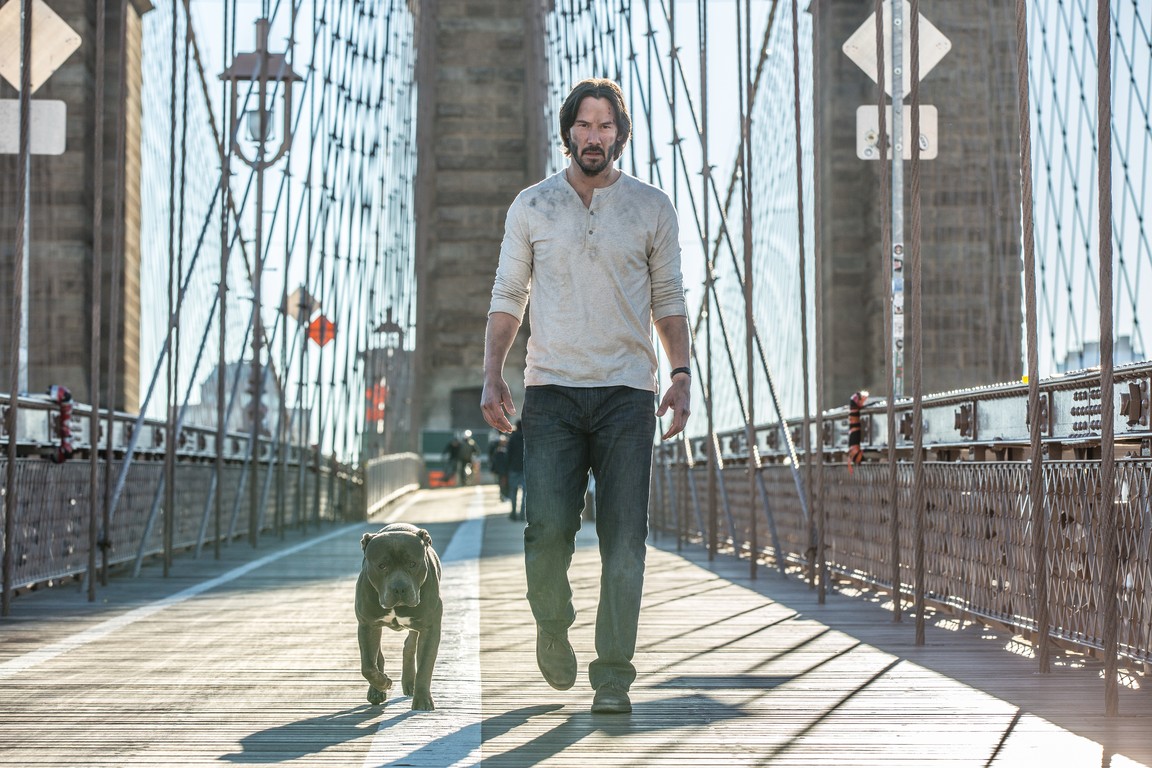
And once again, the characters are separated from each other and from their child. Bonnie and her family rent an RV and go on a trip that puts the toys in two settings rich with fascinating details, colorful characters, and all kinds of wildly inventive and delightfully treacherous adventures. The first is an antique shop, where Woody glimpses the lamp stand that his old friend — and maybe more — Bo Peep used to be on. He brings Forky inside to look for her, and there they meet Gabby Gabby (Christina Hendricks) a Chatty Cathy-style talking little girl doll with perfect curls and an imperfect voice box and her entourage of identical creepy-looking ventriloquist dummies all called Benson. Note that “Toy Story 2” involved “vintage” toys but now they are antiques. Keanu Reeves all but steals the film as a proudly Canadian Evel Knievel-style stunt rider toy called Duke Caboom.
The other new setting is a carnival, with rides and arcade games, and there we meet two plush toy prizes, Ducky and Bunny, voiced by Keegan-Michael Key and Jordan Peele, who have a blast riffing with each other. And it turns out that Bo Peep is there, too, having left her lamp, traveling with the carnival and seeing the world.
There are separations and perilous rescues, many near-misses and close calls, a gasp-inducing sacrifice, and a very sad farewell. The Pixar team is getting older, and they take us with them as they confront their own existential conundrums. You know you’re not going to get out of a Pixar movie without tears, and this one may be more like boo-hoo sobs. But that’s because we care about these characters and we care about the way they care about and for each other. Watch out for another shot of the sky — and for some fun scenes over the credits and, when the long, long list of filmmakers and production babies is over, a just-perfect scene at the very end.
Of course you can now buy a Forky doll. You can even choose between one that talks and one that walks. But I’m guessing that kids who see this movie will want to make something of their own.
Parents should know that this movie has extended action/fantasy-style peril with some scary ventriloquist dummies, and a genuinely shocking moment when a character voluntarily undergoes doll surgery to give up a piece of himself for another toy. Characters use some schoolyard language.
Family discussion: Why does Bonnie love Forky? How does Woody change Forky’s mind? Did Woody make the right decisions about Gabby Gabby and Bo Peep?
If you like this, try: The other “Toy Story” films and Pixar’s “A Bug’s Life” and “Monsters, Inc.”