Nuremberg

Nuremberg

Posted on November 6, 2025 at 5:51 pm

A-
Lowest Recommended Age: High School
MPAA Rating: Rated PG-13 for violent content related to the Holocaust, disturbing images, strong language, and themes including suicide, smoking, and brief drug use
Profanity: Some strong language
Alcohol/ Drugs: Alcohol, drugs, and smoking
Violence/ Scariness: Wartime and Holocaust references, archival scenes from concentration camps
Diversity Issues: A theme of the movie
Date Released to Theaters: November 7, 2025

Those who have studied 20th century history know that after WWII the Allies did something no governments had ever done after a surrender. They held a formal trial, not about Germany’s acts of war but about the “crimes against humanity” that tortured, imprisioned, stole from, and murdered its own people, and tried to eradicate citizens based on their religion, disability, and sexual orientation. They were known as the Nuremberg trials.

Copyright Sony Pictures Classics 2025

But even those who have studied that process may not know that the American military also assigned its own psychiatrists to interview the first 22 German officers and political leaders. It was not, as in an ordinary criminal trial, to determine their ability to understand the proceedings and in some cases their culpability for their decisions, but to try to understand what kinds of minds would create what we now call the Holocaust. Those questions have continued to confound us for 80 years, and continue to be explored by historians and filmmakers, including recent documentaries like “The Last Days,” “Shoah,” and “The Grey Zone” and narrative films like “The Zone of Interest” and “A Real Pain.”

“Nuremberg,” based in part on the book The Nazi and the Psychiatrist by Jack El-Hai, follows three intersecting stories, the efforts of Supreme Court Justice Robert Jackson (Michael Shannon) to get the Allied countries together to agree on the trial, the charges, and its proceedings, the interviews military psychiatrist Douglas Kelley (Rami Malek) conducted with top Nazi official Hermann Göring (Russell Crowe), and Howie Triest (Leo Woodall) a young military officer assigned to Kelley as a translator.

Jackson’s plan seems impossible, “a logistical nightmare.” “What you’re talking about is trying them in some sort of legal limbo that doesn’t exist using laws that haven’t been written yet,” he is told, and reminded that Germany never attacked the US. He would have to get the involvement of all of the Allies to participate, including the USSR. He insists, “The world needs to know what these men did.”

There is an optimism behind it, an idea that if the top Nazis were both convicted and diagnosed, it would help make sure that nothing like the Holocaust would ever happen again.

The essence of the film is in the interviews/conversations between Kelley and Göring, and the two Oscar-winners and writer/director James Vanderbilt’s script make them among the most riveting screen moments of the year.

Vanderbilt is superb in revealing the complexity of the moral and legal issues. Kelley is trained to give therapy, with patient confidentiality. Jackson wants him to use his sessions to find Göring’s vulnerabilities, to help with the prosecution. General Eisenhower insists that there be no executions without a trial, giving the men the opportunity to defend themselves. The risk of failing to find them guilty is the risk of making them martyrs, allowing atrocities to happen again. Jackson and the military are also very aware that the humiliation Germany suffered at the end of WWI played a big part in Hitler’s rise. Göring tells Kelley why he followed Hitler: “Along came a man who said we could reclaim our former glory. Would you not follow such a man?”

Jackson reminds us that the war “started with laws,” and should end with them. They have to create a sense of fairness and justice without repeating the mistakes of the post WWI Paris Peace Conference that divided up German’s territories.

The movie is well paced, as a thriller, a courtroom drama, and an exploration of history and the human capacity for evil and for good. It is never didactic or heavy-handed. There are moments of humor and excellent performances by all.

Vanderbilt has a gift for telling details like Göring ripping the lace-edged hem of his wife’s slip to make a white flag of surrender as his car reaches the Americans, and then casually telling them to get his luggage, as though the American soldiers are baggage handlers.

When the military thinks Kelley is too sympathetic, they bring in another psychiatrist (Colin Hanks), who is clear that he is there to write a book about it. Kelley is disturbed by this unabashed acknowledgement of self-interest. The film lets us know that Kelley did himself write a book, though, 22 Cells in Nuremberg: A Psychiatrist Examines the Nazi Criminals. It is hard to find but well worth reading, especially its conclusion, calling for the same commitments we are still trying to achieve today. It is impossible to watch this film without being chilled by what happened in Germany. It is impossible not to think about the lessons we have failed to learn.

Parents should know that this film includes references to wartime violence and the Holocaust, with real archival footage of concentration camps. There is some strong language and characters drink, smoke, and use drugs.

Family discussion: Compare the Nuremberg trials to a later version, South Africa’s Truth and Reconciliation Commission. Which is better? When the current global conflicts are resolved, how should we treat those involved?

If you like this, try: “Judgment at Nuremberg.” a 1961 film about the later trials, with waning interest in pursuing the Nazi judges, exploring the issues of responsibility for those in lower-level roles. and the American Experience documentary, “The Nuremberg Trials

Related Tags:


Based on a book Based on a true story Drama Epic/Historical movie review Movies -- format Movies -- Reviews War
The Flash

The Flash

Posted on June 15, 2023 at 5:16 pm

B +
Lowest Recommended Age: Middle School
MPAA Rating: Rated PG-13 for sequences of violence and action, some strong language and partial nudity
Profanity: Some strong language, several s-words, one f-word
Alcohol/ Drugs: None
Violence/ Scariness: Extended comic-book action peril and violence, injuries and sad deaths
Diversity Issues: None
Date Released to Theaters: June 15, 2023

Copyright 2023 Warner Brothers
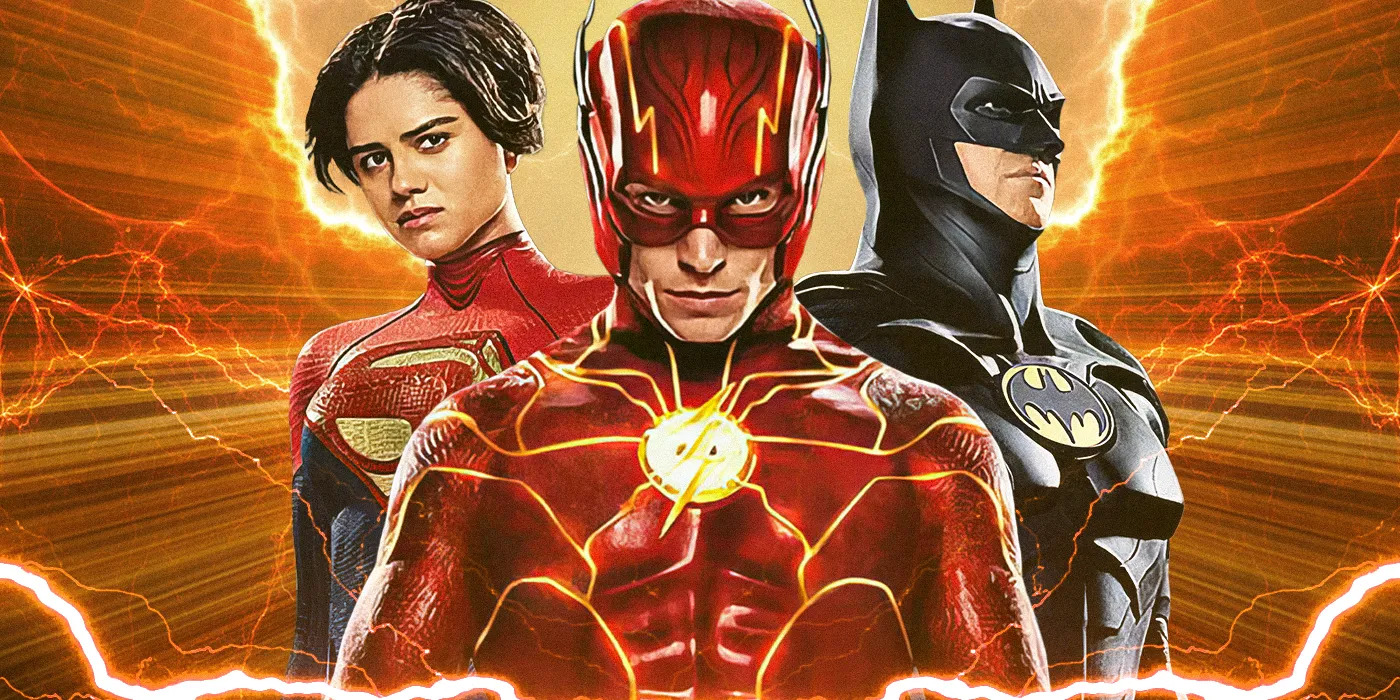
“The Flash” is centered in the sweet spot between action, comedy, and heart because is is grounded in a deep affection for the source material but is not afraid to play with some of its absurdities. I’m going to tread very carefully to avoid spoilers (and alert you to what I hope will be just two of the jokes in this review), but if you want to go into the film knowing nothing, including what is in the trailer, come back and read this after you’ve seen it.

Ezra Miller shows no signs of the instability that has led to troubling behavior and disturbing headlines in his excellent performance as not one but two Barry Allens. The storyline allows for something of an origin story without the too-often superhero film mistake of making it all about the adjustment to the use and purpose of superpowers and attendant vulnerabilities. We first see Barry Allen (Flash’s secret identity) trying to get a high-protein sandwich at a cafe counter. He is, unsurprisingly, in a hurry because first, he is running late, and two, as a result of the energy he burns in his super-fastness requires a lot of food for fuel. It’s not quite like Popeye and spinach, but it’s not not like it, either.

Barry is awkward and shy. He works as a forensic scientist, looking at evidence from crime scenes. And he is hoping to exonerate his father, Henry (Ron Livingston), who is in prison for murdering his wife, Barry’s mother, when Barry was a child. Barry knows his father is innocent, and is hoping that his friend Bruce (Batman) Wayne (Ben Affleck) can help him with a crucial piece of evidence, security camera footage from a grocery store that would substantiate Henry’s alibi. But the enhanced clarity of the tape, shot from above, does not show Henry’s face, only his baseball cap. Barry, devastated, goes for such an intensive run that he passes the speed of light and goes back in time. If he can do that, he reasons, maybe he can go back further and prevent his mother’s murder. Bruce Wayne warns him it is a big mistake. Butterfly effect, etc. He, of course, knows very well what it is like to have your entire live defined by a devastating childhood loss.

Barry cannot resist. And that is when things start to scramble. First, one very small choice somehow had a lot of major repercussions, some strangely random. Somehow, instead of Michael J. Fox coming in to replace him, the original star of “Back to the Future,” Eric Stoltz, stayed in the role. The people he knows from his timeline are either not there or very different. And second, Barry misjudged and instead of returning to the present, he finds himself 10 years ago, which means, yes, that his teen-age self is there, too. The interaction between the two Barrys (both played by Miller), one formed by the murder of his mother and wrongful conviction of his father and one who grew up in a home with intact, loving parents, is at the heart of the film. In fact, the villain (Michael Shannon as Kryptonian bad guy General Zod) is almost an afterthought in this film, relying on our remembering him and his whole deal from previous encounters.

Instead, the movie is more about Barry, both Barrys, their interaction and their growing understanding of their situation and, if it can be put this way, each other. From a small, witty hiccup in the presentation of the movie’s title to the throwaway lines about other anomalies in the pile of spaghetti that is what happens when you splinter linear time, to some funny cameos (Wonder Woman’s lasso of truth provides one of the film’s best moments), the film is more interested in concept and character than mayhem.

That’s a good thing as the mayhem is more serviceable than memorable. This is a movie that is more about the people than the powers, and that is a superpower worth having.

Parents should know that this film includes brief non-sexual male nudity (bare tush), some strong language (s-words and one f-word), and extended comic book-style peril and action violence, with injuries and some sad deaths.

Family discussion: What one small decision have you made that had a surprisingly big impact on your life? If you could go back in time ten years, what advice would you give yourself?

If you like this, try; Other time-warp movies like “Back to the Future” with Michael J. Fox and “Frequency” as well as other DC Comics movies

Related Tags:


Comic book/Comic Strip/Graphic Novel Fantasy movie review Movies -- format Movies -- Reviews Scene After the Credits Series/Sequel Superhero

Trailer: The Current War with Benedict Cumberbatch, Tom Holland, Nicholas Hoult, and Michael Shannon

Posted on July 8, 2019 at 7:16 am

There is no film I am looking forward to more than “The Current War,” with an all-star cast in the true story of one of history’s most consequential competitions: Thomas Edison vs. Nikola Tesla. It looks great!

Related Tags:


Trailers, Previews, and Clips
12 Strong

12 Strong

Posted on January 18, 2018 at 11:22 pm

B
Lowest Recommended Age: Mature High Schooler
MPAA Rating: Rated R for war violence and language throughout
Profanity: Very strong language
Alcohol/ Drugs: Portrayal of misogynistic regime
Violence/ Scariness: Extended wartime violence, characters injured and killed, some disturbing images
Diversity Issues: None
Date Released to Theaters: January 19, 2018
Date Released to DVD: April 30, 2018

Copyright 2017 Warner Brothers
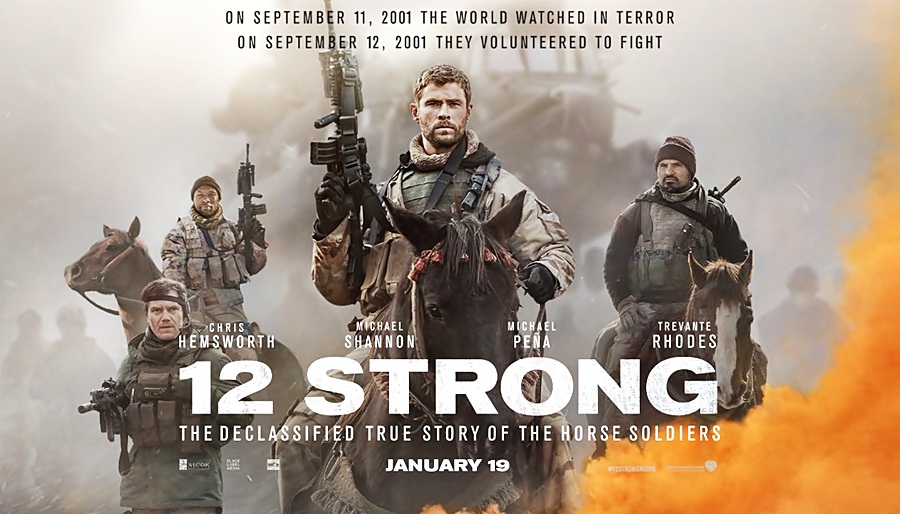
If it was fiction, you’d dismiss 12 Strong as too far-fetched. But this recently declassified military mission following 9/11, with a tiny Special Forces group, just twelve men, led by an officer who had never been in combat, were sent to Afghanistan to take out a Taliban outpost. They were vastly overmatched in terms of men and weapons. And, most improbable of all, they had to travel by horseback. Men trained to use the very latest of technology were riding the mode transportation used by knights and cowboys. These guys are the best of the best, nothing but courage, patriotism, skill, and determination all the way through. Think of them as The Clean or rather Sandy Dozen.

This film begins with a brief reminder of the terrorist attacks leading up to the airplanes that flew into the World Trade Center and Pentagon on September 11, 2001. And then, as in all films of men about to go into danger, we see happy families, just enough to make sure we care about these loving husbands and fathers. We know that Captain Nelson (Chris Hemsworth, back to being mortal after “Thor: Ragnarok” but no less heroic) is not going to be able to keep his promise to pick that adorable ladybug-drawing daughter after school, and pretty soon he knows it, too.

There are wives who bravely say that this is what they signed up for. One says, “Some wives cry; I clean,” as she scrubs her oven. Another looks at her husband grimly, insisting he give their son the bad news himself. Nelson has to undo his plans for a desk job to go back to his team. He also has to prove himself to his commanding officer, who selects him over five other teams because he seems to have the best understanding of the challenges, especially the weather that will make their mission impossible if they don’t complete it before winter makes the route impassable.

And then the twelve are on their way with just the briefest and sketchiest debrief from a CIA officer. There are three warlords in the area who all oppose the Taliban but otherwise are in mortal combat with each other. One of the challenges for the American team will be to keep that fragile alliance in place as they need the support of all of them to reach the outpost, liberating several locations along the way.

It is hard to follow at times. There are so many “the whole world depends on this next impossible thing” moments, so much bro talk, so much tech talk, so many reminders of how many days “in country,” so many similar-looking explosions and shoot-outs. But Hemsworth, Shannon, and Pena create real, relatable and yet heroic characters, and seeing them ride into battle on horseback against daunting odds is genuinely moving and inspiring. The most intriguing part is the developing relationship between Nelson and his local counterpart, General Dostum (Navid Negahban). The outcome revealed before the credits is appropriately both reassuring and disturbing.

Parents should know that this film includes extensive wartime peril and violence including guns and explosions with many characters injured and killed, some grisly and disturbing images, references to child abuse, strong language, and some sexual references.

Family discussion: What is the difference between a soldier, a warrior, and a warlord? How did Nelson and Dostum learn to trust one another? What can we tell about the man by the way they said goodbye to their families?

If you like this, try: the book by Doug Stanton and the movies “Act of Valor,” “Lone Survivor” and “Charlie Wilson’s War”

Related Tags:


Action/Adventure Based on a book Based on a true story DVD/Blu-Ray Pick of the Week movie review War
Elvis & Nixon

Elvis & Nixon

Posted on April 21, 2016 at 5:30 pm

B+
Lowest Recommended Age: High School
MPAA Rating: Rated R for some language
Profanity: Some strong language
Alcohol/ Drugs: Drinking, references to drugs
Violence/ Scariness: None
Diversity Issues: None
Date Released to Theaters: April 23, 2016
Date Released to DVD: July 18, 2016
Amazon.com ASIN: B01EZ6PZSQ

Copyright 2016 Amazon Studios
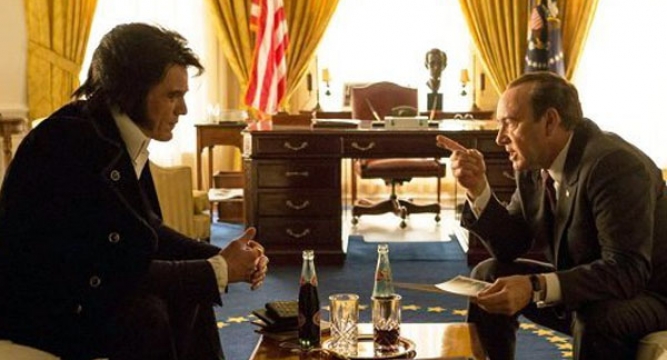
Today it does not seem at all odd to see Beyoncé hanging out with the Obamas or a reality television star as a popular Presidential candidate. But in the before-social media days of 1970, celebrity culture was not as all-encompassing as it is now. Frank Sinatra memorably supported John F. Kennedy in 1960 and just as memorably was not-so-gently pushed aside when his possible ties to organized crime and general inability to follow orders became a problem. Politicians, even today, want the support of celebrity fans but do not want the controversy that sometimes comes with them. And certainly the very serious-minded Richard Nixon would not want to appear frivolous by hanging out with a singer, even the most famous singer in the world. When told that “the king” wanted to see him, he said, “The king of what?” He was used to visits from actual royalty, and prided himself on learning a few pleasantries in their native language to put them at ease. But what could be the native language of a man from Tupelo, Mississippi who was known as “Elvis the Pelvis” for his sexy, hip-swaying performances, and who sang songs of teddy bears and hound dogs that made girls swoon?

Elvis Presley and Richard M. Nixon did meet in the Oval Office. No one knows exactly what they talked about, but this charming film makes a believable case that they had more in common than we might think. As the President points out (he did insist on being briefed on Presley), they both came from humble beginnings and worked hard to rise to the top of their respective fields. They both feel badly treated by the press. They both find the Woodstock-era flower children and Vietnam war protesters disturbing, even seditious. Both are keenly aware of their level of support and power, which will never be enough. They may not be aware, but we are, that their very success has isolated them in a way that leaves them endearingly unaware of some elements of everyday interaction that the rest of us take for granted. Both have daughters they love very much. And both, constantly surrounded by young men somewhere between acolytes, enablers, managers, and favor-seekers, are, somehow, lonely.

The movie is so delightful that its shrewdness sneaks up on you. There is a very funny line about astronaut Buzz Aldrin that makes an insightful point about celebrity, as does a technique Elvis and his “Memphis Mafia” use repeatedly when they are thwarted, to greater comic effect every time. The parallel scenes as two respective entourages brief Elvis and Nixon about the appropriate protocol for the other is well done and the songs — not by Elvis but of his era — are especially well chosen, particularly when Elvis sings along to “Suzy Q.” Director Liza Johnson makes the most of a witty script (“Princess Bride’s” Carey Elwes was a co-author) and maintains a tone that is slightly heightened but just plausible, given the heightened reality of the two men at its center.

Parents should know that this film includes strong language, guns, and smoking.

Family discussion: What did Elvis Presley and Richard Nixon have in common? How did each rely on the young men around them? Why is there no Elvis music in the film?

If you like this, try: “Frost/Nixon” and “Elvis Presley: Thats the Way It Is”

Related Tags:


DVD/Blu-Ray Pick of the Week Inspired by a true story
THE MOVIE MOM® is a registered trademark of Nell Minow. Use of the mark without express consent from Nell Minow constitutes trademark infringement and unfair competition in violation of federal and state laws. All material © Nell Minow 1995-2026, all rights reserved, and no use or republication is permitted without explicit permission. This site hosts Nell Minow’s Movie Mom® archive, with material that originally appeared on Yahoo! Movies, Beliefnet, and other sources. Much of her new material can be found at Rogerebert.com, Huffington Post, and WheretoWatch. Her books include The Movie Mom’s Guide to Family Movies and 101 Must-See Movie Moments, and she can be heard each week on radio stations across the country.

Website Designed by Max LaZebnik