Extensive sci-fi action-style violence with guns and explosions and many characters injured and killed, sad death
Diversity Issues:
Diverse characters
Date Released to Theaters:
December 16, 2015
Date Released to DVD:
March 27, 2016
Amazon.com ASIN:
B018FK66TU
Copyright Disney 2015
The force is strong in this thrilling new chapter in the story set a long time ago in a galaxy far, far away. Fans will get goosebumps right from the start as the familiar logo and musical theme are followed by a scrolling summary to bring us up to date — without a single mention of a tariff or bureaucratic squabbling. Instead, it has words of near-incantatory power: Luke is missing. Leia is a General. An old ally has provided a clue to Luke’s whereabouts and the best pilot of the rebel forces has been sent to retrieve it.
That pilot is the irresistibly dashing Poe Dameron (Oscar Isaac, who finally seems on the brink of the superstardom he has long deserved). Like Leia in “A New Hope,” he stashes the information in a droid, the adorable B-88, and then he is captured by stormtroopers representing the dark side of the force. Now called First Order, it is a group that has risen from the ashes of the Empire and threatens to take over again. And we know they’re evil because they mostly have plummy British accents and when they give speeches they dress like they’re appearing in a Leni Riefenstahl recruiting video.
Stormtroopers are indistinguishable in their white armor and helmets, but in the attack on a civilian village one stands out. He seems dazed and disoriented. He shows compassion for a downed member of his battalion. After returning to the ship, he is ordered to reprogramming to make sure he will never again fail to carry out an order to kill and destroy. He decides to run away. He does not know how to fly, but there is a prisoner who happens to be the best pilot of the rebel forces, our new friend Poe. “Why are you helping me?” Poe asks with understandable suspicion. “Because it’s the right thing to do.” Our Poe is not fooled. “You need a pilot,” he wisely responds.
Whatever. They both want to get the heck out of there, and that is good enough for the moment. Plus, the defecting stormtrooper speaks with an American accent (even though he is played by British actor John Boyega), so he must be okay.
Meanwhile, a scavenger named Rey (Daisy Ridley, yes she has an English accent but is so obviously honorable and kick-ass great that it just sounds elegant, not evil) encounters B-88. And some old friends from the original trilogy show up for call-outs, tributes, and variations on beloved memories.
Co-writer/director J.J. Abrams has a deep understanding and respect for the original characters and themes going back to the very first episode, now chronologically chapter IV and retitled “A New Hope.” He co-wrote this film with Lawrence Kasdan, the screenwriter of Chapter V: “The Empire Strikes Back,” generally considered the strongest in the series. They seamlessly bring the story forward with new characters who are vital and engaging. The special effects and mechanics are superbly designed and the action is brilliantly staged.
I wish I could tell you more but I can’t spoil the wonderful surprises, so just let me just say that this is the “Star Wars” you’ve been looking for. Be sure to check out the deleted scenes and other extras on the splendid DVD/Blu-Ray
Parents should know that this movie has extensive sci-fi peril and violence with many characters injured and killed and a very sad death. There are issues of totalitarianism, loss, and betrayal.
Family discussion: Why didn’t Finn have a name? How are Ren and Hux different? Who do you think Rey’s parents are?
If you like this, try: the original “Star Wars” trilogy
Rated R for pervasive language and some sexuality/nudity
Profanity:
Constant very strong and crude language
Alcohol/ Drugs:
Drinking, smoking
Violence/ Scariness:
Fraud, corruption, economic upheavals
Diversity Issues:
None
Date Released to Theaters:
December 11, 2015
Date Released to DVD:
March 15, 2016
Amazon.com ASIN:
B0177ZM3LO
Copyright 2015 Plan B Entertainment
Director Adam McKay is so obsessed with the 2008 financial meltdown that he inserted a series of charts and graphs and statistics about it over the closing credits of the silly buddy-cop comedy, The Other Guys. Yes, there was a villain played by Steve Coogan who was up to some financial jiggery pokery, but only the most careful viewers of that film could have deduced that what McKay, best known for raunchy Will Ferrell slob comedies, secretly yearned for, as Michael Caine might say, was to blow the bloody doors off the Wall Street bankers who treated the American economy like a bull treats a china shop.
We’ve had sober documentaries like The Flaw and Oscar-winner Inside Job and the superb drama Margin Call, all outstanding, insightful, and illuminating and essential companion pieces to this movie. But “The Big Short” has several advantages in telling the story. First, by giving us someone to root for, however imperfect the heroes of this story are, it keeps us emotionally connected to the story. Second, because it is in most respects a comedy, McKay has a wider range of tricks on hand to make us understand what happened. This fierce, fiery rant of a film is going to make you understand that the people we entrusted with our economic stability were truly despicable and truly stupid. It is funny and infuriating and then funny again and then, when he tells you that the bad guys went to jail and the big banks were broken up — no, just kidding, they weren’t — it is monumentally infuriating.
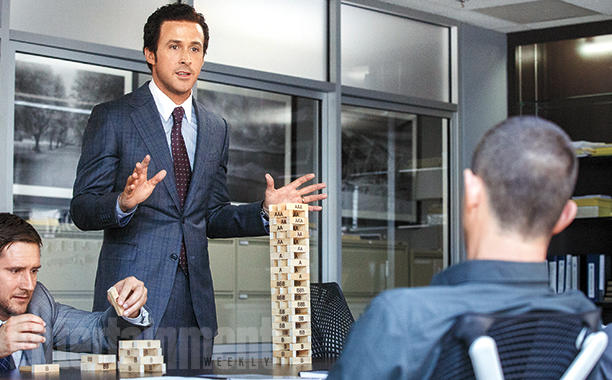
I’ll add a footnote below to give my own very short explanation of what happened.* (And one thing they got wrong.** Pretty much everything else is literally right on the money.) Or, you could listen to Margot Robbie talk you through it, as she sips champagne in a bubble bath. Yes, McKay knows what gets people’s attention and he uses Robbie and other celebrities to come in and explain the parts that the bankers intentionally did their best to obfuscate, using words guaranteed to put everyone to sleep so they could pick our pockets a little while longer. Ryan Gosling also serves as a guide, playing a real-life insider who saw that the mortgage-backed securities were going to tumble down like a Jenga tower.
The real-life acronym used by the bankers during this period was IBGYBG, which stood for “I’ll be gone; you’ll be gone,” meaning that if they could just keep passing the hot potato of economic Armageddon going around the circle a couple more times to collect the fees, they could get out before it all came tumbling down. And many of them did. As Michael Lewis notes in the the book that inspired this film (subtitled The Doomsday Machine), and, if you don’t remember anything else, remember this: the heroes of his book, the small group that bet against the bankers, made fortunes. But so did the people who lost that bet. Everyone on both sides of these deals made a lot of money. Everyone else across the country lost a lot of money, jobs, and homes.
As noted, Lewis’ book and McKay’s movie (the Oscar-winning script is co-written with Charles Randolph of the underrated “Love and Other Drugs”) wisely allow us to enter the story via the scrappy little group of misfit toys who figure out that the game is cooked, that it can’t stay that way, and that there has to be a way to bet against the other side. This grown-up Bad News Bears bunch (two of them barely qualifying as grown-ups) have a couple of things going for them. First, they are skeptics. Actually, they are cynics. They assume everyone is lying to them and just about everyone is cheating them. Michael Burry (Christian Bale), who insists on being called Dr. Michael Burry (he’s a neurologist-turned investment manager) and Mark Baum (Steve Carell) are both men who were already inclined to be skeptics and then faced terrible pain and loss that disabused them of the sense that life was fair. Jamie Shipley (Finn Wittrock) and Charlie Geller (John Magaro), two young partners literally running an investment firm out of a garage, had made almost $30 million finding unseen risks but were so naive about Wall Street that they did not know what the requirements were for being able to trade as an institution and not as an individual. These guys were all outsiders. (All names are fictional except for Burry.)
The second thing they had going for them was that they were not just willing to do their homework; they insisted on it. While the money gusher was going, no one else wanted to check the math (and no one was getting paid to do so). But, in some of the most entertaining moments of this riotously entertaining film, these guys who did not believe what they were told, went to check it out. Burry unpacked the securities to examine each of the hundreds of mortgages they contained to see if they were as secure as promised. They were not. Baum’s colleagues (Rafe Spall and Hamish Linklater) went to Florida to see the homes that were mortgaged. They were abandoned. Baum’s guys spoke to the mortgage brokers who happily explained that they preferred to give mortgages to people who had no possible means of paying them. (Max Greenfield is superbly sleazy in this role.) “They’re not confessing,” one of Baum’s partners says in amazement. “They’re bragging.”
By the time a stripper explains to Baum that she has mortgages on five houses and a condo and has been assured she can refinance when her adjustable rate jumps up, he begins to see the potential in betting that these securities will fall as people like this cannot pay the mortgages. When he goes to a convention of financial types working in this field (Byron Mann is almost deliciously corrupt as the arrogant and ethically vacant Mr. Chau), he knows he is right.
At the same convention, Shipley and Geller are jubilant when they are able to make a big bet against the bankers. And then they get a reality reminder from their their mentor, played by co-producer Brad Pitt. He could not take the corruption of Wall Street any more and left for a life somewhere between disaster prepper and artisanal farmer, wearing a face mask when he goes to town and urging everyone to get colonics. He met the young investor when they were walking their dogs. He reminds Shipley and Geller not to be so happy. When they win big, it will be because the economy is collapsing, causing real, devastating pain.
This is an outstanding film, with sensational performances by a brilliant ensemble cast. It is one of the best of the year and the most important as well.
Parents should know that this film includes constant very strong and crude language, vulgar sexual references, strippers, nudity, and extreme widespread fraud and corruption.
Family discussion: What made just these men able to see what so many other people did not? How did they verify their analysis? Will it happen again?
If you like this, try: the book by Michael Lewis and documentaries about the financial meltdown including “The Flaw” and “Inside Job” as well as feature films “99 Homes” and “Margin Call”
*Here’s what happened, without the jargon or the bubble bath. As you see at the beginning of the movie, Lewis Ranieri, now one of the wealthiest people in the world, came up with the idea of essentially crowd-funding mortgages. He took lots and lots of mortgages, bundled them into bonds, and let big institutional investors, like pension funds, buy them. It was a great investment for them because pension funds need a safe and secure source of income to pay retirees and these were safe and secure — much more than stocks — because people almost never defaulted on their mortgages and because so many mortgages were bundled up together that even if some did default it would have almost no impact. These bundles of mortgages were so popular that the banks ran out of safe and secure mortgages to put into bonds. And so, they started pushing mortgage brokers to issue more mortgages, and that meant giving mortgages to people who would not otherwise have qualified. (Some people will tell you that the government was at fault for pushing home ownership on people who could not afford it. They are wrong. Most of the pressure was coming from people who wanted to buy mortgages, not people who wanted to buy houses.) So, the formerly safe and secure bonds started filling up with less and less safe and secure mortgages. And the people responsible for differentiating the risk of the bonds, including the rating agencies, decided to just keep rating and selling the new, less secure securities as though they were exactly the same as the earlier ones. All of the “formulas” (sometimes called “algorithms” or “models”) used to justify this were bunk. Imagine it this way: there’s a vineyard that makes superior wine that everyone wants to buy and there are strong legal and economic incentives to buy it. But you only have so many grapes, so you start watering it down, still selling it at the same price, and getting the people who rate wine to continue to give it the same rating. Then you run out of water so you start blending it with turpentine, and all of your projections show that it is just as good and will still sell just as well so you price it that way and assume there is no risk.
Here’s the important part: everyone at every part of this conveyer belt of increasingly risky securities all being treated as though they were not risky was being paid based on the number of transactions, not the quality of the transactions, a sort of very big, very expensive game of tag, where there was never any “it” until finally “it” was everyone.
Rated PG for some peril, thematic elements and language
Profanity:
Some strong and crude language
Alcohol/ Drugs:
None
Violence/ Scariness:
Sad terminal diagnosis, gun, some tense confrontations
Diversity Issues:
None
Date Released to Theaters:
December 4, 2015
It may be the most wonderful time of the year, but the Christmas season is also the most hectic and the most fraught. Our to-do lists are overwhelming. Our expectations are even more so. And then there are the expectations of others. Everyone who celebrates Christmas expects at least a little magic around December 25th. Everyone, even the most cynical among us, wants to believe. Like Scrooge, we want to wake up as merry as a schoolboy and like the Grinch, we want our heart to grow.
In the gentle dramedy “Christmas Eve,” six very different groups of people get that chance. They deal in the most literal terms with life and death. There is love and loss and reconciliation. And it all happens because a guy runs his repair truck (labeled “Deus ex Machina”) into a power station and knocked out the electricity, so that six elevators get stuck and the people in them are trapped.
Patrick Stewart plays a wealthy man used to barking orders at cowering underlings. He is trapped by himself in a precarious construction elevator. The others are in groups. One is in a hospital elevator with orderlies, a nurse (played by Shawn King, the wife of producer Larry King — yes, that Larry King), a doctor (Gary Cole),a and an unconscious post-surgery patient.
In an apartment building, an outgoing photographer and a shy young woman are stuck together. A classical music ensemble is trapped together on the way to a performance. There is a lot of artistic temperament in a crowded space and one of them (Cheryl Hines) has a gun.
In another elevator, an IT guy who has just been laid off (Jon Heder) is trapped in an elevator with the boss who just gave him the bad news — on Christmas Eve. And in a shopping mall, two silly girls are trapped between brains and brawn. Their elevator includes a guy with a lot of muscles and tattoos who does not say much, a guy with some OCD issues and a lot of hand sanitizer, and a guy who could do very well on Jeopardy.
Before the power station can go back on line, the repair truck guy has to be rescued in a very complicated maneuver. So that gives us time to go back and forth as the temporary (but not as temporary as they intended to be) inhabitants of the elevators worry about everything from bodily functions to existential issues (I suppose bodily functions are a kind of existential issue).
As one might expect from the unwieldy construct, the movie is very uneven, careening back and forth between “Love Boat” level corny situations to a few moments of surprising insight. We are not surprised when the photographer gives the shy young woman a makeover and takes her picture. But we are at what happens next. The doctor was hoping he would be far from the hospital by the time his patient woke up and had to hear some bad news. But they are in the elevator so long that he ends up having to tell her himself, and the moment is sensitively handled. The weakest elements are the slapstick-ish rescue of the man who hit the power station and the interaction between the laid-off employee and his now-former boss, which requires a suspension of disbelief even Christmas cannot excuse. At its worst, it feels like a late-season “Love Boat” episode crossed with a late-night Hallmark Christmas movie, but at its best it reminds us that even in this busy season, we need to stop to smell the pine needles.
Parents should know that this film includes crude bathroom humor, some strong language, peril, gunshots, a sad terminal diagnosis, and tense confrontations.
Family discussion: Which of these people would you most like to be stuck with? What was the most important lesson learned by the characters? Which one surprised you the most?
If you like this, try: “New Year’s Eve” and “Valentine’s Day”
The fantasy of royalty mingling among the commoners goes back as far as royalty itself, turning up in classic stories from the Arabian nights to Mark Twain’s Prince and The Pauper to Audrey Hepburn’s Oscar-winning Roman Holiday, and in civilian form, the many runaway heiress films like It Happened One Night. An urban myth that Queen Elizabeth II and her sister, Princess Margaret celebrated VE Day, the end of the WWII battles in Europe and the surrender of the Nazi forces, by mingling with the crowd, has been turned into a fantasy that the then-teenage princesses had a wild night out on the town. It’s sort of Cinderella in reverse.
King George (played by Rupert Everett and yes, the one from The King’s Speech) and his wife, also called Elizabeth (Emily Watson) are preparing for various ceremonies to recognize the end of the war, including a speech the King is to give on the radio just before the official end of hostilities at midnight. His daughters are the future queen Elizabeth (Sarah Gadon, with an endearing freshness and just a hint of steel), called Lilibet by her family, and the fun-loving Margaret (Bel Powley of “Diary of a Teenage Girl”). Although their father relies on them to be with him when he speaks on the radio, still a very difficult challenge for the man whose stutter was the theme of “The King’s Speech,” they persuade their parents to let them out just once, so they can mingle among the “ordinary people.” Elizabeth has never made a pot of tea, visited a public ladies’ room, or had a drink in a pub, all of which she will get to experience. She has never been spoken to in a familiar manner, and had to be reminded to remove her tiara by a footman who suggests it might rather give her away.
The king and queen think they have outsmarted their daughters by assigning them a military escort and arranging that their outing will be confined to a closed room with carefully selected guests. But the girls escape and are quickly separated. Margaret spends the rest of the night going from one wildly improbable situation to another (including a brothel) while Lilibet searches for her with the help of an RAF airman named Jack (the very appealing Jack Reynor from “Sing Street”), who does not think much of the military or posh people.
Even the most Masterpiece-loving American Anglophiles will find this story lightweight and inside, with some of the accents hard to parse and some of the references obscure. But Gadon, especially in the last half of the movie, is lovely as the girl who grows to enjoy being called Lizzie, and it is satisfying to see her interest in learning about the people who will be her subjects and growing into her power as a woman and a monarch.
Parents should know that this film has drinking, some drug use, some scuffles and fights, sexual references and situations (including prostitutes and a threesome), references to wartime casualties, and some strong language.
Family discussion: If you were a prince or princess, what would you most want to see and experience? Why didn’t Jack want the help of the royal family?
Copyright Freestyle Releasing 2015
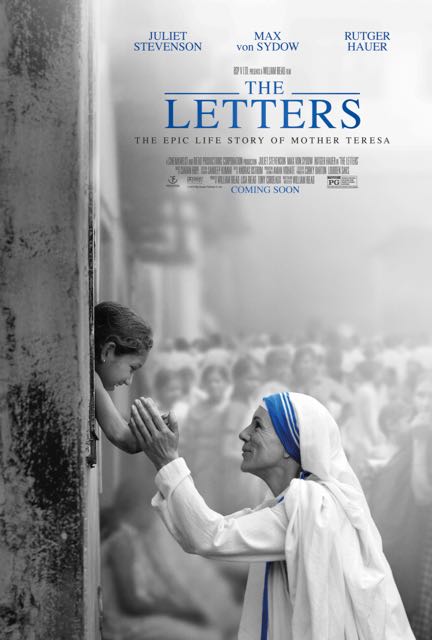
Mother Teresa, the Albanian nun who devoted her life to “the poorest of the poor” in India, is one of the foremost figures of the 20th century, and on the way to being recognized as a saint by the Catholic Church. Some people are disturbed by discovering through her published letters that at times she felt doubts about herself, her work, and even about God. But it was that same resolute honesty that compelled her to follow her calling and it would be more disturbing if she never doubted or if she doubted and did not feel she could express it. Her accomplishments are even more impressive once we learn how fiercely she wrestled with God.
In “The Letters,” Juliet Stevenson plays Mother Teresa, from her early days as a nun to establishing her own order. At first, in the convent in India, she is teaching young girls in starched uniforms who sit quietly and are eager to learn. But she receives “a calling within a calling” and believes she has been called on by God to work with “the poorest of the poor.” Reconciling this determination with her vow of obedience and her dedication to humility is not easy. Persuading the people that she hopes to help that all she wants is to help them, not convert them, is not easy.
The tall actress Juliet Stevenson does a fine job as the tiny nun. Some people may object that the movie caters to those who are already believers. It does not question Mother Teresa’s greatness or her tactics and it elides over some of the controversies concerning the expansion of her operations and whether her faith-based approach was always best for the people she was helping. Some viewers will find the film slow, though for me that was one of its strengths. Writer/director Bill Riead makes sure that its quiet power is more like a prayer than a biographical portrait, a calling inside a calling inside a calling and one that its subject would find most suitable.
Parents should know that this movie’s themes concern work with the “poorest of the poor,” with extreme deprivation and illness.
Family discussion: What is the best way to help the “poorest of the poor?” Why did Mother Teresa want to help people who were not Catholic?
If you like this, try: “The Life Journey of Mother Teresa,” a documentary



 and the superb drama
  , and, if you don’t remember anything else, remember this: the heroes of his book, the small group that bet against the bankers, made fortunes. But so did the people who lost that bet. Everyone on both sides of these deals made a lot of money. Everyone else across the country lost a lot of money, jobs, and homes.
 ) the SEC had no authority to regulate these mortgage-backed securities. The agency that should have had jurisdiction was the Commodities Futures Trading Commission. When then-Chairman

 to Audrey Hepburn’s Oscar-winning
  . An urban myth that Queen Elizabeth II and her sister, Princess Margaret celebrated VE Day, the end of the WWII battles in Europe and the surrender of the Nazi forces, by mingling with the crowd, has been turned into a fantasy that the then-teenage princesses had a wild night out on the town. It’s sort of Cinderella in reverse.
 ) and his wife, also called Elizabeth (Emily Watson) are preparing for various ceremonies to recognize the end of the war, including a speech the King is to give on the radio just before the official end of hostilities at midnight. His daughters are the future queen Elizabeth (Sarah Gadon, with an endearing freshness and just a hint of steel), called Lilibet by her family, and the fun-loving Margaret (Bel Powley of “Diary of a Teenage Girl”). Although their father relies on them to be with him when he speaks on the radio, still a very difficult challenge for the man whose stutter was the theme of “The King’s Speech,” they persuade their parents to let them out just once, so they can mingle among the “ordinary people.” Elizabeth has never made a pot of tea, visited a public ladies’ room, or had a drink in a pub, all of which she will get to experience. She has never been spoken to in a familiar manner, and had to be reminded to remove her tiara by a footman who suggests it might rather give her away.