The Last Witch Hunter

The Last Witch Hunter

Posted on October 22, 2015 at 5:47 pm

D
Lowest Recommended Age: Middle School
MPAA Rating: Rated PG-13 for sequences of fantasy violence and frightening images
Profanity: A few bad words
Alcohol/ Drugs: Drinking, fantasy drugs
Violence/ Scariness: Extensive fantasy-style violence with many disturbing and grisly images
Diversity Issues: None
Date Released to Theaters: October 23, 2015
Copyright Summit Entertainment 2015

A witch would have to cast a spell over me to make me sit through this big, dumb, dull, dud again.

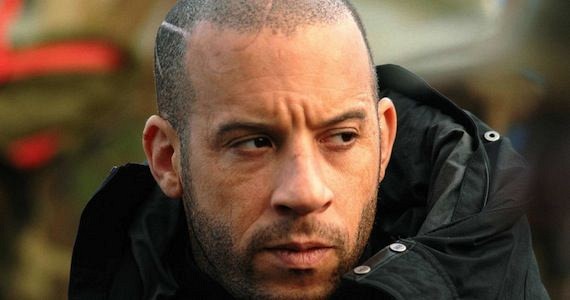
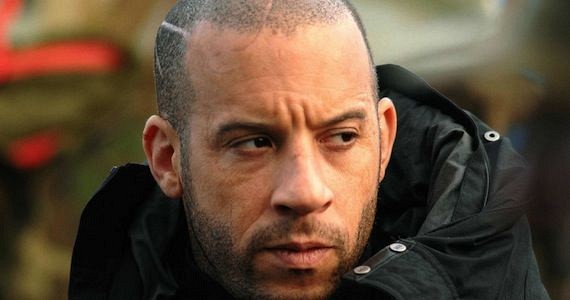
And that’s too bad, because I like Vin Diesel and I can easily be put in the mood for a good-stupid sword and sorcery epic. But not this one, which has a storyline we’ve seen before and dialog that sounds like it was written by people for whom English was not a first language, and probably not a second. It’s like a videogame, and not in a good way.

Diesel plays Kaulder, and we meet him 800 years ago, with long hair and a beard, he is part of a group determined to wipe out the witches who are responsible for the plague that has killed off many of their families, including Kaulder’s wife and daughter. “In her death lies our salvation.” “Let fear perish.” “You must go. You have to fight.” Not very memorable. Oh, let’s be real — it does not even qualify as dialog. It’s just talking.

With torches for light and swords, arrows, and axes for protection, they enter the witch’s cave. Things do not go very well and most of them are killed. Kaulder battles the witch, and as she dies, she curses him to live forever. We catch up with him in the present day, back to being the bald Vin Diesel we all know and love. He’s on an airplane being tossed around the sky by a fierce storm. He realizes that it is not only caused by magic but caused by someone who does not know she is causing it. A young witch with a backpack has carelessly tossed together ancient runes that should never be allowed to touch. (Kids!) “At least you didn’t get them wet,” he says, and we know that (1) the screenwriters have seen “Gremlins,” and (2) they’ll be wet before the end of the movie and the CGI folks will have a heck of a storm to kick up then.

The “Gremlin’s” idea is followed by a few borrowed from “Harry Potter,” “CSI,” and various other vastly superior sources, with some highly predictable twists and a sprinkling of semi-contemporary references. Well, the iPad reference is semi-contemporary. The use of the term “stewardess” and the assumption that they are all super-hot and excellent one-night-stand prospects is rather outmoded.

There are some pretty good special effects and some moderately good stunts, but Michael Caine is wasted as Kaulder’s human aide (about to retire, with Elijah Wood, also wasted, as his replacement). Rose Leslie has some nice moments as a young witch trying to make her way in New York, like she wandered off the set of “Girls.” Ultimately, the remixing of better (and just as bad) films becomes grating and by the time they set it up for a sequel, it is the audience is beginning to cursed for living long enough to sit through this film.

Translation: Sword and sorcery-style fantasy violence with some grisly and disturbing images including dead bodies, a few bad words and brief sexual references.

Family discussion: What would be the best and worst parts about living for 800 years? Why was it so hard for Kaulder to trust anyone?

If you like this, try: “Hansel and Gretel” and “Dragonslayer”

Related Tags:


Action/Adventure Epic/Historical Fantasy Movies -- format
Truth

Truth

Posted on October 22, 2015 at 5:03 pm

Copyright 2015 Sony Pictures

Often a movie “based on a true story” confirms and extends our understanding of what happened. This film, based on the “true story” that led to the departure of one of the most respected newsmen of all time, Dan Rather, from CBS, asserts its ambitions with its title and goes on to explore the very nature of truth and our willingness or ability to uncover and recognize it. I did not have strong views about what happened in 2004, just a recollection of the incident as a turning point, with the most respected broadcast journalist in the country being brought down by bloggers, who were able to determine that documents relied on in a story about President George W. Bush were forgeries. In my mind, the story was about the shift from old to new media, where the Davids of the blogosphere could challenge the powerful Goliaths of CBS News.

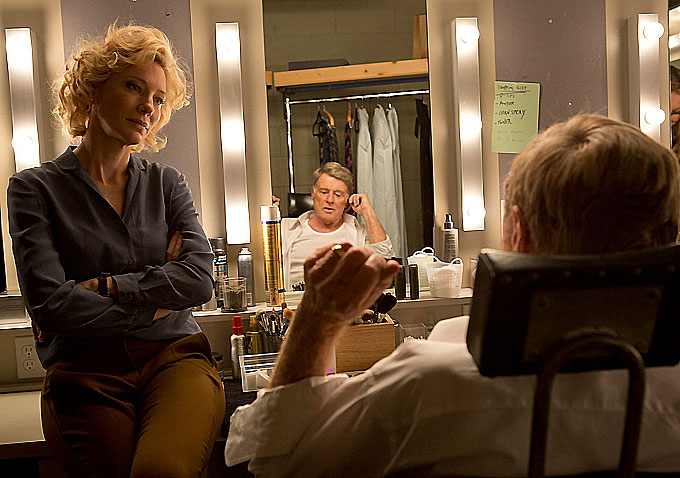
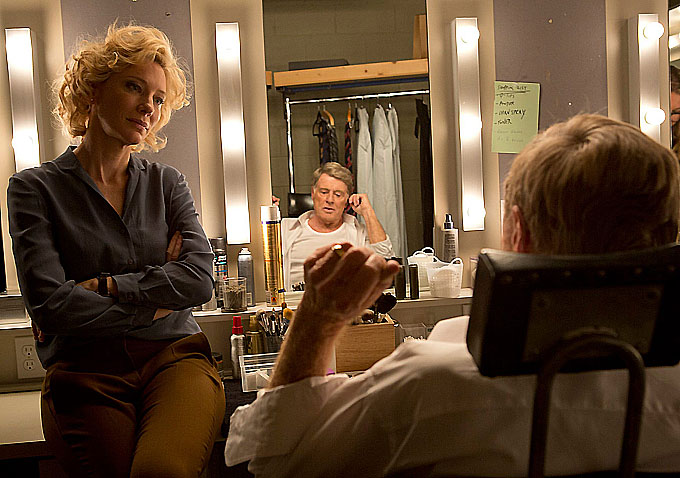
But in this movie, based on the book by Rather’s producer, Mary Mapes (Cate Blanchett, blazingly intelligent and forceful), we see another side of the story, written by James Vanderbilt. This is her version (if there is such a thing as versions) of the truth.

No matter which version of the story you believe, lesson number one of this movie is that you are at your most vulnerable when you feel most powerful. Mapes has just come off the greatest triumph of her career, the Peabody award-winning story about the horrific abuse of prisoners by the US military at Abu Ghraib. She is looking for another great scoop, and as the Presidential election approaches, it looks like she has one. Rumors about special treatment for George W. Bush, both in being allowed to serve in the National Guard and during his time there, have circulated for years, and now there seems to be substantiation, including on-the-record statements by the former Lieutenant Governor and some memos from the younger Bush’s commanding officer. Four document experts were called in by Mapes to authenticate the documents and, with the proviso that as photocopies there was no way to test the ink or paper of the originals to verify them completely, the experts signed off. The other steps taken by Mapes and the staff of reporters, including research expert Mike Smith (Topher Grace, who should be in more movies) and former military officer Dennis Quaid (ditto), are impressive. But it is possible that their supervisors did not ask enough questions and it is certain that moving up the broadcast date at the last minute cut off their ability to lock down all of the story.

And then it all fell apart. Bloggers identified problems with the memos’ fonts that indicated they were created on a computer, not a typewriter, and thus could not have been written in the 1970’s. CBS convened a commission led by a former (Republican) Attorney General to review the story. Their focus was not as much on whether the story was true or not (the memos were just one small part of the story) but whether the reporters had a political agenda.

A lot of people got fired. Smith makes a speech on the way out the door that identifies a culprit more insidious than partisan politics — corporate conflicts of interest. There are times when protection of shareholder value is not consistent with getting the story. The most important question this movie asks is what that means for democracy and for, well, truth.

Parents should know that this movie has very strong language and brief nudity in a photograph. Characters drink and take medicine to deal with stress. There are references to torture and child abuse and there are tense confrontations.

Family discussion: What should Mary have done differently? How did her childhood experiences affect her relationship with Rather and her response to her father? Should she have followed her lawyer’s advice?

If you like this, try two other fact-based films about journalists fighting to expose the truth about powerful people: “All the President’s Men” and “Spotlight

Related Tags:


Based on a true story Drama Journalism
Steve Jobs

Steve Jobs

Posted on October 22, 2015 at 5:01 pm

A-
Lowest Recommended Age: High School
MPAA Rating: Rated R for language
Profanity: Very strong language
Alcohol/ Drugs: References to drugs
Violence/ Scariness: Tense and angry confrontations
Diversity Issues: None
Date Released to Theaters: September 23, 2014
Date Released to DVD: February 15, 2016
Amazon.com ASIN: B0168UF2PS

Copyright Universal Pictures 2015

If you want a straightforward, fact-checked biography of Apple visionary Steve Jobs, watch Alex Gibney’s documentary, Steve Jobs: The Man In the Machine, or the Ashton Kutcher biopic (better than its reputation), simply titled Jobs. You can read the meticulously researched biography biography by Walter Isaacson. This film, directed by Danny Boyle and written by Aaron Sorkin, does to the traditional biographical movie what Jobs himself did to traditional ideas about computers. A lot of people won’t like that, but for me, after years of diligent, comprehensive and increasingly formulaic biographical films, my view is that of Patrick Henry (who might have been considered a candidate for Jobs’ “Think Different” ad campaign) — If this be revolution, make the most of it.

So, let’s get it straight from the outset. A lot of stuff in this movie didn’t happen or didn’t happen when and where it is shown here or between the characters who appear in the film. And no one in history, even Aaron Sorkin, can snap out dialog as dazzlingly crafted as this in normal conversation.

This is not a “and then this happened, and then there was this revelation, and then there was this setback, and then there was this triumph” sort of movie. This movie respects its audience enough to assume that either we already know the parameters of Jobs’ life or that if we do not know the details, we are more interested in the essence. Think of it this way. It is not a photograph of Steve Jobs; it is an abstract painting. Or, it is not Julie Andrews singing “My Favorite Things;” it is John Coltrane’s 14-minute meditation on the Richard Rodgers tune. This is pure cinema, and it is thrilling to watch.

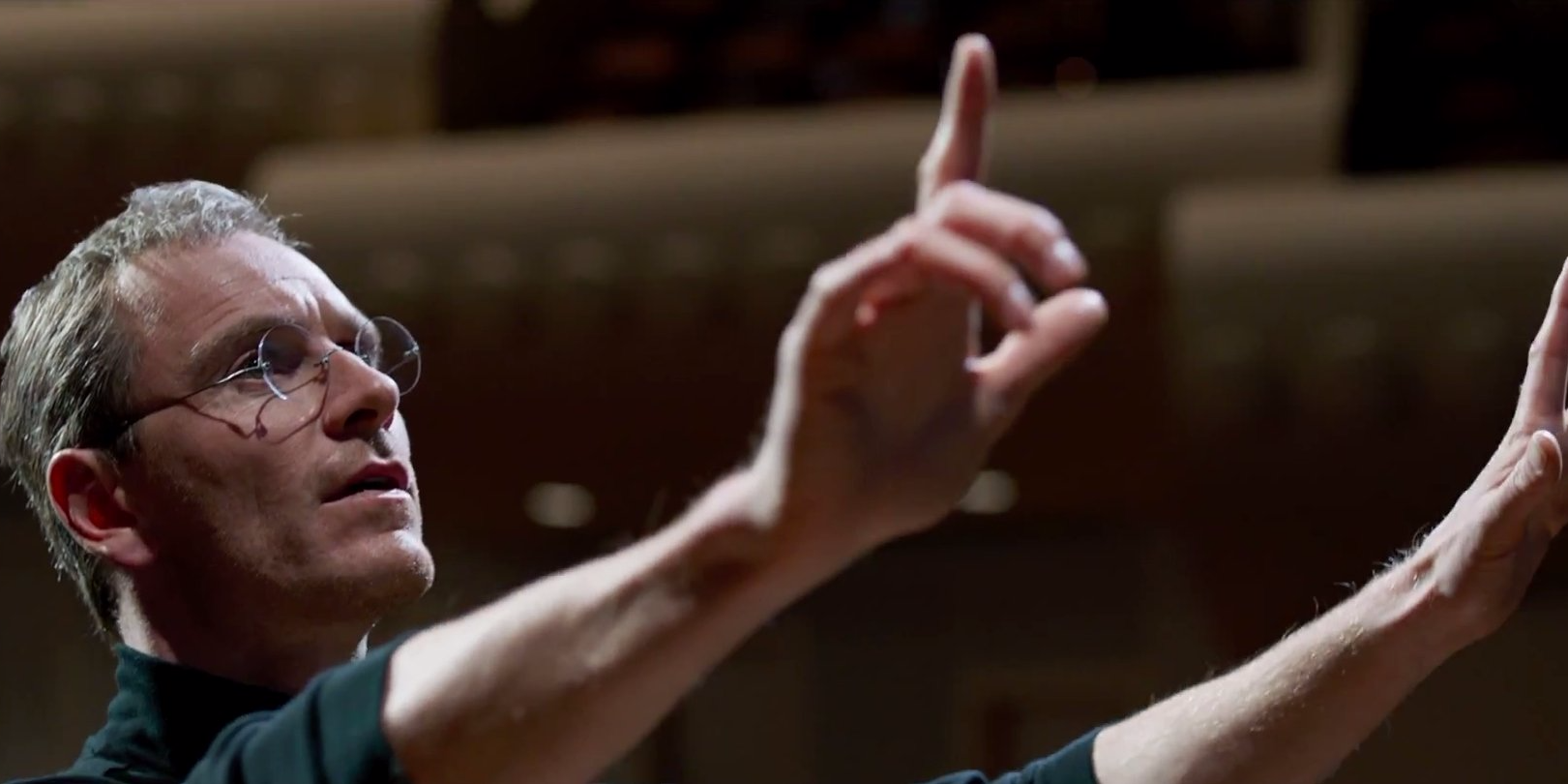
The movie takes place in three acts, three moments in real time, as Jobs (Michael Fassbender, capturing the fury, magnetism, brilliance, and shocking selfishness of the man). Jobs is backstage, preparing for three product launches: the Macintosh in 1984, the Next computer in 1988, and the iMac in 1998, after Jobs had been fired from Apple and then brought back in utter vindication to the company he co-founded. Each act is filmed (literally, mechanically shot) and scored to meld form and content.

Composer Daniel Pemberton wrote three entirely separate movie scores. The first was played exclusively on the technology of 1984. The second, reflecting the grand setting of the launch in San Francisco’s opera house and the operatic drama of the disastrous launch of a wildly overpriced product, is a full-scale symphonic piece with an Italian libretto (the lyrics are about machinery). And the third, with Jobs’ triumphant restoration to the role that meant everything to him, was composed entirely on Apple products.

Sorkin’s favorite tools are all here — hyper, rat-a-tat dialog as characters race around to meet a deadline, people who are superb at their jobs and lousy in their family and social relationships, and people who bring the trauma of their personal failures into the professional context (some vice versa as well). He moves people on and off stage at the pace of a door-slamming Feydeau farce. We see Jobs’ hyper-focus and grandiosity as he barks orders to (illegally) turn off the exit signs in the auditorium so the light won’t interfere with the total darkness he wants for the presentation and complains that he was not on the cover of TIME’s Man of the Year issue. He understands something important, not what people want because they do not know it exists, but what they will want. Computers are designed by engineers for engineers. He wants them to be not just tools but friends. He wants them — literally — to say “hello,” to be so “warm and playful” that English majors and bakers and fire fighters and musicians will want to use them. He wants an ad campaign that tells people they (all) can “think different” like Jim Henson (perfect for a generation that grew up on “Sesame Street”) and Cesar Chavez by using his products. And he wants to “make a dent in the universe.”

People who make a dent in the universe usually do serious damage to their relationships. We see that through the years as Jobs battles with his ex-girlfriend (Katherine Waterston), cruelly denying paternity of their daughter Lisa, with his longtime partner, Steve Wozniak (Seth Rogen), his programmer (Michael Stuhlbarg), and with the professional manager he brought in to run the company, Pepsi’s John Sculley (a very sympathetic Jeff Daniels). He agonizes over the double rejection of being put up for adoption and then being brought back by the first couple who tried to adopt him. He talks to Lisa about two versions of the song “Both Sides Now,” a double double. And, crucially, he knows going into the first two launches that both will be disasters.

The film opens with archival footage of another visionary, Arthur C. Clarke, predicting the future of computers. A movie like this is what helps us understand the future of humanity.

Parents should know that one of the themes of this film is a disputed paternity test and failure to meet the financial or emotional obligations of a parent. There are references to neglect and drug usage and some tense and angry confrontations.

Family discussion: What did the revelation about the TIME cover mean to Steve Jobs? What was his most important contribution and what, at the end of his life, mattered most to him? Should he have thanked the Apple II team?

If you like this, try: the Gibney documentary, the Isaacson book, and “The Social Network”

Related Tags:


Biography Drama DVD/Blu-Ray Pick of the Week

Tales of Halloween

Posted on October 16, 2015 at 5:25 pm

B-
Lowest Recommended Age: Mature High Schooler
MPAA Rating: Rated R for strong bloody horror violence throughout, language and brief drug use
Profanity: Very strong language
Alcohol/ Drugs: Drinking, brief drug use
Violence/ Scariness: Extensive and grisly violence, characters injured and killed, many disturbing images
Diversity Issues: Diverse characters
Date Released to Theaters: October 16, 2015

True to its name, “Tales of Halloween” is a collection of ten short horror stories of the type that Boy Scouts might tell around a campfire late at night. That’s both its strength and weakness.

The movie begins on Halloween night in a small town, where a radio announcer (Adrienne Barbeau, legendary horror star making a meta point) introduces us to a series of spooky goings-on about town. What follows are ten short films by ten different directors about monsters, murderers, devils and demons. Most of the directors are veterans of the horror genre with a genuine affection for the medium. Neil Marshall (writer and director of the 2005 horror film, “The Descent”), Paul Solet (writer and director of the 2009 horror film “Grace”) and Lucky McKee (writer and director of the 2002 horror film “May”) all do their best with limited budgets. Director Darren Lynn Bousman creates an enjoyable story of a trick-or-treater who inadvertently plays a trick on the devil.

These stories are short on depth, plot and dialogue. They are long on the kind of revenge fantasies that appeal to adolescent boys. Parents who steal their kids’ Halloween candy late at night, mean baby sitters and neighborhood bullies all meet terrible fates (usually involving buckets of blood). Many of the tales are more “icky” or “gross” than serious horror stories. Some moments turn out to be more laughable than frightening. But there is a kind of cheerful innocence and simplicity to these stories that will endear them to their target audience. It will not help the film’s marketers that most of that audience will be to young to see a film that is rated R for “strong bloody horror violence throughout, language and brief drug use.”

In a 92 minute movie, there is not much time to develop each individual story. This film is not destined to become a Halloween classic but the eclectic combination of directors, actors and costume designers manages to produce some interesting moments. Some segments stand out for their low budget creativity or for unusual twists and turns. The attitude of the film is displayed in the closing credit, “No animals were harmed in the making of this film, but we sure did kill a lot of pumpkins.”

Parents should know that this is a very scary film with many disturbing images and a lot of violence, as well as drinking, drugs, and very strong language.

Family discussion: Which episode do you think was the scariest? Which villain was the most convincing? Is it important in horror to believe the victims deserved their fates?

If you like this, try: “Dead of Night”

NOTE: I am proud to disclose my conflict of interest — my daughter, Rachel Apatoff, designed the costumes for one of the segments, “The Weak and the Wicked,” clearly the highlight of the film!

Related Tags:


Horror Movies -- format Thriller
Bridge of Spies

Bridge of Spies

Posted on October 15, 2015 at 5:58 pm

Following World War II, Lord de l’Isle and Dudley was harshly criticized when he organized a legal defense fund for a Nazi general. He responded, “Had I met General Manstein during the war I would have shot him on sight. I am not concerned with whether von Manstein is guilty or not…I want Britain’s reputation upheld.”

Copyright Touchstone 2015

Like the nobleman, American insurance lawyer Jim Donovan (Tom Hanks) understood that it means nothing to win a war against tyranny if we then become tyrants ourselves. Donovan, an assistant to future Supreme Court Justice Robert Jackson at the Nuremberg Nazi war criminals trials who had been litigating insurance claims, was asked to defend an artist accused of spying for the Soviet Union. No one would have complained if he provided a less than vigorous defense. His wife (Amy Ryan) worries about the impact that his defense of an enemy spy will have on their family.

But Donovan had two fundamental principles. First, he recognized that the spy was doing for his country what others were doing for the US and he deserved to be treated as we would want our spies to be treated when they got captured. Second, he understood that if even one small rule was bent or one small step was skipped, it could do more damage to the essential principles of justice that define us than the theft of nuclear secrets.

Those secrets were hidden in a hollowed-out nickel. And the man who had them was a British artist named Rudolf Abel, superbly played by Broadway star Mark Rylance with wry resolve. There is a running joke in the film as he is repeatedly told he does not seem nervous or scared and he replies, “Would it help?” Donovan does his best to defend Abel, taking the case all the way to the Supreme Court to argue that the evidence against Abel was taken in violation of the 4th Amendment protection against unreasonable search and seizure. He is unsuccessful in the appeal but does manage to persuade the judge (in a dramatic but highly unlikely and completely illegal ex parte visit to the judge’s home) not to impose the death penalty.

That comes in handy a few years later when American pilot Francis Gary Powers (Austin Stowell) is shot down over the Soviet Union in what the United States calls a mistaken detour by a “weather plane.” But he was flying a spy plane outfitted with special cameras for the CIA. The US wants him back. So they call on Donovan.

Meanwhile, as the Berlin Wall is being constructed, an American PhD candidate named Pryor (Will Rogers) found himself on the wrong side and was captured and accused of spying by the East Germans. Donovan’s government contacts tell him not to worry about Pryor, but Donovan is determined to get both young men home.

Spielberg and Hanks are an unbeatable combination, and their work here, with an unironic and sincerely gripping screenplay by Matt Charman and the Coen brothers, is as good as it gets. Donovan’s time in Berlin, crossing back and forth over the dividing line as the wall is being built — and as people trying to escape are being shot — is so evocatively cold, physically and emotionally, you will want to button your coat and you will feel for Donovan, who loses his to thugs on the East German side. The nuclear age minuet of politics, statecraft, diplomacy, and ego is tense and compelling. As Donovan warns, any mistake they make could be the last one. Spielberg’s signature touches include scenes of American schoolchildren watching real-life “safety” movies telling them to duck and cover and a quick glimpse of a wrenching parallel as Donovan sees children at recess, climbing in a way that echoes the desperate escape attempts he had just seen. It is too bad to see Ryan underused in a “honey, I’m worried — maybe you better not go” role, with a superfluous coda scene at the end. But the movie is still one of the best of the year, with a stunning sequence when Powers is shot down and sheer masterful storytelling.

Parents should know that this is a cold war story of spies with threat of atomic bombs, shooting down a spy plane, and extensive tension and peril including guns and abuse of prisoners, drinking, smoking, and brief strong language.

Family discussion: What do we learn about Donovan from his negotiation over the insurance payout? Why did he insist on including Prior?

If you like this, try: “13 Days” and Donovan’s book about the negotiation, Strangers on a Bridge: The Case of Colonel Abel and Francis Gary Powers

Related Tags:


Based on a true story Drama Spies
THE MOVIE MOM® is a registered trademark of Nell Minow. Use of the mark without express consent from Nell Minow constitutes trademark infringement and unfair competition in violation of federal and state laws. All material © Nell Minow 1995-2026, all rights reserved, and no use or republication is permitted without explicit permission. This site hosts Nell Minow’s Movie Mom® archive, with material that originally appeared on Yahoo! Movies, Beliefnet, and other sources. Much of her new material can be found at Rogerebert.com, Huffington Post, and WheretoWatch. Her books include The Movie Mom’s Guide to Family Movies and 101 Must-See Movie Moments, and she can be heard each week on radio stations across the country.

Website Designed by Max LaZebnik