“Without this,” Clark Wang says, “dying from lymphoma feels so empty and meaningless and pointless.” Dr. Wang was diagnosed in 2003, and we meet him as he is running out of options for treatment. His doctor tells him it is a matter of months. His choice for making his death meaningful is to seek out a “green” burial. He persuades a local cemetery to preserve a tract of forest instead of cutting it down to extend the lawn area. He finds someone who can make a coffin coffin for him out of reclaimed wood. We see him try it on for size, joking that “I’m going to be here for a while.” He approves. “It’s the exact style that I want to go out in.” And, in a moment of both celebration and defiance, he dances on its cover.
“A Will for the Woods” is a documentary about the small but urgent movement for eco-burial. But its focus on Dr. Wang, a psychiatrist and musician, makes it a profound statement about death and therefore about life. While some people in the film speak in euphemisms and indirection, and even Wang himself uses terms like “burial is a very likely outcome,” the way that he and his partner Jane confront what is happening to maintain a sense of dignity, honesty, and control is both moving and inspiring. It is not surprising that this film has won audience awards at four film festivals so far.
“It’s comforting to know I’ll be in such a beautiful place,” Wang says. He speaks of learning to “befriend death,” to make sure that his last act is not an act of pollution. Jane tells him what she will do after he dies, how she will wash his body and spend time with it, caring for him in a way he can no longer care for himself.
This is a touching film and a very important one. It is about dying with dignity, but it is also about living with grace. Just as Dr. Wang approached his own death with purpose and honor, the filmmakers have done the same in telling his story and making it ours as well.
Everything I said about the last two “Expendables” movies, blah blah, with some new additions from the AARP branch of the action heroes club: Harrison Ford, Antonio Banderas, Wesley Snipes, and Mel Gibson, plus a couple of Expendable interns to bring down the median age a bit.
Sylvester Stallone got the gang back together for one more Over-the-Hill gang run-with-a-gun-fest. Once again, he plays Barney Ross, as one of those guys who is most comfortable when he is least comfortable. One of these guys, given a chance to sleep in a bed, puts the bedspread down on the floor and settles in for the night. Barney and the gang are the guys you call when you need the impossible and off the books. I need to point out, however, that it isn’t too hush-hush as Barney’s first meeting with Drummer (ah, the machismo of these names), the CIA big shot played by Ford, replacing Bruce Willis as Church. (There are a couple of cracks about Church, directed at Willis, who reportedly asked for too much money to be in this film.) Barney and Drummer have a nice chat about all the black ops stuff in a hospital parking lot.
Who cares whether it makes sense? We’re here for the stunts and explosions and they are fine. It’s the winks to the camera and the manly quips that are hard to take. Note to the hard-core fans of hard core, however: while the first two films were rated R, this one is PG-13. Which means, basically, just one f-word and less blood.
Despite their name, of course each and every one of the team is vitally important to Barney, and he has a collection of dog tags from those who didn’t make it hanging in the plane like sad little wind chimes. Barney hates to put people in danger, which is something of an occupational hazard when you are in the tough guy business. When one of his team is hit hard, he fires everyone else and brings in new recruits, which (1) gives us a chance to see him hopping around the world with Kelsey Grammer as his talent scout, for one of those “Magnificent Seven,” “Oceans 11” let’s see what these guys can do episodes, and (2) gives them a chance to cast some people audiences under age 25 might recognize, including boxer Victor Ortiz of “Dancing With the Stars,” Kellan Lutz of “Twilight,” and MMA champion Ronda Rousey. Conveniently, each of them can do two things: fight and hack computers, fight and Parkour, fight and rock a mini-skirt, etc.
They’re going after a bad guy played with way too much relish by Mel Gibson, as though he is saying, “You want to hate me? Bring it on!” Of course he is impossible to find and surrounded by armies of security. And Drummer wants him brought back alive. But this is what Barney does. So, he takes his padawans and pretty soon they’re jumping out of plans and exchanging manly quips. And they’re showing old Pops a thing or two about using computers and being in the 21st century. It works out just fine until it doesn’t, and it’s time for the old folks to come in and save the day.
It’s fun to see these old guys in action, and it gives you a lot of bang-bang for the buck.
Parents should know that this movie includes some strong language and crude insults, extensive and graphic violence with knives, guns, fights, explosions, and many characters are injured or killed.
Family discussion: How did the two generations of Expendables differ? Why did Drummer and Galgo care so much about getting into the fight? Why did Barney take off his protective gear?
If you like this, try: the earlier “Expendables” movies and the 1980’s action films featuring these stars
Rated R for language including sexual references, some graphic nudity, violence and drug use
Profanity:
Very strong and crude language
Alcohol/ Drugs:
Drinking, marijuana, meth
Violence/ Scariness:
Law enforcement peril and violence, guns, many characters injured and killed
Diversity Issues:
Diverse characters, some racial, sexist, and homophobic humor
Date Released to Theaters:
August 15, 2014
Copyright 2014 Twentieth Century Fox
Oh, let’s not.
As generic as its name and way too long, any significant connection “Let’s Be Cops” has with its audience comes from the increasing sense of regret that this talented cast wasted its time — and ours.
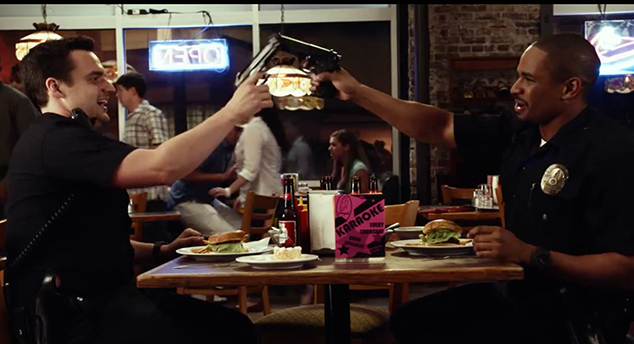
The title is the elevator pitch. Two hapless losers dress up as cops, like the respect and sense of power they get, and decide to wear the uniforms some more so that they can order people around and get past the velvet rope at a nightclub. And impress a girl.
Highly likeable “New Girl” co-stars Damon Wayans, Jr. and Jack Johnson play Justin and Ryan, 30-year old Perdue alums and roommates who are reminded by a reunion party that they have not accomplished very much. Justin has a low-level job at a video game company and is too shy to get the attention of the boss for the new game he has developed, which is about a policeman. That’s why he has a couple of authentic uniforms on hand. Ryan is a sometime actor who — wait for it — is living off the residuals he got for a herpes medicine commercial. Oh, my sides!
The un-dynamic duo misunderstand the invitation to the reunion party and arrive in costume to find everyone else in business attire with masks. Why? No reason except an improbable basis for the even more improbable premise. They leave, embarrassed, but when people on the street believe they are real cops, they think it is a lot of fun. Justin is ready to walk away, but Ryan gets into character, watching YouTube videos to learn police lingo and skills. Pretty soon, Justin is impressing a pretty waitress (“Vampire Diaries'” Nina Dobrev) and Ryan is messing with some guys who crunched his car. It is obvious that these are very scary gangsters, but of course Ryan has no clue and Justin is having way too much fun engaging them in a law enforcement version of Simon Says to pay attention.
The rest of it plays out exactly the way you’d imagine, with the only bright spot Key & Peele’s Keegan-Michael Key hilarious appearance as a tattooed low-level driver for the bad guys, sort of the fake cops’ Huggy Bear. His too brief-appearance only reminds us of the comedic chaos this film is missing. The funny parts aren’t funny enough (Really? Wrestling a naked fat guy? Wasting Rob Riggle as a straight man? Being high on meth? Flirting with a drugged-out floozy?). The action parts aren’t exciting enough. The big surprise twist is neither big nor a surprise. Gene Siskel used to say that the movie should be better than watching the same actors talk over lunch. This one doesn’t come close.
Parents should know that this film has strong and crude language, sexual references and situations, male and female nudity, violence and peril with characters injured and killed, alcohol and drug use (marijuana and meth).
Family discussion: How did Justin and Ryan differ in their thinking about pretending to be policemen? How did their experiences change their ideas about what they were capable of?
If you like this, try: “The Other Guys” and “The Heat”
Rated PG-13 for a mature thematic image and some sci-fi action/violence
Profanity:
Some strong languge
Alcohol/ Drugs:
Citizens are required to take drugs to make them submissive
Violence/ Scariness:
Sci-fi-style apocalyptic violence, murder, peril, characters injured and killed
Diversity Issues:
A theme of the movie
Date Released to Theaters:
August 15, 2014
Date Released to DVD:
November 24, 2014
Amazon.com ASIN:
B00MU2P0HO
Copyright 2014 The Weinstein Company
“Thank you for your childhood.” Are there any more fearsome words in literature than these?
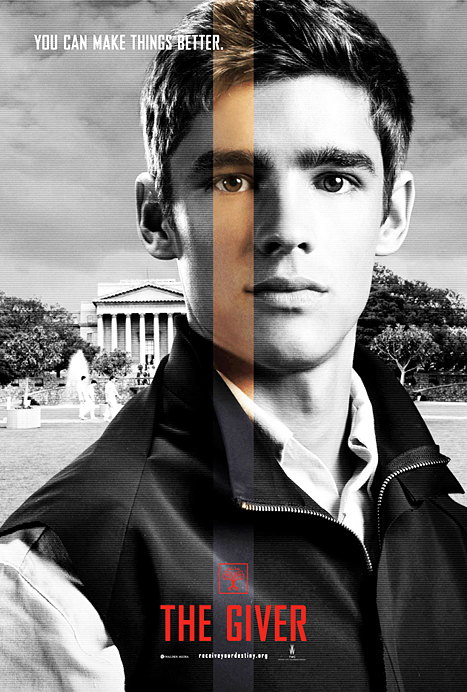
Lois Lowry’s The Giver is a Newbery Award-winning novel, a staple of middle school reading lists and book reports. It tells a dystopian story of a post-apocalypse society that is pleasantly courteous on its surface, but rigidly regimented and ruthlessly enforced. As children come of age and are assigned to their future careers by the all-powerful elders (who will later assign their mates and children as well), they are thanked for their childhood, words that sound grateful and polite, but which imply that all lives belong to the community, which demands that childhood be somehow contributed. And, it clearly communicates that whatever freedoms or pleasures of childhood exist in this society, they are now in the past.
“From the ashes of the ruin,” we are told, “the communities were built” and “true equality” was achieved. Whoever designed these new communities made the decision that human life could only continue if all memories of the past were erased, so that the sources of catastrophic conflicts — individual and cultural differences, were wiped out, along with the freedom to chose that inevitably leads to jealousy, anger, and struggles for power. Fear, pain, envy, hatred, are all gone. So are colors. We see their world through their eyes, muted greys, no color, no music, no art. There is constant discussion of “precision of language,” but it is just a way to eliminate words that describe strong emotions or complicated concepts, while genuinely imprecise words like “elsewhere” and “release” are euphemisms for dire and tragic consequences. People “apologize” all the time but there are no real regrets and the “I accept your apology” responses are just as perfunctory.
Three friends, the serious Jonas (Brenton Thwaites), fun-loving Asher (Cameron Monaghan), and kind-hearted Fiona (Odeya Rush) are about to receive the thanks for their childhoods and be assigned their jobs. Jonas is worried but his “parents” (a couple assigned to each other and handed babies from a collective nursery) reassure him that the Elders will make a good assignment, whether it is as a laborer, a nurturer (caretaker of infants and elderly), a lawyer (like his mother), or one of the other jobs that keep the community going.
But at the assignment ceremony announcements, Jonas is skipped over. Only when everyone else has been assigned does the Elder (Meryl Streep in Very Serious Hair) tells the group that Jonas has been selected for a very important job. The founders of this post-Ruin society erased all memories of the past but recognized that there might be some circumstances when mistakes could be prevented by reminders of past failures. And so, it turns out, one isolated member of society is designated to be the repository of memories. Jonas has been selected to be his successor. He tells Jonas that because he is transferring the memories, he is The Giver (Jeff Bridges). There is a lot of pressure on The Giver and Jonas because a previous effort to find a new keeper of memories (a small role for Taylor Swift, unglammed and made under) failed.
The story retains its power, despite an uneven translation to screen, in part because the book has been so influential that its ideas are no longer as innovative. There is now an entire literary genre about repressive dystopian societies where it is up to an exceptionally attractive and very brave and talented teenager to save the day: Divergent, The Hunger Games, and the upcoming “The Maze Runner.” Those stories have some similarities — the imposition of sometimes-fatal assignments by all-powerful adults, the rigidity and corruption of the society. But the other stories are more inherently cinematic than The Giver, with a lot of the interaction here limited to conversations. The muted emotions and colors are better imagined by a reader than watched as a viewer. Streep and Bridges give uncharacteristically one-note performances in one-note roles. Only Alexander Skarsgård as Jonas’ “father,” a nurturer in the facility where all the newborns are kept for the first year, gives his character some nuance and complexity, particularly in one very difficult scene that shows Jonas just how ruthless the seemingly placid and egalitarian community really is.
Indeed, that is one of the few scenes that seems to come alive. On film, the book falters, more weighted by ideas than by story or character. Despite the gifted work of production designer Ed Verreaux, whose setting convey placid exterior and deeper menace and director Philip Noyce, who uses music and color to deepen the emotional resonance, the film still feels thinly conceived. The Giver can transmit tumultuous events and powerful emotions with a touch. But the audience never achieves that visceral connection.
Parents should know that there is disturbing dystopic material in this story including peril and attacks, murder of people deemed unwanted or superfluous and mandatory drugging of the entire population, some graphic images, reference to adolescent “stirrings,” and a kiss.
Family discussion: If you were The Giver, what memories would you share and why? What are the reasons someone might think this was a better way for societies to function?
If you like this, try: “Pleasantville,” “The Hunger Games” and “Divergent” and the three sequels to this book by Lois Lowry.
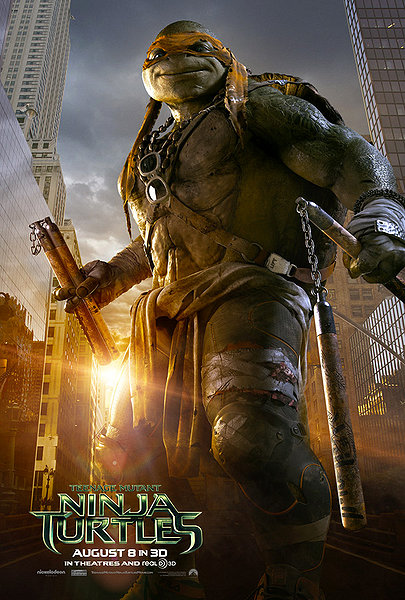
Dear Michael Bay,
Just because you were able to turn one Saturday cartoon series for children into a PG-13 blockbuster, based on nostalgia on the part of its now-teen and 20-something audience and some world class special effects, does not mean that you can do the same with the Teenage Mutant Ninja Turtles. This is less “Transformer” and more “Yogi Bear” or “Scooby-Doo.” In other words, step away from “Shirt Tales” and “The Wuzzles.” Please, just stop. Sincerely, The Movie Mom
Before it wore or, or, more accurately, wore down its welcome, the original “Transformers” was a refreshing surprise that kept the spirit of the original series. But even as a cartoon show, the Teenage Mutant Ninja Turtles were meta and self-referential and cutesy. I mean, just look at the concept: they’re turtles. And ninjas. And teenagers. You can blow them up into CGI behemoths, but they still can’t make a movie work, even by bringing back the original star of the first “Transformers” movie, Megan Fox.
Fox plays April O’Neil, a would-be investigative reporter relegated by her condescending colleagues to cutesy stories like exercising on mini-trampolines in Times Square. She would much rather be reporting on a powerful and merciless gang of criminals known as the Foot Clan. No one believes her when she says she saw a super-strong vigilante in the shadows, fighting the Foot Clan, including her editor (a “what is she doing in this movie?” Whoopi Goldberg). It turns out she has a connection to this mysterious crime-fighter. Her father was a scientist who died in a tragic lab accident as he was working on a special strength-giving serum by injecting it into four young turtles. The night the lab burned down, April rescued the turtles and a rat by letting them escape into the sewer.
A handy martial arts manual found in the sewer gives the rat, known as Splinter (voice of “Monk’s” Tony Shaloub) the chance to train the young turtles, and the effects of the injections make them grow up to be large, muscular, and able to stand upright. Each of the four has a different color mask and a Smurf-like individual personality quirk. But they all love pizza.
The action scenes are well-staged, especially a snowy chase scene, though I have no idea where the snow came from as we only see snow outside the city. But the script is lame and the violence is too intense for anyone old enough to be interested. A slumming William Fitchner plays an industrialist who is not as philanthropic as he seems. And the scenes with an even-more slumming Will Arnett (what happened to his career?), whose two functions are to drive April around and be generally skeezy about his interest in her, are just painful. April strives to be taken seriously as a journalist. Fox, sadly, fails to be taken seriously as an actress (which she really is — see “This is 40”).
And the title characters are under-used as well. For a movie about the TMNTs, they just don’t have enough to do beyond loving pizza and kicking bad guys. Whatever charm existed in the original cartoons is trampled by this over-blown bore.
Parents should know that this film includes cartoon-style action, peril, and violence, sad off-screen death of a parent, some brief disturbing images, some crude humor and a brief potty joke.
Family discussion: Why didn’t anyone take April seriously? Which turtle is your favorite and why?
If you like this, try: the TMNT cartoon series and the earlier films


 is a Newbery Award-winning novel, a staple of middle school reading lists and book reports. It tells a dystopian story of a post-apocalypse society that is pleasantly courteous on its surface, but rigidly regimented and ruthlessly enforced. As children come of age and are assigned to their future careers by the all-powerful elders (who will later assign their mates and children as well), they are thanked for their childhood, words that sound grateful and polite, but which imply that all lives belong to the community, which demands that childhood be somehow contributed. And, it clearly communicates that whatever freedoms or pleasures of childhood exist in this society, they are now in the past.