American Hustle

Posted on December 19, 2013 at 6:00 pm

american-hustle

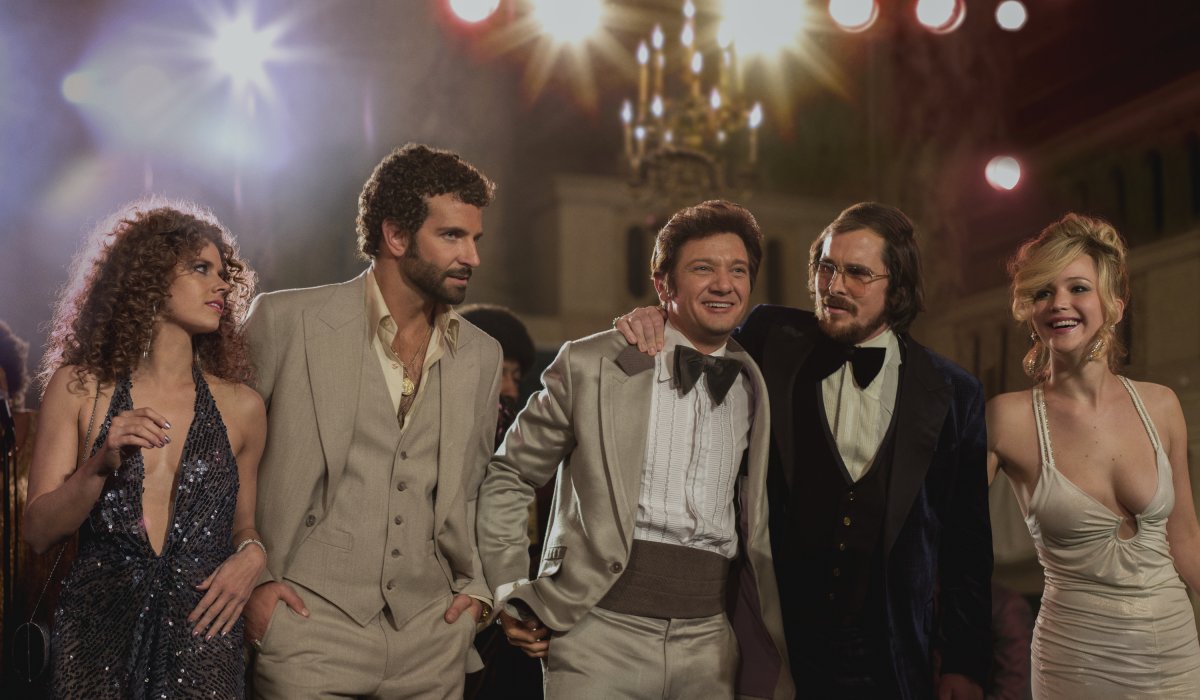
“Some of this actually happened,” the movie’s opening shot deadpans.  It is true that the United States government both threatened and paid a con man to help them con some bigger fish and then accidentally ended up conning some of the biggest fish ever caught — six US Congressmen and a Senator.  David O. Russell directed and co-wrote “American Hustle,” the story of 1970’s fraud, insanity, and betrayal, plus a lot of “what were we thinking” hair and clothes and a rockin’ soundtrack, from “Goodbye, Yellow Brick Road” to “How Can You Mend a Broken Heart,” “Does Anybody Really Know What Time it Is?” and the inevitable “Horse With No Name.”

The storyline has so many layers of double-cross, lies, betrayal, grandiosity, and sheer insanity that the audience may feel they are getting lost, but in a way, that is the point, and of course, that is the decade for it.  I mean, look at the home perm on Bradley Cooper, who plays the hotdog FBI agent Ricky DiMaso as something of a cross between Starsky, Hutch, and Huggie Bear.

And then there is the hair on Christian Bale as Irving Rosenfeld.  It can perhaps best be described as an edifice.  As the movie begins, we are treated to the painstaking assembly of his pompadoured comb-over, remarkable to witness and a dead-on detail that lets us know who we will be following for the rest of the film.  He is a phony, he is all about making the surface look better than it should, and  he will do whatever it takes to put forward the image that will sell whatever he is trying to sell. Ascot, check.  Pinky rink, check. Briefcase full of cash, check.

Flashback.  Rosenfeld is the master of at least half a dozen medium-sized scams when, at a party, across the room, he spies a beautiful woman.  It is Sydney Prosser (Amy Adams).  They share a love of Duke Ellington and a talent for re-invention.  “My dream” she tells us, “more than anything, was to become anything else than what I was.”

They cook up an almost-legal scam, taking  up-front fees on the promise of using their connections to obtain loans from some vaguely defined “London connections.”  All is fine until they get busted.  And DiMaso, intrigued by their world of deception, persuades them to work for him to bring down some big-time criminals.

But things get complicated and messy.  DiMaso’s boss (a terrific Louis C.K.)  is reluctant to have federal officers engage in criminal activities, even to catch other criminals.  One of the great joys of this film is when the boss keeps trying to tell DiMaso an ice-fishing story that never gets to the point because the hotheaded DiMaso keeps interrupting him.  Rosenfeld is married to an unhappy, volatile wife named Rosalyn (a dazzling performance of astonishing depth and mesmerizing assurance by Jennifer Lawrence) and stepfather to her son.  He has to find a way to resolve things with the FBI, the mob, and the politicians.

The unfinished ice-fishing story is the point.  This is not a nice, linear explanation for what happened.  This is a bunch of stories that intersect in a maze of all seven of the deadly sins plus a few that should also be on the list.  Brilliant performances by everyone in the cast (including Alessandro Nivola as an FBI official and an unbilled guest star as a guy from the mob) and a witty, insightful script are what hold it together.  Lawrence makes us furious at and sorry for her character at the same time, and she is sizzlingly funny.

The purpose of this film is not to illuminate the particular events of Abscam.  It is to meditate on the irrepressible American enthusiasm for self-invention and the thicket of betrayal and damage that can be the result.  It is about the stories we tell, even the ones like the ice fishing story that never get to make a point.  Russell himself can’t resist tweaking the details, making the characters more interesting and sympathetic than they really were.  But that wouldn’t be a good story.

Parents should know that this film has very strong adult material including constant bad language, explicit sexual references and situations, nudity, drinking and drug use, extensive criminal behavior and betrayal.

Family discussion: Who are the biggest con artists in this story?  How do the characters determine who deserves their loyalty?  Was justice done?

If you like this, try:  “Flirting with Disaster,” “The Fighter,” and “Silver Linings Playbook,” from the same director


Related Tags:


Based on a true story Crime Drama Politics Satire

Inside Llewyn Davis

Posted on December 19, 2013 at 6:00 pm

A-
Lowest Recommended Age: Mature High Schooler
MPAA Rating: Rated R for language including some sexual references
Profanity: Strong language
Alcohol/ Drugs: Drinking, drug use and drug overdose
Violence/ Scariness: A few punches, drug overdose
Diversity Issues: None
Date Released to Theaters: December 20, 2013
Date Released to DVD: March 10, 2014
Amazon.com ASIN: B00DVZ414C

Inside-Llewyn-Davis-cat

Oscar Isaac gives the best performance of the year as the title character in the most intimate and profound movie yet from the Coen brothers.  The story is set in the New York folk music world of 1961 and the Coens insisted on filming the songs live rather than pre-recording, and one of the wonders of this film is the way that Isaac makes each song more than a musical performance — each is a part of his characterization that tells us who Davis is and where he is on a week-long journey we will see in near Sisyphian terms.  The breaths and pauses are as much a part of the performance as the notes he plays and sings.  When he is not singing, Davis reacts very little, and one of the great pleasures of this film is seeing Isaac convey immense conflict and sensitivity to us in the audience while those around him see only his superficial expressionlessness.  In one scene, a doctor offhandedly gives him surprising news about someone else.  In that one moment he says almost nothing but conveys a dozen different emotions and questions and losses.  This is the story of a man who expresses himself only through his music.  But he does not have the gifts to make him successful enough to support himself or achieve any sense of security and acceptance.

The Coens like to put their central characters under a lot of stress, and in this film Davis must deal with disappointment and anger all around him and his own sense of frustration in not being able to honor the songs that are his whole world by making them as important to others as they are to him.  Ultimately, it becomes a larger story about the way all of us struggle to find meaning and a place for ourselves.  And all of that is to the heavenly music impeccably curated by T. Bone Burnett and performed by a cast that includes Justin Timberlake, Carey Mulligan, and Broadway’s Stark Sands.  The Coens also like to create physical environments that reflect the internal pressure (the peeling wallpaper in “Barton Fink” was almost another character).  Here, the re-creation of early 60’s Greenwich Village is relatively low-key and naturalistic, but there are still cramped corridors with impossibly acute vectors to amplify Davis’ external manifestation of the grungy world that seems to have no exit.

The film’s title, “Inside Llewyn Davis,” is the also the name of a record album made by the early 1960’s folk singer played by Isaac.  We first see him singing in a Greenwich Village club, performing “Hang Me, Oh Hang Me,” a song that “was never new and never gets old.”

The folk singers of the early 60‘s thought of themselves as truly authentic in a world where suburban materialism and conformity were idealized.  A movement that presaged and in some ways helped to spark the counterculture and protest of the late 60’s was, of course, inherently inauthentic itself.  Folk music is beautiful wherever it is sung, even in the kind of homogenized, commercial versions looked down on by Davis (and gently mocked in “A Mighty Wind”).  But what makes it authentic is that it is music sung by folk in their community, not by professional musicians in a New York club.  The essence of the struggle any artist — or any person — faces between integrity and selling out is explicit here.  Davis criticizes his friend and sometime lover as “careerist” for trying to get ahead in the music business.  But he himself makes a trip to an influential producer to see if he can get better bookings.  And as authentic as Davis may think he is, he is contemptuous the performances by a soldier and a woman from the country, both of whom arguably have a better claim to “authenticity” than he does.

Like all Coen brothers anti-heroes, Davis is a man under pressure.  He has nowhere to live, and sleeps on couches he scrounges from friends.  He seems to have no sense of gratitude.  He shows some sense of responsibility.  He spends the night at the home of a benign Columbia professor who loves his music, stopping to play a cut from the album he made with his former partner (Isaac sings with Marcus Mumford).  Then, when he is leaving, the professor’s marmelade cat slips out the apartment door just as it swings shut and locks behind him.  Davis scoops up the cat and takes him on the subway, calling the professor’s office to let him know the cat is safe.  He then drops the cat off at another apartment he often uses as a place to stay, the home of singing duo Jim (Justin Timberlake) and Jean (Isaac’s “Drive” wife, Carey Mulligan), where he finds out that Jean is (1) pregnant and (2) furious because it might be his.  He again responds responsibly, if not graciously.  And when Jim (of course not knowing anything about his relationship to Jean) arranges for Davis to get a quick gig as a session musician for a silly but irresistible little novelty ditty called “Please Mr. Kennedy,” he gives it his best.

We follow Davis over the course of a week, one frustrating encounter after another, with Jean, with the head of the tiny record label that produced his last record, a doctor who performs abortions, his silent father in a nursing home, his suburban sister, on a long ride to Chicago with a jazz musician (Coen brothers regular John Goodman) and his near-silent driver (Garrett Hedlund), a nerve-wracking audition with an important producer (F. Murray Abraham).  In each of them, Davis is subdued. He has feelings, but he expresses them in his music.  There is something in these ancient songs about death, betrayal, and injustice that touches his heart. Singing them is his deepest connection to himself.  “Just exist?” he asks his sister, when she suggests he give up folk music.  But even when he wants to give up, he can’t.

Davis knows that things seem hopeless for him.  He tries to slide his box of remaindered LPs under a table only to find an almost-identical box of another singer’s records there already.  He looks out of the car window at a highway exit that he and we know could lead to an important chance at connection and meaning.  We see around Davis what he cannot.  We see him make a decision as he leaves the recording studio that suits his purposes at the moment but that we know he will be bitter about forever. A young, tousled-hair singer goes on at the club and we know he will transform the world in a way Davis can not.  But in a very real and very satisfying way, the Coens and Isaac have reclaimed him for us with their own story that was never new, and never gets old.

Parents should know that this film includes strong language, a fistfight, references to sex, adultery, abortion, and suicide, drinking, smoking, and drug use and overdose.

Family discussion:  Why was it so hard for Llewyn to succeed?  What do we learn about him from the decision not to go to Akron?  From his heckling of another performer?

If you like this, try:  “Don’t Look Back” and “A Mighty Wind” — and the Showtime concert featuring the music from the film, “Another Day, Another Time”

Related Tags:


Drama DVD/Blu-Ray Pick of the Week Inspired by a true story Musical

Anchorman 2: The Legend Continues

Posted on December 17, 2013 at 6:00 pm

B+
Lowest Recommended Age: Mature High Schooler
MPAA Rating: Rated PG-13 For crude and sexual content, drug use, language and comic violence
Profanity: Strong and crude language
Alcohol/ Drugs: Drinking
Violence/ Scariness: Comic but graphic violence
Diversity Issues: A theme of the movie
Date Released to Theaters: December 18, 2013
Date Released to DVD: March 31, 2014
Amazon.com ASIN: B0083XXVFW

anchorman 2

Will Ferrell and his crew beat the sophomore slump with just the right mix of stuff we want to see again (yes, there will be jazz flute, a rumble with the other news teams featuring wildly improbable surprise guest stars and weapons, and a clueless character being yanked into a new understanding of women) and stuff that’s new (some surprisingly sharp satire about the current state of the news business and its origins in the shift to the 24 hour news cycle in the 80’s — and a twist on the infamous closet of potent man-scents featuring Sex Panther).

The first obligation of a sequel is to undo everything that happened in part one.  Ron Burgundy (Will Ferrell) and Veronica Corningstone (Christina Applegate), married, with a son, and sharing the anchoring duties in San Diego,  find their happily ever after ending torn asunder when their boss (the first of several surprise guest stars) promotes her to a network job and fires him as local anchor. He tries working as an announcer at Sea World, and is soon on the brink of losing that job, too.  Ron Burgundy was put on this earth to “have salon-quality hair and read the news.”  What can he do next?

Something happens that no one could have anticipated.  A zillionaire (think cross between Ted Turner and Rupert Murdoch) gets the idea for a 24 hour news channel.  And that means they’ll hire anyone.  Soon, Ron gets the band back together (Paul Rudd, Steve Carell, and David Koechner) and they’re on their way to two crazy destinations: New York and the 80’s.

“Anchorman” was not a huge hit when it was first released, but it has become, well, kind of a big deal, since it came out (especially unrated) on DVD.  It is one of those films that improves on repeated viewing, not because there are subtle jokes you miss the first time around but because its silly but good-natured humor make it particularly suitable for repeated viewings with friends reciting the catch phrases and acting out the goofiest bits.  That primes the audience for this next one, with a lot of silly, over-the-top comedy and “what were we thinking”-music, personalities, and styles of the era as in the first film.  (The terrific soundtrack includes classics like “Ride With the Wind,” “Muskrat Love,” “Feels so Good,” and “This is It.”)

In the original, the set-up was having the smug, macho world of the local anchors was invaded by a woman — and one who was vastly more intelligent and professional than they were.  This time, there is a woman who is not a subordinate or a peer; Ron Burgundy and his team have a new boss, Linda Jackson (Meagan Good).  She is not only a woman; she is black.  This provokes a whole extra layer of fear and fascination in Ron Burgundy.

Another difference — he is not the alpha male at the new station.  His team goes on the air in the middle of the night.  Prime time goes to the handsome and arrogant Jack Lime (James Marsden).  Ron rashly bets Jack that he will beat him in the ratings.

The sneaky genius of this movie is the way it makes sense out of Ron’s kind of genius response to this idiotic bet, and the way it explains pretty much everything that’s gone wrong with the world ever since. It turns out that the sense of superiority that keeps us laughing at Ron Burgundy may be overshadowed by his sense of superiority in laughing at us.

Parents should know that this film has very raunchy and explicit humor for a PG-13, with a lot of crude jokes and strong language, including bigotry humor.  Characters drink and use drugs and there is comic but graphic violence including a suicide attempt.  NOTE that there are alternate versions available including a much raunchier unrated version.

Family discussion:  Why was Ron so afraid of Linda?  Who should own the news?

If you like this, try: the original “Anchorman”

Related Tags:


Comedy DVD/Blu-Ray Pick of the Week Series/Sequel

Contest

Posted on December 16, 2013 at 9:42 pm

CONTEST_KA_R5.indd“Contest” more than makes up for some first-time-filmmaker shortcomings with its sincerity and unexpected strengths in the storyline and cinematography.

Tommy (Danny Flaherty) is a high school loner, often bullied by the swim team jocks led by Matt (Kenton Duty).  Both boys do not have parents.  Tommy lives with his grandmother (“The Good Wife’s” Mary Beth Peil), who owns a pizzeria.  Matt lives with his older brother Kyle (Kyle Dean Massey).

When security camera footage of the swim team throwing Tommy into the pool lets Matt in trouble, the assistant principal tells him that if he can make friends with Tommy and lead the anti-bullying campaign for 30 days, he can be reinstated in his extra-curricular activities.  Tommy is not interested at first, but when he is selected for a television teen cooking show competition and needs teammates to try for the $50,000 prize, he grudgingly accepts Matt’s help.

Meanwhile, the young, arrogant landlord who owns the pizzeria’s lease wants to get her out.  Tommy’s brother Kyle is given the assignment of making sure she cannot exercise her option to buy the property.

The young actors sometimes struggle with the material and the face-slaps from the all-female opposing team are unfortunate.  But the script is absorbing, with some unexpected twists, appealing characters (I especially liked the grandmother and the pretty blogger), and real insights into the origins of bullying and its impact on the bully as well as the victim.

Parents should know that this film concern bullying and includes some rough talk.

Family discussion:  Why do people become bullies?  How are the teens in this story like the adults around them?  What does Tommy mean about “flipping the switch?”  What changes Matt’s mind?

If you like this, try: “Mean Girls”


Related Tags:


High School School Stories about Teens

Saving Mr. Banks

Posted on December 13, 2013 at 5:17 pm

Saving Mr BanksFor most of this story, Walt Disney (Tom Hanks) and P.L. Travers (Emma Thompson) are on opposite sides.  He has been trying for twenty years to persuade her to let him make a movie based on her books about the magical nanny, Mary Poppins.  She needs money, as her agent reminds her, which is why she has very reluctantly agreed to leave home and fly to Los Angeles to talk to him about it.  But she cannot bear the idea of losing control of the characters who mean so much to her and she abhors everything about Disney and California, including sunshine, cheerfulness, twinkling, music, and calling people by their first names.

But there is one moment when, in the midst of some obvious culture clash jokes, there is a quiet moment that shows they are both on the same side.  Disney tells Travers that he was in her position when someone wanted to pay him for Mickey Mouse and he simply could not bear the agony of allowing anyone else to make decisions about a character he had created.  Travers says that Mary Poppins and the Bankses are her family.  But in a very real way, the character these artist created are their own very souls.  “We restore order with imagination,” Disney tells her.  And, engagingly, throughout the film we see the process, the inspiration, the despair, the triumph, the necessity of creating art, from a father soothing his little girl with a story to songwriters puzzling out a way to show Mary Poppins’ upside down world by having the tune go up as she sings the word “down.”

We all know how it turned out.  Disney’s “Mary Poppins,” celebrating its 50th anniversary next year, is one of the beloved and honored family films of all time, with five Oscars (Best Actress, Song, Special Effects, Score, and Editing) and eight more nominations.  But anyone who has read the books knows that there are some major departures from the Travers version, and that the fears she expressed — as documented in tape recordings of her sessions with the screenwriter and songwriting team — were more than justified.

Some people have criticized this film as Disney’s burnishing of its own brand, with its founder portrayed as a decent man who is just trying to keep a two-decade old promise to his daughters to make a movie from one of their favorite books.  Amy Nicholson writes in LA Weekly that “Saving Mr. Banks” is “a corporate, borderline-sexist spoonful of lies.”  She says that Thompson’s “Travers is as unpleasant as a pine needle pillow, and she’s as far away from the actual woman as ‘supercalifragilisticexpialidocious’ is from being a real word” when in fact she was a “a feisty, stereotype-breaking bisexual.”  I think this is a misreading of the film’s attitude toward Disney, Travers, “Mary Poppins” (the movie), and what it means to be a creative person in a world that is very imperfect when it comes to assigning monetary value to art (see also: “Inside Llewyn Davis”).  To come to Nicholson’s conclusion, one has to assume that the movie wants us to believe that Disney somehow outsmarted Travers by improving her work.  On the contrary, the movie makes it clear that the movie Mary Poppins was very different from Travers’ idea of the characters, moving them several decades earlier, for a start, and, crucially, as indicated in the title of this film, transforming an episodic storyline about children’s adventures with a magical nanny into a story about parents discovering the importance of being close to their children.  It is Nicholson who underestimates Travers by suggesting she was somehow snookered.  She made a decision that it was worth it to her to let that happen to get the money she needed to be as financially independent as she wished.  As is shown in the very first scene, she could have made money another way — by writing more books about Mary Poppins, for a start — but she chose to consent to the movie, and then to make absolutely sure that no American would ever touch her characters again.

colin-farrell-saving-mr-banks-gintyWhile the cute culture clashes and Travers’ resistance to Disney’s brand of pixie dust are featured in the movie’s trailers, the film itself devotes a substantial amount of time to Travers’ childhood, clearly taking her very seriously as a woman and an artist.  We see her as a child dearly loved by the father she adored (a superb Colin Farrell), a man of great imagination and charm, but, perhaps in part due to those same qualities, not able to manage life as a banker in the far reaches of Australia. As we see him sink from manager at a bank to manager at a smaller bank to teller, fans of the Poppins books will remember her description of what Mr. Banks did at the office (it is not coincidental that he shares a name with his profession).  He “made money.”  Meaning that, at least in his children’s minds, he sat at his desk cutting out coins each day.  Some days he was able to cut out many, and the family was quite comfortable.  But other days he was not as productive, and there were fewer coins to go around.

We can see the origins of this idea and many other Mary Poppins book details in Travers’ past, a seemingly bottomless carpet bag, a crisp “spit spot” from an imposingly organized woman who arrives to put the household in order.  But the most telling detail from the past is the key to the invention of Travers’ most important character: herself.  Her name is not P.L. Travers at all.  Nor is she Mrs. Travers, despite her insistence that Mrs. Travers is what she prefers to be called.  The Australian girl who would grow up to be the ultra-English P.L. Travers is named Helen Lyndon Goff, called “Ginty” by her dad.  His name was Travers Robert Goff.  She took his first name as her last name and put a “Mrs.” in front of it to create the character she chose to be.  This revelation, and Thompson’s brilliant portrayal of Travers show us a woman whose most important creation was the character she pretended to be — or became.

And of course Disney, too, played a character, the folksy host who was going to entertain you no matter how hard you tried to resist, and very well aware that these qualities were his best assets as a businessman.  He insists on taking Travers to Disneyland (beautifully recreated as it was in 1961).  Disney is persuasive enough to get Travers onto the carousel and canny enough to tell her the truth — that getting her on a ride won him a $20 bet.  And he tells her a story about his childhood, showing that just because he promotes an idealized vision of the world does not mean that he is unfamiliar with its harshness and disappointments.

Thompson gives one of the best performances of the year, showing us the insecurity and humanity and wit of a woman who is far more complex than she wishes to appear.  Jason Schwartzman and B.J. Novak as the song-writing Sherman Brothers and Paul Giamatti as the limo driver are all excellent as characters who underscore the theme of art as a path to meaning.  The glimpses of the “Mary Poppins” movie are so entrancing (okay, I had to come home and watch it again and am still humming “Step in Time”) that it is easy to be temporarily distracted from the bittersweetness of the story.  Hmmm, where have I heard that idea before?

Parents should know that this film includes the very sad death of a parent, substance abuse, a suicide attempt, tense confrontations, and some disturbing images.

Family discussion:  What did Walt Disney and P.L.Travers have in common?  What do you learn about her from her relationship with the driver?  How can you take details around you and make them into a story?

If you like this, try: the Mary Poppins books by P.L. Travers and the Disney musical film and the documentary “The Boys,” about the Sherman Brothers

Related Tags:


Based on a true story Behind the Scenes Drama Family Issues
THE MOVIE MOM® is a registered trademark of Nell Minow. Use of the mark without express consent from Nell Minow constitutes trademark infringement and unfair competition in violation of federal and state laws. All material © Nell Minow 1995-2026, all rights reserved, and no use or republication is permitted without explicit permission. This site hosts Nell Minow’s Movie Mom® archive, with material that originally appeared on Yahoo! Movies, Beliefnet, and other sources. Much of her new material can be found at Rogerebert.com, Huffington Post, and WheretoWatch. Her books include The Movie Mom’s Guide to Family Movies and 101 Must-See Movie Moments, and she can be heard each week on radio stations across the country.

Website Designed by Max LaZebnik