Captain Phillips

Posted on October 10, 2013 at 6:00 pm

B+
Lowest Recommended Age: High School
MPAA Rating: Rated PG-13 for sustained intense sequences of menace, some violence with bloody images, and for substance use
Profanity: Strong language
Alcohol/ Drugs: Drugs
Violence/ Scariness: Intense, graphic, and disturbing violence including threats, torture, and guns
Diversity Issues: Diverse characters
Date Released to Theaters: October 11, 2013
Date Released to DVD: January 21, 2014
Amazon.com ASIN: B008JFUNKU

captain phillipsMemorable movie villains tend to fall into two categories: volatile and violent or sociopathic and megalomaniac. Both kinds are caricatures, sketched in exaggerated terms to justify our feeling of triumph when the hero prevails. But in “Captain Phillips,” the true story of a US merchant ship taken over by Somali pirates, the villain is far more real and far more terrifying. Somali native Barkhad Abdi stars as Abduwali Abdukhadir Muse, the leader of a group of four teenagers sent to hijack ships for ransom money by elders in their village. Muse is the scariest of villains, someone with no other options and nothing to lose. Abdi’s performance in his first acting role is stunning, terrifying, and heartbreaking.

An awkward opening scene shows Captain Phillips (Tom Hanks) is at home in Vermont, preparing for his trip and driving to the airport with his wife (Catherine Keener), with some clunky, exposition-heavy dialog intended to foreshadow upcoming unrest.  Once he gets to the boat, called the Maersk Alabama, director Paul Greengrass locks into the taut, intimate style he showed in “United 93” and two Bourne movies.  The ship has a crew of 20.  They have been warned about the possibility of pirates and have had some training in how to respond.  Phillips orders a surprise drill to make them practice their defensive tactics.  But this is not a military ship. They are carrying 17 metric tons of cargo.  Their primary tactics are diversion and their primary weapons are their firehoses.

At first, the firehoses work.  But then the Somalis get close enough to the ship to attach their ladder and climb aboard.  “I’m the captain now,” says Muse.  His lack of affect is chilling.

Director Paul Greengrass has an intimate, documentary style that keeps even those who remember the details of the real story on edge.  The pirates search the ship, looking for the crew like a nightmare game of sardines.  Phillips leads them around, genial and cooperative on the surface, but always thinking about how to impede them without making them angry.  When their boat is destroyed, they take one of the lifeboats, more like a capsule than a ship, and they take Phillips as hostage.  For four grueling days, Phillips has to try to keep calm and do what he can to help the US Navy, which is assembling its response.  Hanks goes deeper than he ever has before, ultimately reaching a place of wrenching vulnerability.

After a shaky start, Greengrass and his talented cast make this into more than a story of courage and resilience.  While he clearly has a point of view and never pretends that the pirates are justified, he allows us to understand their desperate circumstances.

Parents should know that this is the true story of a pirate attack on a US ship, featuring intense and disturbing scenes of threats, torture, and violence with some graphic images and dramatic emotional breakdown.

Family discussion:  What was Captain Phillips’ most difficult decision?  What was the most difficult decision for the US military in responding to the pirates? Do you disagree with any of their actions?

If you like this, try: “United 93,” another true story from the same director and Captain Phillips’ book, A Captain’s Duty: Somali Pirates, Navy SEALS, and Dangerous Days at Sea

Related Tags:


Based on a true story Drama DVD/Blu-Ray Pick of the Week Thriller

Romeo & Juliet

Posted on October 10, 2013 at 6:00 pm

William Shakespeare’s “Romeo and Juliet” is the most-filmed play of all time, with dozens of versions and variations from the sublime (the Franco Zeffirelli and Baz Luhrmann versions, “West Side Story” and “Shakespeare in Love”) to the outlandish (the cute Gnomeo and Juliet, the robot short “Runaway Robots! Romie-O and Julie-8”) and the downright ridiculous (Norma Scherer and Leslie Howard were in twice the age of the characters they were playing).  The story of the “star-cross’d lovers” has immediate appeal — impetuous teenagers, disapproving parents, missed messages, and swordfights.  All it needs to succeed is leads with a lot of chemistry and the ability to adapt to the rhythms of iambic pentameter and the glorious language of the greatest writer in the history of English.  This movie fails on all three.  The leads have no chemistry with each other or with the glorious poetry of the dialog.  And “Downton Abbey’s” Julian Fellowes has mangled the adaptation, changing some of the lines and scenes.  It is not a terrible movie, but it is not an especially good one and with so many better alternatives it is an unnecessary one.

It begins with a useless added scene in which the Prince (Stellan Skarsgård) holds a tournament to settle once and for all the dispute between the feuding Montagues and Capulets.  It doesn’t work.  Soon a fight breaks out between the servants of the two houses that are “alike in dignity” (the play’s first scene) and the Prince is furious.  If they cannot keep the peace, there will be trouble.  Romeo (Douglas Booth), a Montague, is in love with a Capulet cousin named Rosaline.  When he finds out that the Capulets are having a masked party and Rosaline will be there, he and his friends attend the party so Romeo can see her.

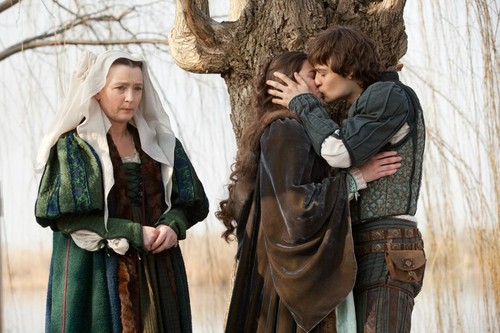
Romeo-and-Julliet-romeo-and-juliet-2013-34909054-500-333But Romeo sees the Capulet daughter, Juliet (“True Grit’s” Hailee Steinfeld), and they are instantly struck by love.  In the play, their perfect unity is demonstrated by their first conversation, witty flirtation in the form of an exquisite sonnet.  It is one of the best-loved pieces of writing in history.  Yet this version mangles it by ramping up the intensity of the attraction right from the beginning so there is no sense of build-up.  More important, the utter lack of chemistry between the very pretty but bland Booth and the game but not up to the task Steinfeld makes us long for Bella and Edward or even Bella and Jacob.

There are some strong performances, unfortunately just making the two main characters look worse by comparison.  Lesley Manville (“Topsy Turvy”) give the nurse a warmth that is often lost in the usual caricatured portrayals.  Natascha McElhone is a sympathetic Lady Capulet and Paul Giamatti is superb as Friar Laurence.  The standout, though, is Christian Cooke as Mercurtio, whose energy is much missed once he is out of the picture.

Most appallingly, Fellowes has decided to make the text more “accessible” with some trims and edits to the language.  The slight gains in “accessibility” are overwhelmed by the loss of the music in the words and the poetry of the rhythm.  I bite my thumb at him.

Parents should know that this movie includes Shakespearean sword-fighting with many characters injured and killed, sexual references and non-explicit situations, and suicides.

Family discussion:  Did the novice make the right decision?  Why couldn’t Romeo and Juliet tell their parents the truth?

If you like this, try: the other versions by Baz Luhrmann and Franco Zeffirelli and adaptations like “West Side Story” and “Warm Bodies,” a zombie romance where the characters are named R and Julie)


Related Tags:


Based on a play Classic Date movie Drama Remake Romance Stories about Teens Tragedy

The Snow Queen

Posted on October 10, 2013 at 5:00 pm

C-
Lowest Recommended Age: Kindergarten - 3rd Grade
MPAA Rating: Rated PG
Profanity: NOne
Alcohol/ Drugs: None
Violence/ Scariness: Fairy tale and fantasy peril and violence, guns, fire, parents killed
Diversity Issues: Strong female heroine and villains
Date Released to Theaters: October 6, 2013

It may be a coincidence that a Russian animation studio decided to make a movie based on the Hans Christian Andersen fairy tale of the Snow Queen at the same time as Disney’s big-budget feature, “Frozen,” inspired by the same source. But it is probably not a coincidence that the low-budget, low-quality Russian version got distribution in the United States as it would otherwise not have attracted any interest beyond the straight-to-DVD bin. Russia, which once produced animation of exquisite beauty and storytelling, shows with this film that it can churn out uninspired, dull animation just like everyone else. The visuals are poorly conceived, with characters that are hardly more expressive than Weebles apart from the cleavage that is the most notable feature of at least three of the female characters. The vocal performances are uninspired and uninvolving. And the one effect that words, a 360 degree swoop-around, is relentlessly overused. The script is muddled and dull.  Plus, there are fart jokes.snow queen

This version of the story has a little girl named Gerda (Jessica Strauss) in search of her brother just as The Snow Queen (Cindy Robinson) has sent her troll (Douglas Erholtz, trying to sound like a Borscht belt comic) to find her.  The Snow Queen has frozen the world.  Gerda’s brother is her captive.  And Gerda may have some sort of secret power to conquer the Snow Queen, having to do with a mirror that reveals the true self.

snow queen gerdaGerda and the troll have various PG encounters along the way that all seem to be half-heartedly designed to teach lessons about cooperation, bullying, and family.  There’s a king with squabbling children, a lady who grows fragrance-less flowers in a hothouse, and a pirate captain and her daughter.  The flat affect of the vocal performances and bland expressionlessness of the characters has a soporific quality.  Both seem…frozen.

Parents should know that this film has fairy tale/fantasy peril and violence, with guns, fire, and pirates.  Parents are killed.

Family discussion:  How did being bullied affect the girl with special powers?  How were Gerda and the pirate girl alike?  What made the flowers smell?

If you like this, try: “The Fool of the World and the Flying Ship”


Related Tags:


Animation Based on a book Fantasy Movies -- format Remake Stories About Kids Talking animals

A.C.O.D.

Posted on October 4, 2013 at 7:30 am

B+
Lowest Recommended Age: Mature High Schooler
MPAA Rating: Rated R for language and brief sexual content
Profanity: Very strong language, some crude
Alcohol/ Drugs: Drinking, drug references
Violence/ Scariness: Tense family confrontations, some shoving, fire
Diversity Issues: Diverse characters
Date Released to Theaters: October 4, 2013

AdamScottCOPortraits2013SundanceFilmMmjP6NGACVblAre today’s 20-and 30-somethings the least-parented generation in history, as a character explains in this film? To quote Rosie O’Donnell in “Sleepless in Seattle” about another depressing statistic, “It’s not true, but it feels true.” While the generation that came of age in the 1970’s and early 80’s were self-actualizing and consciousness-raising and yuppifying, their children were being raised by adults who were too often acting like, well, children.

Adam Scott (“Parks and Recreation,” “Party Down”) produced and stars in “A.C.O.D.,” which stands for “Adult Children of Divorce.” It’s an apt oxymoron. Scott plays Carter, who is very much the adult in his relationship with his long-divorced but still-warring parents and with his younger brother, Trey (Clark Duke). He is also the adult in his professional life, as the owner of a trendy restaurant. But that has a considerable advantage, he points out. “It may be like a family, but I could fire the ones I don’t like.”

Trey’s engagement creates some immediate problems. He and his fiancée Kieko (Valerie Tian) have only known each other four months.  Trey cannot support himself; he is living in Carter’s garage.  But those are minor concerns compared to the “9 year marriage turned into a 100-years war” — their parents, Hugh (Richard Jenkins) and Melissa (Catherine O’Hara).  Trey wants them to come to his wedding and be civil to one another.  Even though both have re-married (Hugh twice), their toxic mutual hostility is still the most powerful and all-consuming force in their lives.

Carter, himself allergic to marriage due to the childhood trauma of his parents’ divorce (and their self-absorption, bitterness, manipulation, and use of him as a go-between and subject of endless custody disputes), knows that Trey’s plans are unrealistic.  But he can’t help being captivated, even a little wistful and the optimism and certainty of the couple.  And he knows it is in part because he has worked so hard to protect Trey from the worst of his parents’ battles.

The stress of negotiating with his parents is so unsettling, Carter seeks help from a woman he saw after his parents split up (Jane Lynch).  She is glad to see him again, but informs him that she was not his therapist.  She was interviewing him for a book about the impact of divorce on children.  And it became an international best-seller.  This puts him even deeper into a tailspin, as he reads the book for the first time and discovers what his middle-school turmoil looked like to an observer.  “Am I living in a shell of insecurity and approval-seeking?”  It is even more disconcerting that the book is a best-seller (“Fourteen printings and Margot Kidder did the audio book.”)

Meanwhile, his efforts to get his parents to be civil to one another has had some very disturbing repercussions.  And Carter’s sympathetic and supportive girlfriend of four years (the magnificent Mary Elizabeth Winstead) may not put any pressure on him, but she does point out that it would be nice to have a key to his apartment.

The storyline may be weak in spots, but the spectacular cast (Scott’s “Parks and Recreations” co-star Amy Poehler plays Hugh’s third wife) makes the most of the sharp dialogue and depictions of world-class boundary issues.  A credit-sequence coda with the movie’s real-life crew discussing their own A.C.O.D. issues is, like the film itself, sobering but still a reminder that ultimately, no matter how dysfunctional our origins, we get to decide who we want to be.

Parents should know that this film includes explicit sexual references and brief situations, rear nudity, very strong language, drinking, smoking, and drug references.

Family discussion: Why was Carter unhappy about the way he was portrayed in the book? How did he try to be different from his parents?

If you like this, try: “It’s Complicated” and “The Baxter”

Related Tags:


Comedy Drama Family Issues Independent Movies -- format Romance

Gravity

Posted on October 3, 2013 at 6:00 pm

B+
Lowest Recommended Age: Middle School
MPAA Rating: Rated PG-13 for intense perilous sequences, some disturbing images, and brief strong language
Profanity: Many s-words, one f-word
Alcohol/ Drugs: Alcohol
Violence/ Scariness: Intense and prolonged peril, characters killed, disturbing images of dead bodies
Diversity Issues: Diverse characters
Date Released to Theaters: October 4, 2013
Date Released to DVD: February 24, 2014
Amazon.com ASIN: B00H83EUL2

gravityIn space, there is no oxygen and no sound. There is no up or down. Everything is weightless. When you cry, the tears float away instead of running down your cheeks.

“Gravity” is one of the once-to-a-generation films that transform our sense of the immensity of space and the potential of film.  Like “2001: A Space Odyssey” and “Avatar,” it makes use of technology to create unprecedented visual splendor that recalibrates our notions — literal and metaphorical — of our place in the universe.  I have two recommendations: see it on Imax 3D to get the full effect.  And see it soon, before you are exposed to spoilers that give away too much of the story.

I’ll do my best to omit comments that give too much away but you may wish to skip the rest of the review until you’ve had a chance to experience the movie’s suprises fully.

Dr. Ryan Stone (Sandra Bullock) is a doctor who is up in space to get data, “a new set of eyes to scan the edge of the universe.”  It is her first time in space and she has had just six months of training.  She is nervous and, if the word applies where there is no air — airsick, or, if the word applies where there is no gravity — motionsick.  “Keeping your lunch down in zero gravity is harder than it looks,” she says a little grimly.  And it is a challenge to use tools that float away while wearing a spacesuit with thick gloves.  “I’m used to a basement lab in a hospital where things fall to the floor.”  But she is intent on completing her work.  And she likes one thing about space: “The silence.  I could get used to it.”  In charge of the mission is Matt Kowalsky (George Clooney), a genial, experienced astronaut who enjoys annoying mission control in Houston (Ed Harris) with corny jokes, shaggy dog stories, and Hank Williams, Jr.

And then Houston warns them that debris is headed their way and that it may knock out communications and destroy the spacecraft.  And then it arrives.  The damage is devastating.  Stone and Kowalsky are stranded somewhere between earth and the moon.  “I am off structure and I am drifting.  Do you copy?  Anyone?”

 Bullock gives an extraordinary performance in a role that calls on her to spend most of the movie by herself, with only her voice and eyes to convey the shifting emotions: terror, resolve, submission, transcendence.   While her visceral first response is an adrenaline-fueled elevated heart-beat and rapid breathing, Kowalsky reminds her that she has to slow down to conserve her limited oxygen.  He chats with her to help her calm down and we learn that nothing that can happen to her in space can make her feel as lost, isolated, and devastated as what she has already experienced on earth.  She has walled off every part of herself outside of the narrow scope of her mission.  Her biggest challenge in space will not be technical or physical but finding in herself the courage and the spiritual bandwidth to take in what is happening to her.  “You’re going to have to learn to let go,” Kowalski tells her.

There is something both reassuring and chilling in the understated vocabulary the astronauts learn to use to describe catastrophic failure in place of the more obvious”OMG!  We’re going to die!”  “It’s not rocket science,”Kowalski says reassuringly, if inaccurately.

Alfonso Cuarón, who directed and c0-wrote “Gravity” with his son, Jonás, is a master of storytelling through camera movement and striking images.  There are brilliantly choreographed near-misses and almost-failures.  Watch how the literally breathtaking continuous shot that begins the film breaks only when Stone’s connection to the spacecraft is severed.  Watch again as our understanding of the crucial importance of the lifeline that is attached to something or someone is upended and turned inside out when Stone is tangled in strings that hold her back when she needs release.  In another scene, Stone gets some literal breathing room when she is able to remove her spacesuit and float in her underwear as though she is protected by amniotic fluid, a moment of profoundly tactile, ecstatic, sensuality.  Every reflection in every shiny surface helps to set the scene and tell the story of her spiritual rebirth and reconnection.  A weightless Marvin Martian doll, a family photo, the earth, seen from almost 700 km above — each image is telling, moving, meaningful.  The script, especially the last half hour, is not up to the level of the visuals, but the setting (I hereby predict Oscars for visual effects and sound editing) for the of inner and outer exploration implied by the title is exquisitely conveyed.

Parents should know that this film has very intense and scary peril and some disturbing images of injuries and dead bodies. There are some mild sexual references, and characters use some strong language and drink alcohol.

Family discussion: What makes Ryan change her mind?  Which was the most difficult moment for her and why?

If you like this, try: other outer space classics like “2001: A Space Odyssey,” “Silent Running,” and “Apollo 13” and the television miniseries “From the Earth to the Moon”

Related Tags:


3D Action/Adventure Drama DVD/Blu-Ray Pick of the Week Science-Fiction
THE MOVIE MOM® is a registered trademark of Nell Minow. Use of the mark without express consent from Nell Minow constitutes trademark infringement and unfair competition in violation of federal and state laws. All material © Nell Minow 1995-2026, all rights reserved, and no use or republication is permitted without explicit permission. This site hosts Nell Minow’s Movie Mom® archive, with material that originally appeared on Yahoo! Movies, Beliefnet, and other sources. Much of her new material can be found at Rogerebert.com, Huffington Post, and WheretoWatch. Her books include The Movie Mom’s Guide to Family Movies and 101 Must-See Movie Moments, and she can be heard each week on radio stations across the country.

Website Designed by Max LaZebnik