Jobs

Posted on August 15, 2013 at 6:00 pm

Lowest Recommended Age: High School
MPAA Rating: Rated PG-13 for some drug content and brief strong language
Profanity: Some strong language
Alcohol/ Drugs: Drinking, smoking, drug use including hallucinogens
Violence/ Scariness: Tense and angry confrontations
Diversity Issues: None
Date Released to Theaters: August 16, 2013
Date Released to DVD: November 26, 2013
Amazon.com ASIN: B00BEIYLAW

ashton-kutcher-as-steve-jobs

Even the most fascinating character, a true visionary with a transformative impact on the world and a story with one of the most wallopingly vindicating comebacks in business history, cannot always translate into a great movie.  A straight-on biopic cannot help but feel formulaic and clichéd, with the inevitable cinematic ports of call: our hero meets his then-unknown, now-legendary posse, there is a start-up montage of hard work with no resources, and when things get going our hero is accused by the people around him of neglecting them and/or abandoning the principles he once stood for. Everyone will tell him he is wrong.  He will be proven to be right.  Everyone will tell him he is arrogant.  He is, but he is also right.  There are setbacks.  There is triumph.  There are “Stars: They’re Just Like Us”-style peeks into his messy private life.  There is hero worship.  As we learned from “The Social Network,” these stories work better when they do not try to show us why someone was great or how he or she became great but instead tell us a story about a limited set of incidents that illuminate not only the life of this real person but tell us something about our own.

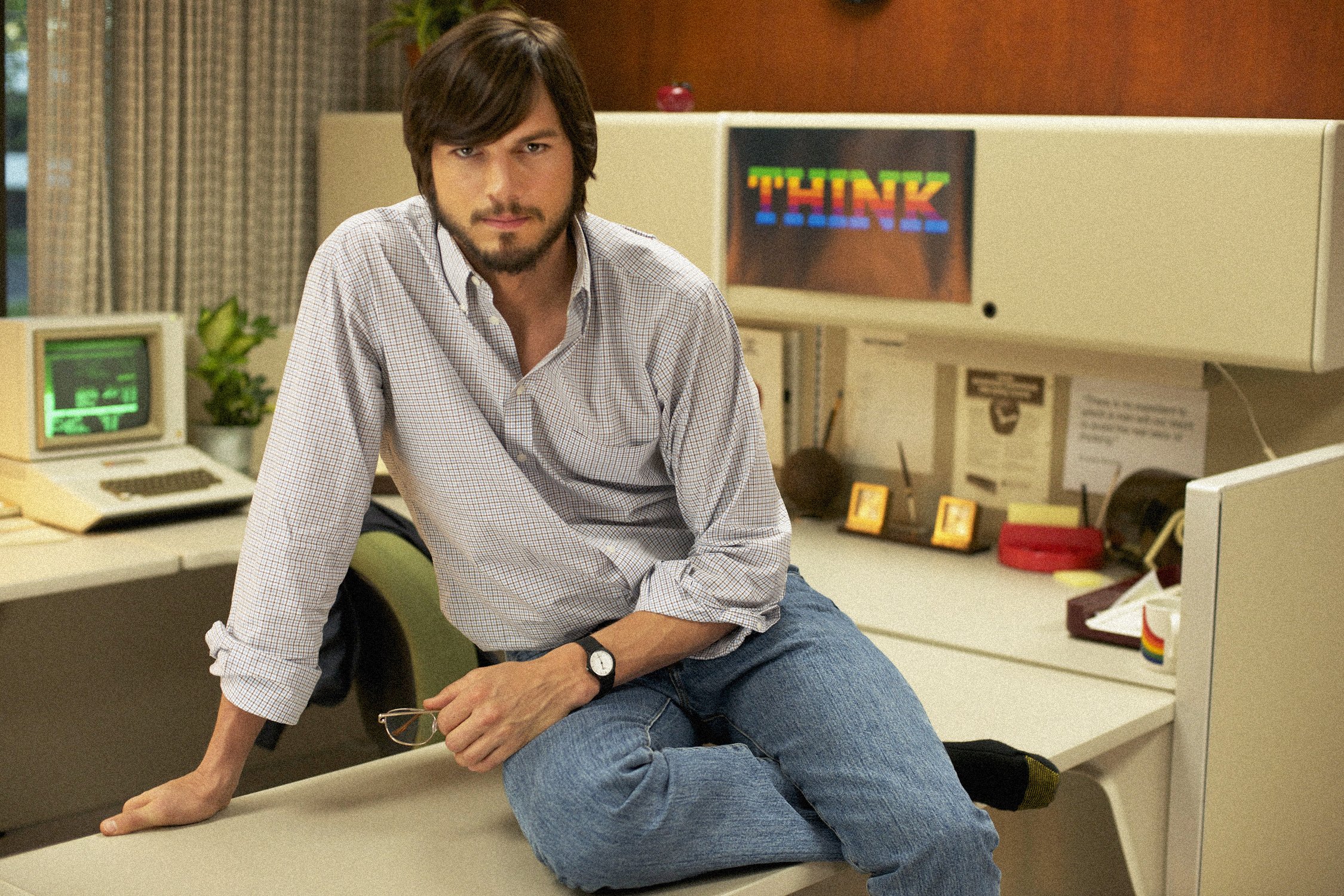
The good news is that just that movie about Steve Jobs is in the works, from “The Social Network’s” Aaron Sorkin. It will show us just three different moments in Jobs’ life, as three products are about to be launched.  And it will have lots of very smart dialog.  I can’t wait to see it.  In the meantime, we have this version, with Ashton Kutcher giving a very respectable performance as Steve Jobs, from his days as a college dropout still attending courses at Reed, in between sleeping around and dropping acid, to his triumphant return to Apple, eleven years after he was thrown out by the board of directors and the CEO he hired. Is it ironic or at least inconsistent that a movie about a man who insisted on “insanely great” innovation and joyfully disruptive, even seismic product development would be the subject of such an old-fashioned, traditionally structured storytelling?  Sure.  It’s like the problem of the computers and other equipment in the movie.  Though it is crucial to the storyline that we see how innovative they are; a couple of decades later they all look as old-fashioned as the rotary phones.  It is not a great or even a very good movie.  It is reporting rather than illuminating.  But it is watchable and modestly entertaining.

We learn very quickly, if clumsily, that (1) Jobs is so brilliant that a benign professor played by James Woods says he is welcome to keep going to class even though he has dropped out, (2) he is something of a user (he picks up a girl, sleeps with her, and then, when she offers him a tab of acid, tells her he is taking a second one for his girlfriend), (3) he is sad and rootless (as he and his friend and girlfriend are tripping as they lie on a blanket in the Oregon countryside, a tear slips out of his eye when he talks about being abandoned by his birth parents).  And while we’re on the subject of tears, there are a lot of damp eyes in this movie.  There may be no crying in baseball, but apparently there are a lot of tears in computers.  And (4) he does not play well with others.  He goes to work as a programmer for Atari, where he alienates everyone by being arrogant and smelling bad.

And then one day his pal Steve Wozniak (Josh Gad, in full nerd mode but with heart) shows him something cool.  He has hooked up his processor to a TV screen so that he can see the code.  Big time light bulb moment for the other Steve.  After an awkward and unimpressive demo for the Home Brew computer club, which led to his first business opportunity.  Jobs realized that there was a market for personal computers beyond the hobbyists and gearheads.  The fact that this seems stunningly obvious now is a tribute in part to his vision.  The clunkiness of the landline phones throughout the movie is another one.  Soon he created Apple with Wozniak and some friends.  Jobs set up a production facility in his parents’ garage and everyone got out their soldering irons and whatever the 1980’s equivalent of Red Bull was and went to work.

We see him rise and fall and rise again, with boardroom battles as vicious and bloodlessly violent as any scene to hit theaters this year.  Jobs is portrayed as a callous but visionary leader who tells his staff that “when you can touch the human heart, it’s limitless,” but parks in the handicapped space and tells his pregnant girlfriend, “I’m sorry you have a problem, but it’s not happening to me.”  He ferociously insists on loyalty from those around him but shows them none in return.

All of the performances are solid, despite the considerable handicap of 70’s hair.  As one of the early Apple employees he cuts out of the IPO gains, Lukas Haas is still making good use of those puppy dog eyes that go way back to “Witness.” Matthew Modine and J.K. Simmons are nicely slick as corporate bad guys.  But so much of both the personal and business story is left out that it feels empty.  The Jobs we see seems more focused on the details of the financing than the details of the product.  The man who felt abandoned by his birth parents (and later refused to see his birth father, even as Jobs was dying) disputed paternity and refused to see his daughter Lisa, but nevertheless named his biggest project after her?  He ran up huge development costs but refused to raise the price of the products to cover them and this made the shareholders the bad guy?  Why was he so ruthless in refusing stock options for the guys who were there at the beginning?  And why doesn’t the movie show that Wozniak gave them a piece of his own share?  Most important, why doesn’t the movie give us more than platitudes in showing us how Jobs got to “insanely great?”

Parents should know that this film includes smoking, drinking, marijuana and hallucinogens, strong language, a paternity dispute, and many tense confrontations.

Family discussion: What were Steve Jobs’ greatest strengths and faults? How can you work toward something that is “insanely great?”  What does it mean to say that “the system can only produce the system” and how can we transcend that?

If you like this, try: Steve Jobs by Walter Isaacson and Steve Wozniak’s iWoz: Computer Geek to Cult Icon: How I Invented the Personal Computer, Co-Founded Apple, and Had Fun Doing It

Related Tags:


Based on a true story Biography Drama DVD/Blu-Ray Pick of the Week

Kick-Ass 2

Posted on August 15, 2013 at 6:00 pm

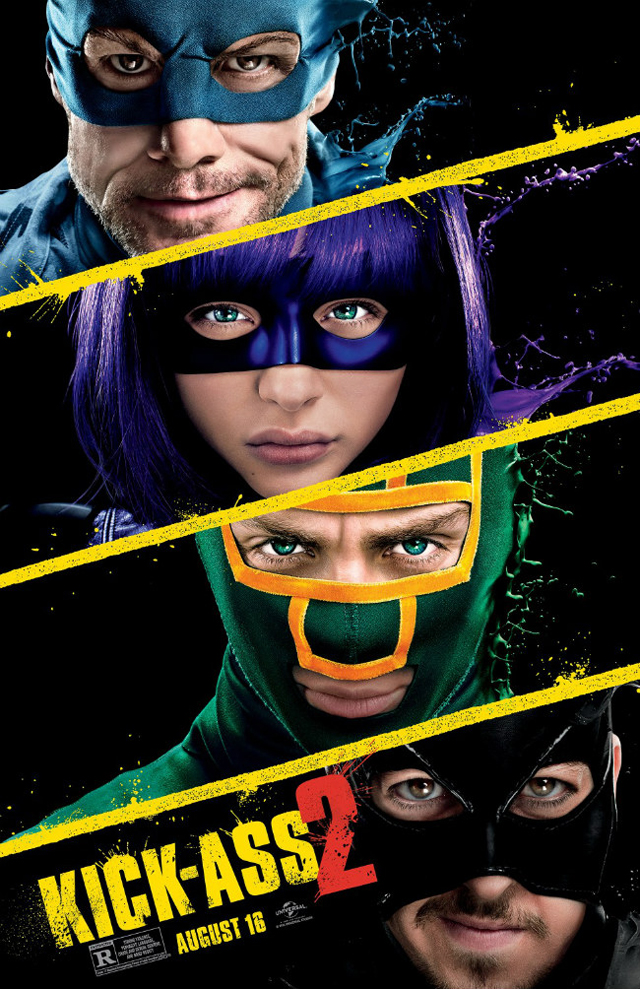
kick-ass-2-poster1The first Kick-Ass was entertaining as an over-the-top response to true-blue superhero movies.  The Dark Knight might think he’s angsty and tortured and tough, but he has nothing on the merry band of misfits who form a sort of Justice League on crack, featuring an 11-year-old known as Hit Girl who was raised to be the world’s greatest assassin.

It is less entertaining this time.  The lines have already been crossed, the 11-year-old is now 15, and all that’s left is to add a few new characters and a lot more violence.  There are some interesting ideas, but mostly it’s just a bloodbath.

The first movie ended with Dave (Aaron Tayl0r-Johnson), who has assumed the identity of a superhero (without any superpowers) named Kick-Ass, killing off the crime boss with a bazooka.  Now the crime boss’ son, Chris (Christopher Mintz-Plasse), wants revenge.  He has unlimited resources and unlimited fury.  He dresses up in his late mother’s bondage gear, looking like a cross between Spinal Tap and Maleficent.  He gives himself an unprintable name, builds an evil lair with strippers and a shark, and hires an international assortment of mercenaries to set himself up as a super-villain.

Meanwhile, and this is the interesting part, it turns out that even knowing dozens of ways to kill a bad guy, with his own finger if necessary, Mindy/Hit Girl (Chloë Grace Moretz) cannot escape a little bit of an adolescent identity crisis.  Though she confidently assures Dave that Kick-Ass is his real identity and it is being Dave that is the mask, when her cop guardian (an underused Morris Chestnut) makes her promise to be a normal highschool freshman, she decides to give it a try.  A section of the movie is like Buffy crossed with “Mean Girls” as she is taken in by her high school’s Plastics and there is a funny scene where she tries out for Dance Squad by imaging herself in a ninja fight.  But, as we all know only too well, the evil in high school is worse than any super-villain, and Mindy, like Dave, will learn what her real identity is.

Over and over, characters tell us that what they are going through is real life, not a comic book.  That gets as tiresome as the over-the-top carnage and efforts to shock.  Writer-director Jeff Wadlow, taking over for Matthew Vaughn and Jane Goldman, fumbles the eternal challenge of a sequel, keeping it enough like the first to deliver what the audience expects while taking it in new directions to make it surprising.  His biggest mistake is in overlooking the obvious — this movie belongs to Hit Girl.  Every time she is off the screen, it’s like the projector bulb fades.

Parents should know that this is borderline NC-17, an exceptionally violent film with very graphic and disturbing images and sounds, massive destruction, and many injuries and deaths.  It also includes exceptionally raw and crude language (a running joke has Mindy filling more than one swear jar), sexual references, and explicit sexual situations and nudity.

Family discussion:  Was Dave responsible for what happened to his father?  What is the difference between Dave and his friends and vigilantes?

If you like this, try: the original film and the comics by Mark Miller and John Romita, Jr.

Related Tags:


Action/Adventure Comic book/Comic Strip/Graphic Novel Crime Fantasy Series/Sequel Stories about Teens Superhero

In a World….

Posted on August 15, 2013 at 3:19 pm

Writer/director/star Lake Bell has produced a smart, fresh, and funny film that sends up Hollywood, sexism, and the conventions of the romantic comedy and yet somehow has us rooting for the characters to find a happy ending.  And she has given juicy roles to a great collection of performers who are too often overlooked — starting with herself.

http://www.youtube.com/watch?v=BpFNTvA93iY

Bell plays Carol, a voice coach and would-be voiceover announcer, the daughter of Sam (Fred Melamed), a very successful voiceover artist well known for his work narrating movie trailers.  The death of Don LaFontaine, the acknowledged leader of this small and very competitive field, has left a perceived opening.  According to this film, LaFontaine’s signature opening, “In a world….” is about to be revived for a new “Hunger Games”-like “quadrilogy,” and the job of narrating the trailers is considered the ultimate achievement.  Sam has just told Carol she cannot live with him any more because his young girlfriend is moving in.  So, Carol has gone to sleep on the couch in the small apartment her sister Dani (Micheala Watkins) shares with her work-at-home husband, Moe (Rob Corddry).lake-bell-in-a-world

Sam is advising up-and-coming voice artist Gustav (Ken Marino), positioning him to take over the big “In a world…” job.  But a temp track recorded by Carol has captured the attention of the studio, and she finds herself in the running for an unprecedented opportunity to be a female voice on a movie trailer.  This makes sense as the quadrilogy is about mutant Amazons, but the established tradition is for a deep, rumbling, male “voice of God” narrator.

Bell makes first-timer mistakes in trying to pack too many ideas into the film, but she does a masterful job of keeping it all in balance.  She serves the other actors as a director better than she does herself.  Carol is sometimes just too much of a clueless, klutz.  But when she shows a young professional woman that taking like a teenager with a question inflection at the end of every sentence how important it is to own your voice, it is clear to us that this movie shows how well she owns hers.

Parents should know that this film has very strong language including crude sexual references and some non-explicit sexual situations with some poor choices.

Family discussion:  Why don’t trailers use women narrators?  What do we learn from Carol’s conversation in the ladies’ room?

If you like this, try: the documentary about voiceover artists, “I Know That Voice”

Related Tags:


Comedy Family Issues

Elysium

Posted on August 8, 2013 at 6:01 pm

elysium posterThe best science fiction acts like a narrative Rorschach test, taking specific elements of our current condition, extrapolating into the future (usually dystopically), and allowing the audience to project our assumptions — and our fears — onto it.  “Elysium” is a smart sci-fi thriller that bundles the action and visuals we want from big-budget sci-fi with some provocative ideas about the logical consequences of the decisions we make on some of today’s most contentious issues.

The word “elysium” means a place or condition of perfect happiness.  Imagine a place of no worries, no illness, no want.  There are endless, perfectly manicured green lawns and soft breezes lightly flutter the sheers on windows that look out on exquisite landscapes.  That is home to the wealthy residents of “Elysium,” the space station.  It orbits above the now-despoiled planet earth, where the 99 percent live Hobbesian lives that are brutal, nasty, and short.  In other words, the set-up is “Wall•E” for grown-ups, without the “Hello Dolly” dance number and cruise ship atmosphere.

Max and Frey meet as children on Earth, and he promises to take her to Elysium some day.  They grow up to be Matt Damon and Alice Braga, and meet again when he mouths off to a robocop, who breaks his arm, and she is a nurse in a health care system that provides only the most basic first aid for Earth residents while Elysians have access to a kind of tanning bed technology that cures all injuries and diseases and even reverses the effects of aging.

Max is exposed to a lethal dose of radiation at the plant where he works, making more robots to wait on the residents of Elysium and enforce the brutal restrictions on Earth. A robot informs Max that he will experience catastrophic organ failure and die in five days.  The arrogant Elysian CEO in charge of the factory, John Carlyle (William Fitchner), is only concerned about whether Max will get the sheets dirty and how quickly he can be gone.

Max knows that breaking into Elysium and hacking into a med-bed is the only way he can stay alive.  And the only way for him to get there is to do a job for his old boss, Spider (Wagner Moura), capturing some data from Carlyle.  To keep Max strong, Spider’s henchmen surgically attach a cyber exo-skeletal device to his arms, spine, and skull.   He gets help from Diego Luna, a highlight as Max’s old friend from the car-stealing days.  It gives him extra power and a sort of USB plug in his brain.  And it turns out that Frey also has a desperate reason to get to Elysium.  And that the Secretary of Defense (Jodie Foster, dressed in spotless white) is in the midst of orchestrating a regime change, so the data downloaded into Max is of vital importance.  She sends a scary operative with a lot of firepower (“District 9’s” Sharlto Copley, scary good) to get Max.

As he did with “District 9,” director Neill Blomkamp adds just enough allegory to this story to give extra weight to the heart-pounding action.  Both of the worlds are thoughtfully conceived, especially the burned-out, graffiti-covered remains of Earth.  The details are evocative and compelling — a robot asking blandly whether Max is using sarcasm, Spider’s hodgepodge lair with its hobbled-together computers.  Foster’s recent performances have been disconcertingly mannered, with head-shaking to indicate the intensity of emotion.  But Damon is top-notch as Max, terrific in the action scenes and even better as we see him becoming more human.

Parents should know that this film includes constant sci-fi peril and violence with some very graphic and disturbing images, many characters injured and killed, constant strong language, drugs, drinking, and smoking.

Family discussion: What elements of this story are based on current issues and controversies?  Why did Max say no to Frey?  Why was the story about the meerkat and the hippo important?  What will happen next?

If you like this, try: “Upside/Down” and “Mad Max”

Related Tags:


Action/Adventure Drama Politics Science-Fiction

Planes

Posted on August 8, 2013 at 6:00 pm

planes-slice1“Planes” literally takes off from the retro world of “Cars” and “Cars 2,” with the story of a brave little crop-duster named Dusty (Dane Cook) who wants to compete in an international air race. A couple of problems for Dusty: he was not designed for racing and he is afraid of heights. A couple of problems for the movie: originally intended as a straight-to-DVD release: it does not have the narrative or emotional impact we expect from a feature film and a misguided flashback with a WWII air battle is jarring and likely too much for the intended audience of young gearheads.

The modest ambitions for this movie are refreshing in a summer of over-plotted movies for kids.  It is a very simple “little engine that could” story (hmmm, could the next installment be “Trains?”), set, like “Cars,” in a charmingly imagined world of anthropomorphized modes of transportation where even the Statue of Liberty is a machine.  It wastes no time giving us the histories of the characters and gets right down to it.  Dusty may be built for seed, not speed,” but he wants to race.  In his dreams, he has soared near the stars, but in reality he flies “low and slow,” dusting crops.  He gets a lot of support from his friends, a practically-minded forklift named Dottie (sweetly voiced by Teri Hatcher) and a loyal fuel truck named Chug (Brad Garrett), who has a copy of “Air Racing for Dummies.”

There is a qualifying race for the Wings Around the World event, and Dusty is determined to participate.  He barely makes it into the top five, only after the plane ahead of him is disqualified for the aviation equivalent of doping.  He knows he will need more help if he is going to compete in the big event.  He asks a WWII Naval plane called Skipper (gravelly voice of Stacy Keach) to be his coach.  Skipper himself has not flown since the war, but he knows that “races are won by skill, not speed” and “it’s not how fast you fly; it’s how you fly fast.”  He also knows about things like torque, lift, drag, turn ratios, and wind shear.

Dusty enters the race and meets his international competition, including the arrogant champion, Ripslinger (Robert Craig Smith), the lovely Asian champ Ishani (Priyanka Chopra), the British Bulldog (John Cleese), who always has a cup of tea at hand, or, I should say, at wing, the colorful Mexican Chupacabra (Carlos Alazraqui), whose design is inspired by a Mexican wrestler’s mask, and the French Canadian Rochelle (Julia Louis-Dreyfus), with whom Chupacabra is instantly smitten. Dusty is determined to win the race his way — by flying low and holding on to his crop-spraying equipment.  But he will have to bend on both to stay in the race.

Each leg of the journey presents different challenges, but all present stunning vistas.  There are some slow patches without the detailed characterization of the community and characters we saw in the original “Cars.”  And, as noted, a diversion into Skipper’s backstory is poorly conceived and out of sync.  It seems a bit off to make fun of merchandising when it comes across as more of an informercial for the very products it pretends to spoof.  But the obvious affection for the mechanics of aviation and the dream of doing more than you are built for keeps things aloft.

Parents should know that this film has some potty humor, a brief WWII battle scene flashback with a reference to the loss of some characters, and some peril.

Family discussion: What can you do that goes beyond what you were “built for?”  Why did Dusty help Bulldog?

If you like this, try: “Cars” and “Those Magnificent Men in Their Flying Machines”

Related Tags:


3D Animation For the Whole Family
THE MOVIE MOM® is a registered trademark of Nell Minow. Use of the mark without express consent from Nell Minow constitutes trademark infringement and unfair competition in violation of federal and state laws. All material © Nell Minow 1995-2026, all rights reserved, and no use or republication is permitted without explicit permission. This site hosts Nell Minow’s Movie Mom® archive, with material that originally appeared on Yahoo! Movies, Beliefnet, and other sources. Much of her new material can be found at Rogerebert.com, Huffington Post, and WheretoWatch. Her books include The Movie Mom’s Guide to Family Movies and 101 Must-See Movie Moments, and she can be heard each week on radio stations across the country.

Website Designed by Max LaZebnik