A Monster Calls by Patrick Ness, inspired by the late Siobhan Dowd, is the story of a boy whose mother is critically ill. He feels utterly isolated. His father has a new family. His grandmother is cold and unsympathetic. The sympathy of his teachers just makes him feel worse. And then one day, a monster calls, a monster with stories to tell. The film stars Liam Neeson, Felicity Jones, and Sigourney Weaver.
“What does AEY stand for?” a newly hired employee asks Efraim Diveroli (Jonah Hill). “You mean morally?” No, he just wants to know what the initials represent, though the answer is the same: nothing. And, as it turns out, asking the question and correcting Efraim’s mistake get him fired. AEY “stands for” making money, no questions asked. That will be the basis for great success, until it is also the basis for catastrophe.
We this know right from the beginning, when we see Efraim’s partner David Packouz (Miles Teller) released from the trunk of a car and beaten up at gunpoint by some very evil-looking masked guys. In Albania. And then we go back in time to see how David, a college drop-out now on his seventh job, working as a massage therapist, and smoking a lot of weed, met up with Efraim, an old friend from middle school, and joined him at AEY, a company that sold equipment to the Pentagon.
It was 2008. The United States was fighting two wars and outsourcing pretty much everything. If it costs more than $17,000 to outfit each soldier, that means someone has to sell them all that gear. The Bush administration got into trouble for dealing exclusively with “Dick Cheney’s friends” and was under pressure to give some of that procurement business to small companies. And Efraim, a high school dropout, had mastered the art of constantly scrolling through the website that was essentially the government’s wish list and bidding on contracts so small they were beneath the notice of enormous government contractors who sell tanks and planes. “All the money is made between the lines,” Efraim says. He tells David that while big companies go for the pie, they can make plenty of money from the crumbs. David, bored and worried about money for his pregnant girlfriend, signs on.
At first it works. They make tons of money. But buying and selling guns puts them in contact with some untrustworthy and violent people. And a little bit of success makes them eligible to go beyond the crumbs. An international arms dealer who is barred from selling to the US because he is on a watch list (producer Bradley Cooper) offers them a deal too good to pass up on ammunition they can sell to the Pentagon at a huge mark-up. But Efraim and David are very good at the details when it comes to making the pitch; not very good at the details when it comes to delivering the product. This is a business school case study in failure of operations and execution. And in the failures of government procurement.
Director and co-screenwriter Todd Phillips is clearly trying to make the kind of shift from raunchy, slob comedies (“Old School,” “The Hangover”) to sharp, trenchant satire that Adam McKay did with “The Big Short.” And Jonah Hill, looking disturbingly puffy and pasty, clearly wants to play the Leo role instead of the Jonah Hill role in his own “Wolf of Wall Street.” Both get partway there. Hill clearly enjoys being the trigger-happy hotshot who can brashly invite a girl to skip ahead to the third date for $1000 instead of his usual role as either the dumb shlub or the smart shlub. Phillips does a good job in laying out the parameters of the story, making it clear how the window of opportunity opened for AEY and Efraim and David were in the right place at the right time. There are even chapter headings for each section, foreshadowing telling comments we will hear, from “God bless Dick Cheney’s America” to “That sounds illegal.”
He also lays out a classic Hollywood movie structure: set-up, early triumph, hubris, wipeout. There are some fine moments, like the surreal use of identical actors (or CGI) as the Pentagon officials who sign off on the deal. But Phillips’ control of tone and character is uncertain and he relies too much on songs (“Fortunate Son,” “Time in a Bottle”) to carry the story.
Parents should know that this film includes wartime and crime-related peril and violence including automatic weapons, war profiteering, constant very strong language, crude and explicit sexual references, non-explicit situations, drinking, and drugs.
Family discussion: When and why did David and Efraim make different choices? What was their biggest mistake? Were they appropriately punished?
Rated PG-13 for sequences of violence and disturbing images
Profanity:
None
Alcohol/ Drugs:
Some social drinking
Violence/ Scariness:
Intense and sometimes graphic peril and violence including battle scenes, crucifixions, abuse, and accidents, characters injured and killed
Diversity Issues:
A theme of the movie
Date Released to Theaters:
August 19, 2016
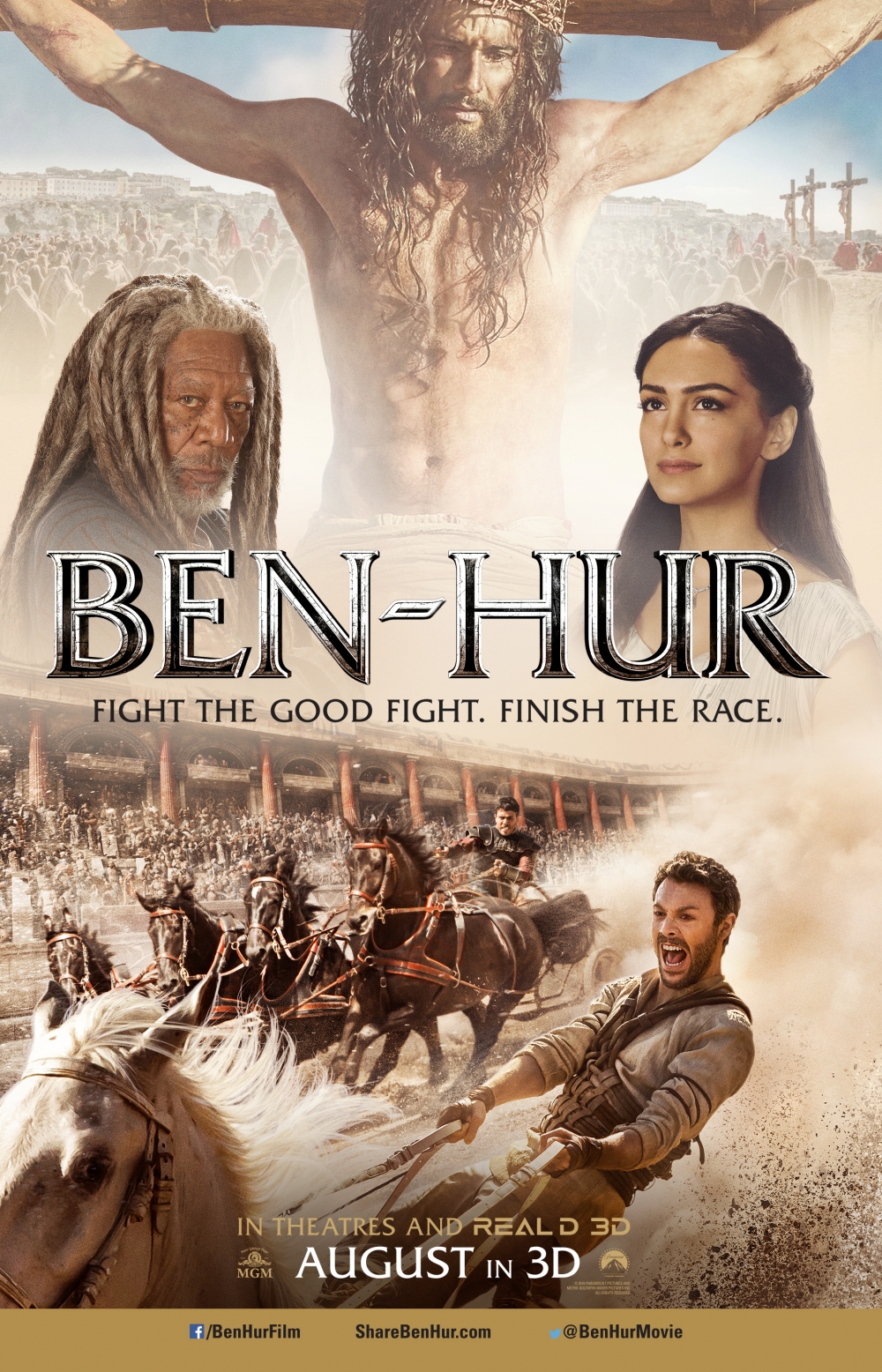
Copyright 2016 Paramount Lew Wallace’s 1880 book, Ben-Hur: A Tale of the Christ, had a revolutionary idea in a spiritual setting. The story of a minor, fictional character at the time of the crucifixion was the first to try to illuminate epic themes through the depiction of a character who was not a participant. Indeed, the title character was hardly aware of the monumental events going on around him. He was too busy dealing with his own personal crises like being enslaved and having his mother and sister contract leprosy. Wallace’s book became the top seller of the century. And then it became a play, two silent films, a Best Picture Oscar winner tied for first place for the most Academy Awards, plus two animated versions and a television miniseries.
Now Roma Downey and Mark Burnett, following the enormous success of their “Bible,” “A.D” and “Son of God” know the genre well and have remade the grand but dated three hour and thirty-seven minute epic. Their version is brisker, not just in the overall running time of just over two hours but in the more contemporary quick cuts and trimmed storyline. It is also more explicitly religious. While earlier versions suggested the presence of Jesus but did not include his face or voice, he is more explicitly involved in the storyline here, portrayed by Brazilian actor Rodrigo Santoro.
As in all of the earlier versions, it is the story of Judah Ben-Hur (Jack Huston), a Jewish prince who is wrongly accused of a hostile act against the Roman invaders and sold into slavery. In this version the Roman Messala (Toby Kebbell) is more than a close friend; he is Judah’s adopted brother. They are devoted to one another but also deeply competitive.
Messala, in love with Judah’s sister, joins the Roman army in hopes of achieving enough wealth and status to be considered worthy of her. When he returns to Jerusalem, Judah is married to Esther (Nazanin Boniadi). Messala and Judah agree to find a way for the local population to live peacefully under Roman occupation. But a rebel hiding in Judah’s house kills one of the Roman officers and Judah is blamed. Messala refuses to protect him or his family. Judah becomes a galley slave, spending five years chained to an oar on a Roman naval ship.
When the ship is sunk, he escapes. An African named Ilderim (Morgan Freeman) gives him a chance to win back his freedom by competing in a chariot race. And that, after all, is what everyone remembers about “Ben-Hur.” Director Timur Bekmambetov is known for action scenes with tremendous vitality and he more than delivers with the chariot race, which is thrillingly dynamic. The naval battle scenes are also exciting. The screenplay has some clunky dialog and awkward transitions, but Huston is always engaged and engaging and balances the intensity of the action scenes with an inspiring message of forgiveness. The movie is true to the story that has endured in its various versions for more than a century.
Parents should know that this film includes intense and sometimes graphic peril and violence with many characters injured and killed, battle scenes, whipping, abuse, crucifixions, some disturbing images, brief non-explicit sexual situation and mild sexual references.
Family discussion: What changed Ben-Hur’s mind about Messala? Was Ben-Hur right to try to make peace with the Romans? What did Pilate mean when he said, “They’re Romans now?”
If you like this, try; “Risen” and the 1959 version of “Ben-Hur”
The American Bar Association’s Six Types of Movie Lawyers
Posted on August 18, 2016 at 3:19 pm
The American Bar Association’s ABA Journal magazine has an article about movie lawyers that is not the usual top 50 list. Thane Rosenbaum writes about the six types of movie lawyers: crusading, heroic, obtuse, disillusioned, vengeful, and buffoons. Of course, some of the best movies have lawyer characters who fall into more than one of these categories. “To Kill a Mockingbird” has the greatest of all movie lawyers, Atticus Finch, who is heroic and crusading. “Anatomy of a Murder,” based on a novel by a lawyer/judge and starring a real-life judge as the movie’s jurist, had a lawyer who was disillusioned and heroic, and so did “The Verdict” and “Michael Clayton.” “My Cousin Vinny’s” title character was a buffoon and sometimes obtuse, but a hero, too.
I’m a lawyer from a family of lawyers, and I love movies about the law, including the ones listed above (I have to point out that “The Verdict” is completely inaccurate and even “Anatomy of a Murder” has one huge mistake). I especially like movies about real-life lawyers like “Gideon’s Trumpet,” “Amistad,” “Erin Brockovich,” and the upcoming “Loving.”
It takes a lot of courage to re-make a film that holds the record (tied with “Titanic” and “Lord of the Rings”) for the most Oscars, but producer Roma Downey has more than updated movie-making technology to bring to “Ben-Hur.” After the success of their previous Biblical epics “The Bible” and “A.D.” they wanted to tell a story from the era with another perspective. The 1870 Lew Wallace novel Ben-Hur: A Tale of the Christ is adjacent to the story of Jesus, and that gave them the chance to tell non-Biblical story about a personal journey with exciting adventures and profound inspiration.
In an interview Downey spoke about what led them to the project and what they hope people will learn from it — and about how many cameras were used to create the thrillingly dynamic chariot race scene.
How do you begin to think about topping one of the most famous scenes in movie history, the 1959 “Ben-Hur” chariot race?
It is the most breathtaking scene in the film, there’s no question about that. You will inhale when those chariots come out of the starting gate. Eight chariots, 32 horses come charging down that track and chances are you won’t exhale until one of them crosses the finish line. It is really amazing. Timur Bekmambetov, our director, did an incredible job. He studied at NASCAR, he looked at Formula 1. He figured out all these different and exciting places he can place a small camera, in the wheels of the chariot, between the ears of the horses, on the armor of the riders. He even put a GoPro in an old soccer ball in the middle of the track so the chariots rode over the top of it. And then when he cuts all these things together from all these different angles, it builds the most exciting sequence that you’re going to see on screen this summer.
And how did you select Jack Huston for the role that Charlton Heston made so iconic? Tell me about the cast.
He is just a really hot up-and-coming actor, and this role of Judah Ben-Hur is certain to be a star-making role for him. I’m sure it will make him a household name. He has all the qualities that we were looking for, an actor who could be princely, who could play the young Prince Judah at the start of the movie. And he played so well the physical; he is athletic. The chariot race isn’t just all stunt doubles and body doubles, this guy was really at the reins of these horses, he was really out there courageously coming down that track, riding that chariot. And he also has a beautiful vulnerability. Remember it’s a character who is confined with his heart set on revenge but because of an encounter with Jesus his heart softens and opens even into a desire to be reconciled even into forgiveness. We needed an actor who could display vulnerability for that broken period of life. So I think that you will agree that his performance is just amazing. And of course we also have Toby Kebbell who plays Messala, the adopted brother. Their on-screen chemistry is amazing. And last but not least the great Morgan Freeman playing the role of Ilderrim and the Brazilian superstar Rodrigo Santoro, who plays the role of Jesus for us, a very important role in this film, differing from the 1959 version that really had more of a sense of Jesus, we never really got to meet Jesus the man, we never got to see his face, we never really got to hear his message. In our film we made certain that Jesus was an important character and you get to see him interact with people, you get to see how he engages with the characters and you get to see how he transforms particularly the heart of our leading character Ben-Hur.
I’ve done a lot of research about all the various versions of this story going back to the book published in 1870. Was your first exposure the Charlton Heston movie?
Yes, it was. I have very vivid memories of curling up with my family every Easter in our little home in Northern Ireland watching Ben-Hur. I have the loveliest memories of that movie but you know the truth is it was fifty-five years ago. The world that we live in has changed since then and our expectations of what we hope to see on screen have changed since then, cinema has changed and editing styles are faster. It was a very long idea with an intermission in the middle of it and I don’t know if the audience really would be willing to sit that long for a movie anymore. And also I think the acting style has changed. We now expect a more naturalistic acting style. And of course what we are able to achieve through special effects has transformed amazingly in the last 50 years. We have kids at home, Mark and I, and when we told them that we were going to be on the producing team of Ben-Hur they actually responded, “Ben who?” indicating to us that there is a whole new generation that actually doesn’t know the story, hasn’t seen it, haven’t even heard of it and so we believe it’s a whole new audience who will be excited to see this great story back on the big screen.
What was it like to tell another Biblical era story from the perspective of a fictional character whose story only touches briefly on Jesus?
“The Bible” and “The Son of God” were 100% focused on the Bible or Jesus or the apostles. We loved making this movie which follows Lew Wallace’s story because of the way that he used Jesus as a smaller part of a bigger story. In the same way this movie will appeal to a very widespread large audience because in the end it’s an entertaining fun big action adventure movie. Woven through it however, is this beautiful story of an encounter with Jesus which changes everything and so I think we have been very faithful to the spirit and the intentions of Lew Wallace.
As the producer, you have to worry about everything. What worried you the most?
Copyright 2016 Paramount
We talked about the chariot race and you can only imagine what a logistically complicated project that was. It takes a village to make a movie and thank God on “Ben-Hur” the village was populated with the very best in business, the best horse trainers, the best stunt men, the best camera men, the best special effects team, an amazing director, cinematographer and so on, an incredible group. But I know that the one thing that weighed heavily on our hearts in the shooting of that sequence was safety, first and foremost, that there would be no injury to people and no injury to horses. And so we were very relieved when after two months of principal and second unit photography that sequence finally wrapped.
A scene that was also incredibly moving and extraordinary to recreate was the crucifixion scene. As producers it is our third crucifixion scene in our three years that we’ve got to do that with the Bible series of course which then became “Son of God” and then again with “A.D. The Bible Continues,” so Rodrigo Santoro was the third Jesus that we have cast in a picture and when we hung him from a cross it was the third time that we had re-created the scene. It is a somber set as it always is. Even though it’s a movie you can’t help but being moved by the violent nature of the method of murder and the intensity of just that scene and knowing that Jesus offered himself willingly is incredibly humbling.
It was an extremely cold morning, which presented its own set of challenges for Rodrigo, especially, who had to strip off. The rest of us had the luxury of warm coats and gloves, but he had to be stripped off and be hung from a cross for a long time. We filmed the entire sequence. We know that Jesus said seven things from the cross, so we actually filmed all of that. We weren’t sure what would end up in the movie but the words that Judah needed to hear, the most important things that he needed to hear was on forgiveness: “Father forgive them for they know not what they do.” It’s in that moment that Judah realizes that he could lay down his hate, that he could set down his anger. His heart is opened and he realizes the only way forward is to forgive and that ultimately is a message of the movie. That vengeance doesn’t work, that it will just leave you empty, it doesn’t to get you anywhere and as Jesus said the only way forward is love and forgiveness.