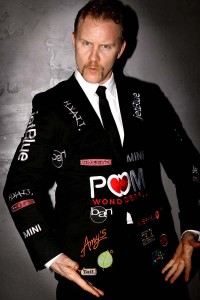
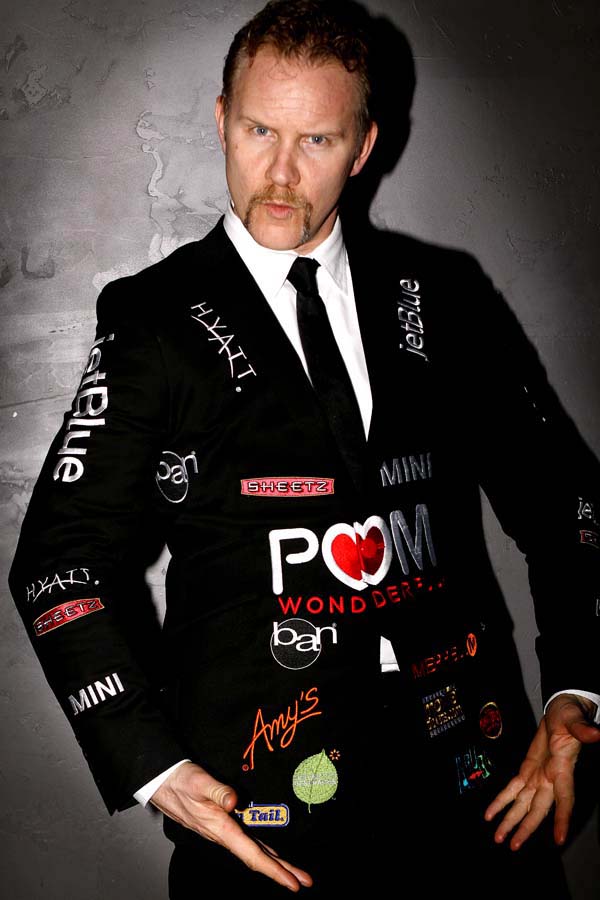
 Morgan Spurlock took on fast food in “Super Size Me.” He was funny, direct, and at times outraged as he tried to live for a month on McDonald’s “supersize” portions, and I liked his even-handedness in taking on the consumers as well as the providers, calling on us to take responsibility for ourselves. His television series, “30 Days,” had people (including Spurlock himself) immersing themselves for a month in a culture outside their comfort zones. Again, despite tone that seemed highly satiric at times, the show was about the middle, the gray areas, the nuances. His new film is called “POM Wonderful Presents: The Greatest Movie Ever Sold.” Yes, he made a movie about product placement that is entirely financed by product placement.
Spurlock spoke to me about the movie.
You were right! At the screening you said that everyone there would never look at the world the same way again. We walked out of the theater and the first thing I saw was a banner on a building I had never noticed before.
And it’s going to get worse — and better at the same time!
Advertising is everywhere. Amazon has just discounted the Kindle for customers who are willing to look at ads.
And it’s such a small discount! Shouldn’t it be free if they’re going to send you ads?
I think the most disturbing thing in the movie is the school selling advertising to raise money. It’s especially sad that it is such a small amount of money and yet they can’t get it any other way.
It’s incredible. School districts are getting literally five to seven thousand dollars a year and in exchange they are letting all this advertising in.
What kind of impact does that have on kids? Does it desensitize them or do they stay susceptible to being drawn into the brands that are put in front of them?
That’s what the jury’s out on. There’s multiple layers to that one. You start to believe that these products and these brands are the ones that make things happen. They’re the ones you should trust, the ones that have solutions. That’s the question I have all the time, do we really want to live in a world where everything’s brought to you by some sponsor? That’s the way it seems to be going.
That’s right. Even at the Smithsonian, the flag that inspired “The Star Spangled Banner” is now brought to you by Ralph Lauren. Is POM happy with the results from paying to have their name in the title of the film?
Everybody seems to be. It’s gotten a great response. I think it makes all the sponsors who paid to be in the film look incredibly smart. I called 600 brands but only these 20 were brave enough to be a part of the film and want to pull back the curtain and have a real honest conversation about transparency. It’s very telling.
For me what was telling was that they basically say, “We don’t care what you say about us as long as you get our name out there.”
That’s part of what I love about it. Who was it who said, “I don’t care what you say about me as long as you spell my name right?”
Will you have product placement in your future films?
I think it really works for this one because the satire makes the whole thing work. I can’t imagine shooting an interview for another movie about Darfur or something where suddenly someone is drinking Coke in the middle of an interview. But one of the things I love is what J.J. Abrams says in the film: “I’m about story-telling, not story-selling.” We live in a world where people use products. They drive Cameros. They drink Coke. They wear Nikes. So it’s not like I think we should try to eliminate this stuff from entertainment. It would create a very unreal scenario. But what I don’t want is Ford in the writer’s room, “I want to start with a wide shot of the car and when the guy gets out of the car it would be great if he could say how well the car handled.”
You want the product to tell you something about the character.
Yes, if he drives a Mustang, he drives a Mustang. If he drives a Volvo, he drives a Volvo. But don’t make them show an extreme close-up of the logo just because they gave them a car to be in the movie.
You kept Mane and Tail shampoo in the film even though they didn’t pay.
They were the only ones where we were contractually obligated to say that they did not pay. But there were others in the film who did not pay. But what they brought to the table was not hard cash but soft money in terms of promotions. Big brands do that all the time with studios so they can have Iron Man in the store or Tony Stark wearing sunglasses in their ads. Characters appear on cereal and candy bars and potato chips and then there are lunchboxes, t-shirts, hats, and all that other stuff. I tried to get McDonald’s to be a partner on this film. I really wanted those documentary action figures. Those would have sold like hotcakes!
Many of the companies that were willing to work with you were family-owned, like POM, Sheetz, and Hyatt. They were very big, but they didn’t have the kind of bureaucracy of publicly-traded companies and were more inclined to do something off-beat.
Some of them make more than Fortune 500 companies. And MiniCooper is part of a giant corporation. Old Navy is owned by a gigantic conglomerate. But they didn’t come on until they saw the film at Sundance. Eight partners came on after Sundance. That happens all the time with big Hollywood movies, too. They wait to see how the film comes out and how audiences react and then say, “I want to be a part of this.”
What do you advocate? Better disclosure?
It’s already at the end of a movie, where it says, “promotional consideration by…” but by then you’ve stopped watching. The BBC has just started to allow product placement. Like we have TV-MA, they have P for product placement before the show.
Do you advocate different rules for children’s programming and programming intended for adults?
You have to look at them different. They’re two entirely different audiences. They consume media in very different ways. Kids recognize brands at a very young age, as young as four years old. I don’t think you should have placement in kids’ shows but it goes beyond that. The character becomes the toy, the lunchbox. The argument for that is, “I can’t have free enterprise?” The problem I have is the targeted advertising around programming. My own son said, “I want to get that wrestler set! But the pieces are sold separately.” I said, “Time to turn off the TV. We’re done.”



 The ultimate reality show, this meerkat community has avid followers who mourned the passing of matriarch Flower.
 Soar with the birds in this breathtaking film.
 The tiny creatures of the insect world are explored in mesmerizing close-up.
 Even the littlest children will be captivated by these adorable baby animals.
 Morgan Spurlock took on fast food in “